Posts Tagged 'Afghanistan'


Life

The one and a half year old child of one of my colleagues died after pulling a pot with boiling water off the stove and over himself. The hospital couldn’t save him. The men in our office went down for a brief prayer together. These rituals happen frequently, but mostly for older relatives who passed away; people whose time had come, not little children.

Another colleague found out his friend was kidnapped in one of the eastern provinces; the ransom is enormous. Some people don’t survive this. People are praying for a good ending.

We picked up our directors’ meeting against the backdrop of this anguish and worry. Our own small worries and anguishes about the project and our performance seemed insignificant for a moment, until life resumed. Here life resumes all the time.

Perched

Today the physical therapy crowd was happier than last week; there was less moaning and more chatter. We compared notes on injuries in shoulders, knees, feet and arms. Some women are on the same schedule as I am, so we are starting to know each other. I am finding out who is the mother, the sisterm the daughter and what caused the injury. My rudimentary Dari is coming in quite handy to satisfy my curiosity

I had another painful deep tissue massage – self inflicted because last week’s massage left me pain free for the entire week, something I had not realized until I was asked.

Judy has arrived from the US for a short course on good consulting. I registered all our provincial staff because I want them to be less focused on ticking off activities from a to-do list and more on the results that these activities produce (and if they don’t, do something different).

Judy and I had lunch (baguette au jambon – imagine that!) at the French Pelican restaurant and caught up on not having been in the same office for 8 months, besides preparing for this week‘s activities. I think this time I was a little better prepared than I was for Anddy’s workshop last week.

I completed my first Dari reading book. It ended well with the two protagonists learning to read and write in Dari and then teaching their wives. It’s a literacy primer so this was not much of a surprise. My homework for the next few weeks is to read book number 2. I can’t wait to learn what the second primer in the series might be about.

For dinner Sabina came over. Sabina reports to a German radio station and was finally let out of the Intercon hotel, having followed the Peace Jirga from the 5th floor press center’s perch. She watched the rockets that were lopped, unsuccessfully, at the jirga tent, while a German military officer provided on the spot expert commentary.

Fruit and grit

The weather pattern in May and June goes like this: crisp mornings, blue skies, no wind. Slowly, over the course of the day the wind picks up and swirls the dust of Kabul around and deposits it on all of our horizontal surfaces. Everything is gritty.

Leaving Axel behind at home to finish a writing task before the end of the day, Katie and I visited Babur’s Gardens this morning, early, before the crowds arrived. Where all the lilacs were in bloom during my previous visit, now it was the turn of the roses, and cherries ripening on the trees.

We were lucky to stumble upon an exhibit entitled ‘Afghanistan Observed 1830-1920.’ It is an extraordinary peek into Afghanistan as it was observed by several famous British military artists, photographers, lithographers, watercolour painters and draftsmen.

The exhibit was mounted in the Queen’s Palace, in the beautifully restored harem with its high walls that kept the women safe from the men who didn’t owe them. Today there were lots of men in the harem. They crowded around us, watching us as much as the pictures.

Katie and I had a salad and mango smoothie lunch at the Flower Street Cafe before making a last trip to Chicken Street (we will both be gone from Afghanistan next Friday). On our way home we shopped for fruit and vegetables, picking up an odd vegetable that we looked up on the internet. It appears to be a prickly cucumber; we don’t quite know how to prepare it yet.
Tomorrow I will take it to my language teacher for further instructions. I discovered Afghan leeks; they look more like the Thai chives we have growing in our Manchester yard and taste more subtle than the American and European leeks.

We also loaded up on the many fruits that are now available in the market: tiny white apricots from Iran, melons, lemons plus freshly made yogurt and butter. After three days off from work (for us as well as for our staff), we have finished all the meals prepared by our cook and are now cooking ourselves; Nasi Goreng tonight, Tacos and Fajitas tomorrow. After that the cook will return and cook again.

We are learning from the foreign media what the Peace Jirga appeared to have produced, against most expectations: a consensus about negotiating with the Taliban, on the condition that the Afghan constitution is not violated (i.e. right of women). This is not welcomed by everyone, especially not by those Afghans who want to move into the 21st century. How all this will play out in real life is far from clear.

Winners and losers

We watched The Message (with Anthony Quinn) last night, about the birth of Islam. We had seen it earlier, dubbed in Dari, on the Prophet’s birthday in March but now I have it in the original English version. I had not understood then that the Afghans would play a movie produced by sinful Hollywood about their prophet but this time I saw the opening credits and an announcement that the film had been certified as authentic by religious scholars from Al Azhar University in Cairo and that Hollywood had agreed not to actually show Mohammed.

It is a long movie with much fighting and preaching. One by one Axel and Katie peeled off to go to sleep and although I tried to, I finally gave up to before the movie was over. This didn’t matter since we already knew the ending. In the centuries that have passed since then many things have not changed much in this part of the world, except maybe that the unveiled women in the movie are now veiled.

After being cooped up all day today in the house we escaped to a local Korean restaurant where they serve beer and great food. A few colleagues joined us, including Pascal who just arrived from Haiti in a very roundabout way, only hours after the rockets landed near the jirga tent. What a start! Pascal is a young doctor who won an award last year that he competed for with many other young MSH professionals in memory of our three MSH colleagues who died here in Afghanistan when their plane hit the mountains on a wintry day early 2005.

This year one of my young female staff applied after much goading from my side and pleas with her husband to let her try. When we returned from dinner I found out she was awarded the fellowship. Now we have to figure out how to make her trip out of Afghanistan work. It is not obvious but I am convinced we’ll find a way. I like these kinds of challenges.

After dinner we settled in front of the TV and watched ‘It’s Complicated,’ which was just what I needed after a long day in front of my computer.

Peace and rockets

We heard about the rocket attacks on the Peace Jirga via sms from our security folks but when we watched live coverage of the Jirga it was as if nothing had happened. The insurgents are bad shots, people say here and shrug their shoulders. But 100 meters away from the tent is a little too close for me. We are probably about 5 to 10 miles away from it all and didn’t hear a thing, other than the beep-beep from my cellphone that there was a message.

I watched the jirga open, the speeches and the patriotic songs with the ethnicities of singers carefully chosen so as not to offend anyone. Row after row of dignitaries, male and female, were sitting in respectful attendance. It looked very boring to me.

We are in lockdown until the whole thing is over, I believe at the end of Friday. That sucks because it means we can’t go on our usual Friday jaunts around town. And so we keep ourselves busy with housework, work-work, cooking, watching TV, preparing for our trip to the US, OBTC and deleting emails.

I was happy to see pictures of Tessa and Steve paying their respects, on behalf of all of us, to the ancestors. The planting of geraniums (maybe it was something different this year) at the Magnuson graves is an annual ritual that always ends with a vodka toast to them; we drink some and dribble some on the graves. And then it is Memorial Day, a day that is meaningless here; in Bamiyan I forgot all about it. Which soldiers would you honour here when you never know who are the bad and who are the good guys until much later and even then many people will disagree?

Comings and goings

Last night we had dinner in a bunker. Not really a bunker but a living space carved out underneath a container, outfitted as a guesthouse. It was warm, said the owner, to be underground during the cold Bamiyan winters. But frankly, I found it a bit depressing.

We sat for a couple of hours in that place while our host was cooking an extravagant dinner, on his own, without help from wife (who was in Kabul) or staff. I think he has none. We did see the driver show up with the rice, so I guess he was called in for help.

We at the dinner in another house in the same compound that opens up to the runway on one side and to a spring and trees on the other. The back side of the house sounds lovelier than the runway side but it was dark and we couldn’t see.

The runway in Bamiyan is one of the few level surfaces in Bamiyan. In between the sporadic arrivals and departures of planes, it is used by the population as a footpath, a crossing or a road. Just before planes land and take off an official car travels up and down the gravel runway to clear cars, motorcycles, donkeys, bikes and people off the surface to make sure there are no nasty accidents.

This morning we travelled back to Kabul. The trip that took us 6 hours and 3 landings and take-offs only took 26 minutes on the way back. With that Katie completed a circle over half of Afghanistan.

We are back in Kabul with its restrictions and polluted air. Tomorrow, when we get up, we will not see the snow-capped mountains and green meadows or hear the gurgling brook; instead we see the still and stinky water of one of Kabul side rivers in back, over the barbed wire, as well as the commander’s house with his army of armed attendants and officers who do nothing but cleaning cars and their boots all day. The little snow that was left on the mountains surrounding Kabul appears to have melted while we were away.

I watched the end of Anddy’s assignment. He got things stirred up and now leaves us with the difficult task of maintaining that enthusiasm. But the team he worked with is psyched and ready and now knows a new tool for participatory organizational assessment, to supplant the consultant-driven assessments.

Maria Pia is also leaving tomorrow because the office has decided to close down in case the Peace Jirga that is supposed to start tomorrow triggers attacks; and even if these won’t happen, then there are the traffic jams caused by whole parts of the city being roped off. We get to stay home tomorrow while Anddy nurses his first beer in Dubai; we get to stay home again the day after, when Anddy and Maria Pia are welcomed back home. And then it is weekend and someone else is arriving.

Talibanned

We are taking advantage of a brief moment of internet access at the hotel while there is electricity, in between our travels around Bamiyan and dinner at our colleague’s house. This is the same colleague who tried valiantly to get to a conference in Geneva, two months ago. Waiting for our turn we sit on the roof while the light is dimming over the valley. It is breathtaking at any time of the day.

We visited a comprehensive health center that I will forever remember because of its spotless but rudimentary bathroom (a hole in the ground, all cemented and reeking of chlorine). Health center or hospital bathrooms are rarely that clean even though one would think they are.

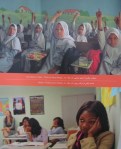
Next to the health center is a school: girls in the morning and boys in the afternoon. The girls, all in their black dresses and white veils clumped around us – we were the excitement of the day. Katie was like the pied piper with at least thirty girls following her every move. I got to sit at a disk with Malika and Rahela and practice writing their and my name in neat little schoolbooks. The eagerness and energy of these girls make you feel a little better about Afghanistan’s future, assuming they get to continue their schooling beyond a few grades and are not married before they reach puberty.

We followed the Community Health Supervisor to the house of a community health worker (male) in a small village outside the provincial capital, which itself is a small village. We were received in his father’s compound which he shares with his brothers and sisters and their offspring. He served us lunch which consisted of traditional bread, large bowls of yogurt with several spoons in each and plates with fresh butter. It was my kind of lunch, all dairy, only cheese missing. It was a feast in a poor man’s house and probably a considerable sacrifice.

Back in the provincial capital we visited the vaccination office and learned about how they manage the data flow and the multiple requests from everyone and his brother to see results. They have good results but the graphic representation of these didn’t really do their results justice.

Next we visited the provincial hospital where we met the nursing team that is working on lowering infection rates. I was happy to find a very smart and vocal nurse among the team with a great sense of humor. She belongs to a pool of female Aga Khan University (Karachi) alumns who I keep running into. They give me hope about Afghanistan’s future, if the men would only let them. She talked about the Taliban with irreverence and referred to it as a boring time. When we mentioned that we enjoyed our freedom here in Bamiyan and were somewhat constrained to office and house in Kabul, she quipped that now it was our turn to be Talibanned.

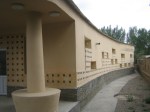
We toured the brand new maternity waiting home, a collaborative effort between the New Zealand Provincial Reconstruction Team (PRT), local citizens who bought the land and UNICEF that will provide staffing. The lovely house, one long architectural curve sweeping around itself to come full circle (I was later told that it was designed by a Dutch (male) architect, engaged by UNICEF, who meant it to be shaped like a uterus.

The uterus building was just completed and awaiting its furnishings, equipment, water and electricity. Fifteen very pregnant women, each with a care taker, can lodge inside this uterine place until their baby arrives. This will free up the 15 hospital beds these women are now occupying. Such maternity waiting houses are being opened in other provinces as well. I was supposed to have witnessed one such opening in Badakhshan early March but the helicopter didn’t fly.

And finally we had a meeting with the provincial health team to digest our very full day. It was a complex meeting in that much was in Dari and I can follow about one third but not enough to really get myself understood well; things get lost in translation. I still have to mull over what our conclusions were and what we can and cannot do here in Bamiyan. Lots of opportunities and lots of constraints. More about this later. Photos also later. Katie has a real camera and is making awesome pictures.

Primer

I took Katie along to my physical therapy session, for yet another taste of Kabul, part of her Afghanistan primer.

It took us more than an hour to get across town. Some roads were blocked with heavy construction equipment and angry policemen waving us into a direction we didn’t want to go in; no one quite knows what’s goin on behind the blocades but we all assume it has something to do with the upcoming peace Jirga and the mobilization of thousands of men in uniform. Is anyone seeing the contradiction?

As there are fewer and fewer back roads these days to get to your destination, the traffic jams become more frequent and massive, especially since there are always people in the traffic jam who manage to turn their car around and then try to drive against the traffic to wherever they came from.

Police presence is visibly increading by the day. It is as if the grimmest looking police officers have been mobilized – sometimes it felt like even smiling at them was an infraction. We were pulled over but we were prepared with all our papers, most of which they can’t read anyways.

It is hard to understand why they’d pull us over but may be they have been given quotas: stop x number of people who look like Arabs with bad intention, x number who look like potential suicide bombers, and, for good measure, x number of blond or grey-haired female foreigners.

Eventually we made it, albeit quite late, to the orthopaedic center where we found the female treatment room fuller than I have ever seen it before. The three PTs were all treating several women at once, putting this one in a neck stretching machine, that one on a bench with a hotpack on her back and a third one with the e-stem, the electrical stimulation to activate muscles or reduce pain.

I did not complete my treatment because we had another appointment, with the Thai massage ladies, that I didn’t want to miss for the world. After yesterday’s khakbad (dust storm) my skin was so dried out that I was craving an oil massage. Katie chose for the, much more intense, Thai massage. We agreed that both had been sublime.

Back home we had lunch and I had a little nap before language lessons – I am now about one third through a literacy primer that teaches adult Dari speaking Afghans how to read and write. This meant I was ready for a 12-page Dick, Jane and Spot kind of reading booklet. I am learning about Asad and Nasim, two brothers, who are working on their plot of land. I am halfway through the story and I have no idea how it is going to end; I can’t bear the suspense!

Tomorrow Katie and I are going to Bamyan. I have flown from Kabul to Bamiyan and back on the way to Herat. It is no more than a 45 minute ride; but tomorrow we are scheduled to leave Kabul at 9 AM, touching down on Bamiyan’s small gravel airfield a little before 4 PM. I think Katie is going to get the aerial tour of Afghanistan, Kandahar, Herat, and who knows what else, before getting to our destination.

An ordinary Friday sans internet

The internet was off for 24 hours, hence the day old post.

We filled yesterday (Friday) with all sort of excursions because we hadn’t done any lately and we wanted to show Katie that life here is not all that bad.
First we had breakfast at the Pelican restaurant, a French (real French, you can tell from the croissants) breakfast and lunch place with a lovely garden, not far from our house. It’s the place where Axel goes when he has gone too long without bacon and eggs.

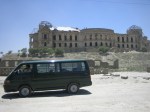
A little further down the road, across from the bombed out shell of Darulaman palace is the Kabul museum. It is probably among the more traumatized musea in the world but it is getting slowly back on its feet. Some of its prize collections aren’t yet in residence though, such as the Bactrian Gold exhibit which has been touring the world for some years now. Much of what was left of its treasures are restored in the basement and then retrieved to put on exhibit.

The wooden Nuristani (Kaffiristani) statues, some of men embracing men, are finally on display in a light and airy room. Those are the statues that survived the wrath and misplaced prudishness of the Taliban. They are reminiscent of African or Polynesian statues, heathen of course in the eyes of those who hacked good chunks of Afghanistan’s cultural heritage into pieces.

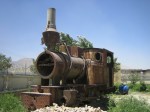
Outside the museum is a small rusted locomotive that was bought in 1920 by King Amanullah, one of Afghanistan’s rulers who wanted to modernize Afghanistan (at the same time that Ataturk was, more successfully doing the same in nearby Turkey). The locomotive was used on a 7 km roadside tramway linking Kabul and Darulaman.

Upstairs was a more contemporary exhibit, a photo project that brought Afghan and American youth together through art. Two cultures, all representing minorities, were let loose with a camera to capture the concept of ‘Being We the People’ in their respective countries. They were then blown up and paired up to express similarities or contrasts. One of Axel’s students has one of his pictures on display.

For our next stop we had ourselves driven to the bird (and pet) market in the enormous Kabul bazaar off the main drag, Jade Maiwand in the old part of town. This part of town was entirely destroyed by the Mujahedeen fighting each other but is filled with life again.

Before throwing ourselves in the maze of narrow bazaar streets we ate some Afghan street food, Bolani, a deep fried dough triangle filled with leek or potato, greasy but very tasty. We then followed the narrow alley way, lined with large and small cages, empty or full with all kinds of birds: pigeons first, then the canaries, small birds with sharp beaks that are made to fight, love birds, small parakeets and parrots, finches and finally the magnificent pheasants and partridges, the latter also used for fighting. We bought a small cage, without bird, because it looked so nice and I have some idea that I can turn it upside down to serve as a lampshade and hide our ugly fluorescent terrace light.

Ignoring our guard and driver’s protests that the street food was not as good as what their women cook at home and this was no lunch at all, we asked them to drive us to our next destination, an upscale clothing and handicraft boutique frequented by foreigners to show Katie what she can bring back as gifts to herself and others.

A very special treat here is to go with Steve to Chicken Street. It’s a unique experience, and one that is about to end as there are only 4 weeks left of Steve’s assignment in Kabul. Katie got her outing with Steve just in time yesterday.

Axel declined the Chicken Street experience. Not having eaten the Bolani, he ordered a real lunch for about 100 time the prize of one Bolani, at the upscale French Bistro restaurant around the corner from Chicken Street. He can do that now because he is earning his own money. We found him content, with only a cold beer or glass of white wine missing.

While Axel is dining, we sniffed up years of Central Asian dust in Ibrahim’s shop where we had bought Daniel’s wedding gift only 3 weeks ago. Katie succumbed to her first purchase of a large embroidered bedspread. I succumbed briefly thereafter – not having enough money in your pocket is never a problem as all can be had on credit or a loan taken out from the Dr. Solter Bank.

On our way home we stopped to stock up on self-medication: the faux beer, that is the closest to beer we can have, and some sleep medicine and a blister pack of diazepam (valium) which can come in handy when you have a 16 hour flight in a cramped economy seat, or when you get too stressed out from living here. All this can be had over the counter at less the price of our co-pay back home.

Back home Axel cooked us a Cesar chicken salad (romaine spontaneously growing in our yard) and served it with lit candles and one bottle of Katie’s fermented grape juice, the yellow kind… ‘as if we are on vacation,’ said Katie.

Miracles

We have a new lodger. Katie has arrived from Boston. It is her first time in Afghanistan. She’s very cool about being here and brought us some cool gifts: fermented grape juice, yellow and pink, and fair trade coffee. She is a connoisseur of both and shares that interest with Axel.

While Anddy will try to perform a miracle with his team in Kabul, I am going to Bamiyan with Katie, my boss and one of my staff. Katie is also expected to perform miracles, hers are related to monitoring and evaluation. She needs to know what it is like in the provinces, who works there, what they do with data and defining success. Hence our trip out of Kabul.

We are taking the 9:00 AM flight that will circle the entire country before landing in mid afternoon in Bamiyan. The direct flight takes only 40 minutes, but here nothing is direct.

Security has cleared us. It is not easy to take people to the provinces as the pool of allowed provinces is rapidly shrinking. Even the usually peaceful northern provinces are increasingly declared off limits. We can still go to Bamiyan, Herat, Mazar, but that is about it. And now the people in Bamiyan are angry at the (only) female governor and want her to resign. It has something to do with the Kuchis, a kind of Afghan gypsies, nomads, who are fighting with the Hazaras about land and things more complex than that.

Today I finished the big Dari book that I have been studying for 4 months. I have completed all 25 chapters, memorized the bulk of the vocabulary lists, completed the exercises and tried to understand the more complex phrases contained in its 300 pages.

It’s close to a miracle. I can now converse, albeit slowly, with lots of mistakes and with much thinking and looking up of words, with our household staff, guards and drivers. They understand me, more or less. However, my own understanding of them is still rudimentary and the risk of miscommunication is considerable higher than when I didn’t speak any Dari at all.

With the big book completed I am moving into phase 2 of the language program, learning to read and write. I am practicing my letters, still drawing them, rather than writing; discovering which part goes on top of the line and what below it, much like a first grader learning her letters. It’s a lot of fun and I am looking forward to my next lesson on Saturday.


February 2026
M T W T F S S
 1
2345678
9101112131415
16171819202122
232425262728  

Categories

Blog Stats

  • 139,796 hits

Enter your email address to follow this blog and receive notifications of new posts by email.

Join 76 other subscribers