Posts Tagged 'Afghanistan'


Fragile

We followed our usual Friday ritual of walking in Bagh-e-bala, then going for lunch, some shopping and then back home. We did not join the Chicken Street contingent because one visit every few weeks is enough for us.

We had green tea, sitting in the sun and practiced our Dari, while looking out over the white mountains around Kabul and enjoying the mild temperature. On days like this Kabul is very pleasant.

We had lunch at the Flower Street café which isn’t on Flower Street anymore. It is one of those places where foreigners hang out. The place is owned by Afghan Americans and serves American breakfast fare. We sat at a table in the snow covered backyard while the sun was heating up my back. It was lovely.

Everything remained lovely until I checked my email. For once I had not checked my email all day with the intent of not thinking about work at all. Since the head office hasn’t completed its work week, opening emails on Friday is risky. But then I did at the end of the day and found a dark message from my brother – the doctors found something really wrong in the lungs of his wife. That sort of stopped everything. She’s my age. Life’s fragile.

Crossing rainbows

Nazima sold socks on the streets of Iran which her mother bought for pennies less in the bazaar, while her father was hunkering down at home, fearing arrest because his papers were not in order. Nazima’s story is one of thousands but I got to hear her tell me directly with a big grin, the memories she had from that time, such as the gentleman who already wore 6 socks, one over the other, each with a hole in the big toe.

One of the references on Nazima’s CV is her former fiancé. Since she is only 20 I wondered what had happened and, with my western lenses on I thought ‘how sad, he ditched her.’ But after some probing it turned out that she ditched him when, five month after the engagement, she had enough of his checking on her and telling her what she could and could not do and what she could and could not wear. The final drop in the bucket was that after marriage she would not be allowed to see her mother anymore. That did it and now she is no longer engaged and free as a bird (with mom’s encouragement, dad’s no longer of this world).

Talking about a narrow escape! She told me that there is a saying in Persian (and Dari) that if you cross over the rainbow you will turn from boy into girl or girl into boy. I suppose it is used as a threat to boys and a dream to girls in this part of the world. Nazima had figured out early in life that being a girl was not a good thing and one day she set out to chase after the rainbow. She was gone for a good part of the day but never caught up with the elusive rainbow and finally gave up. When she came home her mother asked her where she had been. She told her. I would have like to know her mother’s thoughts.

I asked her whether she would still want to cross that rainbow. If you live in Afghanistan being a girl is still not a good thing, but she has decided to educate herself and get a good job, earn a good salary and marry a handsome man. That way being a girl is not bad.

Nazima is an acquaintance of a friend who had asked me for help in finding her a new job as the old one is running out. I promised to meet her and check out her English (excellent) and help her with her CV. Once again I encountered a part of Afghan society that will transform it, with or without permission of the old powers, the white-beards (riis-safed) some of whom would like to keep things as they are and women in their place. But as far as I can tell the cat is out of the bag and unlikely to ever return.

Play ball

Once big change from my previous work is that I am now a director. I direct others to do the work I used to be myself. There are now many Afghan facilitators implementing the Leadership Program here and in the provinces. It has been a while since I was directly involved in one or even observed one. And since it is all done in local language I have no idea how much it has drifted.

And so today I decided to accompany my Afghan colleagues for an alignment meeting with hospital directors as part of an effort to improve hospital performance in the capital city. This sector has been neglected too long and people realize that a significant proportion of the politically active or literate population lives in Kabul and other urban areas. For them hospitals represent the face of the ministry of health, or the government. And this is a face that’s not good looking at the moment.

Two hours before the meeting we heard that the general director for hospital services couldn’t come as he was called to the Salang Pass where hundreds were killed and thousands stranded because of an avalanche. The stories emerging from this catastrophe are horrendous and the response from the government came too late for too many. Emergency preparedness mostly exists on paper, as plans developed at the central level with help from consultants, but implementing them is a bit more chaotic, lethally chaotic.

One hour before our meeting the event was back on – it was after all a regular hospital directors’ meeting that happens every week or month, and life goes on, even with hospitals on standby to receive avalanche victims.

Then, as were approaching the venue for the meeting we received a call that the meeting was off again but we continued anyways, pleading with the Director for Hospital & Curative Services to not cancel the meeting even if she couldn’t be there.

Of the 30 expected people some 12 trickled in during the first 45 minutes of the meeting. Without any presence from the government we are always in a bind – should we take over their functions or drop the ball? We decided to step in and play ball. My staff conducted a shortened version of what was supposed to be a 2 hour alignment meeting and an orientation to the leadership program.

What I observed had strayed a bit from the original design. Always, when time is shorter than expected (a normal occurrence) the tendency is to shorten the experiential exercises and revert back to feeding people concepts from handouts or powerpoints. Still, the meeting had its desired effect, creating enough of a pull for the leadership program that we will go ahead with the first or five teams, later this month; one step back, two forward.

Afpak hands on deck

I spent the entire afternoon at the US government complex to listen to various officials, military and non-military, in the company of chiefs of party or other representatives of all the USAID projects in Afghanistan. I think there were at least 50 of us if not more, the majority men of a certain age.

I had arrived early and was whisked to ‘the red tent’ on the USAID side of the complex going faster through security than ever before. The driver was even allowed to enter the road that bisects the complex (embassy one side, USAID the other) and which is usually reserved for military and official vehicles.

The inside of the tent was smelly; the thing had come from a military store room and had clearly not been used for a while. I preferred to wait outside on a sunny deck that, with some imagination, could have been in a ski resort in Switzerland if you squinted hard and only looked at the tops of the snow-clad mountains.

But as soon as you lowered your gaze you were back in a place that was all about defense: sand bags, hooches (living containers full of bunk beds and one tiny window), barbed wire, uniformed men with guns and high blast walls.

The deck belongs to the local pub called The Duck & Cover. The pub sign shows a duck with a soldier’s helmet standing on a pile of sand bags with snow covered mountains in the back. The establishment dates back to the year 1387 (=Afghan calendar, last year) it says in old English typeface. On the door is a sticker that says ‘last pub for 240 km.’ I presume you can get beer and watch sport games but I didn’t have any money on me and only helped myself to the free tea and cookies (flown in from the US).

I felt very out of place and experienced an enormous disconnect in this US enclave in the middle of Afghanistan. I did not really want to be there. But then the presentations started and things got better.

I learned about the district development focus for the next couple of years (note ‘couple’ which I take to mean ‘2’) and how the military is planning to play a supporting role (‘you guys are doing the work, we are there to support you!’). The presentation about the district development strategy raised as many questions as it answered, mostly because of the disconnect (another one) between the new decentralized US government approach and the heavily centralized way of operating in the Afghan government.

The most interesting presentation was from a colonel who presented a face of the US army that I have never seen: culturally sensitive, intent on fixing errors made in the last 7 years, creating a core of AF/PAK hands with language skills and frequent immersion in both Afghan society and the world and work of the NGOs.

These military men would not be in uniform or carry personal armor. The colonel answered his own question (wouldn’t that be dangerous?) with the words, ‘not any more dangerous than combat.’

Although I don’t think that we won’t be taking in military anytime soon, other organizations will and that is a good thing. Having military in the various regional commands (and central command) who speak the language and understand something about both the culture and the work that the NGOs are doing can only be good.

We also learned how fraudulent behavior of nationals and internationals alike is aggressively pursued and can be the end of your career, here and anywhere else. When a staff member who handles contracts in a USAID project owns a castle in one of the provinces, the USAID police will surely take a closer look.

Not reporting fraud, by an organization, is also bad for business (debarment). These agressive strategies are clearly in response to concerns raised in the US and the probing eyes of Congress as the total bill of US taxpayer money spent here (excluding the military) runs in the billions.

Slush

‘This will past’ was written in colorful letters on the minibus driving in front of us as we made our way around the increasing number of checkpoints that have sprung up over the last few months between our office and the ministry.

We drove in stop and go traffic for nearly an hour through the mud and slush while the snow and sleet kept coming down. It was as if the weather was trying to make up for the many sunny and dry days we have had so far.

Many Afghans knew from TV, internet, friends or colleagues that the US east coast was hit by a mega winter storm while we got to watch how Kabul digs itself out from a much milder one; wet snow (barfetar) as opposed to dry snow (barfe-something else).

Everywhere I saw people cleaning off their flat roofs, kids and adults throwing wet and hard snow balls at each other and pedestrians trying in vain to avoid the muddy puddles that were everywhere.

Here streets don’t get plowed – I have yet to see a plow. Cars turn the thick heavy snow into muck and on the smaller side roads like in our quartier, the cars create grooves that are hard to navigate for pedestrians and bikes, with a real chance of sliding into one of the jewies (open gutters).

Later in the day a cold front announced itself with a nasty cold wind which left countless people shuddering in their not-very-winter-clothes. Unlike the US where we all have an entire separate winter wardrobe, here people are wearing the same clothes all year round; maybe people have one shalwar kameez made from wool rather than thin cotton, but otherwise the clothes appear the same.

Footwear is another source of wonder: some women wear mules, barefoot, of the kind we’d expect to see on a summer evening; some men even trudge through the thick and slushy snow wearing the ubiquitous plastic slippers, barefoot as well, that you usually find indoors.

I rarely see people wearing gloves but maybe it has not been cold enough. We brought all our guards and household personnel Thinsulate gloves but have never seen them wear these (maybe tomorrow when northern winds will chill us through our bones).

Mercenaries and leaders

Some weeks ago a team went out to Farah Province; one of the provinces considered insecure. Farah borders Iran; Herat province is on its northern border, relatively secure, and Nimruz province, a dangerous place, is to its south. Travel in Farah is risky. There is also, as far as I know, only one female doctor in the entire province. This combination leads to often lethal consequences for those who are seriously ill, who are victims of accidents or violence, or simply having a baby.

The team was looking at the hospital there that is barely functional and thus not helping to build confidence in the country’s government to care for its people. It is teetering on the brink for all sorts of reasons. The US government has stepped in and is making a significant amount of cash available to upgrade this critical part of the health system for the citizens of Farah Province.

According to the report, several of the single story buildings have been built by different agencies and donors for different purposes and following different standards. They are not fit for hospital services and what is there cannot benefit from proper maintenance as there is no plan nor are there resources available to fix what needs repair. There is no drainage, no waste management system, no septic tank and no water supply.

It is hard for us who are used to gleaming hospitals to imagine having to rely on a place like that for our survival. And I haven’t even mentioned the staff. Salaries and benefit are greatly inequitable and a source of friction between those paid by the government and those paid by the NGO that runs part of the hospital.

The staff list attached to the report lists all of the hospital staff; there is a column named ‘designation’ which lists each one of them as ‘mercenary.’ This makes me think of the Hessian mercenaries that fought on the British side in the revolutionary war. It is true that this country is steeped in warrior imagery, but hospital staff as mercenaries?

Still, not all is about war and destruction here. Today I visited the Blood Bank which has made a remarkable turnaround in its ill-fitting and deeply depressing Russian built bastion. There are still traces from the Russian days: its elephantesque architecture, and the habit of closing everything for lunch time. But the legendary Russian disregard and disrespect for the people who come through its doors, either to give or to get blood, has changed a hundred and eighty degrees.

In large flowing Dari script on the walls all who enter are reminded that blood is not for sale and that, if someone claims the opposite, a particular mobile number should be called. Corruption used to pervade the practice of this organization but now all is transparent. Some people don’t like this and are using heavy-handed techniques to throw the current leadership out.

The 60 odd staff members, from the lowly guard at the door to the young and energetic director and his many female staff in between, have all been transformed into ‘managers who lead.’ I got to give them their certificate that proclaimed they had successfully completed a course called ‘Leadership for Infection Prevention.’ And then I got to see what their leadership looked like.

This was not a hollow term: I heard and saw several examples of creative thinking and taking initiative: from getting Afghanistan’s president and vice president to give blood (and photographs to prove it) to cubbyholes at the entrance with plastic indoor shoes so that the muddy street shoes stay at the entrance to the building.

The best part was how the Blood Bank team, as part of their effort to raise voluntary blood donations, had been able to convince the Shia leadership to counsel their flock to donate their blood to the Blood Bank rather than letting it spill on the ground during their annual self-flagellation ritual. In my book that is leadership!

Navy treatment

Leslie is a uniformed US Navy physical therapist. He is part of a US Navy medical team that is embedded in the military hospital, built some time ago by the Russians. I assume this because of the square and chunky concrete architectural style (functional without any elegance or esthetical value).

He is a trainer and assigned to assist the local PT team with the rehab of amputees and war-wounded. When he heard that there was this American woman with shoulder problems his curiosity was peaked. Fahima asked if I was willing to have him look at my shoulder.

He stood waiting in the hallway with his interpreter because he was not allowed to enter the female PT room. Since I could also not enter the male PT room we were left with the staff lounge and the lunch table became the examination table.

He checked my range of motion and strength while my PT looked on. I became a training session. I learned that I am a prime candidate for frozen shoulder (female, in her late fifties and post-menopausal) and my PT was instructed to watch out for signs of imminent frozen shoulder. This reminded me not to take this shoulder business lightly. I was given a few exercises and Leslie instructed my PT to treat me as if I had just had my rotator cuff operation and start from scratch with my exercises, the same I did faithfully every morning in September.

In the meantime Sara took pictures of the PT team receiving the supplies provided by my PT place in Manchester that had been packed in our container the day before our return trip to Kabul via Holland. She got to witness what happens in the female PT treatment room – something that appears more like a social affair than the serious treatment in separate treatment rooms practiced in the US. For me these ‘sessions’ are always great ways to practice my Dari. We can have more and more interesting conversations now that my vocabulary and master of grammar is expanding.

More snow and rain is coming down, as if the winter realized it had not done its work yet not that spring is just around the corner, and is in catch up mode. Sara would have preferred two sunny days on her last weekend here but the Afghans are happy. This is after all primarily an agricultural society and people like rain and snow because it means water and water means new life in spring and new life in spring means food.

While we were at our Dari class Sara watched 6 episodes of the (British) The Office and prepared our goodbye dinner party with people she has met and people I thought she should meet before she leaves.

Spooky, suave and calming

We have a very busy social life in Kabul and on Fridays we are busiest. We had hoped to give Sara a tourist tour of Kabul but the rain and sleet made going up on a mountain for a panorama view of Kabul rather pointless. We were in the clouds.

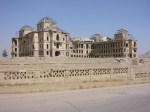
We did take her down to the spooky Darulaman palace at the end of the road with the same name, going southwest right by our office. A shell of its former glory, what’s left of the palace stands there as a monument to war and destruction, destroyed beyond repair itself. It has been like that for more than a decade I believe and I wonder on whose to-do list this mammoth structure figures.

The newly dug and cemented jewies (open drains on each side of the roads) were no longer draining the snow/rain mixture that was consequently flowing into the street turning everything into mud. On days like this Kabul is very ugly.

We made a last stop on Chicken Street for Sara to buy a few more scarves to gift. We found the chief doctor herself shopping for scarves at the same place and so Sara got to meet her after all.

From there we drove in circles for about half an hour until we found the new Kabul Health Club – the same that we had not found last week. But this time we had a phone number. It took about 4 calls before we found the place, or rather the place found us as they had put a young man out on the street to flag us down.

Inside we discovered another part of Afghanistan – the educated, suave and polished Afghan diaspora that had returned and was determined to (a) help Afghanistan become more like the London, Dubai, Paris or New York they had reluctantly left when the relatives called them back to Kabul and (b) make it more palatable for them to live in.

The health club could have been in London or Dubai with brightly lit and elegantly designed dressing rooms for him and her, each with their steam rooms and saunas, a restaurant, a juice bar and a place to have nails, face and hair done (ladies only for now). The young couple whose venture this was, supported by several generations of family, greeted everyone warmly and flitted from one place to another trying to attract pre-paid one year memberships. The prices being American and the place as far from our house as it is, we decided to wait a while to see whether we can live without it.

Next stop on the agenda was for Sara and me a visit, once again, to the Thai beauty spa, me for a massage and Sara for a pedicure. An hour and a half later, all oily and shiny, while were waiting for our car, several (western) men entered the place, we assumed for a ‘gents beard trim.’ But thenl we noticed that only one of them actually sat down in a barber chair. The others, including two bulky men with military vests that had all their many pockets filled with various lethal objects – walked into the one place where, as far as we know, neither massage nor barber work is done. This parade of testosterone was so out of place in this beauty salon with its diminutive Thai ladies and pictures of smooth skin and Thai hair styles that it made us very curious.

We tried to casually walk by the room in which the men had entered but all we could see was four guys (two armed) sitting in a living room with several Thai ladies. Were we witnessing some historical secret talks? We will never know.

We drove home through more snow and sleet to find our house with doors and windows wide open because the leg of lamb that Axel was cooking had smoked up the house. He was doing this without knowing the oven temperature and had improvised a little bit too much on the hot side.

Nancy and Bill came over for dinner. Nancy lived here in the 50s and speaks fluently Dari – her husband Bill got here in 2002. Between the two of them there were a thousand stories to tell requiring many more than this one dinner.

It’s good to hear stories from people who have lived in a place for a long time as it puts all the current crises in perspective. I found this rather calming.
Dusty

We have been using the words ‘until the dust settles’ quite a bit lately. The top tiers of the ministry are not fully staffed and there are, as my African wisdom calendar said, many rivers coming together creating turbulence (or dust).

But today it felt as if a giant new vacuum bag full of dust was shaken out over the ministry. None of the new dust is likely to settle soon. The whole place was stirred up by a new org chart that was activated today by the country’s presidential team, producing major changes in reporting relationships – some logical and long overdue and some incomprehensible.

Apparently new org charts are produced repeatedly and once in a while one is approved after much haggling between power broker. Org charts are always about territory and territory means power and the ability to put your friends and family in positions that get nice salaries. This latest org one appears to have its origins in various power battles between people within the ministry and between various government structures that have something to do with staffing, salaries and rules about transparency and equity.

Some people lost whole directorates, others gained new departments, some were split in half and lots of people were unhappy. Since the dust is not settled, and it is weekend in Afghanistan, we don’t quite know all the implications of these changes in the boxes and lines on the org chart. Time will tell but messy it is for sure.

We did get another audience with the chief doctor and her staff and I got to talk about senior leadership challenges, the spiral of visibility and vulnerability that women leaders at the most senior levels get caught in, the balancing acts at the top between the urgencies of now and the necessities of the future; attention to the loud voices of those with power and the absence of voices from those to be served. I am glad it’s not my job.

My boss offered my assistance ‘day and night’ to which I protested. As it turns out this is a literal translation of the Dari expression that means anytime. But first it is weekend. Friday is off for everyone.

Kabulungs

One of my colleagues in Cambridge told me that the EPA did a survey back in 2004 that found the suspended fecal particulate matter in Kabul to be the highest in the world. This has to do with all the animals in town and the dry desert climate. Giardia too may be airborne, as some other colleague here in Kabul told one of our house guests. This may explain the constant throat clearing that we are all collectively engaged in. Hearing others doing this throat clearing drives me nuts and doing it myself is mostly ineffectual, also driving me nuts.

I am imagining the layers of soot, fecal matter and other debris that are floating in the air and then settle in my lungs and wonder whether it is worse than the smoking I gave up some 30 years ago. It is one of the less attractive side effects of living in Kabul, aside from the restricted movement – but so far all of it is worth it.

I just wrote in mirror script on the inside of my office window that is covered with a thin film of soot: please clean me. I could have written it in Dari as I know both the words and the letters, but writing Dari in mirror script is still a challenge.

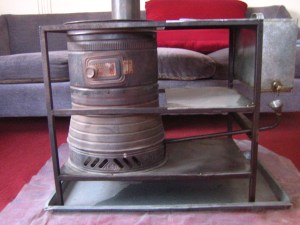
In our language classrooms there are traditional diesel stoves; a little more primitive than the German designs we have in our house. The bukhari wataniye as it is called is the most basic of designs: a small faucet is turned to slow down or speed up the drip-drip of drops of diesel fuel from the storage tank on the right into a tiny funnel attached to a fuel line that runs into the chamber of the stove on the left. You light a match which lights the fuel and voila…drip, drip, drip. The alternative to the traditional fuel stove is the traditional wood stove which is equally bad for your health according to Axel who read something about our various inefficient heating systems in the New Yorker.


February 2026
M T W T F S S
 1
2345678
9101112131415
16171819202122
232425262728  

Categories

Blog Stats

  • 139,798 hits

Enter your email address to follow this blog and receive notifications of new posts by email.

Join 76 other subscribers