Posts Tagged 'Afghanistan'


The attraction of feminism

Yesterday I bought a bouquet of fresh daffodils (from Jalalabad) and a video with cooking lessons in Persian, for our cook. The fresh flowers needed a vase and are now nicely settled into a Herat blue glass vase, drooping a bit, but still nice. The cooking video was pirated from a German show and dubbed in Farsi.

Sara and I watched lesson one of the cooking class: rosemary and garlic roasted lamb, braised carrots with carrot greens and thyme, and tiny leek-and-apple tarts. I noticed that all the ingredients and utensils needed for the meal are available. It was a good exercise from a language perspective and will be a good lesson for our cook from a quality-of-life perspective.

I started the day with a meeting with Douglas who works in the ministry and who I won’t get to see for a week to make sure everything is moving along well as we prepare for the potential impact of the new US Government AFPAK strategy that landed in our mailboxes yesterday. It feels like a tsunami coming our way.

Douglas left with Sara for a meeting with the military to educate them about how health services are delivered (through a grant project that is managed by the government with our assistance). While they were educating the ISAF folks I was educating myself further about the AFPAK strategy: ambitious and clean, sometimes a bit too clean knowing the messy reality of daily Afghan government life.

It was a beautiful day, spring like again, still no snow in sight, which made it possible to sit on the terrace without a coat (but otherwise well covered), preparing for my Dari class.

We had dinner with Razia Jan which I am now discovering is like a refueling visit. When I see too many men make dumb decisions or get embroiled in sandbox fights or think narrowly about their work, all I have to do is go to Razia’s house and meet the extraordinary women she collects around her.

I talked with one young woman who got an MBA in the US some years ago. She told me that in her life at work here in Kabul she thinks about the lessons from her leadership and OB classes more than any other of her MBA classes. I asked her why. She told me the consequences of not understanding OB and poor leadership are visible all around her.

Few people see the gender dynamics at work when the (few) women who hold professional positions try hard to avoid making mistakes, creating a whole series of non events, while the men (98% of all decision makers both in civil and military life) get away with making one bad judgment after another, poorly thought through decisions, cover their behinds and take silly risks; the damage of this is then either cleaned up by women or good men (this goes mostly unnoticed) or the day is saved by other men who then become heroes.
Escapade

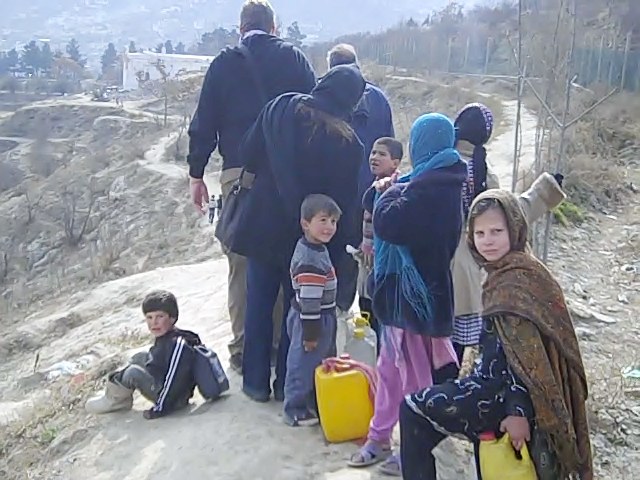
We went on our usual walk in Bagh-e-bala below the Intercontinental hotel. As we walked back Janneke spotted a hole in the fence and a path up the hill where a bunch of young girls and boys were carrying a variety of jugs with water. The older girl would gather as many jugs as she could, carry about 50 yards up the hill and then return to get another bunch that the smallest kids were not able to manage.

We picked up the jugs and took them to another hole in another fence all the while enjoying our escape into the wide open of Kabul. Our guard walked along and we would look at him each time we moved further away from the path as if to ask whether our jail break was OK.

But then finally the call came from our security folks that we had strayed too far and we marched obediently back to the main road. We ended our walk seeking out a different tea tent and settled on a carpeted platform to enjoy green tea and a snack that was fried and served in vinegar. It led to conversations about GI afflictions but some of us were too curious not to try. Now, many hours later, I can say that all is well and the snack was quite nice.

We had lunch at the Wakhan Cafe which serves the best espresso and macchiato in Kabul, nearly as good as the macchiato in Addis. It was a balmy winter day, more like spring, and so had out lunch outside in the withered garden.

On our way to the newly opened Kabul health club we stopped at one of the supermarkets that cater to the foreign community. Sara ran into a colleague from CRS who took her job in Bolivia before moving to Herat, right in front of the frozen meats, imagine that!

Right in the middle of the candy aisle I dropped a bottle of fish sauce which stank the place up so badly that the staff thought it a good idea to cover up the smell with room fresheners. The end result of this is best described as rotting fish in a perfume store. These odors mingled with the very strong chemicals from the painting that was done on the second floor – a nasty cocktail of chemicals that gave me an instant headache.

We never found the Kabul health club. Because it expects to cater to the well-heeled foreign community it is trying to fly so far under the radar that we couldn’t find it.

After introducing Sara to Chicken Street we returned home with a bunch of daffodils, green peppers for our chili omelet tomorrow and a bag full of eggs. Back home it was time for Dari homework (write down your daily routines in Dari), learning the vocabulary words for lesson 9. The reward for all this studying was watching Seinfeld for the remainder of the evening. It was a good Friday! No bombs, no explosions, no kidnappings.

Reconnecting

I plucked from the internet ’10 ways to clean your whiteboard using common household products.’ I tried the hand sanitizer and lo and behold the old sketches on my whiteboard disappeared. But the board looked more grungy than white.

When I returned to my office a little later I noticed that the whiteboard sparkled bright white. My assistant came in with a big smile on her face; she had given the whiteboard a toothpaste treatment and showed the empty travel tube of Colgate. It did work if whitening was the goal. But the smooth surface over which the marker is to glide was mostly gone and subsequent writings on the whiteboard will need sandpaper I think. It was a nice idea.

This afternoon we had an appointment with the new interim minister of health, the lady doctor who was rejected earlier by parliament, presumably according to some sources, because she did not pay her ‘dues.’

On our way to the ministry we passed by the shopping center that the whole world saw in flames on TV on Monday. It was a testament to the resilience of the Afghan people to see that the shops at the bottom of the burned out shopping center had already replaced their windows and had their shops full of merchandise again, as if nothing had happened.

The only sign that something had gone terribly wrong, aside from the blackened 2nd to 6th stories, were the big black SUVs and the young American or British security guys with big guns, wires behind their ears and dark sunglasses, protecting, I assumed, some Big Cheese who was checking out the damage. The insurance adjuster maybe?

Our new minister received us gracefully in the same office that was formerly occupied by the minister I got to know – their personalities are about as different as personalities can get. She had removed the little lectern table that the former minister would occupy when holding meetings – creating a psychological distance that had power. A small bell on the little lectern would summon a tray with green tea and cake. The new minister had removed the lectern and replaced it with a chair that matched the furniture of her visitors and placed the bell discreetly out of sight. The place definitely looked more feminine with enormous bouquets of silk flowers everywhere.

She greeted Steve with ‘my mentor’ and acknowledged several of my Afghan colleagues with whom she had worked in earlier days. We offered our support and listened to her priorities: child survival and quality of urban hospital care – two areas that intersect in some of our projects and that are sprinkled throughout our annual workplan.

Back in the office we prepared for the worldwide MSH meeting, eating a hasty meal catered by a nearby restaurant, fed the leftovers to the office cat and settled in front of the video conference camera.

I find it each time astonishing that we can conference like this with our colleagues all over the world. I discovered that we are now over 2000 people representing 74 different nationalities and 80% of our staff from the countries we work in. We were proud to support our Afghan boss who presented, for a change, about the good things that are happening here.

Rehearsal

We have a new housemate, Sara, who was only supposed to overlap one night with Susan. Axel moved his office to accommodate this double occupancy. But then we learned that Susan lost her wallet with her passport inside it and everything changed. Afghanistan is not a good place to lose your wallet and passport, especially not the day before your departure.

A bunch of people sprang into action and are trying to have the right piece of paper issued by the American consulate so that airlines will let her onto the plane and on her way home. Susan can leave tomorrow after all. Not at 8 AM as she had hoped, but maybe on the afternoon flight, the one that stops in Kandahar on the way to Dubai.

Oblivious of Susan’s woes most of my day was focused on the quarterly worldwide meeting of the MSH family that takes place tomorrow night (for us) and tomorrow morning for our colleagues in the western hemisphere, with people listening from nearly all continents and many time zones.

My boss is presenting the Afghan program, now in its umpteenth incarnation after the first MSH team landed here in 1973. Steve and Peter were on that team; this fact makes many of us feel old.

And so today was about rehearsals: first with our IT colleagues to get the technology set up right; then among ourselves a first dry run, then a practice presentation via video conference with our colleagues in Boston (using that much bandwidth shut down the internet connection for everyone else). And tomorrow, long after our workday is over, we’ll do the real thing and keep our fingers crossed that all the rehearsing and the technology checks will pay off.

Afterwards

We were still on high alert in the morning and only essential business travel into town was allowed. Our business was essential and so we drove into town past the other shopping center across from where the first detonation was completed – broekn windows top to bottom, glass all over the place, fresh bullet holes in a building that hadn’t even been completed.

Our essential mission was to show our support to the new acting minister who is the same person rejected lasted Saturday by parliament. I wondered whether this is construed as a slap in the face to the members of parliament who voted against her. But having finally a minister again, even though acting, is good.

So far we have 2 women in the top team – a reason for joy.

I listened to various speeches in Dari and although I couldn’t really understand them, I was able to distinguish the preliminary thank yous and welcomes from the substance of the speeches. The new (acting) minister laid out her plans for the first 100 days and gave everyone something to judge her by. It is an ambitious program but it matched what we can offer in support.

We had lunch at the Turkish restaurant where the signs on the wall and the menu remind me of the Turkish I learned several years ago that still comes in handy. My boss gave us, three non Dari speakers, a summary of what the speeches contained while we enjoyed our Lahmacun (Turkish) pizza and Iskander kebabs.

We holed up for a brief while at the ministry waiting and preparing for our scheduled appearance at the US government offices around the corner for our weekly touch-base meetings.

These are the meetings where we can inform the US government policy and strategy making simply by telling people what we know about healthcare in the provinces and the activities within the ministry of health. This is where we can influence ideas that come from or will make it onto PowerPoint slides, by sharing our experiences of the messy reality on the ground.

Our counterparts are good listeners and appreciate what we bring to the table. It is a very collaborative and supportive relationship and we consider ourselves lucky. But people change frequently and rotate in and out these government positions so this may change. So far it has been a good three months.

Once again I got home after dark; another 11+ hour work day. They keep on happening unless I put a stop to this. Easier said than done. I know the workday is over when I hear the driver call on his radio: hotal-see-oh-say-mobile-panj-over. It miraculously opens our guesthouse’s driveway gate. And then I am home.

When I entered the house it smelled like a French whorehouse (Axel’s words). We trained one of our staff not to use the ‘air freshener’ but not yet the other. The sick smelling perfumed mingles with the diesel fumes to produce a nauseating aroma until you get used to it – the human being is infinitely adaptable!

Onwards

The attack on the center of Kabul was chilling and ineffective. It did create much chaos, traffic jams and few dead and wounded. Still, any death is one too many. There had been signals that something big was coming. My subconscious had registered these cues and, in the form of a hunch, started to surface yesterday as I was on my way to the ministry and then back after meetings there.

I ignore these hunches because what can you do? There is chatter about imminent attacks all the time and if I were to listen I better stay home which would make living here rather useless. So we continue to do what we are tasked to do, despite the absence of our minister and attacks like this.

Steve and I were the office top dogs in the absence of our Operations Manager and Chief of Party and so we received the security briefings, alerted our staff using phone messages and then returned to the work of the day. Life does go on.

I missed the first hour of my class because I couldn’t cross the main drag from the center to the parliament where more attacks were expected since there were still four of the 6 stolen armored vehicles missing. Darulaman avenue was lined once again with police but this time side streets were blocked and no one could get in our out of our compound.

One hour later the block was lifted and I was able to get to my Dari class for its second hour to concentrate on imperatives and sentences that begin with please and thank you.

For the evening we are told to stay at home. Not a great sacrifice given how comfy we are here with meals waiting and good company.

We are all tired and realize that the day has been full of stress. Axel cooked a great curry to make up for the stress and fright. Bedtime is early tonight. We hope we have put everyone’s mind at ease about our well being and now it’s time to put our own minds to rest.

Steakholders

Once in a while there is a day where I wonder, can this behemoth of an oil tanker-like ministry be turned around and do what it claims to want to do?

I was called to a meeting by one of the director-generals who needed the stuff of everyday office life: paper to print, printers, pens, etc. Since the government cannot seem to provide this people have learned to ask the foreigners. Eventually one will buy what you need.

We could say yes because we all have the money but we don’t want to say yes because this should be the responsibility of the government. Everyone shakes their head in agreement, but what do you do when you cannot write or print? And so we say yes, sometimes adding that this is the last time. Or we say ‘only this one time,’ because we claim that the government has ‘ownership.’ But for that you need paper, printers and pens, all the time.

From an organizational development perspective we are colluding by protecting our client organization from the consequences of its behavior – in this case the unwillingness to change rules that impede the work. When we buy things the government could get, someone, someplace won’t find the negative consequences that we prevent from surfacing. So, what’t the problem?

I think that the donors need to get together and draw a line and then the procurement process and the signatory authorities have to be reconciled and streamlined because otherwise everything comes to a halt. It is a risky strategy because it means our work also will come to a halt.

This is not just about stationary but also about drugs in hospitals. One hospital orders 100 kg of meat daily for its patients and distributes about 60 kg. It is of course much easier to skim things off meat than of vials with pills or vaccine. So telling the hospital to stop buying meat and start buying medicine won’t work (how’s that for steakholders!)

At such moments I get a little discouraged. Where to start? If even the DG feels powerless to do something about that how high should we go? And who is ‘we?’ I know that pretty much anything in this world can change if someone with power says ‘yes!’ But finding that one person who can say yes without exposing others who can cause trouble is the tricky part.

I get the sense that most of the people don’t want to trouble themselves with such battles. As it is, there are enough battles here already. And so you pay things out of your own pocket or ask a friendly foreigner.

The other source of a mild form of discouragement are the consequences of the inequitable salaries paid to government employees. There is a grand divide: those that live comfortably on 1500 dollars a month or higher (‘topped up’ by donors, or super-scaled as they call it here) and those that get what the government can afford, somewhere around 250 dollars per month.

We have spent much time and energy investing in both types of salaried employees: the former stay and make our lives easier, the latter grow (if they can) until their resume is solid enough for a job that earns more and then they leave the ministry. It is capacity building allright but not of the ministry staff.

And so we start all over again with the low-paid staff, with no end in sight other than the project’s end date. What happens then with the 1500 dollar plus staff is anyone’s guess but one thing is sure – they’ll go to wherever the higher salaries are paid. Everyone will.

Hope and despair

A message came in this morning that several armored vehicles had been stolen and that Taliban were on the loose in Kabul out to kidnap high level ministry officials and foreigners to hold as ransom for a Taliban prisoner exchange.

Getting a phone message like that at 8 AM when you are in a deep sleep is a bit of a shock. There was a fleeting moment where I felt teetering on the edge of a deep dark pit. It is a reminder of where we really live, something that is easily forgotten considering the comfortable life we are living.

And so we were grounded for the morning and not able to go on our Friday morning walk in Bagh-bala. It felt a bit like a snow day – no need to get dressed. We strung out our breakfast, Susan having her second of the day, with French toast and the Christmas jelly that has had brought.

By the time the all clear was given, a couple of hours later, it was too late for us to go for the walk because of a lunch appointment that had been made two weeks ago with a colleague in a part of Kabul that is nearby and generally considered safe.

I wondered how our security people could call the ‘all clear’ without a capture. As it turned out the story was, once again, a rumor, playing out through phone messages across continents. This is part of the daily chatter of imminent attacks. One could argue that evidence can only be determined after the fact but apparently there are people who can do informed guesses distinguishing chatter from the real thing. We are grateful for the people looking out for us.

While my colleagues enjoyed their usual outing to Chicken Street we immersed ourselves into a small piece of Afghan society that gives us lots of hope. My colleague has four small children under the age of 10, three of them girls. When I asked their mother what her dream was for the girls she told me ‘any profession they want.’ At this stage all of them want to become doctors and the father, a doctor himself, is helping them on their way by sending them to a private school.

They are learning English and the oldest two (8 and 10) could speak better English than I could speak their languages (Dari and Pashto). While waiting for the meal to be served we practiced our Dari on the children and they practiced their English on us. We named just about every object in the sparsely furnished room.

The house is still being finished. In 1992 the family fled Kabul with only the clothes on their backs as one or another warlord’s troops closed in on their neighborhood. In between the fighting that destroyed a good part of Kabul in the ensuing years, all their possessions and everything that could be removed from their house was carted away by armed thugs, down to the wires, doors, windows, glass and tiles.

When the couple returned eight years after their forced departure all they could do was leveling what remained of the house and start over again. It made me realize how much of an over-insured society I come from. When such things happen to people in the US there is always a lawyer ready to sue someone or some institutions and a sense that one shouldn’t have to pay for such an injustice. Here there is never any recourse. Where would you go?

Now, ten years later, the new house is nearly finished but a few essentials are missing, such as running water, sinks, flushing toilets, curtains. There are some rooms with heat and a few naked light bulbs hanging from the ceiling. With every paycheck something more gets finished with the money that is left over after taking care of other family members, living expenses and school fees. I can see why it is a slow process.

Still, the lunch that was prepared under such conditions was phenomenal. I did not do it any justice with my chicken appetite. Axel tried a bit harder.

After lunch we went to the roof which was made with dreams of long and peaceful summer evenings in mind. We sat in the warm winter sun drinking green tea and eating various dried foods for which Afghanistan has always been famous. We enjoyed watching the four children riding their bicycles; the roof terrace was designed for that too.

At the end of our visit Axel and I received a present each from our hosts. I received an embroidered shawl and Axel a dress shirt with fancy tie. These were offered to us to thank us for being in Afghanistan and helping the country build a better future for their children. It was very touching and, we feel, entirely undeserved.

There may be a lot of people in the US and Afghanistan who think that having more troops here is bad – but this Afghan family is very grateful for the sacrifices that some American families are making on their behalf.

Cheap and tired

The cheap Chinese light bulbs flicker in their sockets – they have a very short lamp life. The worst quality Chinese products end up here, not in the US where customers are more discerning and have deeper pockets. The alternative is the bright spiral long life (supposedly green) bulbs that make our rooms feel like public bathrooms (light-wise that is).

I feel a bit like these flickering lights especially those that are getting dimmer and dimmer. It is Thursday night and the week is over and I am ready to tumble into bed. It wasn’t a particularly trying week in spite of, or maybe because our two bosses are out but it was yet again a collection of at least five 10 hour days which doesn’t count the hours and hours of Dari homework.

I came home late because I was checking out hundreds of pictures taken during a field visit by one of our staff who monitors the NGOs that implement the services. You can tell from the pictures that he took his work seriously: all equipment in the clinics, all drugs, all wall charts, all graphs, binders and registration books were painstakingly photographed.

On many pictures he is busy putting marks on a checklist. That must be the famous NMC, or national monitoring checklist I have heard so much about. I wonder whether this could not be better done using handhelds as I saw demonstrated last summer at the Global Health Council’s annual meeting that featured technology. It seemed like a great idea there and then; but here I realize that you would need a high level champion, otherwise people will see it like another extra thing to add to their work load.

Rumors continue to whilr around town about our candidate for health minister. Apparently she did a good job presenting her vision to the parliament but the rumors come from people who are biased: they helped to prepare her speech and prep her for giving good answers. Some of the rumors have moved on to the next level down: were she to be voted in, who would she pick as deputies? Some of the rumors include one of our own.

I watched local TV and the imagines shifted between the catastrophe of Haiti and improvised explosive devices being detonated here. The Haitian scenes are more depressing.

Axel went to a goodbye party across town in Wazir Akhbar Khan at one of the fortified places. Someone is leaving the fortified place to set out on his own and start a new business. He’s Dutch of course; they are congenitally entrepreneurs and business men or women. I am an exception.

I wonder what it is like to go from living in a bubble to stepping out like that. Axel went with Pia who introduced him to the Dutchman. They didn’t leave until close to my bedtime. I told them to be careful and hoped they had fun. They left saying ‘bye mom!’

Daunting

I am reading the stories about Haiti; the place is in some ways like Afghanistan and I couldn’t imagine an earthquake like that happening here. Yet it is possible. We too have houses precariously pitched against the mountain side, just like those of some of my colleagues in Petionville.

And so for a moment the world’s gaze moves away from Afghanistan and Iraq to look at the Haiti tragedy which in some ways is no different than Afghanistan’s: abject poverty, drugs, guns and lots of money streaming in. More money will stream in now, but none of that will make the poverty, drugs and guns go away.

In the meantime we keep on trying to transform the money that is streaming into Afghanistan into competent and motivated staff to help Afghans get better or not sick, a task that gets more complicated by the day as our scope of work just increased once again after our weekly meeting with our donor today– ripples of things cooked up in our national’s capital.

On a micro level it was a good day today: in the morning a meeting to review what is on our plate, then a good report from one of my team members who returned from the north to tell me that some things are working as they are supposed to and even better; then meeting with another team member and his team to make sure all the pieces of their work at the central ministerial level add up to make a difference, a daunting task when this has to be produced through 100s of people with different agendas and, at the moment, no chief.

The proposed new minister of health has, supposedly, presented her vision to the parliament today. On my way to work this morning we had to cross a phalanx of police jeeps with flashing blue lights and armed policemen standing guard at every 50 meter, all the way down to the parliament building further down the road.

The rumor mill reported that there were very few MPs listening to the candidates’ speeches and that most people already know what they are going to vote on Saturday. This is not about competence; say some, which would put the current candidate at a disadvantage because she is very competent. But others say that the MPs want technicians, not politicians. I suppose it all depends on one’s political and ethnic alignments and the pressures from people with money and power.

We are happy she is competent and a little concerned about her alleged lack of political acumen. She was first in class in medical school, one of hundreds, and rose fast in the UNICEF ranks. That should be good for something.


February 2026
M T W T F S S
 1
2345678
9101112131415
16171819202122
232425262728  

Categories

Blog Stats

  • 139,799 hits

Enter your email address to follow this blog and receive notifications of new posts by email.

Join 76 other subscribers