Posts Tagged 'Cambodia'

Killings and a foot massage

Friday was play and rest time. We started with a visit to the Killing Fields which left us gasping. Some images from that tour are hard to chase out of your head, such as soldiers slamming babies against a tree with survivors recounting the tree covered with brain matter and blood. The audio tour with stories from survivors left most of us visitors in awed silence. I knew about these stories from my previous visit and a book that Tessa read in high school; an account by a woman of her experiences with the march out of Phnom Penh and everything that followed when she was 9. I could not finish that book. And now, we couldn’t finish the planned visit to the Toul Sleng high school that became the infamous S21 prison and torture/death chamber for many. I had been there in 2009 and was not all that keen to see it again. Axel had not seen it and he too, after the Killing Fields, felt he had enough.

When we watched the news that night about ISIS, we recognized that the same story is repeating itself over there. It is hard to admit but humans seem to be able to repeat such crimes against humanity over and over. The trigger may well be an explosive mixture of bleak (if any) employment and education opportunities for male teenagers and young men, a surfeit of testosterone and weapons, and a dose of ideological fanaticism that offers simple answers and promises to complex problems.

We spent the rest of Friday by the pool in a luxury environment that stood in stark contrast to the hardships that the Khmer suffered under Pot Pol and his cronies. And as if not luxurious enough, I was offered a half hour foot/leg massage by two ladies with flowers in their long black hair. For 10 dollars it was a steal.

We had our last dinner in the place that served the ramen noodles, which we completed with 6 tiny ice cream cones before packing up. On Saturday morning we left for Bangkok which is a megalopolis compared to small town Phnom Pennh.

Mission completed

I had proposed an agenda for the wheelchair stakeholder meeting that was based on a generic design we used in Manila and Mongolia last year. When I tried to explain what we would be doing I could tell it tickled their curiosity. But I could also sense that they really couldn’t imagine how I could pull this off with people working across hierarchical boundaries in an intimate atmosphere, or how I could get people to draw their visions and work with colored markers and modeling clay.

People everywhere use the words ‘thinking out of the box,’ liberally but few understand how you get that to happen. Even with my colors, music and markers, I rarely see action-out-of-the-box. The straightjacket is this: where else to find people who are willing to fund the bad habits that we, the international development community, have cultivated over the last 40 years, like payments to high level people to show up at openings and closings, the generous per diems and transportation costs that M. keeps doling out. For this she makes nearly daily trips to the ATM across the hotel which spits out countless one hundred dollar bills.

I was pleased about the dynamics and energy that was generated and the relationships that got started or reinforced. I always like to show people what is possible if you drop the U-shape or theatre setting and the powerpoints, and all things that emphasize hierarchy and status differences. We had a good number of people with disabilities getting their voices heard but unfortunately not as many government officials as we had hoped to hear them. The international agencies that provide or manufacture wheelchairs and/or services where well represented, as well as two UN agencies and Australia, all actively involved in improving wheelchair services. And of course the US government, though not represented, paid for the whole series of activities we did here: two weeks of training to provide wheelchair services to people who cannot sit upright by themselves, a two-day stakeholder meeting and a two-day meeting for managers of rehab centers. I am happy to be an American taxpayer spending our money on these kinds of things.

We have now completed our assignment. The rehab centers managers have their certificates, the stakeholders have their vision and the students in the intermediate level wheelchair training have their certificates and will soon have wheelchairs to work with.  My two team mates are flying out tonight and tomorrow morning early to return to their respective homes in Washington DC and Mindanao. I will have a day of rest in Phnom Penh with Axel who is returning from Batambang this evening on an express mini-bus, a scary thought. I have booked a Khmer massage at 9 PM tonight and expect a good night sleep. On Saturday we will depart for Bangkok where my next assignment starts the moment I land.

To the sea

We spent the weekend partially on the road, a hair-rising trip, and partially relaxing at a lovely lodge near Kaeb (Kep or Kip) Beach on the southern coast of Cambodia very close to the Vietnam border. It was Chinese New Year Weekend and so we saw accidents – these happen here, people say with shrug. I suppose you can say that as long as the victims aren’t related to you. We saw one nasty accident on the way out and one on our return.

Because of the Chinese New Year long weekend all the busses were booked, forcing us to take a pricey but comfortable taxi. “Special price,” meant 10 dollars more than usual.

Three hours after our departure from Phnom Penh we arrived at a lovely little lodge with an infinity pool presided over by a life size Buddha. As it was lunchtime we headed out to the famous crab market with its many restaurants serving up the seafood that was sold right next door, not just crabs.

Our innkeepers had told us their guests rated the restaurant named ‘The Democrat’ very highly and so that is where we sat down for lunch. We were seated by the water front on a rickety pier next to an older American couple (volunteer teachers) who asked us promptly whether we were democrats (they were) and gave us a thumbs up when we replied with a yes. The bamboo walls were decorated with pictures of democratic US presidents. They were quite up to date with Obama’s iconic Change poster gracing the walls.

I spent the afternoon agonizing about how to relax before a busy week. I can’t simply turn a switch, despite Axel’s attempts to find my reset button. I have found during our summer holidays in Maine that it takes me a week to unwind, hence our decision to take two weeks in a row.

On Sunday we visited a green pepper farm and were instructed by a Spanish volunteer how peppers are grown, harvested and processed. It is a very labor intensive process that explained the high cost of green pepper when we buy it in our local store.  The Kampot Pepper is actually an ‘appellation controlee,’ something you don’t see very often in developing countries. I am sure the French had something to do with this. The pepper farm also was full of fruit trees with many kinds I have only eaten but never seen on a tree: rambutan, jackfruit, durrian, mangosteen aside from the more familiar mangos and papayas.

The trip home was less comfortable and 20 dollars cheaper, another hair-rising ride. Whatever state of relaxation I had reached by our departure was gone when we arrived back at the hotel in Phnom Penh.

As I headed into a busy week Axel got ready for another venture and took the bus to Batambang in the northwest, close to the Thai border, a 7 hour bus ride away.

Reunited

We finished the week of preparatory interviews so I could understand the lay of the wheelchair land here. The puzzle pieces are falling into place. We have been looking through each individual or organization’s window and then crossed these views with those of others, looking through a different window and findings some sort of rationale behind the different views. As I find over and over again, everyone is right. The task is not to convert but to integrate.

Axel arrived in Phnom Penh after a 6 hour bus ride from the north. He had come in 2nd in a trivia night and won a glass of garlic infused vodka. His seat mate in the bus offered him a mint.

While he was making his way to PP we completed the intermediate level wheelchair provision training, with final presentations, a distribution of posters and equipment that the trainers are not taking home. This included four electric knives (to cut foam) which all blew their fuses within minutes of use because they came from America and could handle only 110 volts. Being inoperable at the moment did not affect these knives being the most coveted items. We had to do a lottery and then each of us offered one of the four grand prizes to the lucky winners under loud cheers. They say they can fix the knives and make them useful again. I hope.

The official closing was delayed because we were waiting for the excellencies, the name given to senior government officials. After having been told they were on their way, we learned later that they would not come. And so the lead trainer from the Philippines and my colleague M installed themselves as minor excellencies on the dais, a gold stain cloth-covered table with a plastic orchid and lily arrangement on top. It was all very formal with an official program and led by a master of ceremonies, even though it was all ‘entre nous.’

We returned home to the hotel, me to find Axel and have a lemongrass martini with him by the pool, the others to change, before heading for a closing dinner cruise on the rivers intersect here at Phnom Penh.

And now it is weekend and I am preparing for both a relaxing weekend and a preparation for the intense week to come. I am not sure how I am going to do that.

Double duty

I have  completed 3 of the 5 days of preparing for our alignment meeting, plus three evenings for running my ‘night’ jobs as one colleague calls them: being the lead facilitator on a French language virtual leadership course for teams from Ivory Coast, Madagascar, DRC, Senegal and a few other countries, and putting the finishing touches on session designs for the TB-medicines conference that starts on March 1 in Bangkok.

The day job has been relatively light with lots of time spent in tuk-tuks in traffic. I am wearing my mouth mask, as do so many others here, to protect my lungs from the fumes. We interview stakeholders in the provision of wheelchairs. It is one great puzzle to entangle and the notion of a stakeholder meeting is unclear. People are polite. When I ask what they want out of the meeting they say: ‘that you meet your objectives!” I can hear them think ‘dear’ at the end of the sentence. I am sometimes embarrassed to be part of a long line of donor representatives, which I am for all intents and purposes, selling their wares. There was a kind of a stakeholder meeting in December; some attended, some did not; some saw the report, some did not, and no individual or organizational names are attached to the action plan items. Who is responsible I cannot discern. This too was a workshop/meeting organized by externals. These are the only ones that would pay for such a gathering. I would like this meeting to be different, with a focus on energy, passion for the task, collective inspiration and accountability, rather than purely intellectual, focused on producing more plans that don’t make your heart beat faster.

The antidote to cynical thoughts is watching the young kids with cerebral palsy being fitted in their tiny wheelchairs. The ear to ear grins, the sense of liberation that they show brings tears to my eyes. For the first time in their lives, these kids will be able to interact with the world in a seated position. It is hard to imagine what that means: it means better nutrition, better muscle tone, and the learning of social skills. The lives of these kids and their families will never quite be the same, and better for it. Our alignment meeting is to make sure that these kids are followed as they grow, get bigger wheelchairs, get PT. But right now there is no guarantee that this will actually happen. In 6 months they need to be fitted again, but by whom, and where, is the question.

In the meantime Axel is touristing in the north, seeing the Ankor Watt complex, having massages, resting, worrying about snow in Manchester, and eating food that taste good but sometimes upsets the stomach. He will bus down to Phnom Penh on Friday and arrive, hopefully, in time for our dinner cruise on the Mekong to celebrate the end of the level 2 fitting of wheelchair course with the participants.

On Saturday we are taking a break and drive to Kep on the coast for a relaxing 24 hours. After that it is show time.

Endless journey

Even though we escaped ‘the weather’ in Boston, we didn’t entirely escape later. In Japan Delta decided to wait for the very delayed connecting flight from Detroit. As a result we left Narita 3 hours later than scheduled. By the time we approached Bangkok the weather was so bad and the air so choppy that the captain decided to cancel our last meal on the plane.

We arrived tired and hungry at the enormous Suvamabhumi International airport amidst thousands of holiday makers, mostly from China and Japan at 2 AM in the morning.  It took us a while to figure out that our hotel, although of the same chain, was not the one at the airport but rather 45 minutes away. The seemingly endless lines at the public taxi stand, with taxis trickling in at a snail’s pace, pushed us to return to the terminal and rent a limo, something we had at first thumbed our noses at because it was three times the cost of a public taxi. The Thai currency is the Baht. Like any other unknown local currency which relates unfavorably to the dollar, it presents itself with intimidating zero’s. In the end our ‘expensive’ limo-taxi ride was less than half the price we paid for the same distance from our home to Logan airport.

By the time we had made up for our missed meal through the hotel’s night menu service, it was 4:30 AM. This was only 3 hours away from our wake up call to return to the airport for the last leg of our journey to Cambodia. Once again, we joined a cast of thousands: pale Japanese and tanned Northern Europeans snaked their way through this and that line to get to their respective planes. As a mantra I kept repeating Mark Twain’s words: if you are patient you can wait much faster.

By the gates we said our goodbyes for the week: Axel boarded the Siem Reap flight and I boarded the Phnom Penh flight. I arrived at the lovely Plantation Hotel, sipped from a fresh coconut while waiting for my room and then fell into a deep sleep from which it took me at least 30 minutes to recover.  I had, after all, missed 3 nights.

A little groggy I joined my colleagues for dinner in a shopping mall where all of Phnom Penh seemed to hang out for Sunday fun. There we met one of our counterparts who had been so kind to sacrifice his Sunday evening to give us the lay of the wheelchair land in Cambodia. I had a hard time keeping up with the long list of acronyms and the cast of characters that make up a complex web of interactions, agendas, needs, priorities and habits. It was a French restaurant with a buffet that was essentially French with some light Italian and Cambodian influences.

I had booked a massage, the last slot at 9 PM, to help me resume my sleep without difficulty. Our informant had offered to drop us off at the hotel after our meal. I soon regretted that we had accepted his offer as he had forgotten where he had parked his car in the large mall garage. For about 15 minutes we searched for a car that we would not recognize even if we stood in front of it – with a color shared that is rather ubiquitous here. Although I arrived a little at the hotel I got my full hour of expert massage after which I sank into a long and deep sleep.

In transit (beginning)

Room-less I scout around the hotel lobby for a plug so that I don’t have to use up precious battery time for the long trip home that starts in an hour. I checked out of my room at noon time after doing all my reports and emptying my mailbox so that I can start with a clean electronic desk when I get home.

Prateek came to pick me up for a last Cambodian curry lunch and a last tour of Phnom Penh which included a visit to the mall to replace the socks that got lost in the free laundry at the 12 dollar a night hotel. This mall is the hotspot for Cambodian teenagers; they hang out, date, go roller skating and eat American fast food on top of a noisy six-story building. If you make it past the throbbing crowds of teenagers you actually have a very nice view of the city and its river.

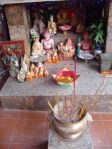
To balance the new with the old we also visit the hill that has given the city its name, with its temples, shrines and statues and countless places that can hold bills, incense sticks and other offerings that keep this place and its visitors in good shape. There are monkeys on the hill that escape into the city and walk across the various cables that crisscross above the streets as if they are in the jungle. I have never seen urban monkeys. Only the tourists pay attention to them.

At the airport I buy one of the many books I now want to read about this country, a biography of the bad guy (Brother Number One) by David Chandler. I had not expected the variety of books about the dark period at the well-stocked airport bookstore. Many of them are first person stories but these are not what I am interested in. I select the biography because I am curious about the personal history and how it intersected with what was happening on the world scene. I read about one fifth of the book on the short hop to Bangkok.

Emirates is at the uninteresting concourse where I have a long wait, sans lounge access, seeing both AF and KLM depart long before my flight, going straight where I want to go. But first I have to go to Dubai, my 6th visit in 3 months. I am already tired, feeling sweaty and grimy as if at the end of various long transits but I have only just started my long journey home. I keep my fingers crossed for an empty flight – why would anyone want to go to Dubai in the middle of the night?

Luxe and leisure

I have a gravlax croissant and coffee for lunch in the small area in the Phnom Penh hotel lobby that is cordoned off for tea and pastries – as if to pay homage to Axel’s ancestors. But it is also to give in to a desire for coffee, even bad Nescafe, after having been coffee-less for 10 days and living on an entirely Cambodian diet. I like variety and the sandwich plate in the showcase seemed to offer just that.

I have returned to luxury, to a hotel that costs 5 times as much as my luxury room in the province and it is luxury indeed: no mosquitoes and geckos on the wall, a real bathroom with a full bath, internet and a mini bar (extra charge of course) – and down one floor all sorts of massages to choose from plus a bunch of restaurants. I think I’ll go for Japanese tonight.

We had our final meeting with the team in the provincial capital in which we celebrated once more the significant accomplishments of the last two weeks and gave ourselves another round of applause. I handed out my usual small symbolic gifts and received two real gifts in return, one for myself and one for Axel. Then Leonard focused the team on what will need to be accomplished in the next 6 weeks.

Back in Phnom Penh we met at the fortified USAID embassy in the center of the city to brief our funders on the accomplishments of the last two weeks and make promises for the next 5 months and then it was time for a second round of goodbyes. There are no plans for me to come back here as I am not in any budget but I wouldn’t mind another visit to this country, and, as Leonard reminds me, I haven’t tried the fetus-in-egg yet (plus a few other insects).

I rewarded myself with a massage by Nika at the Seeing Hands place. For the price of six dollars she gave me an hour long massage, exclaiming ‘Oh!’ each time she found another set of knotted muscles. Nika is 33 and has been blind since she got measles at the age of 1. The Mary Knolls Sisters send her to Japan to learn massage and English; as a result she speaks English with a Japanese accent. Stacked against the wall of her small room are several tomes about massage in Braille; a Braille version of the poem ‘The Gift’ is tacked on the wall – not framed of course. She massages me expertly even with one hand when she answers her cell phone.

The tuk tuk driver brings me back to the hotel and points at the Raffles Royal Hotel that we pass on the way. “The very special person room costs 2000 dollars,” he says. I wonder what this means to someone for whom 100 dollars is probably a fortune.

And now a leisurely evening in luxury – sushi, sake and a long warm bath.

Done

Leaving my computer at the reception desk to let it download emails at snail’s pace, I ate by myself last night since my team mates all had other plans. The restaurant was awash in noise: a bunch of totally unrestrained young children running around and screaming at the top of their lungs, a loud family party that was spread out over three tables with much drinking and falling and braking of bottles and a TV that was set at high volume showing a Chinese drama, whimpering women, bad men and all; a dining experience with much distraction.

The young men who is the night attendant on my floor in the hotel is studying a mimeographed paper called ‘Leadership and Communication,’ in English. I flipped through it. It’s theory that comes from the US. I’d love to sit and chat with him about what he is learning but the period in which we are both in the hotel and awake is very limited. Many of the young people on our team are also studying in the weekend, after work hours. There is a tremendous commitment to improving oneself through study.

For the last time we pile into the car for the 60 km drive to Chamkaleu, three people in front and four in the back of the pickup truck. We arrive with mopeds streaming in from all sides and once again we start exactly on time. The discipline here about arriving and ending on the appointed time is striking; it helps that this is a society of early risers and there is little traffic this far out in the province.

Nara from the provincial health department opens the day with a morning reflection about what we did yesterday. This is where not understanding a word is a handicap. I am trying to get the facilitators to adopt this practice of reflecting regularly but it is still very new and the responses from participants superficial (question: what did you learn? Answer: leadership!). I explain that the role of the facilitators is to make explicit what is implicit, to have people notice how their feelings and moods are affected by design and methods; to help them articulate vague and unexpressed feelings of engagement into actionable lessons about how alignment around a shared vision can mobilize otherwise inert and passive people.

I struggle behind the scenes to get the translations of the results that each health center has committed to produce in the next five months. We are looking at flipcharts with script that is already undecipherable for me, made more incomprehensible by words crossed out or added. Even for the best English speakers this is not easy; a word by word translation leaves me with multiple meanings. I seek a kind of precision that is hard to get, even in English, as I try to wean people from imprecise abstract language that is copied from highly conceptual documents and has little meaning to people who do very concrete work.

I can see the pieces falling into place for the facilitators when I notice that one has improvised a session that is not in the notes and should have been, logically connecting one session to the next. From time to time I check on translations especially when the group is suddenly energized. I have learned in the past that such surges are sometimes caused by the (real or perceived) expectation of goodies coming in from the NGO or donors. People spent much energy on making of lists of things they want to have (and be given). The idea is to stimulate people’s creativity and encourage them to look for the resources that are already there with people’s energy among the most precious and least well managed of them all.

The last session before the break is Covey’s circle of influence. This is interesting because it is so very American in its key assumption: the only thing you can control in life is your own behavior, attitudes and, in principle, your thoughts. This society knows a thing or two about control and so, not surprisingly, the central belief is challenged and needs some digestion. Bunthoeun leads the discussion with great verve and a booming voice that reverberates so loudly through the sound system that I take refuge outside the classroom. He was told earlier that he scares the more timid women and needs to speak more softly to the females. I am told he is trying after he gets feedback from his peers.

For lunch we go back to the same restaurant which has more wonderful soups, vegetables and fish ready for us but also many flies. It is hot again and some of the food is too and so my face gets red. They are worried that something is wrong with me and I explain it’s my northern skin, unused to heat of any kind but nothing to worry about.

There are a few features about eating here that I like at lot, one is the large beer mug filled with hot water from which you retrieve your eating implements, forks, spoons and chopsticks. The other is the young women that walk around with large bowls filled with rice and spoon more on your plate as soon as you finish. People eat huge quantities of rice – it’s always the centerpiece of the meal.

The afternoon starts with an ice breaker, as each afternoon has, accompanied by much laughing. The provincial chief has arrived to be with us in the afternoon. The session he was going to facilitate has come and gone without him. I am curious what will happen next, since we had announced earlier that he is on the facilitation team. He jumps in at the end of the session about sphere of influence and gives an example that has to do with drinking. It’s a message about being a role model and controlling one’s own behavior and not succumbing to group pressure – a rather unusual message in this part of the world I gather, but received with applause from the group.

In the meantime Leonard is busy preparing our presentation to USAID tomorrow afternoon and so we have to recreate the vision in English, from pictures and Khmer words. I create a new mind map. It has the same content but is organized a little tighter in four categories: staff, services, environment and sustainable results. We carefully pick words that can be found in the picture and resonate with our funder.

In the meantime Rany is doing an exercise about listening that is always an instant success in Africa and needs very little explanation. Here it’s different. Rany needs to demonstrate the exercise twice and explain it in great detail. I am puzzled by the difference and explore with Leonard, in the back of the room, the patterns he sees in Cambodia that he already told me about two years ago in Nepal. Some concepts and tools are picked up much faster here than in Africa while others require considerable effort. People ask questions or make comments that surprise me and that no one has ever asked before (‘what if you don’t want to listen’? Or, ‘people are used to being interrupted by cell phones, what’s the big deal’?)

But in terms of energy I have found my match in this country, or at least with this group of facilitators. They have boundless energy, like I do and they are doing much of the work I usually do, freeing me up to write long entries in my blog and reflecting on what I am seeing happening here.

We end the first workshop and my task here with formal speeches and then the 60 km drive back again. We ‘debrief’ over dinner that includes singing and incomprehensible dancing, in an open air restaurant with bugs everywhere and geckos feasting as much as we do. Everyone is happy, proud, relieved and exhausted. Although I still don’t understand a word of what people are saying I am happy and proud too and enjoy watching these people I have gotten very close to these last two weeks, thinking ‘this is what people ask for when they say they want to live in peace and happiness.’
Letting go

In the parking lot of the hotel is a camper with stickers from various Latin American countries, and France. It is inhabited by a French family, consisting of a dentist, his wife and their two children in their early teens. They are on a four-year around the world tour, homeschooling the kids and exposing them, quite literally, to the world. After their dinner in the restaurant they retreat into their camper which is surrounded by a crowd of locals who stand or sit on their haunches around the vehicle. You can see them wondering in their mind what this is all about. I am given a business card with the family’s website. We talk in French. He apologizes for being a little behind in his postings. That makes at least two of us writing about our adventures in Cambodia. They’re leaving for Vietnam tomorrow.

We’re off early to get to Chumkaliu on time. The restaurant isn’t even open and I wait between the sleeping bodies of the receptionists and guards, lying on stretchers around me. I use the time to fill up my inbox, which takes awhile. The breakfast we ordered isn’t ready at 6:15 AM as promised and we have it packed up because we have to leave. Leonard drives us, claxonning loudly through clusters of motorbikes, kids walking and biking to school and dogs.

When we arrive many people are already there. Half of them have already been exposed to what we are going to teach them in one of the three events we have done so far – some, including the big chief from the province have now been part of the introductory session three times. For the facilitation team it is their fourth time.

We go through the usual opening protocol which I now know by heart: the highest chief is called to take his seat at the front table – applause accompanies him. The table is decked out with a baby blue satin skirt and pink rosettes at the corners, a flower arrangement next to the microphone in front of him. Then Naomi’s name is called (Dr. Naomi) and she moves in position, applause again, and then it’s my turn, applause. Naomi is asked each time to say a few words before the official opening by the chief. The microphone has an echo that reverberates around the small room. It reminds me of the chocolate salesperson at the Topsfield Fair who uses his microphone to gather a crowd. I fail to convince my team to put the microphone away since it they have convinced themselves that they cannot be heard in the back. I suggest they check rather than assume but after four tries I give up. And then, suddenly, they stop using the microphone, after I stop pushing. Something about yielding.

I am getting a bit distracted about my flight back to Boston because I discovered, rather late, that I am routed from Bangkok via Dubai to Amsterdam while there is a direct flight out of Bangkok to Amsterdam that will save me half a day and a two hour wait in the middle of the night in Dubai. It’s a little detail I missed in the hurried last-minute travel arrangement before I left Boston on January 9. In the meantime I learn from the head office that the travel agency that issued the ticket has gone out of business and my request is not an emergency. I decide to send an email SOS to Axel to see what he can do – it’s in his own interest as he would get me back half a day earlier and slightly less exhausted.

For lunch we go to a local restaurant; lunch was already ordered and shows up instantly: spicy beef that makes our eyes water and ginger-fried fish. Naomi has brought a can of vegetarian beans (including a can opener) and a can of Pringles which she offers to everyone. I pass and indulge in the dishes put in front of us. There is much joking about the junk food but some try.

After lunch we start with the Cambodian version of Simon Says; here it is Angel Says. There is much laughing. The enthusiasm, anywhere in the world, for such games tells me that adult don’t get to play silly games as much as they would like. For some reason in workshops it is OK to do this.

The rest of the day proceeds exactly according to plan. I am letting go, shedding tasks one by one. They are being picked up by Leonard and the team; the freedom this creates makes me yawn and I realize how tired I am. I run the feedback session for the last time and hand the baton over to Leonard and urge everyone to take notes throughout the day and do what I have been doing till now. This leads to a conversation about status and how to get feedback to people who are higher in status. The positive feedback is easy but the suggestions for improvement are a little bit trickier. I ask the senior staff if they can make requests for getting feedback. They say they want it. I suspect it will remain difficult.

We drive the 60 kilometers back, us in the ADRA pick up and several of the facilitators on their motor bikes – it takes them over an hour each way.


December 2025
M T W T F S S
1234567
891011121314
15161718192021
22232425262728
293031  

Categories

Blog Stats

  • 136,982 hits

Enter your email address to follow this blog and receive notifications of new posts by email.

Join 76 other subscribers