Posts Tagged 'Japan'


Birthday eats

We managed the long flight to Tokyo by watching endless movies when the sleep wouldn’t come. The 12 hours ticked down slowly to landing time at the end of Tokyo’s Sunday – we left on Saturday morning and had skipped 14 hours. When we opened our hotel room door it was exactly 24 hours after the alarm clock had woken us up in Manchester by the sea.

It took 2 hours to get from the airport to our hotel by public transport. I think I am done cheaping in out; being sleep deprived and with an ankle that doesn’t operate very well, the last metro transit was murder.

We checked in, dropped our bags and found a fast (Japanese) food place nearby that served me a small strip of grilled salmon and a bowl of vegetable broth, and Axel a bowl of rice with caramelized onions, beef strips and shiitake mushrooms.

The hotel we selected from the internet is nice for being reasonably priced. Tokyo is an expensive city. You can select the number of square centimers you want from the website. We chose an option with medium number of square centimeters which still makes for a tiny room where Axel cannot do his exercises on the ground while I am around. So I am sitting in the lobby now which is also the only place with internet access.

In the morning we spent a few hours in the ‘precious’ coffee shop which also doubles as the hotel’s breakfast restaurant, waiting for a FASID colleague to come and get stuff we don’t want to carry to Nagasaki and back.

We then walked to the Suntori museum in the Midtown mall which is all decked out for Christmas and could compete with the fanciest shopping mall in the US (and win). A Finnish glass exhibit showed the subtle and not so subtle links between Finnish and Japanese design – extraordinary.

We walked on to visit another museum but my ankle gave up and we had ourselves driven to an exquisite tofu restaurant at the foot of the Tokyo Tower, a bright orange Eiffel-Tower-wannabee monstrosity that spoils the view  (if you look up) from the tofu restaurant’s beautiful traditional gardens.

It is good that the yen is still monopoly money to me otherwise I would have gasped at the price of our lunch. It was an 8-course affair; a dainty tofu lunch served in or on a variety of beautiful small dishes made from wood and ceramics. Each new course was served by a smiling waitress in traditional costume, shuffling quietly on white stocking-ed feet over soft tatami mats, to and fro, to and fro. We could have been somewhere in the country side, 100s of years ago. The only modernity, aside from us, was the credit card machine (thank God) and the digital camera used to take my birthday picture. It was tastefully delivered (separate from the bill) in an envelope decorated with an origami crane and accompanied by a bright yellow gerbera in its own portable vase.

By then we were exhausted. Although late afternoon here it was for us also still the middle of the night. We returned to the hotel for a nap, hoping to do another art museum in the afternoon but we woke up too late for that. So we selected a sushi restaurant out of the 100s of restaurants available to us (these are the visible ones, not counting the ones on 2nd or higher floors or hidden behind curtains and below ground doors). Our tactic for selecting a restaurant is to find a place with lots of salary men (and an occasional salary woman), who are having their post work drinks and dinner before heading out to the suburbs, to wife and kids.

Tomorrow we are off to Nagasaki, leaving us a short morning in Tokyo and another travel adventure.
Return to base

Being at the airport again, in less than a week, makes Japan a bit of an ‘in-and-out’ place. Axel’s good luck did not produce an upgrade but that might have required a grade of luck higher than available. We did get two adjacent economy comfort seats, so we are feeling a little bit lucky, and we get to use the lounge.

The second day of the workshop we were riding a wave of great enthusiasm that lasted into the evening. The students invited us to eat in a Chinese restaurant that is famous for its Peking Duck.

The atmosphere was festive and full of energy. Pitcher after pitcher of local beer was ordered to wash away the various little dishes of Chinese delicacies. The chef himself came out with two whole gleaming roasted ducks, to great applause, before carving them up into tiny slices to put in the thin rice paper wrappers.

I am already being contacted through LinkedIn and facebook by my newfound student friends. They wanted to know how I got to where I am now – how a psychologist could be working in public health – question after question rained on me. “Look for mentors, role models,” I suggested, and then they picked me as their mentor. “Ask people who do this work what books to read,” I said and then they wanted my email so they could ask. “Visit the departments of management and psychology and find out whether there are courses on organizational behavior.” They wrote down the suggestions in their notebooks and in their phones. I have a feeling I am going to be doing some mentoring in the near future.

We said our goodbyes and extended our good wishes to everyone’s future. A similar course is being planned next year – I hope I can do it again. It is quite nice to have students who come for the learning rather than the extra money that a training workshop entails in the developing world.

This morning Axel took me for a short walk near the hotel to one of the art places. There are many buildings with names that include ‘Art,’ ‘Tokyo,’ ‘National,’ ‘Center,’ and ‘Museum,’ so I can’t quite remember the name of this one. It is an enormous display of architectural daredevilry and art, even without the exhibits, with its chrome, glass and wood, its four story atrium, its cone-shaped bases for restaurants at level 2 and 3 and its wide veranda along the galleries. Despite its size it had an intimate feel and they served good coffee, including a little barista heart drawn in the milky foam.

Good fortune

There are some twenty five twenty-somethings in the class. A few are quite a bit older, they are the career changers, and some are in between. But most are fresh out of school or on their first jobs. Several are with the Japanese branches of the big consulting firms and a few with government agencies.

During the introductions I asked them why there were in this class. The responses were heartwarming and would make one believe that the next generation is going to make this a better world. Of course there is a good dose of naiveté in all this about what is possible and human nature, but still…

Before we did any introductions T started the class off with a few of her relaxation exercises. I watched the faces of some of the people – the puzzled looks were priceless. But this is Japan: when the teacher tells you to do something you do it even if you are clueless about why or wondering whether you are in the wrong class.

In the morning we talked about leadership and the leaders they see around them and what they do that earns these leaders their high approval ratings. I am finding that the notion of what leaders ought to do is quite universal – the amalgamated pictures of the best qualities and behaviors of their examples produced some sort of super mensch who would do away with such noxious things as inferiority complexes, confusion, aimlessness, revenge, or feelings of disillusion, abandonment, poor self-care, the total absence of self-awareness and the loss of hope.

I had the class study the management and leadership competencies that my organization expects of its staff and we compared this with the UN approved competencies. Interestingly the competency of ‘managing the money’ was missing in the UN list. We know about the importance of this as we have gotten burned a few times. One would think that the UN would have burned itself more than a few times.

In the afternoon we did a variant on the Barry Oshry Power Game simulation with as task for the temporary organizational system the creation of origami products. To determine who would be tops, middles or bottoms we had people line themselves up according to their position in their current work hierarchy. Not surprising everyone was crowding around the lower end, fighting for positions at the very bottom. The winners of this contest we put in the top position. There was an expression of shock on their faces when we announced that their push towards the bottom actually had put them at the top.

I don’t think I could introduce the origami variant of the simulation anywhere else in the world. Here paper-folding is a bit like singing in South Africa – it is in the genes. Everyone was able to create complicated things like balls and cameras from pieces of paper no larger than a sticky note.

The mass production of certain prototypes created stress in the system. The Japanese workers were sliding into the habits of Chinese mass producers resulting in uneven quality of the products. This created more stress in the system. The salaries consisted of candy – high quality and large for the tops, small and cheap for the bottoms. Bonuses were freely provided to increase production output.

As in experiences elsewhere, the middles felt useless, the tops were clueless and felt powerless and the bottoms were without direction. We spent most of the afternoon talking about this.

By 5:30 PM one would expect a class to be exhausted and anxious to go home, especially since we are doing this on a Saturday – their day off from work. But no, we couldn’t get them to stop talking about their experience in the simulation. Never has a debriefing of a simulation been so self-generated. Although we stopped at 5:30 many didn’t leave until after 6 PM.

In the meantime Axel had gone on a breathless tour into the innards of Japanese religious life, guided by a friend of T who happened to go to a shrine to hand in her good luck face for last year and get a new one. She comes from a line of priests and took Axel on a trip to the country side, into Buddhists and adjacent animist shrines and more.

He lucked out on rituals that happen only 4 times a year and received the fortune that is of the highest ‘luck’ grade. It was as if some invisible hands pushed him into the path of experiences that are rare and unusual for a foreigner to see. And then to think that I had nearly let him sleep in in which case he would not have met his guide at breakfast, invisible hand indeed.

For dinner we had yet another culinary adventure (I believe it is called shabu-shabu), a variant on Mongolian hotpot. We were served thinly sliced strips of raw meet (pork and richly marbled beef) on slatted wooden platters. The meat was balanced by a large plate piled high with Japanese greens, Enogi mushrooms, carrots and turnips, leeks and other vegetables I didn’t recognize.

All this we dipped in a broth of collagen (yes, indeed, the stuff that makes your skin look good), and then mixed with all sorts of ground spices, pastes and sauces, neatly served in dainty little dishes with tiny bamboo spoons.

At the end a plate of noodles was dumped into the remaining broth and we slurped these from our lovely pottery bowls. The meal came to an end with a small scoop of green tea powder ice cream and a cup of tea – everything once more served in artful ceramics.

I am sorry that we have only one more culinary adventure left. Axel too has only one more day left of exploring (modern) Tokyo. Departure is tomorrow afternoon.

The food we eat

All the parts of the chicken that we in the US discard were on the menu of tonight’s dinner, presented on tiny bamboo skewers: piece of cartilage from the chicken’s back; slices of fatty chicken skin; pieces of its liver, and the gizzards. Each skewer received some special spices before being put on the braziers that lined the tiny cooking space around which we were all seated. And then there was the chicken breast sashimi (yes, raw), grated daikon with a raw quail egg, tiny green peppers. And we loved it all. It was yet another culinary adventure.

In the morning I conducted a session about organizational behavior with nine junior but fairly experienced international development professionals in the room and one on Skype from Washington. The latter was a last minute surprise. I took it, optimistically, as an experiment but I think it failed. Experiential exercises and small group work with all but one of the students in the room and the other 14 time zones away, plus a connection that dropped every 5 minutes was not a formula for success.

For lunch my Japanese colleagues proposed Italian. I politely declined and proposed Japanese as there are still many discoveries to be made. Lunch consisted of a raw egg broken over grated taro root and rice with soy sauce, thin strips of fatty pork dipped in a fish sauce, miso and pickles.

After lunch we went over the program for tomorrow’s workshop which is about leadership, basically a repeat of the one we did in November. The difference is that this group’s English is very poor, at least according to test scores. This means I will speak less and T will speak more.

We racked our brains, once again, to come up with a scenario that would allow small teams to experience the role of ‘opposer’ in a group task. Finding a task where anyone would oppose the leader is nearly impossible in this culture. Nowhere else have I had such difficulty finding the right topic.

We also re-wrote the tasks that the students have to tackle in a simulated work environment. In November the task was the writing of slogans to educate the Japanese public about emergency preparedness. This time we are using a more traditional Japanese pastime, paper folding, as the main task. I was assured that everyone here masters this skill.

In the meantime Axel is exploring the art scene and collecting more brochures than you can shake a stick at.

Amazement

Nagasaki was sunny and relatively warm compared to yesterday. We had a day of tourism in front of us. We are way outside tourist season and did not see any other foreigner until we arrived at the airport. Most of the time we are the only white folks around.

First Axel guided me through the reconstructed Dutch enclave of Dejima (Decima) where the Dutch had a trade monopoly with Japan in the late 18th and early 19th century. Thanks to the 1000 Autumns of Jacob de Zoet we knew a bit about daily life on Dejima at the turn of that century.

Now the fan-shaped enclave is no longer on the ocean and has gotten a bit lost in urban sprawl, hemmed in by parking garages and office buildings. Still, it is a breath-taking experience to walk in the footsteps of those Nederlanders who ventured so far from home.

Next stop was an architectural marvel, the prefectural museum of art, which needs a bit more of a collection to put in its enormous spaces. From the roof you have a wonderful view over the harbor and to the many volcanic eruptions turned islands as far as the eye can see.

After a sushi and tempura lunch, accompanied by a small bottle of sake, we headed inland toward the museum of Professor Siebold, a German scientist who further drove in the wedge already created by trade, into this society that had been so introverted for so long. His enormous knowledge and curiosity earned him respect and students from all over Japan. His Japanese daughter was the first female OB/GYN in Japan.

And then it was time to head for the airport and board our plane to Tokyo with hundreds of salarymen going home or going on a business trip. We got lost in a sea of black suits until we alighted from the airport monorail and found all the salarymen relaxing in subway noodle and sushi shops – they weren’t running home quite yet.

A nice lady from the Canadian embassy helped us find our way back to the surface through a maze of underground tunnels. And now we are settled in our (much less fancy) hotel – more of an international youth hostel – here in Tokyo. Or rather, I am settled as Axel went out for a late meal somewhere back in that maze.

Cold

While Axel was exploring the old Dutch remnants in Nagasaki, Miho and I took the tramway to the university and walked through alternating snow, sleet and rain to the school of public health where 12 eager students were awaiting us.

The best thing in Japan, during the cold season, is the heated toilet seat. I could manage the cold knowing that somewhere a heated toilet seat was waiting for me.

At lunch time we had the traditional Nagasaki noodle soup called Champun, that was just the right thing to warm up. After lunch we continued the ‘lecture’ and I had the students explore the meaning and utility of the concepts of mission and vision. It was all very new and mysterious.

We met up with Axel at the Atomic bomb museum – a complex of exhibits, reflective pool, meditation rooms, gruesome photos and artifacts. The whole thing made me extremely angry – the pictures of the male protagonists in this drama: Hitler, Stalin, the Manhattan project men, the Japanese, Truman, Oppenheimer, Bohr, Einstein, Russell – the latter eventually realizing that the bomb was a really bad thing and becoming peace activists. The only women portrayed where survivors with their horrendous stories of loss and suffering, and the non survivors, the charred bodies of mothers and their babies. What were people thinking?

We rode back in a packed tramway, sober and shivering from the cold, me longing for the warm toilet seat that we found across from the old Decima (Dutch) enclave in a restaurant named Garcon Ken. Ken was there waiting for customers in a tiny but empty restaurant. We stated that we came for drinks, to warm up. But Ken expertly seduced us to stay for a meal, bringing out one delectable tapa after another, plying us with ‘warm up’ drinks. And so we had a French Japanese meal (fish of course) that will be among the more memorable culinary experiences of this trip.

Up above

If Australia is down under, then we must now be up above. We arrived safely in Nagasaki after a very long and exhausting trip.

In our non-existing Japanese and the waitstaff’s non-existing English we managed to order lunch in a nice fish restaurant across from our hotel. We arrived at 11:30 AM but the rooms are not released until 2 PM. That we travelled more than halfway around the world was apparently no cause for some leniency on this rule. We could have paid our way into our rooms but the restaurant beckoned.

There too was a time constraint; we were 8 minutes ahead of the start of lunch hour but they let us in anyways and served us a nice hot cup of tea. We found all our favorite Japanese dishes (and more) on the menu.

Earlier, what now seems a life time away, We had landed in Tokyo, in a dark and rainy drizzle. It was cold, after LAX. We were glad we brought our warm coats and gloves.

Haneda airport was a new experience for both of us. It is pristine, immaculate and totally sanitary. We wondered whether that makes the Japanese more vulnerable to infections. Many walk around with masks.

Just before landing we were told by the airplane crew that avian flu is back in the news in this part of the world. We had to walk through a temperature detector and over a disinfecting mat. Would it mistake a hot flash for an avian flu risk?

At the domestic airport, equally clean and full of the most polite people, we tried a Japanese breakfast and an American coffee before boarding a half full plane to Nagasaki. As we circled up from the runway that is built like an enormous bridge, sticking out into the harbor, we had a breathtaking view of Tokyo going on forever in each direction. I think we saw Mount Fuji or else a mountain with a Fuji profile.

We flew over a winter landscape southward to Nagasaki. The palm trees and the still flowering bougainvillea hinted at Southern France. But on all the north-facing slopes the pine trees were more than dusted with snow – much like we want Christmas trees to look like – even the palm trees had a light snow cover.

A colleague of my friend, host and ex-colleague waited for us at the bus stop, hailed a taxi to take us to the hotel and pointed us to the fish restaurant after which she bid us farewell to return to the university.

Still to early for check in we took a digestive walk in the hotel’s neighborhood. We are in or near the Chinese quarter. It is decorated festively with lanterns for the Chinese New Year. According to a historical marker this is the old Chinese entertainment quarter. Now it is full of bars, sometimes multiple bars on top of each other. In the olden days (1870s), we learned, there were more than 1400 geishas and prostitutes working here. An ironworks frame over the alley way shows a scene of a gentleman in a pull-rickshaw being taken to his entertainment with shy geishas fanning themselves on the side. Just as I remember from the “Memoirs of a Geisha” movie.

Finally checked in we had hoped we could stick it out till an early bedtime. We thought that we ought to try to stay awake or else we will never get used to being 14 hours ahead of ourselves. But we both succumbed to a deep sleep from which only a phonecall could wake us up. It was Miho who had to sit for a PhD exam and is now ready to party. We are of course totally ready for our next culinary adventure.

Missions accomplished

The second day of the workshop was slow because I was sleepy and had gotten up at 3 AM, not able to return to sleep. So by the time we started (9:30) I had already half a day behind me. I tried to yawn inconspicuously.

T. started the day off with her exercise regime that has an untranslatable name and that requires a lot of sound making that are also not translatable – they have some meaning in Japanese but she couldn’t give me any more precision. We rubbed and shook our hands, shoulders, belly and each other’s backs – the kind of thing you couldn’t possible do in Afghanistan in mixed company. There was again much laughing. I concentrated on making the right sounds.

And then all of a sudden the event was over and check in messages appeared on my computer screen. We had a quick debrief with the course coordinator and then headed for a restaurant with about half the group. We had a separate room, good for two hours of eating and having a good time. It was one of those rooms with a low table but, thank heavens, a well underneath so I didn’t have to bend my stiff knees.

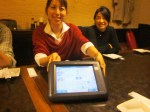
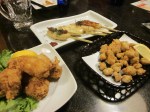
Ordering goes electronically. A console with all the items, drink and food, allows for immediate communication with the kitchen and near instant service. I had deferred the ordering to the locals and enjoyed all the delicacies that came out way: Korean potato sandwiches with something that had the texture of cheese food on top, a plate of sashimi (especially for me I think), something that tasted like tiny little knuckles, breaded, a variety of tiny bamboo skewers with various meats on them and accompanied by a sambal like substance, an egg salad (salad with pieces of eggs). It was like a tapas experience – everyone picked at the food while engaged in very animated conversation, occasionally translated. And then of course there was lots of beer and sake which made the conversation even more spirited.

I collapsed once again before I could write in my diary – my internal clock is so utterly confused that once again I woke at 3 AM and was unable to go back to sleep.

This morning I went for a long walk in the neighborhood and saw Japan get to work. Works starts late, between 9 and 9:30 – it is a time to avoid the metro. I remember seeing those images of people being pushed into the cars. I am told this is still happening. So I stayed above ground and watch endless masses, the men dressed more or less alike, the women in endless variations – hurrying into skyscrapers – it could have been New York.

Tessa had asked for Japanese paper so that was my last mission in Japan. I found a paper store that has nine floors, it is, apparently THE paper store (Ito-ya) and clearly a place where I could lose Axel easily if he ever found it. It had the most exquisite paper collection (and that was only on floor 6) I have ever seen with sheets ranging from small (copy paper size) to very large (two flipcharts side by side) and from about a dollar a piece to over 50 dollars apiece. It was very easy to spent 60 dollars on not a whole lot of paper.

And now I am in the Delta lounge at Narita, hovering around the area where a lady in Delta uniform periodically places a tray of sushi rolls. They disappear within a minute so one has to be alert. I am not the only one hovering but I was successful a few times. I had my last Sake and am now trying to prepare myself psychologically for the long trip back, with two days that will collapse into one – hoping that the plane is a little empty in the section where I am seated.

Slurping and vending

This morning I watched a bunch of elderly Japanese as they ate breakfast and learned how to eat the fermented soy beans with their long thin slimy threads: you keep the cup with the soybeans right by your mouth and shovel the beans in. Slurping is OK. It’s easy that way.

This morning I got up very early, my internal clock still utterly confused. I got myself a canned coffee from the vending machine down the hall – walking there on my hotel slippers and in my hotel kimono – a piece of clothing that is put on my bed daily, nicely starched with the tie neatly folded in an 8-shape on top.

Vending machines are ubiquitous here. There are several machines on each floor: one contains alcoholic beverages, another noodle cups; a third holds a variety of juices and cold teas and then there is a machine dedicated entirely to energy, holding all sorts of booster drinks and several kinds of coffees. I learned that if the label below the item is red the drink comes out hot. If it is blue it comes out cold. It seems obvious now but my first hot can of coffee came as a surprise.

Halfway point

Some 27 eager twenty and thirty-somethings showed up at 9:30 on the first day of their weekend to learn more about leadership. This is one among other sets of skills and knowledge that the Japanese government considers important for a future career in the UN. The Japanese have a similar arrangement that the Dutch (and many other European governments) have with the UN to provide its civil servants. It is what brought my co-facilitator to Hong Kong and then New York, my ex to Lebanon and Yemen and me to Senegal. The Japanese are more intentional about this recruitment process than the Dutch were at the time.

We asked everyone, by way of introduction, to share their dreams (“where do you want to be in 10 years?”) and the answers were moving and inspiring. Although many did not know how to get there, they did know what would give their life meaning: environmental action, education, peace work, a maternity ward in Rwanda…some were very specific others following a vague hunch.

During the morning sessions we talked about how to create open dialogue, what competencies MSH expects from its project leaders and they assessed themselves against these standards. This provided them with some form of guidance for self-development and the host organization with some data on what other kinds of professional development they might want to propose to the government.

In the afternoon, to experience leadership in action, we entered everyone in a fictitious organization with tops, middles and bottoms (workers) to produce messages for the population of a fictitious country on emergency preparedness. The workers were asked to write slogans on how to prepare for weather calamities, earthquakes, radiation and chemical spills, terrorism and epidemics. None of those are farfetched for the Japanese of course. Although in real life most of the participants are at the lower end of the hierarchy, several of them got to experience the stresses and pressures of those above them. For many it was an eye opener that also created much energy and hilarity during the dead hours of after-lunch.

These workshops are not of the kind I am used to where donors pay for travel and lunch and people hold their hands out, obsessing about getting their money. Here people pay to attend and bring their lunch and sacrifice their entire weekend – it is all so very refreshing.

Tokyo is full of convenience stores (Seven-Elevens, Family Marts), I think I have seen one one about every 100 meters. Imagine getting your bento box at the corner shop. They even heat your meal and, if you spend more than 500 Yen you get to draw a chance ticket for a prize. None of us won – our tickets said ‘Challenge Next Time’.

During the afternoon my colleague, who is a teacher of some sort of stress reducing and limbering up exercise regime, got everyone to do just that – an important enrichment of the very long program of the day (9:30-5:30), creating both release and some good laughs.

After the work of the day was done we went to an eating establishment where, several years ago, when Axel had accompanied me, we had enjoyed a stupendous meal. It is a restaurant that is also a pottery shop, serving all its dishes and drinks in or on exquisitely turned and infinitely varied earthenware. At the time we had bought fern-shaped stirrers which have all broken since – unfortunately a discontinued line.

This slideshow requires JavaScript.

The restaurant was empty except for us. It is located in a office district in town so its usual clientele had gone home. The owner and her mom treated us as if we were visiting dignitaries, pulling out all the stops. One dainty dish after another, each presented as artfully as food can be presented, was put in front of us after unintelligible consultation between my colleague and the owner.

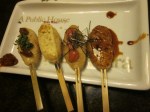
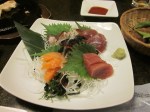
We started with a tiny lump of a soft cow’s cheese sitting in some savory sauce and decorated with a green dot and a tiny yellow petal. Then came the sashimi from mackerel and bream, served on shredded dakon and carrot and a chrysanthemum leave. This was followed by roasted taro root and soycakes, small fried anchovies on roasted onions and tiny slices of marinated chicken sashimi. The meal was concluded with fragrant rice dotted with black sesame seeds and tiny slivers of salted somethings and miso soup. Just as in Afghanistan, hot tea signaled the end of the meal.

The meal was accompanied by a glass of cool draft to soothe our facilitator throats followed by Sake served, of course, in lovely pottery flask and tiny hand turned cups. We had to actively resist the efforts by the owner’s mom to have us try other great types of Sake though she did succeed in signing my colleague up for some sort of Sake-tasting event in the future.

In Japan it is not proper to fill your own glass or cup as this would indicate that one’s host or table mate is not paying attention. If you don’t watch out you can get drunk easily because your glass never empties no matter how much you drink. And so we filled each other’s cups, me grateful that the flask and cups were tiny.

We are at the halfway point of the workshop and I am only one day away from my departure. It is hard to believe that in a few hours I can already check in online for my return flight.


December 2025
M T W T F S S
1234567
891011121314
15161718192021
22232425262728
293031  

Categories

Blog Stats

  • 136,984 hits

Enter your email address to follow this blog and receive notifications of new posts by email.

Join 76 other subscribers