Posts Tagged 'Tanzania'


Eurobath

I never got to see Mount Kilimanjaro. It was always in the clouds and on departure from Kilimanjaro airport I sat on the wrong side of the plane. To make up for this, the decorators of the Kilimanjaro Kempinski hotel in Dar es Salaam have hung a huge photo of the top of the mountain above my desk. Now I can look at the mountain to my heart’s content for the next 5 days.

I took the Precision Air shuttle to the Kilimanjaro airport, saving US taxpayers US$60. I recognized some of my fellow passengers as the graduates from the Trade Policy course. We traveled in an odd looking plane, with luggage stored between us and the pilot. The plane was full of French, Dutch and British tourists on their way to Zanzibar, our first stop before landing in Dar es Salam.

The driver who took me to my hotel started talking about Bush as soon as he heard I was from the US. What a good man he was to have come all the way to Tanzania. I asked whether his visit had been very disruptive, traffic wise. One would expect a professional taxi driver to complain about such things; but no, it had been wonderful. He had stood along the road where people had waved little American flags. For the first kilometer, large lightboxes in the divider strip proudly speak of Tanzania-US unity in English and Kiswahili (Umoja). After one kilometer they are empty again waiting for new messages of friendship.

My driver was particularly impressed with Bush’s having danced with the Maasai. He kept mentioning it, complimenting me on having a president who is a good dancer; really, the things you learn while abroad, I had no idea. His handshakes with common people, his visit to a school and to ‘unabled’ children all added up to leave a big impression here. We then turned to the current elections. Everyone I have met so far is following the elections with great interest. An elderly gentleman who teaches at the institute told me, ‘mark my words, McCain will win!” There is also a fear of Obama getting shot. I understand that that is a fear that is particularly prominent in the US black community and it seems to have made its way to Africa. My driver did not know that it was Obama’s father who was a Kenyan (he thought it was his mother) and the idea that a simple villager from Kenya had produced a son who had produced what might become the next US President clearly caught his fancy. He was speechless for a moment and then broke out in a big grin. The Tanzanians don’t particularly like the Kenyans, who are loud, aggressive and too tribal in their eyes (the current crisis is no surprise to them); but vis-à-vis the US, they are brothers.

As it happens, I am staying in the same hotel that Bush stayed in. Of course for him it was emptied of ordinary people. I asked the bell boy what it had been like and he said it was very exciting, especially all these security people and CIA and FBI, things he knows only from Hollywood films, right here in his hotel! He too was impressed with the whole show, and in particular with how hard these Americans worked (day and night).

I, too, am impressed. Bush’s visit added two more stars to the hotel’s five star rating (according to my driver). eurobath.jpgIt is of a luxury that I haven’t seen much in Africa. The bathroom looks like an advertisement in Modern European Plumbing (Italian), with floor to ceiling glass windows looking into the bedroom. They are covered with louvered shades for privacy, which I don’t need. I can watch TV (watching the homecoming of Prince Harry over and over on BBC) while sitting in the tub and look out over Dar es Salaam at the same time.

I had contacted one of my students in a virtual course a few years ago. She is the only one from the team I was able to reach by phone. As it happened she is now working closely with Marc who used to work at MSH during my first 12 years there. And as it happened he is in Dar es Salaam, so the three of us went out together for dinner and caught up with each others’ lives.

Giddy

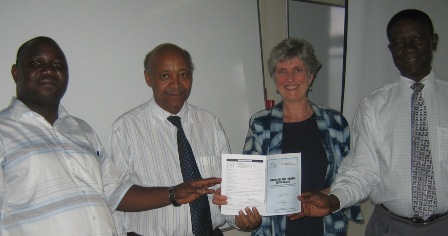
sl_brochure.jpgWe wrapped up the work and it was crowned with the delivery, hot from the institute press, of an official brochure announcing the workshop to the world. It was not quite perfect but it was more than ‘good enough for now’ – my motto on these trips. It can even be distributed to anyone talking about leadership at the big African Health Workforce conference in Kampala next week.

We talked about the next steps, which is the detailed session planning for the actual workshop next November. My co-facilitator will be a Tanzanian of Indian descent, a real gentle-man with whom I look forward to work. I suggested we use Google Documents, a virtual workspace, to fill in the details of the course as the weeks and months go by, suggest experiential activities, share readings, etc. To show how Google Docs works I downloaded a 3-minute You Tube video on it and showed it to my colleagues. Watching the little movie in the company of my African colleagues made me utterly aware of how American it was, in language, tone and style. They picked up things I had not paid attention to. It reminded me of a film about malaria control that was tested on a group of villagers. Knowing a lot about chickens, they focused their attention entirely on the unknown breed of chickens that happened to be running in the background while the film focused on the drainage of standing water. They missed the part about drainage. We see what we are looking for (or are familiar with). I know I do; I see group dynamics and organizational behavior everywhere!

I hung around for a meeting with the marketing people in the afternoon but they never showed up. I was surprised that no one called them or went to find out what happened to our meeting. There was a sense of fatalism and some anger (we are more senior, we have a foreigner with us, how impolite!) but also a sense of acceptance that this is how things are. I learned a long time ago to take my cues from my counterparts and used the waiting time to explore possible activities for next year, write my report and take advantage of a dependable internet connection. And of course I always love hearing the commentaries each group makes about the other, in private only. This is how I learn much about organizational dynamics and about the (perceived) characteristics of various identity groups: some validated by my own observations, but much comes from (unsolicited) editorials made by others.

A course about trade policy finished yesterday at about the time that we had given up on the marketing people. They celebrated the course’s completion outdoors at the entrance of the institute with many varieties of hard and not so hard liquor, snacks and endless picture-taking with multiple digital cameras. I was invited to pose for the pictures as well, as if I had been in the course with them for 4 weeks. I just imagined the Bangla woman telling her husband, “Here, look at these pictures of the people in the course” and him saying, “Who is she, that white lady?” “Oh she is just some random person who showed up for drinks…” I actually had gotten to know some of these folks from our lunches in the dining hall. The participants were giddy with the excitement of having completed something significant and going home. I know that feeling so well.

My colleague Lucas drove me back to the hotel after I said my goodbyes to the rest of the team sl_team.jpgand then I packed for my departure. I pulled out my books about coaching and executive leadership for my next assignment, an executive coaching one. Although I have done much informal coaching of senior execs, I really haven’t done any such thing formally called by the name of executive coaching. So this will be a somewhat new experience, hence the books.

Wrapping Up

Today we are wrapping things up in Arusha. We will present the product of our week of work to serve as the input for the brochure that will be printed to announce this course for next November. I will be teaching it with one of my team mates. It is too bad I missed seeing him teach yesterday afternoon; no one told me and I didn’t ask. When I arrived for tea in the cafeteria I heard his voice behind the harmonica doors but by then it was too late as I didn’t want to show up in the back unannounced.

Instead I got to watch the Director General teach his course in organizational behaviour (here spelled with a ‘u’) to an evening class of MBA students. I arrived early hoping to find myself an inconspicuous place in the back of the classroom. Of course when you are the only white person it is hard to be inconspicuous, and so I ended up sitting on one of the sides of the U-shaped table, right between two students.

The class was about groups. The professor was a great lecturer and, more importantly so, a man with impeccable management and leadership credentials with an understanding of OB that I rarely encounter. It is therefore not surprising that when he took over the leadership of this institute, he has turned it around from a phlegmatic and inert para-statal, owned by 10 governments – one can just imagine – to a thriving institute that is expanding and attracting good people from all over the region, both as faculty and students.

Over tea one of my counterparts told many stories about what it is like to work here. Every year at Easter, some 75 faculty and staff, spouses and children travel to Dubai for a 5-day holiday. Once there, they split into groups with similar shopping interests. Dubai, after all, is about shopping. Since the institute is an intergovernmental organization, it has tax free status and employees can important cars tax-free. So there is a lot of car buying done there. This explains both the many shiny brand-new SUVs in the parking lot and why, when you get to Dubai airport, there are shops that sell cars and have show models parked right in the transit area. I was imagining the MSH equivalent of such a trip – like going to the Caiman Islands or some destination like that. Or maybe it would be Wall Drug?

The other remarkable story is about the institute’s Cooperative which practices the business skills taught here. It runs on a volunteer basis and invests staff member contributions in running the cafeteria and shop. It also employs the caterer for the dining hall and gives out loans to members, like a mutual savings institute. If there is a surplus at the end of the year, it pays out dividends.

At lunch yesterday we sat with more financial management students, this time from Uganda, Malawi and Zambia. There was much joking about senior leaders once they knew about the senior leadership course we are developing. It is quite striking how badly the top bosses are perceived. I asked them whether they would be like their bosses who they despise once they get to that position. The answer was, ‘Probably!’ as it would be their rightful turn to ‘take’ rather than ‘give.’  Maybe this is why the notion of stewardship is so attractive here to people who are not at the top – an ideal that keeps you going while you are down and which can be discarded once you are up on top.

At the end of lunch break I went to say hello to the Ethiopians, who always sit together, and of whom I had befriended a few. As it turned out, one of them is a colleague of me, from the MSH project in Addis. Another had applied for a job with MSH but had not gotten it; also at the table were two people who I was told I will see on TV when I come to Addis. They are comedians who are active in HIV/AIDS prevention campaigns. They each gave me a shiny colored business card with the promise of a great time in Addis, where I am slated to go at the end of April.

Sun-dried pineapple

Everyday at lunch we eat with the students who are in residence at the institute. Because the dining hall is too small to accommodate everyone at the same time the tables are always full and you have to search for a place to sit. This means that you are likely to sit with people you don’t know, mostly students and occasionally with faculty or staff who are also in residence. This has been an unexpected treat. Yesterday I was sitting with a Zambian and Kenyan accountant who are following a course on financial management; the day before I was having lunch in the company of a insurance company director from Uganda, a trade representative from Malawi and a few Ethiopians following a course offered by the WorldBank about HIV/AIDS (“We are mainstreaming AIDS!” “Really? Why would you want to do that?”). And the day before that we learned about what trade representatives do in Zimbabwe.

For someone who is a great believer in networks this place is paradise. It also gives one a very different picture of Africa than the one that is generally known in the West. Here, Africa is populated by young and eager professionals who want to make a difference; very stimulating!

Before the lunch doors open everyone congregates in a cafeteria-like place; a WorldBank-sponsored HIV/AIDS course is given in back of folding harmonica doors while a large TV is perpetually on (and loud) showing South African soap operas with much drama, tears and shouting. Maybe this is a familiar backdrop for people who are, as they say, ‘in HIV/AIDS.’

I have heard some interesting perspectives here about Bush’s visit last week. He has gained much goodwill among people who rarely speak highly of him. One colleague surprised me most when he said that Bush’s visit was a testimony to America’s (generally admired) long term strategy which has been consistently implemented from as far back as Carter. To my surprise he saw no fundamental differences in the policies and strategies pursued by any of the presidents who followed him; including Bush. The choice of African countries visited was, in his view, very carefully planned (probably, we hope) and related to long term strategic interests around trade, access to primary resources and allies in expected future regional conflicts (just as described by Upton Sinclair in Oil!). It was an utterly novel idea to me and taught me something about how hard it is to leave the mainstream of opinions and explore current reality on its own merits; a topic, incidentally, that I teach.

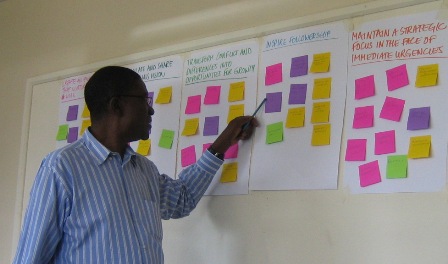
I spent another full workday after I returned to my hotel in the early afternoon to assemble the results of our work in the morning; we refined the objectives of the course and identified the topics we think need to be taught to achieve each of the objectives, using colored post-it notes, complementing each others’ perspectives. We are very productive and I am hearing great stories; the work can hardly be called work. My colleagues are happy with the process of collaborative design which is new to them. img_1442.jpgHere, courses are developed by a professor about his or her favorite topic and then presented to a curriculum committee, all in a day’s work. Before I arrived they had balked at the idea of working a whole week on course design (why so long?) while we in Boston thought one week was very short to come up with a whole course. The final arrangement of work in the morning and, for me, putting things together in the afternoon is working perfectly.

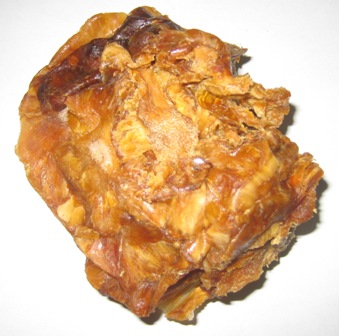
I made a little outing to the supermarket across the street and bought a package of dried pineapple produced by a cooperative of local women. Although it tastes great, the presentation leaves something to be desired. driedpineapple.jpgThe content of the package look like it was scraped from the surface of a dark and dank place where things similar in appearance grow. This may explain why I have never in my life seen sun-dried pineapple slices; packaging, by the way, is a topic that one of my colleagues is studying at the Maastricht School of Management with financial aid from the Dutch for his Ph.D. The Dutch offer a range of topics to choose from. If you want to pick your own topic, you pay for your studies. The available topics appear to be all trade related; those pragmatic Dutch!

All Ears

Yesterday when I woke up the skies were clear and I could see Mount Meru right from my window. It is huge and rises out of nothing; most of the time it is hidden from view by clouds. I have yet to see Mount Kilimanjaro. I wonder about these sturdy climbers from the plane. Where are they now?


We had a wonderful and productive day yesterday. This is one of these assignments when I marvel how I have come to be so lucky to be paid for something I would do as a hobby. I wonder if journalists feel this way. We spent a good part of the morning telling stories, or rather, me asking questions and my colleagues telling stories, about the people they admire and why. I heard many stories about how their lives have been touched by the larger than life Africans of their/our generation such as Nyerere or Mandela. The African history book (The State of Africa) that I finished reading in fall is coming to life through these stories. Much of the appeal comes from these leaders’ principledness, their integrity, their humility. At some very grassroots level, this is the story of African communities and their leaders; at a national level these stories represent the opposite of what the world has generally seen displayed in this part of the world.


We also talked about what events or conditions trigger personal growth and which ones of these we can re-create in a classroom. I learn much about my colleagues this way and I see, again, how racism and colonialism has touched people. It is very humbling.


Throughout these conversations the course is beginning to shape up. This morning we will agree on the learning objectives and begin to brainstorm about the kinds of activities that may bring about the achievement of these objectives. We are right on schedule.


I spent another 6 hours or so, till about midnight, struggling with my connection to the rest of the world. It is funny how isolated I feel without my mailbox being wide open, at all times, to Boston and home. At least my cellphone is now known by my colleagues and some have called, transmitting all these messages that I usually transmit by email.

As a result of my internet problems I am making good progress in my book. Usually, being connected at all times, means that new work or reminders of old work keep appearing on my screen. That is not happening right now. This is both good and bad. Good for the reading and bad for what will happen once I am connected again.

In the afternoon I visited two gentlemen who I had last seen in Gothenburg exactly 12 years ago. It was interesting to hear how they experienced the course which was for me so full of conflict that it still hurts when I think about it. Apparently I missed the last of four workshops, in Entebbe, in which more conflict erupted. I had tried to use the conflict as the source for productive conversation and learning; I didn’t really manage to do that, only piss off a lot of people. My African friends remembered the conflict and smiled but, diplomatically, made no comments. For me that particular course was a lesson in what happens when you don’t want to deal with conflict but it was also one of the times that I got a glimpse of the extraordinary amount of hurt and anger that colonialism and racism has accumulated into the very cells of some people here. It gives you pause. It is also an antidote for the usual impatience that characterizes much foreign assistance. The paradox is that this very impatience has led to a situation where people, especially from the West and North emphasize that they have been patient long enough and now it is time for action. Maybe this is why these internet problems are thrown at us when we are here….to calm down (which we can’t because we need to get that goddam mail!).

Disconnect

I was picked up early in the morning and driven to the campus of my host on the outskirts of Arusha. The school’s architect must have been inspired by the German pillboxes that dotted the North Sea beaches of my childhood. The lovely hilltop campus is rudely interrupted by one very tall and a few lower concrete structures with small narrow windows and entrances that don’t feel like entrances and are hidden from sight. If I hadn’t followed someone who knew his way around I would have been hopelessly lost.

The buildings violate everything that I learned about Pattern Language from Christopher Alexander. They are also not designed for people with handicaps. I am happy that my ankle has healed. Endless narrow stairs make learning, teaching or eating pretty hard for someone who has difficulty walking. You can also tell that the place was designed by a man for men. The men’s bathrooms are right next to the eating hall but the women have to go down a flight of stairs and are squeezed in a small space between the front door and the reception. It appears their bathroom needs were an afterthought.

Despite the physical distractions of the building itself, the 360 degree views are lovely and, I have been told, include Mount Kilimanjaro and Mount Meru on clear days.

Back at my hotel in the afternoon I called a few people who I had taught some 12 years ago in a memorable course in Sweden and Mombasa. To my great surprise a few are still in the same place, whch is just down the street from me. I will visit them today. As it happens, their organization might already be teaching a course about health leadership and management; so this I will find out today.

I went out of the hotel after my phone calls to make the short trip to the supermarket across the street and take a picture of the (Coca) Cola Clock Tower. Countless young men, hanging around the hotel in the hope of selling trinkets to hapless tourists descended on me like flies on honey, trying to lure me to their shops and calling me ‘my friend.’ They feigned shock when I told them I did not make friends that quickly. It was very annoying and I escaped quickly back into the safe confines of the hotel.

I had planned to have a ‘mocktail’ as encouraged by the welcome letter from the hotel manager in the Hatari Tavern, at exactly the same place, though now renovated, where John Wayne had a real cocktail in 1962 after a busy day of filming. But instead I got terribly distracted by my efforts to connect to the Internet.

The hotel advertises itself as “The Essence of unrivalled quality.” It came up a bit short in the Internet Access Department. After 4 hours of trying to connect my mailbox to the internet I gave up. It did mess up my planned evening of work on tasks that need completion this week, as I got completely pre-occupied and obsessed with getting the connection to last long enough to empty my outbox and send several messages composed after dinner on their way to America. I think I would have torn my hair out of frustration it wasn’t for Upton Sinclair’s Oil! that I am reading while pressing periodically the ‘connect’ or ‘reboot’ buttons. I finally gave up, long after midnight and settled into an uneasy and restless sleep.

Boomtown Arusha

I arrived in Arusha with a plane load of safari goers and mountain climbers – sturdy folks with good shoes and gear for a climb up Africa’s highest mountain (nearly 6000m), and, as I learned, the highest stand alone mountain in the world. I asked the driver who took me for the hour drive to Arusha what the name meant. He said it was Swahili for ‘never ending journey.’ I think that was his private, rather than the official, version. He told me he had gone up there once and, clearly, it felt like that to him. I have only once in my life climbed a mountain over 4000 meters, some forty years ago when I was still considering a career in mountain climbing. It was a memorable climb. The idea that you’d have to do another 2000 meters after that is hard to imagine, especially now with the knees and stamina no longer what they used to be in my teens.

I met Jet’s brother Karel as we boarded the plane in Amsterdam. He was on his way to the top of Kilimanjaro, doing the first few thousand miles by air. I think we had not seen each other since Willem and Jet got married in 1975 – he recognized me; I am not sure I would have recognized him; people change in 33 years. We are all grey-haired old folks now.

I rode shotgun in the taxi to Arusha because the back seat was not available. I am glad we arrived on a Sunday night as there was hardly any traffic on this road which is the main thoroughfare from Nairobi to Dar es Salaam. Most of the traffic consisted of pedestrians walking in the pitch dark on the side of the road until we’d pick up them up as dusty silhouettes in our headlights. There were only a few moments when I dug my nails into my hands but the driver was cautious (it’s the other drivers I worry about) and regularly spaced speed bumps kept the speed of all cars down. This is the road along which refugees streamed into Tanzania, 14 years ago from Rwanda and last month from Kenya.

Upon entering Arusha the driver told me proudly that the town now has its first set of traffic lights. The installation of the light was not without glitches: one side did not get a light leaving cars from that direction bewildered as to when and how to cross the newly regulated square. It took a few days of policemen observing the oversight and angry letters in the paper to correct the mistake.

clocktower.jpgOnce you pass the lights, tall street lights are planted (but not lit on Sunday night apparently) on each side of the main road that leads to the (Coca Cola) Clock Tower roundabout, presumably the city center as well as the location of the hotel. Clearly this second largest city of Tanzania is coming of age and traffic lights are one of its latest accomplishments. Go, Arusha, go!

The boom is fueled by tourists (now including those chased from Kenya) and I suppose the business surrounding the UN Tribunal on Rwanda. There is also the rebirth of the East Africa Community in 2000 or so after its disintegration in the 70s due to fundamental incompatibilities between socialist Tanzania, capitalist Kenya and the Uganda dictatorship of Amin.

Today I met the team that I will be working with. We had a productive first morning of work, setting goals for this week and putting our collective knowledge about challenges for senior leaders on the table. There was much convergence among these experiences, so we are off to a good start. I learned that the course is already announced in the course brochure and slated for November of this year.


December 2025
M T W T F S S
1234567
891011121314
15161718192021
22232425262728
293031  

Categories

Blog Stats

  • 136,983 hits

Enter your email address to follow this blog and receive notifications of new posts by email.

Join 76 other subscribers