We are meeting with the public health institute. After yesterday’s all male policy and planning team we now have at least one woman (a deputy director) at the table, and two younger women as observers. The latter are here to observe and they get to teach bits and pieces. The institute is smaller than the other directorates and convening the direct reports to the DG is easier, despite the fact that one of the directors is responsible for coordinating Afghanistan’s influenza A response – he’s a busy man these days.
There is a good atmosphere in the room and the group is a congenial one. When the two young women stand up front and do their teaching I notice a subtle shift in energy in the room as if the men become more boisterous; the noise level certainly goes up. I seem to be the only one noticing it. I share my observations; people laugh. They don’t think anything has changed. There is much hilarity in the room. Still at some point my co-facilitator, a senior male doctor, has to step in to refocus and bring the energy down to manageable levels.
We conduct the same diagnostic that we did with the policy and planning team. We move faster in some areas and slower in other. This directorate has a beautiful brochure that looks like a glossy magazine, with its mandate, vision, staffing chart and pictures of senior health officials at official occasions in addition to staff sitting at their desks and in action in the field. There are also picturesque Afghan landscape scenes (and some that don’t look very Afghan to me).
When we ask whether they have a shared vision, some say yes, some say no. I step in to explore whether they have the same understanding of the construct of a vision. Some of the directors have a very sharp and compelling vision for their own teams while others don’t – it’s a little uneven. The women trainers return to the back of the room, and sit next to me. They are giggling and telling me about all the mistakes they made. 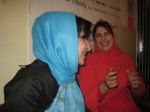 They discover more mistakes in the Dari flipcharts they prepared and giggle some more. I admire their resilience – they are pioneers for their sex. I ask a male colleague who has been observing with me, and occasionally translating, how big a barrier these women are trying to break through. He tells me proudly that having younger women teach older and senior males is OK in his department. It is quite an accomplishment considering that only a decade ago this would have been unthinkable.
I postpone going to the bathroom as long as I can because it is such a hassle. I am told that, in the entire central ministry of health, there are only a few bathrooms for women; one of them is across the hall from our basement training room but it is permanently occupied by women cooking on little stoves and men eating. One floor up are two stalls but these appear to be permanently locked. If you are lucky someone will find the key. It is attached to a rather yucky looking rag that is probably full of interesting bacteria. This time I find a bathroom on the third floor. It’s a very long walk across the building and three floors up. “This is our big problem,” say the young women who serve as my guide. Men don’t seem to need clean bathrooms, but we women do. There is clearly not yet a large enough constituency to demand such a change.


 Sylvia's Journal
0 Responses to “Men retreat, women advance”