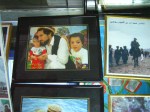
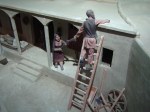

The provincial health director had arranged a private, behind the scenes, visit to the jihad museum that is not open to the public yet. The painters and model makers where still at work when we showed up after dark. But to me it looked ready for the public.
The entrance hall consists of display cases full of guns (Russian), more guns (British), landmines, grenades, etc. It so turned me off that it took much mental energy to follow the group as it stopped at every case. All the men (once again I was the only female) were fascinated with all the toys and were busy snapping pictures in spite of the signs forbidding this.
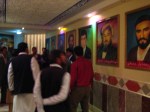
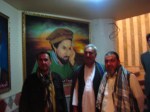
We were taken through a long hallway with bigger than life-sized portraits of all the commanders who had died at the hands of the Russians. They looked attractive, with soft features, but I know none of them were angels, especially if they decided you were their enemy, whatever the color of your uniform.
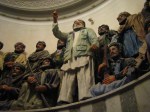
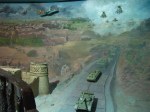
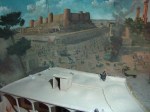
Suddenly a sound box was activated with the loud and grating sounds of bombing and fighting; it got louder as we emerged in an enormous domed space with a walkway at the bottom and a staircase to the top where you had a 360 degree view of the onslaught of war, its perpetrators and its victims.
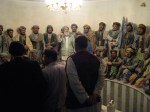
As we walked up the spiraling stair case 30 or so near life size figures of all the commanders crouched above us, led by Ismail Khan, the commander/warlord from here in whose office I sat earlier in the day. With an arm pointed forward he reminded me images I had seen as a child of Moses, leading his people to a better future that remains elusive.
All the men were having pictures taken off themselves in front of the havoc and destruction while I noticed how quickly I got de-sensitized to the battle field and battle noises around me. With my white veil-like scarf I looked rather incongruous in this testosterone-loaded environment, like an angel of some sort.
On another floor glas cases showed us postcards, military snapshots and official photos, even family snapshots, and pictures (sometimes Polaroid photos), dramatically arranged, of fighters in hospital beds with bandages or missing limbs.
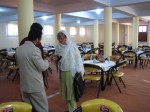
A side door took us into the museum’s resource center that was turned into a dining room with platters heaped with fruit (oranges, grapes, bananas, appled, figs) on the tables and dainty English style tea cups filled with green tea. All of this was arranged for us by the local shura, a traditional deliberative and decision making body.
By now my head was spinning with all the Dari I had been immersed in all day and my body was tired from everything. Still, the day was not over. After we said our thank yous and goodbyes we boarded our SUVs and drove up a dirt road that took us to the Thousand and One Night restaurant overlooking the brightly lit city of Herat. Another offering of friendship and support, although this one was paid for by us I suspect.
Raised platforms with carpets were lined up outside (too chilly) and inside; I was glad most of my companions decided to sit on chairs around a large table (my poor knees), although some preferred the traditional seating. Once more we were served a huge meal with much meat, rice and yoghurt; and once more everyone rattled along in Dari but now I gave up learning as I was too tired.
By the time we returned to the hotel it was nearly bedtime but there was more work to be done; USAID had asked us to translated the speeches from the governor, the minister and the health director which had all been given in Dari. I was called in to fix the English of the translators.
All of these impressions balled together into a vivid dream in which a man was ready to die until he had a reason to live again. In my dream I had something to do with his transformation. My calling here?


Recent Comments