Archive for January, 2010

Ingesting

The workweek started with a thousand big and small tasks swirling around my head. I am still trying to catch up on an entire work week missed while I was in Herat; from 300 virgin emails down to 75 and back up to 200. Sisyphus comes to mind.

The ministry is slowly coming out of its leadership transition limbo and things are moving again. The National Health Retreat, pushed onto the back burner until May is being pulled back to the front burner again, adding some intensity to our work. The cast of characters has changed rather substantively and I am wondering whether the painstaking process of setting the agenda was all for naught. But such is the process of capacity building and teaching about organizational process: it’s live! One step forward, two back. The good thing is that we are moving again; moving two steps back may be better than not moving at all.

We are going to try once again to start a senior leadership program with the new top team – another one of those steps forward that has to be retraced again with a new cast. I remember thinking we had a breakthrough when we finally sat down with the previous minister about the challenges of leadership at the top. That was in December. Now we are back to square one but this time I am addressing a she rather than a he and the new dynamics between key players hasn’t had a chance to set yet – the pudding is still soft and warm. Everything is possible, or is it?

Sara has started her last week of her assignment and is suddenly worried about the days flying by and there is so much to do – I sense some guilt mixed in about not being as productive as home office people are expected to be. But this is an orientation I tell her and it is part of the work – the pace, hectic as it may be, is different here, the deliverable always in flux. What was up one day is down the next and whole plans get scrapped when priorities change. We are but a small player in a large drama.

A cold spell has hit Kabul as if the winter finally realized it hadn’t done its job yet. The rabbit fur feet muffs that I had thrown into the container at the last minute are coming in handy. I was going to give them away but now I think I am holding on to them a little longer; I too work in a place that is all cement and heats poorly, especially the floor.

Axel is still teaching his young students every day, spinning Martin Luther King’s Dream speech into a long string of conversations about vision, responsibility, minority/majority conflicts, social abuses and what would you do if you were seeing injustice committed right in front of your eyes. He does this in an essentially unheated room coming home chilled to the bone.

And so I reminded him about weather and inappropriate clothing: it is time for long underwear, wool socks and lamb’s wool slippers. Here people seem to have a higher tolerance for the cold – in Dari you are not cold, you ingest it – because they are used to it during the long winter. In most houses only the essential places are heated (main room). We consider a bathroom essential but that’s one room that doesn’t to be heated anywhere except in our house where a visit to the bathroom makes you think you are in the Sahara desert at high noon.
Stuff

The weekend raced by so much faster than I had wanted. On Friday we went for our walk in Ghazi stadium because the snow and rain had turned the paths in the parks into mud. After our walk we made a quick visit to our furniture man on Chicken Street for some very focused shopping: a small table and a tray. I also discovered some lovely hand-woven upholstery fabric from Mazar-e-Sharif that I think I can turn into a a shalwar kameez.

We had lunch at the Wakhan café among a crowd of foreigners. I heard Dutch spoken in a corner and introduced myself to a young couple checking out various producers of the woolen wraps that men use as coats here. They think there is a market for those in Holland. For people with a nose for business there is a profit to be made by trading with Afghanistan.

Sara and I had ourselves dropped off at the Thai Spa in the Wazir Akbar Khan section of town for a delicious oil massage. We were oiled and pounded and stretched by two diminutive Thai ladies who explained their presence in cold and war-torn Kabul with the words ‘good money.’ A massage here pays about 4 times the price of a massage in Bangkok; yet for us it is a good deal: half the price of a US massage. Shiny from the baby oil we re-appeared one hour later and were taken home.

We tried out the new pasta maker which is much more fun to use with someone else than alone. We produced a great egg noodle which we consumed right away but also a bowl full for vermicelli-like pasta which we dried in the shape of bird’s nests.

On Saturday we all slept in late, had a chili omelet and went to work on a presentation that Sara will do on Sunday.

At noon time I accompanied Sara into town and dropped her off at a pricy French bistro for lunch with of friend of hers who escaped the US compound. I didn’t join them because I was looking for kapok and buttons for which I needed to go to the bazaar. I cannot do this alone but with a guard it is OK.

The guard took me deep into the bowels of the large Kabul bazaar in Jaday Maiwand which is the commercial center of Kabul. It was a treat beyond description to walk around the bazaar, practice my Dari and feast my eyes on all the stuff that is piled up in tiny little stalls for miles on end. I wished I could just amble around the enormous market without having to rush behind a guard who wanted to have his lunch break. Everything is for sale in the market if you search long enough. I could have spent the entire afternoon there.

I found one salesman who was willing to sell me a small plastic bag of cotton stuffing rather than the enormous bales of cotton that are used to make the traditional sitting/sleeping mattresses you find in Afghan homes. We had to go into a dark and clammy basement to find a pile of loose cotton stuffing that he was willing to sell to a stranger for a nice profit: a good deal for both of us.

Both Axel and I had our Dari classes in the afternoon which left very little time to relax and enjoy the final part of our weekend. Especially since at 6 PM the container that the movers had packed on the 30th of December in Manchester arrived on our doorstep and flooded our already full house with more stuff, some of which we missed and some we could probably have done well without: Axel’s new printers so we can print out pictures we take of people to give to them, coffee, winter boots, our wok and some other kitchen stuff that we now know could have been purchased here, and a good supply of books and videos. We are now officially settled with nothing left to be desired.

Touchdown

All of yesterday and today I had Carmen, Christi and Amy on my mind, my young colleagues who perished in the Kam Air flight from Herat on its way to Kabul. That was exactly five years ago.

So far we have had almost nonstop clear blue skies since I moved here but now it is suddenly winter, with cold temperatures and snow and a sky full of clouds.

Everyone here is thinking about that fateful trip and it was my luck to find myself in Herat wanting to go back to Kabul on a snowy day. While we were waiting at the airport in Herat we received calls from several people who were concerned about us coming back into Kabul given the inclement weather and the nasty memory of 5 years ago.

We were four in Herat, one booked on the Pamir flight and the rest of us on the UN flight. Contrary to expectations and track record, the Pamir flight arrived and left on time. All of us were asked to reconsider flying to Kabul.

We decided to wait for the incoming flight and see what the pilot had to say. In the meantime the Pamir flight left and landed safely an hour later. Our wait for the delayed UN flight felt a little bit like a wait at the dentist for a root canal treatment.

We decided to rely on the judgment of the UN flight pilot and his co-pilot – assuming, right or wrongly, that the call whether to fly to Kabul or not would not be lightly made. All the UN terminals are full of posters stressing that safety is their first and foremost concern.

And so we left about 3 hours late in a very small twin prop. All through the flight I tried not to think about the flight five years ago that followed the same route. To keep my head cool I concentrated on my knitting and knitted as if my life depended on it.

The flight at high altitude was smooth and easy. I wasn’t worried about the cruising part of the flight as the skies are clear and there are no mountain tops up there. But the moment we started to descent into total whiteness my knuckles turned white. My last experience of total whiteness, when leaving Kabul on April 10, 2008, came back with a vengeance. That was the flight that nearly ended badly as well on the side of one of the mountains surrounding Kabul. All the cells of my body remembered.

It took a long time before we cleared the clouds and I could see the ground. To my great relief I noticed that we had already passed the mountains and were in the ‘bowl’ that holds Kabul, with the landing strip in sight.

It’s funny how flying in weather that wasn’t even bad by US standards, doesn’t faze me at all back home but here it is different. I think there were a lot of al-hamdu-lillahs or whatever the equivalent is in the four or five language spoken by my fellow passengers when we touched down. It’s great to be back home in muddy Kabul!

Trim tab

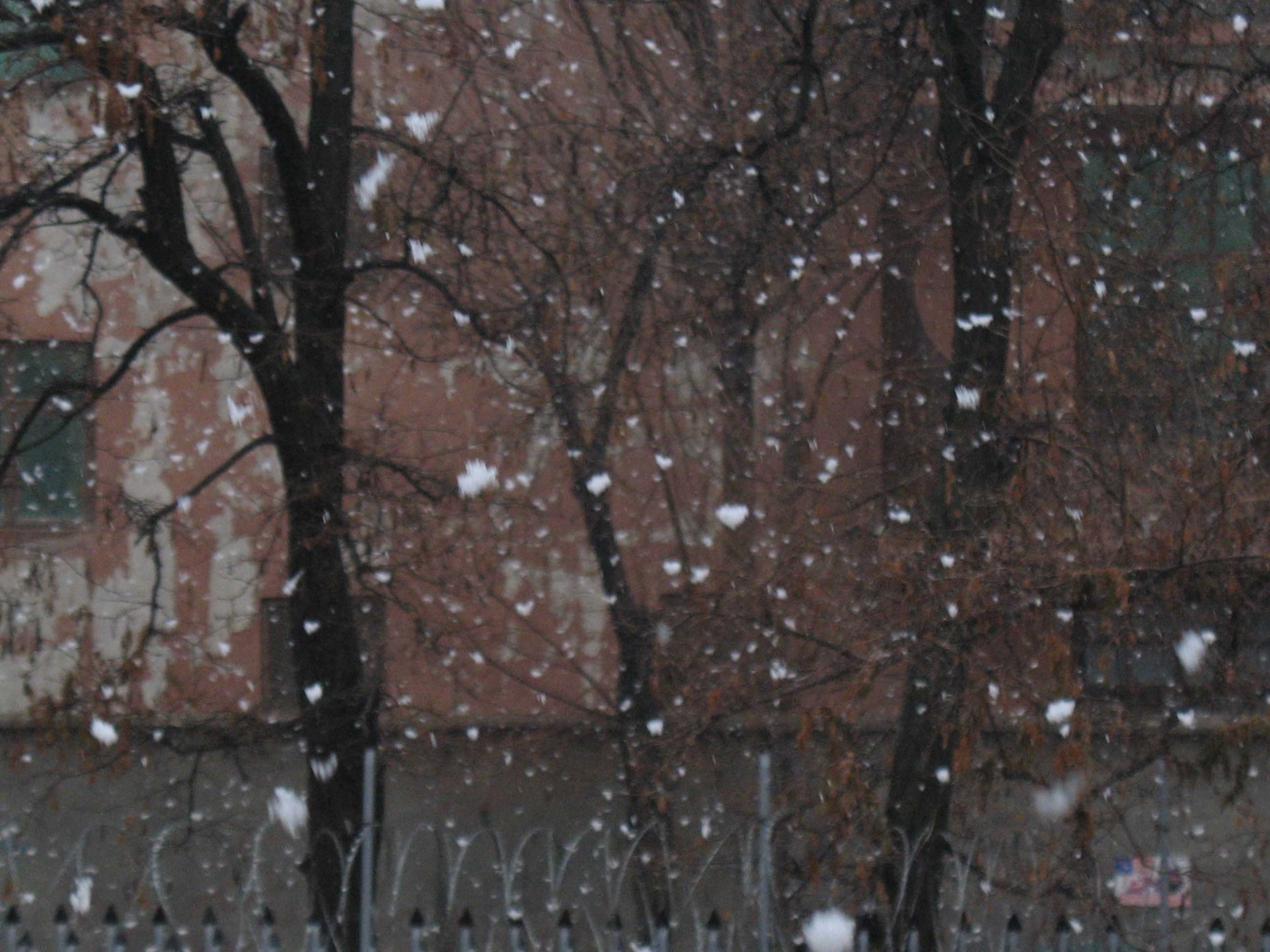
The predicted snow showed up in Kabul, not Herat. Axel took a picture out of our bathroom window (one of the few we can actually open on the mountains side), and concluded these were the biggest snowflakes he had ever seen.

I had another uncomfortable night under the 30 pound blanket and with the tiny sheets. In the morning I told the hotel management that this was the only hotel, over 3 dollar a night, I had ever stayed in where you had to make your own bed. I also requested to not replace my towel everyday which comes also wrapped in plastic with a tiny pink shampoo bottle that shay Ivan and a piece of soap that is wrapped in Chinese characters.

I explained that many hotels in the world are trying to be a little greener by not washing everything every day and I told them about the little cards that one finds in hotel bathrooms that say: towel on the ground means clean towel; towel on the rack means keep it another day.

They thanked me profusely for the feedback and promised they would take care of my requests. But when I returned to the hotel in the afternoon it appeared that only part of the message was received: They had left me my old towel (no new Ivan bottle or soap packet) and they also left me my tiny sheet which I found re-folded and put on top of the Chinese blanket. I got to make my bed by myself again. I gave up.

Our planned after action review got off to a very slow start today. Our guard noticed that with the provincial health chief called to Kabul yersterday afternoon for business everything became a little slack in the office. People showed up late (apparently a meeting by some other US funded agency that pays ‘sitting fees’ was more attractive), then they took about an hour to organize themselves to sit down, and just when everyone was seated someone reminded the group that someone’s nephew had died and they all got up again to offer the family their condolences. And so we didn’t start until about 20 minutes past 11 AM for the 2 hour session.

I used the waiting time to study my Dari lessons with our guard who kept given me the answers for the ‘fill in the blank’ exercises. This is how I was able to do my homework and have it instantly corrected as well. It was a very good use of my tiproductive morning.

While we waited I also learned more about how change comes to this country: very, very slowly. My colleagues sometimes get a little discouraged about how hard it is to change people’s work habits. I used the image of an oil tanker and how you can’t change its direction directly but have to use the trim tab and push it in the direction that seems counter intuitive.

Here the intuitive mode is changing people by punishing them for undesired behavior. The problem is that it doesn’t work because if you punish someone with connections (and everyone has connections) you can expect a phone call from someone more powerful than you who will remind you that you don’t have any power and please undo the punishment. Fear of consequences is what keeps things the same. This is what we, who are tasked to be change agents, are up against. And so I keep thinking ‘trim tab, trim tab, trim tab.’

Sober

My boss left at the end of the morning, after an inspiring speech that illustrated something about the kind of leadership we are encouraging: making a connection between the village women, men and children who need medical care and all the conceptual and analytical work, the planning and organizing that sometimes seems so remote from all that.

Sara left with him and both are now safely are back in Kabul. Part of me wanted to go with them but duty keeps me here. The intense Dari immersion continues but it’s not enough for me to follow closely the discussions and understand the reporting out. I couldn’t tell much about the quality of the reports and the underlying reasoning and so I kept quiet. I am always a few sentences behind when someone translates and few people can do this.

In between translations I did some house cleaning of my mailbox, reading stuff saved for later and tried to keep my feet warm by rubbing them under the table. While it is nice and warm outside, on this inside of this marble and stone building it is kind of clammy, a cold that gets in your bones.

Outside spring is not only in the air; new grass is covering the hills with a thin green veil and the gardeners were already busy preparing beds for planting. Still, snow is predicted for tomorrow.

I was asked to close the four day event with a final speech which I needed to improvise on the spot. Luckily, while one sentence was being translated I was able to think up my next sentence.

After lunch the participants in the event from the other provinces were taken on a tour of Herat and I joined the ride. We paid a visit to Ismael Khan’s Jihad museum that I had already visited last October, then by night.

Last time I had labeled it a monument that celebrated war but now I saw it differently as I watched the Afghans intently stare at scenes and speak in muted tones to one another. It is not an abstract thing for them and they recognize names and dates and faces. I kept wanting to ask them, where were you when all this was happening in Herat, but decided not to.

I kept looking at a small replica of a traditional village house where the roof had been blown in and the adult-size dolls were all crumpled under the debris while an infant was sleeping peacefully in its crib – a yaatim, I learned, an orphan. I calculated that the real life model for this baby would now be about 16 years old now. Would he be full of revenge or dead already?

We visited the site of the Jihad House high on the hill with its unwelcoming blue glass mirror windows (no entry) and surveyed what may have been a battle field. Driving back to the main road we passed much war debris: rusted tanks in various states of dismantlement.

At the main road we passed the Five Star Hotel where the US consulate had just settled in when a mortar destroyed part of the 4th and 5th floor. There is still a gaping hole. It is a miracle no one was killed, the mortar hit the staircase, right in between the guest rooms.

We visited two more sites, one a shrine of a famous poet, surrounded by white marble graves and another of a spiritual leader whose name I name I can’t remember. Next to the shrine, in its enclosed yard, is a gravel patch with a narrow marble slap.

Legend has it that if you place your head on the stone, pray, fold your arms, you will roll towards the edges of the flat surface as if you are rolling down a steep hill. Under loud and irreverent laughter several of our group tried this, most without success, until some elder called our party to order and all the doctors became quiet like a bunch of reprimanded boys in class.

They were living right up to the stereotype that western-clad and educated men are breaking with tradition and are doing things that are bad for Afghanistan. This tension runs like a deep fissure through this country.

At the second shrine several male and female beggars showed the really desperate side of this society. I usually don’t give money to beggars but the sight was so sorry I couldn’t stop the impulse. I was immediately reminded that the men were heroine users and would use my 10 Afs to by one fifth of their next hit. This is the dilemma of giving to beggar: you care enough so that you can’t say ‘I don’t care what they do with the money.’

Daylong Dari

We followed the visiting teams from the five other provinces (Jawzjan, Takhar, Badakhshan, Ghazni and Kabul) on their field trip to see how indicators for health services get collected and analyzed. Sara went with one group to a comprehensive health center (CHC) and I with the other to the District Hospital that is run by the Danish-Afghanistan Committee. Even if I had not known where the funding came from I could have figured it out from the small sketches of Copenhagen’s inner harbor and a rustic scene with a farmer.

Everywhere in the hospital I saw signs of our leadership program that has taken root here: it has led to team work where none existed before, joint and very systematic analyses of challenges and root causes and an abundance of graphs showing improvements over baselines taken months if not years ago.

I am told I am seeing some very successful students from the leadership program who have now become champions themselves. I watched the hospital director behave in ways that I don’t usually see in societies that are as hierarchical and gendered as Afghanistan. The director mostly listened and let his young female staff explain their vision, challenges and the graphs on the walls.

I used the time to sit with the women and ask what number baby they had in their arms – I can have such simple conversations in Dari now – and learned that many were baby number 2 (to women looking like small girls themselves) or baby nr. 9 or 10 to women who looked older than me but probably weren’t. I am now addressed as bibi-jon which is an endearing word for older women (dear granny). None believed I had no grandchildren.

One of these leadership champions, a young doctor working in another district was kidnapped two weeks ago and a ransom of 200.000 dollars demanded by the thugs who took him away from his family (under the guise of a medical emergency). About a year ago I handed this same doctor a poster which he had earned for his extraordinary work. Some people think that government officials are in on the plot – this is what President Karzai has to root out; but in the meantime there is the dilemma – nearby family want to pay of course as non payment may mean instant death. Who can afford this kind of money even in the US? And so family and friends go into debt from which there is no recovery. And payment of course means the crime gets repeated.

After lunch our guard Amidullah took Sara and me on a tour of Herat, first to the cistern that is an old architectural wonder with an enormous domed ceiling that has no support beams or anything like that – just bricks, each row slightly off center but not enough to collapse the dome.

After this we saw the gigantic minarets, 5 are still standing despite the many wars that have ravaged this city over hundreds of years. I couldn’t help consider these spires testimonials to the Y chromosome – they are rather phallic from a distance and still so close up.

While Sara went to see a colleague from her previous work life for dinner I joined a group of about 12 men, several of whom I didn’t know, all doctors, at the house of one of our Kabul staff who happened to attend to his sick mom. I was let in past the curtained off inner room to watch the cooking and preparation of the meal while mom was sitting coughing in a corner, another sick child near her and a bunch of sisters and wives were cooking a spectacular meal.

When the meal was served all the women scurried away, even sick grandma and I was once again with the men. We ate our meals in silence while watching a program about the production of Christmas ornaments somewhere in the US: blond women of a certain age delicately painting US Air force bomber planes on frosted glass balls with tiny paint brushes. When it was dessert time we were watching elephant polo in Nepal. I couldn’t have made it up if I had tried.

Sitting cross legged on thin mattresses for the duration of the meal is a bit of agony for me, especially when hemmed in by both sides. I was very grateful when the meal was over and we could return to the formal guest room with its western furniture. I watched with some jealousy how everyone, old and young, rose from their folded up position with great ease – I had to unfold myself very slowly and trying not to show any wincing. After that more tea, more nuts, more dried fruit and more Dari immersion until I anounced that my hard disk was full and I couolnd’t take in any more Dari. It was one very long Dari lesson today.

Sheet challenge

We always stay in the same hotel in Herat, a blue-glassed architectural-eyesore high rise that stands out in the neighborhood like a sore thumb. But the staff is nice and stable – each time I arrive here I see the same people and am greeted with more enthusiasm than the previous stay. We are practically old friends now.

The rooms are spacious and comfortable; now with the armoire I can actually hang my clothes. That the armoire is put right in front of the desk which has now become unusable is a minor irritation. It’s not that there weren’t any other places to put it and I try to imagine the reasoning that placed it in the most inconvenient spot.

The one thing that is a major irritation is the sheet arrangement. The bottom sheet of the bed is put on the mattress like a table cloth that is too small, it doesn’t cover the surface and edges of the mattress remain uncovered (who else slept on this I wondered). The sheet is more the size of a crib sheet than the full-size it should be. The rest of the bedding is do-it-yourself: a plastic bag on top of the bed has another sheet of the same size that therefore also cannot be tucked in. And finally there is the 15 kilo Chinese blanket that lies folded next to the plastic-wrapped top sheet at the foot of the bed.

Unlike the sheets, the blanket is made for a king size bed. It size and weight make it impossible to unfold with my one good arm as it is too heavy for my (still) injured and weak-muscled right arm. After trying for a while to spread the 15 kilo of dead weight over a slithering piece of cloth I gave up and slept in a jumble of mostly blanket and a little bit of sheet that’s always in the wrong place.

The label on the blanket says ‘handwash in warm water only’ and a stern warning to not dry clean. Given its dry weight I cannot imagine a human being hand washing this behemoth blanket (wringing not allowed luckily) and so I assume this blanket doesn’t get washed very much (this only bothers me the first night).

The pillow is another issue, a decorative affair with little things sewn around the edges that look like the ears on Halloween animal outfits. It too has only a sliver of a sheet wrapped around it by way of pillow case but ‘case’ is the wrong word as there is no encasing. Would they wash the decorative case after each use? I hate to ask because I can sort of predict the answer.

All of this is of course only a problem on the first night. After that I adapt and prove once more that we humans are, among many other things, endlessly adaptable and able to lower our standards if there are no obvious and immediate other options. It’s called accommodation, and probably a good thing.

Third time Herat

We left early for the airport, the UNAMA part of the airport, a separate small building that has its own entrance (please unload your weapons in this box), its own fleet of planes and its own tiny business center and canteen. If it was a commercial enterprise it would be broke by now but the Canadians and Japanese are keeping the fleet in the air and we help a bit by paying insanely high airfares, for extra safety and reliability.

Security at the airport was ratcheted up to a level I had not seen before. For the first time our car was not allowed to enter the airport grounds and Sara and I walk the distance that we are usually driven. We didn’t mind because we don’t get much of a chance to walk. We passed the women’s checkpoint where bored female employees watched a grainy TV screen, drinking tea and chatting.

They gave us a cursory pat down and resumed their talking. As we discovered later all this extra security was because the Afghan president was flying someplace (this also caused a three hour delay in our departure but we didn’t know that at the time).

We passed through the parking lot C that, as Sara noticed, doesn’t have any signs to say it is C. People just know, just as people know that behind it is parking lot B, also without signage. We walked through the small building with snack shops and coffee places (not like Starbucks, this is Nescafe land, there is no critical mass of demanding coffee drinkers here). Finally our office guard was blocked from further accompanying us and we were on our own until my boss joined us some time later.

We didn’t arrive in Herat until 2 PM even though the flight is barely 2 hours and we started our journey at 7:30 AM.

Sara may have expected people with guns trying to ambush us on the airport road (such things sometimes happen as Steve had told her not realizing that this kind of information makes people nervous). Instead we watched an entire planeload of new army recruits empty out of the airport – mostly young boys walking three abreast with nervous smiles on their facing. Each three-some was holding hands, while marching someplace in a slightly disorderly way as only new recruits can get away with, under the stern gaze of their trainers. It would have been cute if it wasn’t for the fact that they were about to be turned into men-in-uniforms-with-guns.

Our guard, who had flown ahead of us, waited for us at the airport and took us to the provincial health office, built by the Italian PRT (=military) and opened in October 2009 when I came here first.
This is my third visit to Herat since I arrived in Afghanistan at the end of September. My Dari lessons are paying off; I can follow a lot more than 2 months ago although I am still far away from participating in Dari. I am frantically thumbed through my Dari-English dictionary to find words (or rather sounds) that I heard repeatedly. That is how I discovered that ‘to choose’ in Dari is, literally, to make happy. Huh?

At the hotel I noticed that the rooms are now equipped with an armoire, a piece of furniture that had been missing on my previous trips – everything was hung on an elongated hat rack. Now I have hangers. They clearly do listen to their customers.

I thawed my frozen feet in the tiny bath tub and then watched Bollywood soap operas until dinner time. They are love dramas and some play out in halls that look like the Afghan wedding halls. Now I understand where the Afghan wedding hall fad comes from. The funny thing is that the Indian wedding hall is full of women and men together, the women rather exposed in comparison to their Afghan sisters (arms, midriff, ankles, neck, cleavage)

The attraction of feminism

Yesterday I bought a bouquet of fresh daffodils (from Jalalabad) and a video with cooking lessons in Persian, for our cook. The fresh flowers needed a vase and are now nicely settled into a Herat blue glass vase, drooping a bit, but still nice. The cooking video was pirated from a German show and dubbed in Farsi.

Sara and I watched lesson one of the cooking class: rosemary and garlic roasted lamb, braised carrots with carrot greens and thyme, and tiny leek-and-apple tarts. I noticed that all the ingredients and utensils needed for the meal are available. It was a good exercise from a language perspective and will be a good lesson for our cook from a quality-of-life perspective.

I started the day with a meeting with Douglas who works in the ministry and who I won’t get to see for a week to make sure everything is moving along well as we prepare for the potential impact of the new US Government AFPAK strategy that landed in our mailboxes yesterday. It feels like a tsunami coming our way.

Douglas left with Sara for a meeting with the military to educate them about how health services are delivered (through a grant project that is managed by the government with our assistance). While they were educating the ISAF folks I was educating myself further about the AFPAK strategy: ambitious and clean, sometimes a bit too clean knowing the messy reality of daily Afghan government life.

It was a beautiful day, spring like again, still no snow in sight, which made it possible to sit on the terrace without a coat (but otherwise well covered), preparing for my Dari class.

We had dinner with Razia Jan which I am now discovering is like a refueling visit. When I see too many men make dumb decisions or get embroiled in sandbox fights or think narrowly about their work, all I have to do is go to Razia’s house and meet the extraordinary women she collects around her.

I talked with one young woman who got an MBA in the US some years ago. She told me that in her life at work here in Kabul she thinks about the lessons from her leadership and OB classes more than any other of her MBA classes. I asked her why. She told me the consequences of not understanding OB and poor leadership are visible all around her.

Few people see the gender dynamics at work when the (few) women who hold professional positions try hard to avoid making mistakes, creating a whole series of non events, while the men (98% of all decision makers both in civil and military life) get away with making one bad judgment after another, poorly thought through decisions, cover their behinds and take silly risks; the damage of this is then either cleaned up by women or good men (this goes mostly unnoticed) or the day is saved by other men who then become heroes.

Escapade

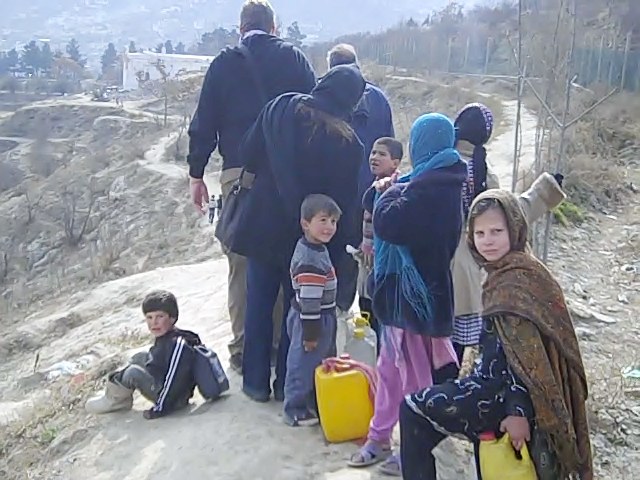
We went on our usual walk in Bagh-e-bala below the Intercontinental hotel. As we walked back Janneke spotted a hole in the fence and a path up the hill where a bunch of young girls and boys were carrying a variety of jugs with water. The older girl would gather as many jugs as she could, carry about 50 yards up the hill and then return to get another bunch that the smallest kids were not able to manage.

We picked up the jugs and took them to another hole in another fence all the while enjoying our escape into the wide open of Kabul. Our guard walked along and we would look at him each time we moved further away from the path as if to ask whether our jail break was OK.

But then finally the call came from our security folks that we had strayed too far and we marched obediently back to the main road. We ended our walk seeking out a different tea tent and settled on a carpeted platform to enjoy green tea and a snack that was fried and served in vinegar. It led to conversations about GI afflictions but some of us were too curious not to try. Now, many hours later, I can say that all is well and the snack was quite nice.

We had lunch at the Wakhan Cafe which serves the best espresso and macchiato in Kabul, nearly as good as the macchiato in Addis. It was a balmy winter day, more like spring, and so had out lunch outside in the withered garden.

On our way to the newly opened Kabul health club we stopped at one of the supermarkets that cater to the foreign community. Sara ran into a colleague from CRS who took her job in Bolivia before moving to Herat, right in front of the frozen meats, imagine that!

Right in the middle of the candy aisle I dropped a bottle of fish sauce which stank the place up so badly that the staff thought it a good idea to cover up the smell with room fresheners. The end result of this is best described as rotting fish in a perfume store. These odors mingled with the very strong chemicals from the painting that was done on the second floor – a nasty cocktail of chemicals that gave me an instant headache.

We never found the Kabul health club. Because it expects to cater to the well-heeled foreign community it is trying to fly so far under the radar that we couldn’t find it.

After introducing Sara to Chicken Street we returned home with a bunch of daffodils, green peppers for our chili omelet tomorrow and a bag full of eggs. Back home it was time for Dari homework (write down your daily routines in Dari), learning the vocabulary words for lesson 9. The reward for all this studying was watching Seinfeld for the remainder of the evening. It was a good Friday! No bombs, no explosions, no kidnappings.


January 2010
M T W T F S S
 123
45678910
11121314151617
18192021222324
25262728293031

Categories

Blog Stats

  • 136,984 hits

Enter your email address to follow this blog and receive notifications of new posts by email.

Join 76 other subscribers