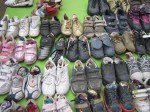
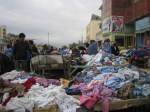
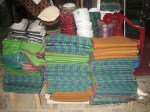
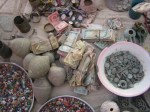
A good part of the market is taken up by merchants in second-hand (European/US) clothing and shoes. After that came the market for shiny women’s textiles before the bazar where men get their ‘Karzai’ coats, their woolen wraps, their hats, their scarves, their long Arabic dresses, and Punjabi outfits; less shiny than the women but exotic nevertheless.
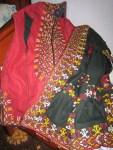
I wanted to bring back one or two of the Turkmen embroidered ‘chapans, stiff coats with long sleeves that have more of a ceremonial function than having arms in them.’ The Turkmen embroidery is the most striking part of the wedding dress that Sita bought in Lebanon. I had some fantasy of cutting one up and making a matching tie for the groom.
Our hosts led me to a shop that had what I was looking for, hundreds of them, stashed away between thousands of other exquisitely embroidered pieces of clothing and bedding. It was hard to choose from the collection. I don’t think I could ever put scissors into these coats to turn them into something else, least of all a tie.
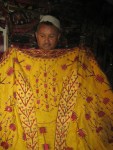
When the shopkeeper indicated that one of the coats was 8000 my colleagues asked, Afghanis or dollars, jokingly [8000 Afghanis is about 160 dollars – 8000 dollars is 8000 dollars]. The shopkeeper told us he actually had an 8000 dollar chapan. Everyone wanted to see it. He climbed on a rickety stair and pulled something wrapped in Ikat cloth from a pile of nondescript items. He unwrapped it as if it was a newborn baby. Inside was coat in perfect condition with the finest embroidery on yellow silk. The manufacturing date was embroidered at the bottom: 1915. The museum quality coat was made for and worn by an Uzbeki Prime Commandar nearly 100 years ago. We let him wrap his treasure up and put it back where it was waiting for the day that someone would gladly pay those 8000 dollars.


0 Responses to “Treasure”