Archive for February, 2011

Inch work

On paper, or even in conversation sitting around a table, things always appear more clear cut or obvious than in real life, once the paper is read and the chairs have been pushed back for action. I find myself annoyed with little progress by this person or that person. But then, when I sit when them and talk the complexity of what we are trying to do here emerges in full bloom.

With the new USAID strategy of letting the Afghan government (as if it was one person) decide how to spend the US government contributions to the development of the country, we may solve the problem of ‘imposed’ initiatives and ideas. But what we end up with may not be the kind of initiatives that are badly needed, or services for the people without voice (usually women and children). We don’t know this yet but it is possible.

I talked with one of my colleagues about the little progress that has happened in some of the departments we are working with and expressed my impatience. He responded something like this, “well, we have moved a few inches. If we hadn’t tried we wouldn’t have moved at all.” I was wondering whether I should count my blessings and be grateful for those few inches or fire someone for having produced too little.

There is a time horizon that we are beholden to that assumes that significant results can be achieved in one year intervals and that each interval’s result adds up to the next and will eventually produce the massive transformations we are after in this country where a significant part of the population is still dwelling in the habits of the Middle Ages.

I couldn’t go to the children’s hospital today because Afghanistan’s president was either coming from or going to the airport. With his enormous cavalcade of dignitaries and men with rifles, such movements always leave the center of the city in a complete state of paralysis. And so I stayed in my office and watched the (wet) snow come down all day long while wondering whether we will get this pediatric triage business going to the point of a routine in a month’s time or not.

Once again my mood fluctuates between joyously recognizing the victory of progress measured in inches and the feeling of despair that sometimes wells up in me when the end result is so very far away in the distance.

Old and new brains

Today I did little from my to do list and much impromptu coaching, something I like to do – mentoring younger staff how to be more effective in their jobs.

We worked on the upcoming leadership program for the midwives. Going over the facilitation notes, line by line, I helped M and S get ready for their facilitation task in this second of four workshops that will take place next week. It is the most challenging workshop to lead. They are throwing themselves enthusiastically into the deep end of the facilitator pool while I will be cheering them on from the sidelines, trying to understand as much of the Dari as I can, dictionary in hand. Brainy work for all of us.

Later in the day, with some other staff, we strategized how to contain the ripples of a confrontation inside one of the general directorates that we work with. We are getting mixed up in internal disagreements about procedures that make it hard for us to get our work done.

And then there was a textbook case of an email sequence that had spun out of control leaving people angry and undermining the very thing the people sending the emails had hoped to accomplish. It was full of examples of imprecise language, various interpretations of the same text and examples of the reptilian brain trumping more rational thought that would have considered consequences of actions.

I have seen a few examples over my 17 months here of reptilian brains in action at very close range (and further afield in daily newscasts, both here in Afghanistan and in the Arab rage countries). I explained to B how to recognize the tell tale signs of the reptile, the increased heart rate, the sweaty palms, the urge to fight or flee, so that next time she can recognize them and push decision making back to where it belongs in the frontal lobe. Maybe it’s time for a staff session on emotional intelligence.

Cross

I am progressing, four strands at a time, with my Quaker sampler. I dream of cross-stitching at night. It is good relaxation, combined with listening to the machinations of Cleopatra and her besotted Antony in an otherwise far from relaxed place.

While I was eating my French toast this morning two rockets were fired on parts of Kabul that are far from our home. Still, they did put an end to our plan to go for a walk in Bagh-e-Bala. Too bad as it was one of those beautiful crisp winter days with the snow glittering on the, for once visible, mountains around Kabul and a sense of spring coming.

Saturday is one of my two Dari class days. I got the time wrong and ended up studying Dari for three full hours. My teacher had brought a newspaper. I read and translated two articles; one about 16 female police officers graduating in Balkh and the other about a traffic accident in Herat that included a Mazda truck (the word for truck is ‘barbari’) and a Toyata Linux and landed three people from an NGO in the international forces hospital at the airport. The exercise added to my growing vocabulary; new words that will help me understand radio and TV news as well.

My colleague AB showed up with a plastic bag holding a bottle of Russian water. This is quite extraordinary as people here rarely show up with plastic bags that contain adult beverages. As luck had it, we had just finished our Russian water yesterday and were able, once again, to enjoy a very special pre-dinner cocktail.

Axel cooked dinner (well, not really cooking but warming up in the microwave). This elicited many comments from our male Dari teachers. We are finishing the last leftovers of the feast we had on Thursday while watching the next installment of the Arabs being very cross with their leaders.

Pleasing the foreigners

We have become creatures of habit here. After our usual Friday chili omelet the driver and guard came to pick me up for my Friday massage. ‘Message’ they call it (while many Afghans spell message as ‘massage’). Lisa cut my hair, very short, more or less according to something she had seen in a magazine. The haircut should last me for a good while.

After the haircut came the massage, by Lisa’s trainee, 20 year old A. who is starting to get the hang of it. She is the same girl who peeled some skin of Janneke’s middle toe some months ago that saw us rushing to the clinic with unstoppable bleeding. Janneke got a professional bandage and a tetanus shot. I trust A. with the massage but not with a pedicure.

Andreas came by on the way to the airport to go over the various forms, checklists and reports that should help us make sure the hospital continues with the triage in the outpatient department and start the one in the emergency ward. The challenge is to keep the staff from dropping the effort now that the consultant has left.

We fear that if they stop now and lose the momentum we will never get to the vision they drew a week ago. But maybe that wasn’t their vision, just what they thought was the vision we wanted, politely pleasing of the foreigners.

Although the refrigerator was full of food we cooked a Thai/Indonesian meal, a slightly modified Pad Thai and Tahu Goreng with the tofu we picked up at the Korean restaurant last week and the bean sprouts that have been sprouting for the last 5 days and were about to turn brown.

We called our tax lawyer in DC to get some advice on filing taxes and what to do and where to hang out after we leave Afghanistan. We will owe a considerable amount of money to the IRS if we go straight home and so the idea of hanging out in Holland for awhile may not be a bad idea.

Extra work

The day started rather discouraging. Towards the end of a debrief by our emergency pediatric triage and treatment consultant, when we thought the work to be done was clear and everyone took responsibility for their role in continuing to improve the triage processes after the consultant has left, the chief surgeon extended his hand to us asking what incentives we would give the doctors for doing this extra [sic] work. While the consultant and I were rather turned off by this request, my Afghan colleagues think little of it and consider it normal in a place that is overrun by projects that need to be sold to the project implementers. “Why not try?” they reason.

It was thus quite fitting that the rest of the day we helped our funders think through a new and urgent policy directive from top US government administrators on how we can shift US assistance from off-budget to on-budget. We had never heard of this new terminology a month ago. On-budget means that the US monies go to the ministry of finance and from there to line ministries, in our case the ministry of public health. Off-budget refers to the current arrangement where contractors, like MSH, get some of this money and produce deliverables according to an approved workplan.

The main assumption behind this shift in the channeling of foreign assistance monies is that on-budget would mean the government is in charge of deciding on what projects or systems strengthening initiatives the money is spent. This should end the current practice of donors pushing projects on uninterested implementers who then put out their hands for incentives.

It may seem a simple shift from off- to on-budget but it is hugely complex with countless moving parts, many assumptions about how decisions are made and processes and procedures being in place to guarantee both performance and transparency. The big idea is accepted but the implementation of it is far from being worked out and will, in the meantime, signify a lot of extra work for a lot of people.

If it works, which may not be clear until many years from now, it will change the discourse on development assistance; if it doesn’t it might be difficult to admit. It is a huge gamble but the current US foreign assistance leadership is emphasizing the word risk. What sort of risk is acceptable and what is not will emerge later when we see how people are punished (or not) for failure.

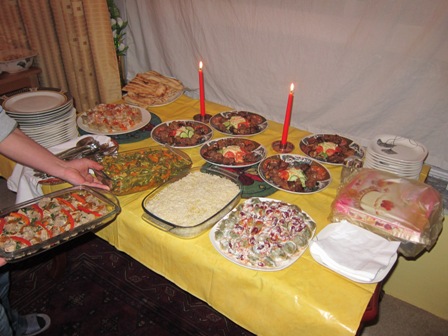
We celebrated the end of this long and difficult work week with an Afghan feast prepared for us (a lot of extra work) by our cook and housekeeper who stayed overnight with the guards after leaving everything spotless as if nothing happened. We had an assortment of friends, nationalities and professions in our house, a few escapees from the US bubble, colleagues, consultants, new arrivals and old timers. It was a joyful gathering that reminded me of everything that is good here (and worth at least some of the extra work).

Missing Cleopatra

Our elliptical exercise machine needs to be serviced. It groans and creaks so much that I have stopped using it. This means that I have had to change my early morning routine of a 30 minute walk during which I listen to books on tape. There is really no other time of the day for me to listen to a book. As a result I have no idea what Antony and Cleopatra are up to. She had just manipulated him in given her some choice pieces of real estate around the Mediterranean.

Instead of my walk I am now doing yoga. Yoga and Cleopatra don’t go well together as she interrupts the relaxed breathing. The yoga is giving my very tight muscles a good workout. Living in our restricted ecosystem some muscles are not being exercised at all.

As I usually do on Wednesdays, I try to go to one of the consultative forums where developments, strategies, policies, research related to the ministry’s mandate are being reviewed, praised or criticized. This morning I learned, only partially understanding the local language presentation, about acute severe maternal morbidity and whether these women, who by a stroke of luck, avoided death in childbirth, are more or less likely to use contraception. As it turned out it was not the nearly dying that led to contraceptive use but whether the child born before the current calamity survived. If it did women were more likely to avoid another pregnancy; if it didn’t they were not. Not all that surprising.

A very interesting review of the current situation of the country’s blood transfusion services showed how much work is to be done especially in the private sector. It is at the moment entirely unregulated, with poor or no records of where the blood comes from and who gets it. A frightening number of establishments use either expired test kits or no tests at all to detect transfusion transmitted infections like HIV, syphilis, and hepatitis. We all looked at each other and hoped we would never need a blood transfusion.

It was another long day with a phone call with Boston. The compromise is for our colleagues in the US to start early and for us to stay late. We are looking forward to day light savings time when we are an hour closer to each other making the compromise less taxing for each side.

Feasts

We are organizing a dinner party on Thursday. It got a little out of hand. We started with 3 people and now there are 15 plus or take a few invited. Instead of cooking ourselves we gave the cook some extra money and asked him to prepare an Afghan food fest. We also asked him to stay so the kitchen will be clean when the last guest leaves the house. I like that idea.

I am told that local cooks like to be present when the guests rave about their food. It is a matter of professional pride and advertising for when the current employer leaves (foreigners nearly always leave) and a new employer is needed. He would want people to say, remember that great meal he cooked at Axel’s and Sylvia’s back in February?

Today Alison arrived from our Washington office with a Christmas package from Tessa, a pile of books for my girls’ book club (Three cups of tea) and an embroidery ring to stretch my Quaker sampler fabric so I can see the threads more clearly and save my eyes from going bad.

In the Christmas package, aside from various drugs to preserve our health, was a book for Axel about famous’ people’s lists. Axel is a list person and so is Tessa so it was a fitting present. For me there were lovely green sea-glass earrings which immediately made me homesick – glass from down by the beach that is so very far away from here. A final suprise was the, to us unknown, Australian TV series (mockumentary) about a high school – 16 episodes no less. We will invite our Australian colleagues for a viewing and, I presume, a good laugh.

For dinner we met Razia jan at the local Korean restaurant. She is off to the US soon for a whole slew of fundraisers for her girls school just outside Kabul. The money raised will buy more school books and allow the school to extend its reach into grade seven.

Things nearby are looking better again even though elsewhere in Afghanistan really bad things are happening and many people are killed or maimed by desperate Taliban & cronies – it is as if the summer killing season has an early start.

If only…

Sometimes my teaching about management and leadership takes on forms that are not in my workplan or in a formal training. Today the emphasis was on inspiring and being inspired, on aligning and mobilizing rather than implementing. The emphasis has been so much on results and implementing that the actual leadership work fell by the wayside, draining me, or, rather, not supplying me with the necessary energy to break through the multiple obstacles that surround us here.

Like for instance when the agreement reached yesterday about breaking through logjams and getting the licenses we need to import the controlled substances was nixed by a lower level person who keeps on singing the same obstructionist tune. How that is possible is something I cannot understand (but imagine).

M and S had lunch together and we talked about makes it hard for them to keep their heads up. I explained what assertiveness by drawing an imaginary picture of ‘standing one’s ground,’ drawing the line that indicates this is mine (my right, my responsibility, my concern, my voice).

In the afternoon we joined with others, some men of influence and authority, to be inspired, once again, by the urban renewal project of the Turquoise Mountain Foundation in Murad Khani. This time the clinic was finished. Last time, in the fall, it was still a construction site, and the craftsmen had not yet moved into the complex, the woodcarvers, the jewelers, the ceramic tile makers, the calligraphers. Now we caught the students hard at work, supervised by their masters, as in an old fashioned guild. I think we all left the site thinking that there is hope for Afghanistan, if only…

Thaw

Despite the cold and remaining snow there was a faint smell of spring today, a thawing and greening that surprised me just when I thought we had gone back to winter. There is still snow on the ground and the white mountains surrounding us are beautiful but the gardeners uncovered tiny little rose bushes (rose babies he called them).

The 4 inch rose stalk sticks that they had put in the heavy clay ground next to our office last fall, in a sheltered sunny spot, then covered with plastic, have sprouted leaves. They have clearly done this before, opening the jerry-rigged greenhouse exactly at the right time and raising the plastic cover by a few inches to give the baby leaves more room.

I had lunch with M’s kids in the day care center, along with the other kids sitting around a plastic table cloth eating their lunch of rice and potatoes with a few small chunks of fatty meat. The youngest child is Suleiman, now 5 months old who was waiting patiently for his meal that required the presence of his mom, who promptly joined us for his and her lunch.

M’s oldest son read me from his notebook, packed in a plastic Sponge Bob case that Qatar airlines had given him. He had drawn a few pictures in his notebook: one of the river Nile (a bright blue blotch that I thought was the view from the airplane), a fish (they ate) and a crocodile (they saw) plus the MC initials that stood for McDonald, possibly the biggest treat of his stay in Egypt (‘Kabul should have one,’ he noted).

He wrote about their trip to Abu Simbel (boring and tiresome), a fight with his brother (quickly made up), his mother’s headache and a trip to the souvenir bazaar. He also wrote about the four-star tourist hotel with its tasty breakfasts. He did not write that the hotel quickly emptied as the revolution took on steam further north.

After lunch we pulled rank. In order to solve a 9 months old attempt to obtain a license from the government to import pharmaceuticals on the controlled substances list (for mental health and trauma care) I went with my drug unit program manager to the ministry. Exasperated because of endless petty requests and having to do letters over and over, and continuing to be strung along, we jumped to the near top of the hierarchy and brought our funder along. Most of the meeting was conducted in Dari but I got the gist as body language revealed quickly that our decision had paid off. A rush of phone calls should get this resolved quickly although when I asked, in my best Dari whether the issue had been resolved it was met with an ‘incha’llah.’

Back in the office I welcomed Bill back to Afghanistan, one of our frequent consultants who has become a good friend, and then attended an excellent presentation about drug management by staff from that unit. We ran out of time but the discussion was fascinating and I learned more about this topic I knew nothing about two years ago.

Our snowman, on whom I have projected all the bad happenings of the last few weeks, is melting and nothing more than a 1 meter tall blob, revealing around him grass that is turning a little greener each day.

But the blob holds still some very bad things. We think R. may be on her way to safety, out of this country, as I write this; but the shelters are still under attack. Please click on this link to sign a petition to the government and forward it to others. We need to mobilize an angry outcry to stop the Afghan government in its tracks, to make it realize that its plans are bad for women. We do have some leverage after all with all our tax monies streaming into this country.

Visions of spring and other things

We should be turning to spring, in fact one of my colleagues, returning from Konar province, said everything is starting to get green and the sun is warm. But here in Kabul we appear to be turning to winter. The snow that fell last week is still on the streets and the temperatures are dipping down. We have gotten into the habit of putting our night clothes on top of the electric mattress heaters so that when it is time to turn in, both our sheets and our jammies are warm. We just have to remember to turn the switch on at 6 PM.

This morning we had a two hour conversation about the emergency triage and treatment of kids that are brought into the Indira Ghandi hospital. It was a fascinating exercise that revealed all the moving pieces that need to be managed, controlled, and improved before it can become a learning center for other hospitals.

There is the physical layout and the patient flow, the staffing, the procedure rooms, the records and registration process, the drug and consumables supply, the training materials and much more. People may talk lightly about creating a learning center but this morning revealed how complex the enterprise is. Nothing can be forgotten because everything is connected to everything although not everything is urgent right now.

Two small groups sat around a large piece of white paper with markers to draw their vision. I tried to have them anchor their discussions about what to do now in a picture of what is to be in the future. We didn’t entirely complete the task as most of the discussions focused on the physical layout and patient flow, who does what where and some on the training, but it was a good start.

It also served as a diagnostic for Andreas’ who is here, only this week, to help push the process along. I am glad he was there as there is very little I know about emergency pediatric care and I have therefore no credibility when there is a choice of options. All I can do is asking dumb questions.

Afterward we had lunch in the hospital director’s office followed by a tour that followed the patient flow. I only got to see the start of it as Saturday is my Dari class and I try not to cancel it except under duress.

I finished reading a text, in Dari, about Ibn Battuta, a contemporary of Marco Polo who, I learned, travelled 120000 kilometers, from China to Spain to Timbouktou and finally settled in Fez. During my last few years at MSH headquarters I flew that number of kilometers in a year.

Emboldened by yesterday’s barbecue experience Axel is grilling a steak, his first time I believe. We are having it together with home fries and a thick potato/leek soup that has some likeness to traditional Dutch pea soup, without the bacon and trotters of course.


February 2011
M T W T F S S
 123456
78910111213
14151617181920
21222324252627
28  

Categories

Blog Stats

  • 136,984 hits

Enter your email address to follow this blog and receive notifications of new posts by email.

Join 76 other subscribers