Archive for the 'Kabul' Category


Fruits and guns

I sacrificed half of my day off to attend a meeting in the EC container. When I first heard the venue of the meeting I laughed, the EC container? What’s that? But here plenty of people live and work in containers, practically all US government employees, if not all.

The European Commission solved the problem of space for its advisors to the ministry of health by placing two containers, one on top of the other, in the inner courtyard of the ministry. There is a small conference room, a bunch of cubicles and a kitchen. That’s where we met.

It was my first participation in a working group meeting. For once I was not the only woman. We sat next to each other to make it look as if there were more of us. The meeting was a little fluid with no clearly identified outcome other than a ‘meeting of the minds,’ and no hard time boundaries. As a result we drifted past the official ending time of the ministry’s workday. I could tell because the government employees were checking their watches. Steve and I never need to check our watches as there are no time boundaries for us. And for lunch and dinner we simply listen to our bellies.

On our way home today we inched our way through the dense traffic, made denser by multiple roadblocks put up in case of irregularities that were predicted after the election results announcement. But it never came, postponed once more, for the fifth time. I gather Karzai and Abdullah are not ready to shake hands despite the pressure from all the heavyweights in the world.

One of our consultants made the mistake of taking a picture of the red-bereted elite troops in the center of town. This angered one of the soldiers so much that he started pounding the car window where the consultant was sitting and shouting at the top of his lungs, attracting more shouting from other men with guns. It was a little frightening. We were pulled over and our driver and guard jumped out to calm the soldier with the frayed nerves and the gun. The drama lasted only a few minutes and ended with the promise that the picture would be deleted. That was actually funny because no one checked if the picture got deleted. This is different from the olden days when they would have demanded the camera and ripped out the film.

Back home we indulged in another one of the wonderful meals that our cook prepares for us. It was followed by the sweetest and juiciest pomegranates and melons I have ever had, complemented by Peet’s coffee, Iranian dates and the Indian sweets dripping with honey that we bought yesterday on Flower street.

The evening temperatures are dropping fast and the daytime – night time difference is nearly 40 degrees Fahrenheit: 75 degrees at midday and just above freezing at night. The down puff I brought along in September is coming in handy now. Leaving my warm nest in the morning is a little bit more challenging each day.

The weekend is now over. It wasn’t much of a weekend as I took care of the last assignments of my previous job which I cannot possibly handle during my workweek here. On the side I am writing a chapter for a book about third-culture-kids (TCKs) authored by the wife of our organization’s president. It’s not much of a sacrifice because I love this kind of writing.
Eating tea

No alarm this morning. I slept in until 7 AM. It was another one of those glorious Kabul mornings, the kind that make you want to sit outside and have breakfast in the sun. I have to wait a few more weeks for that but the rehabilitation of our house (khana si-o-seh or guesthouse 33) is progressing according to schedule.

The hiring of staff is in process. I have asked that each of the cooks who have applied for the job prepare a sample meal next week in our guesthouse for its five current occupants, one vegetarian, one carnivore and three omnivores, so I think it will be a good test. It would be nice if he can prepare sushi but Afghan food would be fine too.

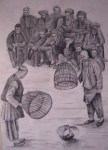
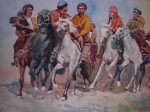
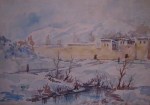
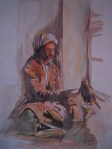
In the meantime I have bought some local art to put on my bare office walls. I spotted some lovely pencil and watercolor drawings in a rack in the back of a small dusty bookstore on Flower street during our weekly outing into town where I also found Dupree’s famous book on Afghanistan, a well used and somewhat dirty copy that will do the trick as a reference.

While Greg and Steve went on their weekly carpet hunt on and off Chicken Street, I went with Naranjan, an Indian colleague who is staying with us, for a stroll beyond the carpet and knick-knack stores to a more ordinary street with small grocery stores and shops that sell ordinary household goods.

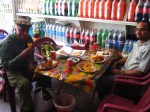
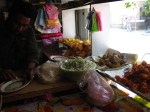
In between the shops we spotted a window filled with pakoras, small deep-fried beignets with potato and spinach filling. Naranjan is a vegetarian while the other housemates of us are carnivores and so this was his chance. Together with Abdul Ahab who is there to guard is, we filled our plates with all the pakoras and something like potato latkes. I generously offered to pay for everyone; combined with 3 cokes the bill came to 3 dollars and 60 cents.

My Dari teacher showed up late for our first lesson because he works with an organization that had one of their cars taken into custody by the policy somewhere in the north and his services were required to ‘solve the situation’ as it was referred to. Eventually he arrived and we had an hour and a half lesson working on verbs, pronunciation and numbers. I learned, among other things, that here people ‘eat’ tea rather than drink it. Maybe it is because of the chewy candies that are such an integral part of the tea consumption.

He gave me much homework that includes declinations of at least 15 verbs, the numbers I was tripping over and, if I get all that done before Tuesday, also a writing assignment. We are tackling talking, reading and writing all at the same time.

The answer to tea

This morning at 6 AM or so the tens of thousands of doses of seasonal flu vaccine arrived at Kabul airport. Only very few people know what an enormous accomplishment that is. People have given up their private lives and sleep for the last few weeks to make sure that Afghan hajjis are not turned back upon their arrival in Saudi Arabia, a scenario that has given some people here nightmares.

Kabul, and probably all of Afghanistan, is spinning with rumors about the election results that were supposed to be announced today but apparently delayed till Saturday. It is strange to live in a place where rumors take the place of the traditional media. I have yet to see an Afghan read a newspaper or hold a transistor close to his ear. This stands in such sharp contrast to Africa where everyone has at least 2 if not more newspapers under his arm in the morning and even in the most remote areas you will see men listening to tiny transistor radios held together with elastic bands.

We get our news from the BBC. There is a TV in the house across the yard but I rarely watch and most of the time I cannot figure out how to use the three remotes. Instead of finding a news channel I may chance upon some slightly naughty programs that show a little bit more of the female body than is usually accepted. I do have a TV, given to me in custody by Brad who has left the country for North Dakota or some other faraway place. It is sitting in his old room at guesthouse number 26 and waiting till we move into the new guesthouse 33 – a few weeks from now. In the meantime the only remaining source of news is the internet. But I spend enough time sitting at my computer as it is.

I finally figured out why there are saucers with small wrapped chewy candies everywhere. Now I understand why tea is never served with sugar, unlike elsewhere in this part of the world. The tea is supposed to be consumed at the same time as the candy which then sweetens the drink. Oblivious to this, I have been eating the candy without the tea. Related to tea, I learned today that the Dari word for tea is, literally translated, ‘the answer to tea.’

In what others thought was a moment of impaired judgment I volunteered to coordinate the annual report production process together with a colleague in Boston who was supposed to be with us here but cancelled after the Indian Embassy bombing. These processes have been a little traumatic in the past which I think has something to do with a very imperfect understanding of Word’s formatting potential as well as English. During those periods everyone is underemployed: countless doctors doctoring documents, ad nauseam. One of the pieces of my vision for this job is to help make the planning and reporting processes if not joyous then at least occasions for reflection and learning. This is my chance.

Grappling

On the way back from our weekly meeting at the US gated community I noticed several SUVs with ski racks. That struck me as odd. But when I asked my Afghan colleagues it turned out that people used to ski in Afghanistan, at the Salang Pass. In fact, when my housemate Steve got married here in 1977, MSH gave the couple skis as a wedding present. Skiing now would be a bit risky because of all the mines. So, no skiing this winter, unless of course we choose to go to Dubai and ski on the ski slope in the shopping center.

The consultant floodgates have opened and I now watch the stream from the other side of the table. Consultants want to meet, and should meet of course. Between counterparts, funders and consultants, most of my office hours seem now to be spent in meetings, some short and sweet, others long, at times arduous and occasionally difficult. There is much more ‘grappling’ at this level with complex issues that have no simple solutions and have consequences for many more people. This is the reality of being in a senior leadership position. Although I always knew this intellectually, living it is something else. The flipside is that I have staff who can do things for me, a luxury I enjoy.

The entire day we ran our meetings past their ending time. Time boundaries here are very elastic, more than the rigid time keeper that I am is used too. But everyone is very accommodating, partially because there is always the excuse of the traffic jam. Here traffic jams are the same as everywhere else in the world and then a little worse because of shifting military or police presences. Whenever high level people with their enormous security contingents move around town everyone stands still. Sometimes whole roads are blocked off because of a conference or meetings. On some streets our green car plates give us special privileges that ordinary white number-plated cars don’t have. Still, I sometimes wished that I could take taxis and explore the city streets on my own, stopping whenever and wherever I wanted.

I use the time I spent in traffic to learn Dari or practice the names of drivers when I am the only passenger. When I travel with a bunch of Afghan colleagues I learn about the jokes that Afghans from one province make about another province, like Wardakis about Konaris. These are very much like the jokes that the Dutch make about the Belgians or vice versa. That alone would be a good reason to learn the local language. There is much joy in those moments.

Surprise

Last night I was invited by Sabina from Germany who is a radio reporter based in Delhi. She travels all over Afghanistan, essentially alone, unfazed but veiled whenever in public (like most of us Western women).

She stays in a guesthouse in Shari Nao that is not recognizable from the street. Rooms surround a lovely garden and are luxurious and costly, at 124 dollars a night. Dinner is not as luxurious but costly as well. The menu includes much British comfort food such as steak and kidney pie, sheppard pie in addition to pizza, pasta and a few Afghan dishes. There is wine and beer which makes it a favorite foreigner hangout. A very English looking pub is in the basement including darts and a big screen for cricket games.

When I ate the grapes last week that were washed under the garden hose I probably ingested something else with the grapes that nestled inside my intestines. Today I asked for a consultation with my boss and watched local prescribing practices. He checked my pulse and asked if I had a fever. When I said no he wrote a prescription on a Post-It note: 1+1+1 Flagyl – 20, gave it to me and sent me to the deputy director for provincial capacity building. I don’t know why, but the man was prepared, asked me for 50 Afs (1 dollar), made a phone call and about 10 minutes later one of the office housekeepers showed up with a small plastic bag with 2 strips of 10 pills each. The provincial doctor checked the strips for tinkering and approved them as authentic Flagyls. That’s how these things work. Easy.

For lunch the boss had invited us all to the Intercontinental hotel that is built on a hill overlooking part of Kabul. It was in this hotel that I participated in my first post-Taliban activity in Afghanistan in 2002. That was a time of relative freedom and so much optimism. We thought everything was possible then and that the Taliban would never come back, the veils and burkas thrown to the wind.

One of our Boston-based colleagues, Saeed, is here for a few days more. He is Afghan himself and left this country 16 years ago. He has relatives at high places and hears much of what is cooking behind closed doors. He was hopeful which made me hopeful. The idea of Afghanistan returning to something akin the normalcy of the 70s makes for the sweetest fantasies.

After lunch we drove off in two cars, one back to the office and the other back to the ministry. I was in the latter heading for a meeting with one of the Director-Generals to explore expectations about our staff (some are on my team) who are placed in the ministry. This has taken years to be realized and now it is nearly done. We only need to get everyone to agree what they would be doing there. As it turned out, many will find they are asked to do something they are not quite equipped for (and may be didn’t sign on for), namely being a management and leadership coach rather than a technical (public health) advisor. Surprise!

Patient 7015

I am patient nr 7015 of the Kabul Orthopedic Organization, located at the very back of the military hospital that was opened by the Russians in 1990. The hospital is also referred to as the 400 bed hospital, a phrase I need to learn in Dari so I don’t end up at the wrong hospital for my next visit.

Fahima came recommended to me by a Swedish physical therapist who lived for several years in Kabul and knows the PT scene here well.

The first home-visiting therapist turned out rather useless in addition to being extraordinarily expensive for Kabul (35 dollars) now that I know that the hospital charges 20 dollars for a session that consists of 6 half hour visits. I was led into the ladies side of the building and into a room with several beds, a big exercise ball, an infrared lamp, some flex bands and very basic and well used exercise equipment.

I was impressed by the professional approach of Fahima. She first studied the surgery notes and then the protocol for rotator cuff surgery. She had me do my exercises and checked those I had been doing wrong, substituting the wrong muscles.

The whole place was impressive; very basic but well organized and employing many handicapped people. That was actually in their mission statement and goals, prominently displayed above a large bookcase full of records.

The rest of the day was a blur as I am trying to bring my email box down to near zero and set priorities for the countless tasks that were hiding in there –some rather urgent. Sometimes I feel like I am handed a ball of wool that is entirely tangled. I am trying to find the ends so I can start unraveling the knots.

Back

The training program that we finalized on Friday was supposed to start at 8 AM. When we left the restaurant last night everyone was told to show up at the health center at 8. But at 8 AM very few of the participants were ready to even leave the hotel, some just coming down for breakfast. It was Afghan, not American time I figured. Most men were still walking around on the ubiquitous plastic slippers that are standard equipment, even in our guesthouse; Afghan indoor shoes.

I, always on Dutch time, was ready long before the others and way too early. I ended up hanging out in the lobby for hours, engaging then with this then with that Afghan gentleman, each one doing his best to either speak English or teach me Farsi. They call it Farsi here because we are only 150 km away from the border with Iran.

Iran’s influence is palpable; not only in the white on black or grey print chadoors that women wear when not in burkas but also, I am told, in the undermining of nascent businesses that are trying to survive on the outskirts of Herat. Many have already closed their doors because of security concerns, kidnappings and other acts of sabotage. My colleagues have no doubt about who is behind this. ‘Why?’ I ask. Are they afraid of the competition?

Another bad guy was killed, the son-in-law of the bad guy who was killed when we arrived; I offered to take the team to Kandahar and see if I could magically make this happen again, orchestrating the forces from the universe to kill one bad guy on my arrival and another on my departure day.

The tension between greed or blatant self interest and enlightened stewardship of resources is a constant one in this country. Islam has something to say about it but it is of course not practiced by the people who make the news; much like the basic tenets of Christianity, in the societies I know, have little to do with the actual behavior of its most notorious citizens. In that sense both religions appear to be more aspirational than normative.

I finally gave up the practice of walking to my fifth floor (10 stairs) rather than taking the lift, because of stomach troubles that required a quick escape to a private bathroom as the lobby toilet is for both sexes, which here means men. And like men’s bathrooms everywhere they are wet, dirty and stink.

The elevator appears to be made in Japan. While ascending or descending I listen to Flamenco music and when the door opens the recorded voice of a Japanese lady announces the arrival at my floor, in Dari that sounds like Japanese. The music stops abruptly when I open the door and starts after it closes.

I learn that the UN flight that is supposed to bring us back to Kabul will depart a few hours earlier than we expected. As a result we hastily say goodbye at the provincial health office before the session has even opened. That was just as well since somehow the careful design was combined with another event about polio and countless participants had arrived expecting something else.

I told the team we would call them later to hear how everything went and what they learned. I think in the end they will do what they had planned from the beginning, something loose and unstructured with flexible beginning and ending times resulting in everyone having a good time but dubious results.

When we arrive at the airport we discover that our plane hasn’t even departed Kabul, two hours away. I don’t understand the UN flight schedule as it seems rather loose to my untrained eye. I wonder how people plan their travels. Apparently routes change easily, with planes landing at or overflying airports based on considerations other than what’s in the schedule.

Our Thursday flight to Herat was supposed to go via Bamiyan but an hour into the flight it was clear we were flying directly to Herat. Now I am not sure how we will fly, some people mention Kandahar. In the end we sit for hours on uncomfortable baby blue plastic chairs in a special room for UN passengers. For lunch there are chips, sandwiches with contents of unknown origin that I decline, and little Turkish cakes with pictures on the wrapping that have nothing to do with either the color or texture of the real thing inside.

A bunch of foreigners who are travelling with us show up with several boxes of great looking pizza which they eat, within smelling distance, for lunch. They clearly have connections with the Italian PRT, whose barracks are right next to the terminal. The water we buy in the little shop also comes from Italy and we wonder whether we are buying stolen (leaked) good.

Finally we board our DeHavilland Dash 8 Combi, a small two propeller plane that is supported, according to placards displayed prominently in the front of the plane, by the governments of Japan and Canada. The two flags look nice side by side with their red centers: one a sun and the other a maple leaf.

Everything in this country that runs or works for the common good is supported by one foreign government or another, openly; everything that does not work towards the common good is also supported by foreign governments, neighbors or world powers who have a deep stake in regional or international geopolitical games that few really understand; none of this is posted on placards, but everyone knows.

We land in Bamiyan on a gravel strip and I can see the former Buddha alcoves without their occupants. I am glad I saw what was supposed to be in there 31 years ago and the memories remain vivid in spite of what I see, or rather not see, now.

When we circle back up to altitude to cross increasingly high mountains the canned safety announcements are repeated again for the new passengers; always in two languages even though there is no French speaker on board. It’s a Canadian plane and the two languages remain programmed into system since Canada pays part of the bill.

Back in Kabul I join Azmah who has just arrived from Pakistan, also on a UN flight. She is as part of the large stream of consultants that is coming in now that the elections have faded into the past and the future and MSH has lifted travel restrictions for consultants.

I find my room just as I left it except that my bed is made and my laundry is neatly folded on my bed. It’s nice to be home again in my temporary quarters. I treat myself to a pretend beer to celebrate a first successful and safe trip out into the field, as we call it.

High alert

As we drove to the airport a bomb exploded at the Indian embassy. It was the second time. The authorities had just decided to open the road again that blocked the embassy from ordinary traffic. Now it will probably be closed forever.

We were driving around the center of town to pick up a colleague when one pointed out a large dust cloud. I would have assumed it was a dust cloud but he knew better than that. I watched the reaction of my Afghan colleagues to the explosion while the radio crackled to life and our security man communicated with all his drivers, scattered across the city about the target.

Everyone got on the phone to call relatives or friends who work or live in the area where the cloud originated. There was such a sense of despair – will this ever end? But then, very quickly, after ascertaining that no friends or relatives were injured, life resumed and we pursued our trip to the airport.

We talked about stress again, the constant high alert people are on, with increased levels of adrenaline a perpetual physical state. It reminded me of living in Beirut in the late 70s; it was like that there too. You forget that you are always on high alert but your body knows it. It shows up as high blood pressure, and, I am sure, a constant state of low depression, with spikes every time a bomb goes off. Healthy people of average weight don’t understand their high blood pressure, but my doctor colleagues do.

It is nice travelling with my new colleagues because you learn much about them as persons rather than as co-workers, employees or bosses. I have always preferred that over travelling alone. During the flight to Hirat we talk about things we have never time for in the office.

This field trip is a new experience for me. We drove to the UN terminal for our domestic flight. Outside the terminal is a square box with a small hole at the top. A sign above it urges people to empty their weapons in the box. I didn’t see anyone do it but I would have imagined if they did I shouldn’t be looking, as if this was a very private thing, like peeing in a paper cup at the doctor’s office.

In the waiting room we watched Al Jazeera’s presenting one depressing piece of news about the world after another: a typhoon in Japan, floods in India, three earthquakes in the Pacific and a bomb in Kabul, the one that we had just seen from a distance.

In between all the pcitures of distress we saw Obama with his cabinet discussing troop deployment in Afghanistan. I asked my boss what he thinks about that. He is convinced that this is not how you win minds and hearts. Many others share this opinion. The military live in a bubble. When they come into the ministry of health (any ministry I suppose) they enter in groups with their fire arms visible. It is a frightening sight. How can we possibly expect Afghans to warm to them?

One of our consultants had dinner last night with a military surgeon at one of the bases. He reported that the entire experience was surreal. There was no sense of the ordinary reality of Afghan people, Afghan hospitals and what’s possible in hospitals here. The doctors live at the base, eating imported cafeteria foods and having access to near unlimited amounts of money for their projects. I recognize a very deep-seated American assumption that anything can be bought. But it doesn’t work here. You cannot buy hearts and minds, you have to earn being let in.

The way to wiggle your way into the hearts of Afghans is to learn their language, respect their culture, ask to be taught about things you don’t understand. But much of what we do here as Americans is cooked up in these bubbles. Foreigners who are here on their own talk pejoratively about this and I assume they consider me a bubble person as well. It is true that we expats at MSH cannot mingle freely with Afghans on the street. But I can mingle freely with Afghans at work and at their homes; this is something US government officials and military cannot do. I feel sorry for them as they miss out on that one thing that makes this place so special.

Offiscat

Today was more varied than yesterday and did not give me a headache. We now have every morning a touch base as the senior leadership team. It is helpful and short. After that I make the rounds of my staff to let them know what they have to do. This is an interesting new reality to me – making sure others do their job rather than me doing it. I kinda like it.

After I informed every one of urgent tasks I tried to sort out what my work was. In the frenzy of last minute requests from higher ups (from our funder and our government client) this is not obvious. Any message to be communicated to these higher ups needs to be very carefully thought through: what’s the medium (phone, in person, email) and I always have to image the possibility of the receiver receiving my message in a bad mood. It’s a good discipline for communicating. To be on the safe side, since I don’t know the personalities yet, I ask my boss for advice. So far I haven’t made any faux pas I believe.

From the high and complex to the banal and simple, Akram took me to select carpeting and carpets for the new house. For carpeting I picked beige rather than purple or dark green; for the carpets I asked if they can give me the money and I go to Chicken street and select my own but that is not according to the rules. I will get machine-manufactured carpets. We went to see what they look like in Guesthouse 32. They are not bad for industrial carpets (forgot to take a picture).

I did decline the monstrous furniture and asked if I could have the traditional Afghan ‘furniture’ that consists of mattress-like cushions on the floor with cushions in the back. That is how we had arranged our house in Lebanon 30 years ago. I can already picture myself lounging on those.

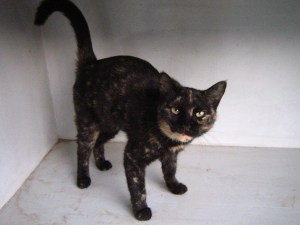
OfficeBack in the office I made my acquaintance with the office cat. When people keep a dog here they give it a name but not to cats; they are simply called peshak, the Dari word for cat. That is just like my first cat which was called Poes, the Dutch word for cat. I have baptized the cat, daftari-peshak , or office cat in Dari.
In between work related crises I have to make sure I have all my paper work in order. One such thing is my foreigner registration card that requires a visit to the ministry of interior. Everyone is searched upon entry to the ministry compound. My male colleagues are searched at the entrance. I am let in to a tiny shack where female employees do a cursory search or none at all. They are mostly curious about foreigners like me, sometimes asking for make up (I have to disappoint them).

This morning, when I asked them in Dari how well they were and answered their return question with a praise-the-lord, one of the ladies got up and planted a big kiss on my cheek. I think this is why people fall in love with this place. You simply can’t help it.

The office where the registration cards are manufactured (handwritten, a passport picture first cut to size and then stapled and then a stamp) is occupied by a person that I thought a woman but Steve told me was a man, since a woman would have worn a scarf, and he didn’t. He is a dwarf who is also dwarfed (anyone would be) by the gigantic registers that are piled up on his table.

Baskets full of cancelled registration cards are placed willy-nilly on the floor. The purpose of the registration process is not entirely clear but it keeps at least one Afghan busy and on salary. Signs are posted to say that it is a free service of the Afghan government; so no salary supplements for the little man. But the upstairs official who adds one other stamp did ask for donations to replace his old furniture and office equipment. A thinly veiled request for bribes, I asked Khalid? No, not at all; it’s a very poor ministry and they need help. That is obvious.

I asked what happened to all the registers and cancelled cards when the book or basket is full. Khalid, our logistics man told me that from time to time these places catch fire and that takes care of the archiving.

We had our weekly phone call with Boston which is tedious, partially because it is after work hours, because at least one of us is called on another cellphone and the quality of the connection is often bad and requires several re-calls.

I can now be disturbed twice as often since I am now in the possession, like many of my colleagues, of 2 cellphones and 2 numbers. One is pre-paid (using scratch cards) and one is post-paid. The latter is for calls to Boston that would exhaust multiple scratch cards. For that phone we get a bill monthly. I am now a two-fisted cellphoner.

Headache

We create most of our own stresses. Here, in this country, these self-made stresses are put on top of stresses that others created: social, financial, political, technical, etc. I got a taste of the self-made ones today and it gave me a headache so big that I am ready to go to bed at 7 PM.

We met with the minister to discuss two urgent issues. There are doomsday scenarios if the issues don’t get resolved quickly. I have questions about the accuracy of the doomsday scenarios but was in no position to challenge or ask questions, given the set up.

Anyone who has an audience with the minister, of lower status than his excellency, first waits in a large but windowless ante-room, populated entirely by middle-aged men, some in suits, others in local attire. Then one is ushered into his inner sanctum.

Two rows of matching couches and arm chairs, facing each other, with low tables in between lead to a small table with an Aeron chair behind it and a small contraption that I later discovered is a bell that rings in the ante-room and immediately produces a younger man who serves tea and cake, brings paper or ushers in other people.

Whoever sits in the chairs closest to the minister gets to have his ear while those further back wait for their turn. Then as one is finished and gets up the people in the back move towards the front. It’s a clever system that moves people fast. We got exactly half an hour. No chit-chat. The military, 3 men and one woman, took our places near the front. I was curious about their agenda but we had to leave. They got to hear our discussions.

The big event in Herat is coming into focus and the enormous detail that the US contingent needs, probably because of security and not wanting any surprises, has kept us busy all day to the point of a big headache.

I discover in person what I have learned from the literature: the higher you go the less need there is for technical knowledge about public health. Technical considerations in the decision making processes called for today were consistently trumped by political considerations. As a senior person you need some good technicians on your staff or in your pool of consultants, but that is not the skill set that is asked of me here and now. Yet there is the illusion that technical skills are the most critical, even, or especially at the highest levels. I don’t think so.

I finally had my first long conversation with my new boss, an Afghan doctor who has worked with MSH since the 80s. Our talk was interrupted several times by calls from this then that person at USAID who wanted more details or (re)direct our attention (which it did). Eventually we completed my agenda, with a new set of marching orders for me.

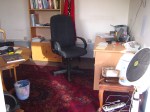
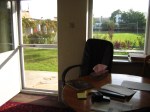
I escaped to my office, a small square room that is wedged in between the Security office where there is much coming and going and the provincial capacity building advisor, one of my staff. It is a bright sunny office that looks out into the garden, and sits on the outer perimeter of our compound. I have my new Chinese bookcases, unpacked my book shipments, I got a slightly larger Chinese desk than the dinky one I had before, a fancy (also Chinese) contraption to hang my scarf and coats on, a printer, a landline phone and two cellphone numbers, one pre-paid, the other post-paid (subscription). Like many Afghans, I am now a two-fisted cellphoner.

Even though my spot is a bit noisy I like it because I feel more out in the world (as much as one can in a compound that looks like a prison from the outside). When I walk out of my door I am outside rather than in another office or hallway. And the grapes are all around me, that is probably the most joyful part right now.


December 2025
M T W T F S S
1234567
891011121314
15161718192021
22232425262728
293031  

Categories

Blog Stats

  • 136,987 hits

Enter your email address to follow this blog and receive notifications of new posts by email.

Join 76 other subscribers