Archive for the 'Kabul' Category


Fruit and grit

The weather pattern in May and June goes like this: crisp mornings, blue skies, no wind. Slowly, over the course of the day the wind picks up and swirls the dust of Kabul around and deposits it on all of our horizontal surfaces. Everything is gritty.

Leaving Axel behind at home to finish a writing task before the end of the day, Katie and I visited Babur’s Gardens this morning, early, before the crowds arrived. Where all the lilacs were in bloom during my previous visit, now it was the turn of the roses, and cherries ripening on the trees.

We were lucky to stumble upon an exhibit entitled ‘Afghanistan Observed 1830-1920.’ It is an extraordinary peek into Afghanistan as it was observed by several famous British military artists, photographers, lithographers, watercolour painters and draftsmen.

The exhibit was mounted in the Queen’s Palace, in the beautifully restored harem with its high walls that kept the women safe from the men who didn’t owe them. Today there were lots of men in the harem. They crowded around us, watching us as much as the pictures.

Katie and I had a salad and mango smoothie lunch at the Flower Street Cafe before making a last trip to Chicken Street (we will both be gone from Afghanistan next Friday). On our way home we shopped for fruit and vegetables, picking up an odd vegetable that we looked up on the internet. It appears to be a prickly cucumber; we don’t quite know how to prepare it yet.
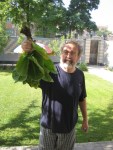
Tomorrow I will take it to my language teacher for further instructions. I discovered Afghan leeks; they look more like the Thai chives we have growing in our Manchester yard and taste more subtle than the American and European leeks.

We also loaded up on the many fruits that are now available in the market: tiny white apricots from Iran, melons, lemons plus freshly made yogurt and butter. After three days off from work (for us as well as for our staff), we have finished all the meals prepared by our cook and are now cooking ourselves; Nasi Goreng tonight, Tacos and Fajitas tomorrow. After that the cook will return and cook again.

We are learning from the foreign media what the Peace Jirga appeared to have produced, against most expectations: a consensus about negotiating with the Taliban, on the condition that the Afghan constitution is not violated (i.e. right of women). This is not welcomed by everyone, especially not by those Afghans who want to move into the 21st century. How all this will play out in real life is far from clear.

Winners and losers

We watched The Message (with Anthony Quinn) last night, about the birth of Islam. We had seen it earlier, dubbed in Dari, on the Prophet’s birthday in March but now I have it in the original English version. I had not understood then that the Afghans would play a movie produced by sinful Hollywood about their prophet but this time I saw the opening credits and an announcement that the film had been certified as authentic by religious scholars from Al Azhar University in Cairo and that Hollywood had agreed not to actually show Mohammed.

It is a long movie with much fighting and preaching. One by one Axel and Katie peeled off to go to sleep and although I tried to, I finally gave up to before the movie was over. This didn’t matter since we already knew the ending. In the centuries that have passed since then many things have not changed much in this part of the world, except maybe that the unveiled women in the movie are now veiled.

After being cooped up all day today in the house we escaped to a local Korean restaurant where they serve beer and great food. A few colleagues joined us, including Pascal who just arrived from Haiti in a very roundabout way, only hours after the rockets landed near the jirga tent. What a start! Pascal is a young doctor who won an award last year that he competed for with many other young MSH professionals in memory of our three MSH colleagues who died here in Afghanistan when their plane hit the mountains on a wintry day early 2005.

This year one of my young female staff applied after much goading from my side and pleas with her husband to let her try. When we returned from dinner I found out she was awarded the fellowship. Now we have to figure out how to make her trip out of Afghanistan work. It is not obvious but I am convinced we’ll find a way. I like these kinds of challenges.

After dinner we settled in front of the TV and watched ‘It’s Complicated,’ which was just what I needed after a long day in front of my computer.

Peace and rockets

We heard about the rocket attacks on the Peace Jirga via sms from our security folks but when we watched live coverage of the Jirga it was as if nothing had happened. The insurgents are bad shots, people say here and shrug their shoulders. But 100 meters away from the tent is a little too close for me. We are probably about 5 to 10 miles away from it all and didn’t hear a thing, other than the beep-beep from my cellphone that there was a message.

I watched the jirga open, the speeches and the patriotic songs with the ethnicities of singers carefully chosen so as not to offend anyone. Row after row of dignitaries, male and female, were sitting in respectful attendance. It looked very boring to me.

We are in lockdown until the whole thing is over, I believe at the end of Friday. That sucks because it means we can’t go on our usual Friday jaunts around town. And so we keep ourselves busy with housework, work-work, cooking, watching TV, preparing for our trip to the US, OBTC and deleting emails.

I was happy to see pictures of Tessa and Steve paying their respects, on behalf of all of us, to the ancestors. The planting of geraniums (maybe it was something different this year) at the Magnuson graves is an annual ritual that always ends with a vodka toast to them; we drink some and dribble some on the graves. And then it is Memorial Day, a day that is meaningless here; in Bamiyan I forgot all about it. Which soldiers would you honour here when you never know who are the bad and who are the good guys until much later and even then many people will disagree?

Shangri-Lafghanistan

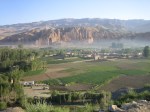
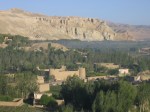
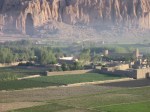
After circumnavigating half of Afghanistan (with stops in Kandahar and Herat), we landed safely in Bamiyan, the Shangri-La of Afghanistan. Axel and I remember it from 1978 as a place of great beauty, then still under the gaze of the Buddhas (not really a gaze as the Buddhas were already blind by then, but the rest of the giant bodies were still more or less intact.)

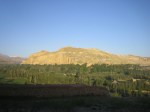
The contrast between Kandahar and Bamiyan couldn’t be bigger – a giant hot and dusty military tent camp on the edge of the desert – and a lush green valley tucked in between snow capped mountains. The sound of military planes deafening one’s ears on one place, the stillness and serenity of a high mountain abode in the other place.

In Kandahar I watched a drone practice taking off and landing. It’s an extreme form of solo flying, or, given that the pilot sits somewhere in the US, maybe ‘nolo’ flying is a more appropriate term. The drone looks like a creature from another planet. Looking back at it from the natural beauty of Bamiyan, it is a creature from another planet, one that is about destruction and ugliness.

Of course Bamiyan has seen its own share of ulginess and destruction. Many towns and villages were entirely destroyed, thousands of people killed, government services non-existent. For example, after the Taliban were ousted the entire province had only 7 health facilities.

Things are improving. With the help of New Zealand, Singapore and the Americans Bamiyan is transforming, slowly but steadily. The public health director, who I had and Afghan dinner with only 2 weeks ago in DC, proudly told us about progress in health. Now Bamiyan counts 70 health facilities; not enough by a long shot, but surely a sign of progress.

New structures, neatly painted, clean and simple, are popping up like mushrooms; these are already housing or going to house various government agencies. If I squint a bit and ignore the mudbrick buildings and veiled women, I could imagine I am in Switserland.

We are lodged in the Roof of Bamiyan hotel which is simple but has the most beautiful views on the rockface, that housed the Buddhas, and the valley at their now absent feet. Our hotel has no internet so I am posting early from the Provincial Health Office.

Primer

I took Katie along to my physical therapy session, for yet another taste of Kabul, part of her Afghanistan primer.

It took us more than an hour to get across town. Some roads were blocked with heavy construction equipment and angry policemen waving us into a direction we didn’t want to go in; no one quite knows what’s goin on behind the blocades but we all assume it has something to do with the upcoming peace Jirga and the mobilization of thousands of men in uniform. Is anyone seeing the contradiction?

As there are fewer and fewer back roads these days to get to your destination, the traffic jams become more frequent and massive, especially since there are always people in the traffic jam who manage to turn their car around and then try to drive against the traffic to wherever they came from.

Police presence is visibly increading by the day. It is as if the grimmest looking police officers have been mobilized – sometimes it felt like even smiling at them was an infraction. We were pulled over but we were prepared with all our papers, most of which they can’t read anyways.

It is hard to understand why they’d pull us over but may be they have been given quotas: stop x number of people who look like Arabs with bad intention, x number who look like potential suicide bombers, and, for good measure, x number of blond or grey-haired female foreigners.

Eventually we made it, albeit quite late, to the orthopaedic center where we found the female treatment room fuller than I have ever seen it before. The three PTs were all treating several women at once, putting this one in a neck stretching machine, that one on a bench with a hotpack on her back and a third one with the e-stem, the electrical stimulation to activate muscles or reduce pain.

I did not complete my treatment because we had another appointment, with the Thai massage ladies, that I didn’t want to miss for the world. After yesterday’s khakbad (dust storm) my skin was so dried out that I was craving an oil massage. Katie chose for the, much more intense, Thai massage. We agreed that both had been sublime.

Back home we had lunch and I had a little nap before language lessons – I am now about one third through a literacy primer that teaches adult Dari speaking Afghans how to read and write. This meant I was ready for a 12-page Dick, Jane and Spot kind of reading booklet. I am learning about Asad and Nasim, two brothers, who are working on their plot of land. I am halfway through the story and I have no idea how it is going to end; I can’t bear the suspense!

Tomorrow Katie and I are going to Bamyan. I have flown from Kabul to Bamiyan and back on the way to Herat. It is no more than a 45 minute ride; but tomorrow we are scheduled to leave Kabul at 9 AM, touching down on Bamiyan’s small gravel airfield a little before 4 PM. I think Katie is going to get the aerial tour of Afghanistan, Kandahar, Herat, and who knows what else, before getting to our destination.

An ordinary Friday sans internet

The internet was off for 24 hours, hence the day old post.

We filled yesterday (Friday) with all sort of excursions because we hadn’t done any lately and we wanted to show Katie that life here is not all that bad.
First we had breakfast at the Pelican restaurant, a French (real French, you can tell from the croissants) breakfast and lunch place with a lovely garden, not far from our house. It’s the place where Axel goes when he has gone too long without bacon and eggs.

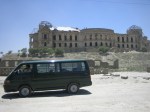
A little further down the road, across from the bombed out shell of Darulaman palace is the Kabul museum. It is probably among the more traumatized musea in the world but it is getting slowly back on its feet. Some of its prize collections aren’t yet in residence though, such as the Bactrian Gold exhibit which has been touring the world for some years now. Much of what was left of its treasures are restored in the basement and then retrieved to put on exhibit.

The wooden Nuristani (Kaffiristani) statues, some of men embracing men, are finally on display in a light and airy room. Those are the statues that survived the wrath and misplaced prudishness of the Taliban. They are reminiscent of African or Polynesian statues, heathen of course in the eyes of those who hacked good chunks of Afghanistan’s cultural heritage into pieces.

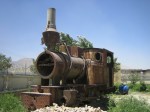
Outside the museum is a small rusted locomotive that was bought in 1920 by King Amanullah, one of Afghanistan’s rulers who wanted to modernize Afghanistan (at the same time that Ataturk was, more successfully doing the same in nearby Turkey). The locomotive was used on a 7 km roadside tramway linking Kabul and Darulaman.

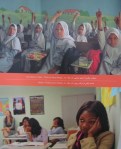
Upstairs was a more contemporary exhibit, a photo project that brought Afghan and American youth together through art. Two cultures, all representing minorities, were let loose with a camera to capture the concept of ‘Being We the People’ in their respective countries. They were then blown up and paired up to express similarities or contrasts. One of Axel’s students has one of his pictures on display.

For our next stop we had ourselves driven to the bird (and pet) market in the enormous Kabul bazaar off the main drag, Jade Maiwand in the old part of town. This part of town was entirely destroyed by the Mujahedeen fighting each other but is filled with life again.

Before throwing ourselves in the maze of narrow bazaar streets we ate some Afghan street food, Bolani, a deep fried dough triangle filled with leek or potato, greasy but very tasty. We then followed the narrow alley way, lined with large and small cages, empty or full with all kinds of birds: pigeons first, then the canaries, small birds with sharp beaks that are made to fight, love birds, small parakeets and parrots, finches and finally the magnificent pheasants and partridges, the latter also used for fighting. We bought a small cage, without bird, because it looked so nice and I have some idea that I can turn it upside down to serve as a lampshade and hide our ugly fluorescent terrace light.

Ignoring our guard and driver’s protests that the street food was not as good as what their women cook at home and this was no lunch at all, we asked them to drive us to our next destination, an upscale clothing and handicraft boutique frequented by foreigners to show Katie what she can bring back as gifts to herself and others.

A very special treat here is to go with Steve to Chicken Street. It’s a unique experience, and one that is about to end as there are only 4 weeks left of Steve’s assignment in Kabul. Katie got her outing with Steve just in time yesterday.

Axel declined the Chicken Street experience. Not having eaten the Bolani, he ordered a real lunch for about 100 time the prize of one Bolani, at the upscale French Bistro restaurant around the corner from Chicken Street. He can do that now because he is earning his own money. We found him content, with only a cold beer or glass of white wine missing.

While Axel is dining, we sniffed up years of Central Asian dust in Ibrahim’s shop where we had bought Daniel’s wedding gift only 3 weeks ago. Katie succumbed to her first purchase of a large embroidered bedspread. I succumbed briefly thereafter – not having enough money in your pocket is never a problem as all can be had on credit or a loan taken out from the Dr. Solter Bank.

On our way home we stopped to stock up on self-medication: the faux beer, that is the closest to beer we can have, and some sleep medicine and a blister pack of diazepam (valium) which can come in handy when you have a 16 hour flight in a cramped economy seat, or when you get too stressed out from living here. All this can be had over the counter at less the price of our co-pay back home.

Back home Axel cooked us a Cesar chicken salad (romaine spontaneously growing in our yard) and served it with lit candles and one bottle of Katie’s fermented grape juice, the yellow kind… ‘as if we are on vacation,’ said Katie.

Miracles

We have a new lodger. Katie has arrived from Boston. It is her first time in Afghanistan. She’s very cool about being here and brought us some cool gifts: fermented grape juice, yellow and pink, and fair trade coffee. She is a connoisseur of both and shares that interest with Axel.

While Anddy will try to perform a miracle with his team in Kabul, I am going to Bamiyan with Katie, my boss and one of my staff. Katie is also expected to perform miracles, hers are related to monitoring and evaluation. She needs to know what it is like in the provinces, who works there, what they do with data and defining success. Hence our trip out of Kabul.

We are taking the 9:00 AM flight that will circle the entire country before landing in mid afternoon in Bamiyan. The direct flight takes only 40 minutes, but here nothing is direct.

Security has cleared us. It is not easy to take people to the provinces as the pool of allowed provinces is rapidly shrinking. Even the usually peaceful northern provinces are increasingly declared off limits. We can still go to Bamiyan, Herat, Mazar, but that is about it. And now the people in Bamiyan are angry at the (only) female governor and want her to resign. It has something to do with the Kuchis, a kind of Afghan gypsies, nomads, who are fighting with the Hazaras about land and things more complex than that.

Today I finished the big Dari book that I have been studying for 4 months. I have completed all 25 chapters, memorized the bulk of the vocabulary lists, completed the exercises and tried to understand the more complex phrases contained in its 300 pages.

It’s close to a miracle. I can now converse, albeit slowly, with lots of mistakes and with much thinking and looking up of words, with our household staff, guards and drivers. They understand me, more or less. However, my own understanding of them is still rudimentary and the risk of miscommunication is considerable higher than when I didn’t speak any Dari at all.

With the big book completed I am moving into phase 2 of the language program, learning to read and write. I am practicing my letters, still drawing them, rather than writing; discovering which part goes on top of the line and what below it, much like a first grader learning her letters. It’s a lot of fun and I am looking forward to my next lesson on Saturday.

Anddy

Today I watched Anddy do the kind of work I used to do here; facilitating the change of thinking processes. It made me go back to my files from those trips and look at the designs I used to bring people together. Nostalgia.

Anddy is from Nigeria. It took us months to get him here. And now that he is here I discover that no one was prepared for him. He is finding one obstacle after another on his path because we had not communicated well with key stakeholders. I remember those times too – constantly having to change course, adjust expectations, roll with the punches, and keep smiling all the while. That is what Anddy does, and he does it with grace.

I find myself in a different position. I am no longer like an Anddy; I am senior management. I am the one to talk to senior colleagues of our sister project, and confront them – if you are not available to work with your primary client, then what the heck are your people doing, sitting in front of their computers? Who are you serving?

One person’s mental map is light years away from another. We are on different planets, speaking different languages and pretend we are communicating. I am relying on Anddy’s magic to align these mental maps and create a common language, maybe not on Sunday, but hopefully on Monday.

As if this is not challenging enough, the Peace Jirga is coming to town next week, accompanied by threats from insurgents to blow up prestigious and highly symbolic targets that lie exactly on the road between us and the ministry. If the event is not postponed there will surely be a travel ban which means that Anddy’s work might be cut short by half. I prepared him for that eventuality. “Why the hell are you working here?” he asked.

Still, he keeps smiling and remains dedicated to his assignment, whatever part of it he can fulfil. I like people like that. He can come back anytime, if he wants to.

It’s complicated

Sometimes I marvel at the complexity of our work, and the implications of what seem to be very straightforward ideas back home in the US.

Take the branding issue. We want the beneficiaries of our donations to know who paid for them (you, the US taxpayer). This means that there need to be US government stickers on the boxes with medicines that we provide to the NGO clinics in the provinces that are supported with US government funds. That’s part of the deal: we pay and the Afghans get to see our good deeds and be grateful. (Funny, now that I think of it, US arms don’t need stickers or do they?)

But when being associated with America becomes a liability and truck drivers get kidnapped and their loads confiscated, this was no longer a good idea and we needed a waiver. So we got the waiver, which is, by the way, not at all easy to get.

And then there is the branding on the health facilities. It became soon clear that the US flag needed to be removed, no matter how patriotic we felt, from the entrance signs of health clinics.

The services are provided by NGOs, they do this on behalf of the Afghan government – they signed contracts to that effect and it is part of the deal. But in some places, even being associated with the Afghan government became a liability and some of the (mostly local) NGOs were balking at this requirement, stating that they are providing humanitarian rather than government services.

But this is how it works: the NGOs get grants from the US government which are channelled through the Afghan government. The idea is to show that the Afghan government cares for peoples’ health and provides services, however indirectly by way of these NGOs. It’s called government stewardship and contracting out. It’s a model that has worked fairly well in this country.

But enforcement of ‘serving on behalf of the government’ is hard to enforce. First many places are too dangerous to get to and second, if the NGO stopped serving people they would get even madder than they already are. It’s a bit of a pickle.

It gets even more complicated because the prescription pads, registers and other signs in the clinics say nothing about the Afghan government (or US government for that matter) and bear the logos of the NGOS. So should we be replacing all the prescription pads, internal signs, registration books? They should have the government logo on them and be provided by the government, but that is a logistical nightmare of untold proportions – what if they run out of the registration books, then patients don’t get registered and then we won’t know what is really happening on the ground. If you follow this thread for a while it gets hopelessly tangled.

In the end the big idea is that the Afghans will turn away from the insurgents and towards the government. It is of course a hypothesis of major proportions that has so far not been confirmed. So if we wanted to test it, confirm or disconfirm, we should ask the patients exiting the health facility. So let’s assume a fictitious patient leaving the clinic in a district in, say, Ghazni, an increasingly turbulent place. We approach him or her and ask, ‘Who attended to you today?’ How likely is it that they would say, ‘Oh, it was the Afghan government.’

We are all pretty sure that the patient walking out of the clinic would say, it was the doctor (nurse, pharmacist) who attended to my health needs. These patients would have no inkling about the thousands of processes and millions of hours of labor, combined efforts of the US and Afghan governments, that made this encounter with the Afghan health system possible. They would have no idea at all.

Soldiering on

I dreamt last night that I lost Axel, in a crowd, couldn’t pick out his blue and black jacket – from then until I woke up I wandered around in my dream world, looking for him – the alarm brought him back to me. Small victories, huge relief.

During the workday I nearly got lost myself in the paper mass that accompanies the annual performance review process. Today the rubber hit the road as I gave my first ‘not met expectations’ judgment, quickly followed by two more. I knew I was going against the grain of this society which prefers politeness over honesty (as I see it) or, as they see it, over directness. What I considered blatant under performance was called ‘met expectations.’ People are hedging their bets. You never know what will happen in the future and so it is better to not make enemies – there are enough of them here already, why risk making more. Your underperforming colleague can one day become your boss.

It is safer to say that a colleague met expectations and so I am finding the term ‘expectations’ rather meaningless; they are all over the map. Except those of my boss who I seemed to have disappointed. I think he expected some magic tricks from me about changing the behaviour of top officials – I am thinking as hard as I can how I can lead horses to water AND make them drink. So far I haven’t come up with anything good. It’s not for lack of trying.

The paperwork and the performance interviews filled another 11 hour workday (but I am done now, with all 27 of them). As a result I have fallen hopelessly behind in processing emails, replying, deleting, reading and whatnot and have reached a point where I am not even trying anymore. Sometimes I am just trying to be too good, too efficient, too organized in a place that is all but that. It is also not something I am being judged on. I am being judged on whether the management and leadership capacity of people at the central and provincial ministry offices has improved. My biggest challenge, aside from doing just that, is figuring out how I could demonstrate that I have been successful, if ever I could.

I felt my frustrations mounting as the hours ticked by and the people wanting things from me (now) kept reminding me. But then, reading the local newspaper on the way home, everything was put right back in its place: ‘girls school bombed, 80% destroyed in Ghazni.’ ‘Governor and police chief in Nuristan not on post of months and selling food donations in the market for cheap, not only depriving the intended beneficiaries of their food but also undercutting farmers trying to sell their stuff at real cost.’ And someone doing work for us has been caught undermining the very ethical behaviour we are trying to model.

Although a war metaphor is not something I like to use, I can’t think of anything else than soldiering on.


December 2025
M T W T F S S
1234567
891011121314
15161718192021
22232425262728
293031  

Categories

Blog Stats

  • 136,982 hits

Enter your email address to follow this blog and receive notifications of new posts by email.

Join 76 other subscribers