Archive for the 'Mazar' Category

Music, birds, wolves, guns and roses

Our provincial health advisor from Jawzjan province had arranged for a dinner outside Mazar in a place we should have seen by daylight. It was the country house of the father-in-law of a friend of his; a large piece of walled land with a simple mud brick building with a veranda as wide as the house on one side.

Surrounding the house were bird cages with parrots, small colored birds and at least 20 kawks all feathered down for the night. Kawks are the fighting partridge-like birds that you see everywhere in small rattan cages, frantically circling their small space till the next fight.

There was also a wolf, people said, and we walked around the grounds in the dark to find it. It turned out to be a German Sheppard tethered with a frayed rope to a tree. An adorable fluffy puppy was kept in a crate. The puppy will grow into a huge fighting dog. The owner of the house supposedly likes animals but I think he also likes to fight.

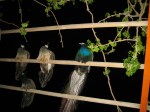
Following our host with a flashlight we stumbled over small dikes, through rose gardens, past an empty swimming pool, under the almond trees, a grape arbor with four magnificent peacocks resting on top, and back to the house where the rest of our party had already installed themselves on the flat pillows around the beginnings of a meal.

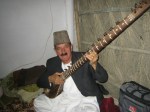
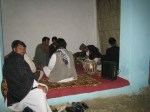
At the head of the ‘table’ sat an elderly gentleman next to a slighter younger man with a pockmarked face. They were the musicians summoned to enhance our pleasure. As it turned out they are famous in Afghanistan, Hadji Bahawaladin, the tambour nawaz and his table side kick. They are more often seen on stages inside and outside the country playing to large crowds. Our host knew them and has asked them to play in this very intimate setting, just for us.

The older of the two played the tambour, which I always thought were drums; but here a tambour is a kind of zither with a very long neck; the younger man played two full-bellied drums (table) that had a remarkable range of tones. He tuned his drums using a hammer to push small wooden blocks all around the drums up and down under the tense straps that held them in place.

But first we ate: qabuli pilaw, yoghurt, fried fish, kafta kebabs, salad followed by apples and oranges – a fairly standard menu. There was little talk; eating is serious business here. Then, after our walk around the grounds and after the dinner remains were cleared we sat down for an extraordinary and intimate concert. Only at the very end was there some dancing by a few of the resident staff and finally by our own guys, including one of the provincial health advisors who turns out to have a talent for singing.

And with this our trip to Mazar has come to an end. We headed home in a small twin engine over the snow capped mountains again and in less than 45 minutes were back on the ground in Kabul. Alain and I met Axel at the Flower Street Café in Qala Fatoula for a lovely lunch outside.

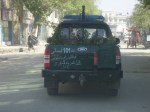
We drove back to Karte Seh behind a Police truck that was filled with roses – that’s what this place is all about: guns and roses.

It was too late to go to the office after that; we spent the rest of the afternoon and the beginning of the evening playing backgammon and scrabble outside until it was too chilly. It’s nice to be home again.
Stories

All morning we are hearing stories. Some made us happy, like the one from a ENT doctor who impressed the (German) funders of his clinic with the achievements that he accomplished after he went through our leadership program. He was even given a scholarship for a course in India.

But then the story, at least as told by him, turned sour. When the German organization discovered that he had a received a colleague of mine from the US who had interviewed him about his clinic’s success and highlighted the leadership program (we try to create leaders, and since this looked like one, we took some of the credit), his scholarship was withdrawn and he was asked to resign [I am sure we are missing some of the fine nuances].

Now he is deputy provincial director and leading there to his heart’s delight. This includes telling the governor about the Challenge Model while diagnosing his hearing problems.The ENT doc and his team proudly showed us all the initiatives they had taken which had resulted in an impressive array of public health achievements: number of patients showing up with dog bites at the clinic per month reduced from 40 to 0. For this dogs had to die – until the public is better informed, slaughterhouses removed to outside the city limits, losing fighting dogs not turned loose and pet dogs vaccinated. All this is part of their leadership project, for the long term.

They also increased vaccination of pregnant women to avoid tetanus, deliveries attended by skilled birth attendants, increased compliance with hospital infection prevention procedures and antenatal care. We all cheered; and not just for this team but for all the other teams that had produced similarly impressive results simply by changing their behavior.

A team from Balkh Province was invited to participate since they are our host. But Balkh is not a USAID-funded province and thus is not benefitting from our leadership programs. It is part of the arrangement between the European Union, the WorldBank and USAID: the 43 provinces were assigned (on what basis I don’t know) to the three funders. Balkh wants what the others get, and so we told them to talk with their chiefs and chief funder.

Each of us got some ‘easy’ (read ‘safe’), some difficult and some dangerous provinces, according to the conditions at the time of the agreement. That situation has changed a bit since then and the US is increasingly taking on provinces and health centers that were not in its initial portfolio. The EU and WB have not always taken kindly to these incursions. But, like the case of the Germans, one wonders, aren’t we all in this together to help Afghanistan?

The sad stories have mostly to do with security: friends killed by Taliban, death threats, not being able to wear a suit and a tie when travelling from one province to another, drugs being stolen and health personnel resigning to save their skins. We were also disappointed that a quick escapade that Alain and I had planned to the river further north that separates Afghanistan from Uzbekistan was nixed by our security people. They thought it too risky for us and, by extension, risky for our Afghan colleagues. And so we stayed in the basement all day, observing the workshop and our dynamite facilitator team.

Trying

After my first good experience here with the internet it stopped and didn’t come back for the night, nor the next morning; As a result I was not able to post an entry yesterday even though there was much to tell. And there certainly was no chance of putting the wonderful pictures up that I took during our tour yesterday later afternoon.

Alain and I took the facilitator team out for dinner to a restaurant that was recommended, the Kefayat Clup. It is a large complex that would have been called a pleasure garden in Babur’s days. Several halls, restaurant and even a coffee shop surround gardens and walk ways.

Outside one of the restaurants are the now familiar 6 by 8 feet carpeted eating platforms with their sitting (tushaq) and leaning (balish) pillows. We found it too cold and instead opted for sitting in the empty restaurant with a large and centrally placed flat TV screen and harsh fluoresecent lights; it was slightly less cold inside, the only redeeming feature.

The food was great: kabobs, manto, homemade yogurt, spinach, rice and ‘shepards’ salad (any dish labeled as a shepard dish indicates that it was and can be put together quickly).

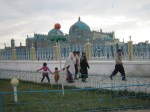
Colored lights outside outlined the shapes of trees (real) and giant flowers (not real) shaped like daisies and tulips. The tulip is everywhere: embroidered on ancient textiles, knotted into carpets, as giant shapes on top of the mosque, in advertisements for cell phone service. The tulip came from these parts of the world; the Dutch only exploited the commercial opportunity it provided by perfecting its shape and colors to match the whims of the buying public. But nature had given the tulip to the people here first; they just left it small and wild.

Back at the hotel I finally had to figure out the bedding arrangement. There were two small beds and one large one. Each had a mattress with a scratchy tweed-like cover, then a curtain-like shiny piece of cloth put over that and then there was one sheet, all slightly smaller than the mattress. Folded at the foot of the bed where a few of the giant and heavy Chinese blankets that are ubiquitous here. It was a little too cool to do without them.

I pulled the cover over me and its warmth quickly dispelled any thoughts of all of the hotel customers before me who had slept under the same cover. I marvel once again how easy we humans adjust to change – we may not like it, but we have no choice. That’s how things go here.

I was up early and joined Ali in the large meeting room in the basement where he sat in the half dark reading the book that we wrote at MSH some 5 years ago about leadership development. It is in its third printing now and we hope to have a Dari/Pashto version sometime in the future.

When Afghans have breakfast they ‘eat tea’ and so I was invited to do so. Breakfast, served on long tables, consisted of two kinds of breads, one small and savory and the other large and sweet with black cumin seeds sprinkled over them. The breads are served with small saucers of jam and cream, foreigners’ cream they call it, but this foreigner, who otherwise loves cream, declined.

Breakfast, as most other communal meals I have observed in Afghanistan, is hardly a social affair – everyone eats in silence and fast – as if it is nothing more than a biological requirement.

Treasure

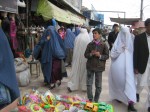
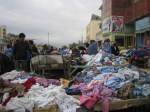
Alain and I asked for a tour of the city while it was still light. We drove to the enormous bazaar and then got out and joined the throngs of shoppers, walking through the sometimes narrow, sometimes wide streets of the bazar, with one of our hosts and guards in front of us and the others in back.

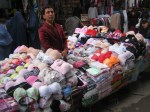
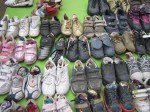
A good part of the market is taken up by merchants in second-hand (European/US) clothing and shoes. After that came the market for shiny women’s textiles before the bazar where men get their ‘Karzai’ coats, their woolen wraps, their hats, their scarves, their long Arabic dresses, and Punjabi outfits; less shiny than the women but exotic nevertheless.

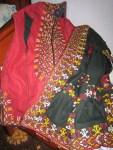
I wanted to bring back one or two of the Turkmen embroidered ‘chapans, stiff coats with long sleeves that have more of a ceremonial function than having arms in them.’ The Turkmen embroidery is the most striking part of the wedding dress that Sita bought in Lebanon. I had some fantasy of cutting one up and making a matching tie for the groom.

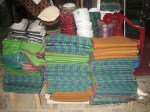
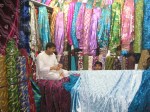
Our hosts led me to a shop that had what I was looking for, hundreds of them, stashed away between thousands of other exquisitely embroidered pieces of clothing and bedding. It was hard to choose from the collection. I don’t think I could ever put scissors into these coats to turn them into something else, least of all a tie.

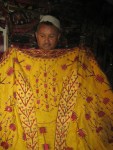
When the shopkeeper indicated that one of the coats was 8000 my colleagues asked, Afghanis or dollars, jokingly [8000 Afghanis is about 160 dollars – 8000 dollars is 8000 dollars]. The shopkeeper told us he actually had an 8000 dollar chapan. Everyone wanted to see it. He climbed on a rickety stair and pulled something wrapped in Ikat cloth from a pile of nondescript items. He unwrapped it as if it was a newborn baby. Inside was coat in perfect condition with the finest embroidery on yellow silk. The manufacturing date was embroidered at the bottom: 1915. The museum quality coat was made for and worn by an Uzbeki Prime Commandar nearly 100 years ago. We let him wrap his treasure up and put it back where it was waiting for the day that someone would gladly pay those 8000 dollars.

Mazar

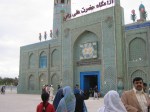
It was a little over 30 years ago that Axel and I had visited Mazar-i-Sharif and Balkh Province. At that time we had come here using a combination of public transport and hitch-hiking. It was fall and the colors were magnificent.

That trip was a little less costly than our 300 dollars one way flight with the UN plane. At that time we could have lived on that single fare for an entire month. But we never saw the magnificent snow-capped mountains that stretch between Kabul and Mazar. The plane provided us first row seats to this spectacular landscape.

We are lodged in a rather odd guesthouse that is clearly not catering to westerners. Signs and names are all written in Dari, including the name of the hotel. If it is appealing to any foreigners it would be Russians. The second language on the guesthouse business card is Cyrillic. This is no surprise as the old USSR is not far from here.

The place looks like some builder got a hold of pattern books with architectural flourishes from the oddest places, and then copied and distributed them pell-mell across the building and its various add-ons. The prevailing colors are pink and pastel green, except my room which is tinted pastel yellow and violet, like an Easter basket arrangement.

To its credit (and my surprise) the guesthouse has wireless (it works for a while); to its discredit the bathroom turned out to be without towels, soap or toilet paper. Someone had to go out and get it and came back with two brand new towels, 2 new toothbrushes, a big bar of ‘luxury’ soap, a large tube of toothpaste and a small bottle of anti-dandruff shampoo. Ask and the universe will provide.

When we arrived at the hotel at least 40 pairs of (men’s) shoes were outside the door. It looked like a second hand shoe market. I put my shoes among the others. My small clogs were hopelessly out of place between all the large and pointy shoes. But then I discovered that there was a separate shelf for the women’s shoes inside the entrance – a small shelf; after all how many women use hotels? As with anything else here women have a separate place for just about everything, even their shoes.

And so we all walk around the hotel in our socks or slippers – it feels a little intimate, as if you are among family. And in some ways I am – there are many people here I have known since early 2008 when I started working with the provincial teams. We are in this unusual and enviable position that we have the resources (thank you American taxpayer) to bring the provincial teams together not just once, not just twice, but every year at least a few times. As a result we are developing deep experience, deep knowledge and repeated skill practice rather than the usual shallow exposure that people get in one-off workshops.

When the program for the day was over the facilitation team started their end-of-day huddle and did all the things, and more, that I taught them a long time ago when I was still part of the team. But now I was excused, as all was done in Dari and it is their show, not mine anymore.


December 2025
M T W T F S S
1234567
891011121314
15161718192021
22232425262728
293031  

Categories

Blog Stats

  • 136,983 hits

Enter your email address to follow this blog and receive notifications of new posts by email.

Join 76 other subscribers