Archive for the 'On the road' Category


Retrofit

The blogposts are retrofitted, I am writing them while relying on my memory. It is not as good as writing daily but it will have to do. I was too exhausted every night to write. I made 14 to 16 hour days and this time period I clocked an all-time high of 184 hours (92 per week), which is more than double MSH’s normal 40 hour workweek.

There also was no respite. We worked all day on Saturday (since I had left on Saturday this was now a 7 day workweek) because the Directorate we were working with was being re-organized and my pharmaceutical colleagues decided that having everyone in one place was a good opportunity to finalize some of the restructuring tasks.

Originally I wasn’t supposed to be part of this but since I had re-designed the event to be more participatory, I was given the task to also facilitate the day. My Kenyan colleague worked with the TOTs to do more facilitation practice, and rehearsing upcoming sessions. The design was, after all, to have all of them conduct the leadership program to their colleagues, including a new batch of pharmacists who came from the districts. Our roles shifted to coaches and organizers of feedback and support sessions.

Sunday was supposed to be off but many tasks came in over email that needed attention, unrelated to the Sierra Leone assignments. And so Sunday turned out not a day of relaxation as I had hoped  (and wanted and needed). I put in another 8 hours of work taking care of things I could not postpone, such as  tasks related to the closing of the Madagascar program which starts happening next Tuesday. I owed it to my Malagasy colleagues to provided them with as much support as I could muster from a distance. And then there was my vacation, just days off, that I did not want to spoil with urgent tasks I could take care of now. Sigh!

Trust fall

I found my co-facilitator at breakfast the next morning, as well as my colleague who was responsible for getting me there, after a chance encounter at the airport in Brussels, both coming and going, when he went to Sierra Leone and I went to Liberia – the plane touches down in both countries.

My co-facilitator used to run the MSH leadership program in Kenya and turned out to be the best thing that happened to me. I had never worked with her in those days but knew of her reputation, which is why I had recommended her. She is a first rate coach and facilitator, besides being great company. She is a consultant now, since her MSH project ended, which is such a shame – all that talent not being used, whether in Kenya or elsewhere in the world. I am intent on finding her more assignments, preferably with myself.

The first week of our assignment was to create a pool of leadership developers. We had three days to turn some 17 lecturers into facilitators. We sometimes scratched our heads those first 24 hours. On the last day of the TOT all the participants, in pairs, had to do a session. Many of them lectured their way through the practice session or improvised and tied themselves up into knots. Lecturers are supposed to have all the answers – it was both funny and sad to see them trying to be more knowledgeable than they were. We knew they had a ways to go.

When people are used to giving lectures and presentations they tend not to do any of the things that our Leadership Development Program (LDP) facilitators have to do: prepare, follow the instructions in the guide , arrive early, have all their materials, flipcharts and resources ready (no PowerPoints allowed), read the room, pay attention to the energy in the room, do something when half the room is on Facebook, watching a soccer match, are texting or looking at pictures of full-breasted women, etc.

We selected the best 4 (2 women and 2 men) of the TOTs as we called them (for training of trainers) and spent some intense prep time with them because we wanted them, rather than us, facilitate the stakeholder alignment meeting that was planned for the Tuesday in the following week.  The purpose of this was not only to provide them with an immediate opportunity to put their news skills to the test, but also to show our audience that they now had a new resource in the country that could help implement the renewed attention to leadership and governance. It was a trust fall.

Chinese outing

My Ethiopian colleagues (both from HQ) had been talking about the Chinese restaurant nearby and took me there on my second night. It was a lovely walk along the beach where people were enjoying themselves with food, swimming and listening to good music.

The Chinese restaurant is located in a complex that includes a hotel, a casino and a restaurant, all decorated with bright neon lights that light up the neighborhood. The restaurant entrance takes one into a kind of alleyway, past the kitchen and a bunch of tables with people just sitting there; the smell is not encouraging. Large vats with liquid (water?) line this alleyway. It is clear we are not yet in the restaurant. This is hidden behind a simple door which lets one into a bright white and very cold room with more bright lights in pink and orange that flicker on and off. Another section is closed behind sliding doors. This is where the important Chinese hang out we assume. We see people going in with platters but never see anyone come out.

The place is frequented by Chinese who are drinking a white liquid in green bottles (when we asked the waiter what that was he told us ‘milk’  but we don’t believe him) and endless cups of green tea poured from an elegant copper tea pot with a long spout that makes you think you are in the Middle East.

The menu is provided in print form and on an iPad. We discovered Bull Penis with Old  Chicken Soup and other dishes that I remembered from our trip in China. We stuck to more acceptable dishes such as Chicken with Cashew, Spicy Beef and such and order too much. We had the leftover wrapped up and give it to the guard who lets us in the back door of the hotel grounds.

The food at the hotel is mediocre. A two week stay at the hotel would pretty much exhaust the choices and I tried most. Heavy on animal protein and starch, it was getting a bit tiresome, but two escapades to the Chinese were enough. I am craving the fresh vegetables that must be starting to arrive in the markets in Massachusetts.


Car, boat, bus, plane

I had used one of my ‘thank you’ rewards from Delta for my loyalty and countless trips. It is good for a one way upgrade to business class. It is supposed to get you all the way to your destination but the award program of KLM is not aligned with that of Delta, so when I connect in Amsterdam for the KLM flight the business class deal was over.

I was glad that I got the B-class seat as I was feeling increasingly lousy as I boarded the plane. As soon as we were airborne I put my seat into sleeping position and didn’t wake up until we arrived in Amsterdam. I kind of sleepwalked to the lounge in Amsterdam and slept there as well until it was time to board for Sierra Leone and then I slept some more.

I arrived around 10PM at the hotel in Freetown. The trip from the airport to the city is quite an adventure. I had heard about it (it involves a bus and a boat) but never experienced it. My Sierra Leone colleagues had given me detailed instructions and everything was exactly as described: someone with my name on a sign handed me a boat ticket and took me to the bus stop. I boarded the bus and gave my suitcase to an attendant. The bus drove for a while and then dropped us off at the beach where a simple concrete structure with plastic chairs served as our way station. We hang around until the boat returned from the other side of the lagoon and we filed on board, all 40 or 50 of us.

We squeezed into seats around tables as you expect on a yacht and the 45 minute trip started. It was all very congenial – for a brief moment we were a community with a shared goal: getting to the other shore and either to home or to our place of assignment. Total strangers started sharing why they were on the boat. It was really quite nice, and not the pain in the neck I had expected. It is true that the bus and boat trip added another good hour and a half to arrival time (and thus also to departure time), but if you are not in a hurry (and I had slept a lot) then it is OK.

The Radisson Blue in Freetown is, as it claims, an iconic hotel; I have been in other so-called ‘iconic’ hotels that didn’t seem very iconic to me (maybe they used the same advertising agency). The hotel has carpeted floors which I think is insane in a climate with 80% humidity. Everything was musty, a smell I stopped noticing after a couple of days. My clothes were also always damp.

Brutes and tender(er)s

I was given the luxury family suite in the not very attractive looking hotel right in the center of the town of Moramanga, some 100 kilometers from Tana. It was very Chinesy looking and I am sure all the hotel decorations had been trucked in on one of those tractor trailers years ago. The Chinese and the Malgache have intermingled for a long time – they may have been the Chinese from Malaysia or further northeast. Some go back to the 1800s.

Some Malgache look decidedly Chinese. Unlike the Indiens and Pakistanis who some fear are now in a more stealth way taking over the country, the Chinese were and are rather quite open about their infiltration. There are major construction projects all over the place. They would do poor families a favor if they could fix route national 42!

I noticed how development here (and probably elsewhere) is both brute and tender at the same time. The brutish part is the Cartesian, mechanical, engineering-dependent exploitation of primary resources with a focus on gain and short term profit. And then there are the people who we met who sacrifice much (so much more than we would ever agree to sacrifice, we wimps); the young idealists from here and abroad who study trees and plants, the ecology, to ‘unexploit’ it, to reforest, replant, make healthy again all life, human and other; those are the people with the long horizon, who focus on the other bottom line, who are driven by care.

But, people will say, we cannot abandon the trucks and the containers because the goods provide livelihoods for so many people who come to Tana, and initiate the detail commerce from there on, fanning out to the next level capitals where commercants of an even more petite entreprise continue further down, all the way to the tiny wooden shacks in the villages that sell the fake plastic Barbie dolls (pink with yellow hair), the soccer shirts, the leggings and the cheap tools that came in from (probably) China.

And while all this driving to and fro is done, the trucks gouge what remains of the secondary roads so that the people who have the bad luck of living far from a health center choose dying at home over dying a horrible death on the road (there are no painkillers!)

The trucks also do terrible things to the lungs of the more vulnerable members of the population who live and toddle along the road, breathing in the fumes all the time, if they don’t get run over. Brutes and tender(er)s.

Sacrifices

I somewhat dreaded the long way back to our next interview which would be along Route National 2 that connects Tana to Tamatave. It would be first the ferry, 30 minutes this time because we went with the current, then another hour of the undulating sand piste, then another 3 hours to the main road and then another two hours west. We would arrive at sundown. And we did, also in the rain, at the next, and our last, health center.

The path to the health center was up a slippery red clay road. The doctor was running around, her white coat flying, as she was trying to induce an abortion of a woman who had walked 2 days while in labor. The baby had died inside her before she arrived at the health center and needed to be aborted to save the life of the mother. If only Trump and his prolife supporters would see this, I wished. I suspect Trump has probably never heard of Madagascar and couldn’t point to it on a map if his life depended on it.

While she was putting the traumatized woman on the abortion-inducing drip we talked with another woman who was waiting to see the doctor, 6 months old baby on her hip. She looked healthy as did the baby who smiled at us. It was her 11th child (she was 38 and had her first child at 16). The baby was called Sunday the 11th. She was here because the baby had diarrhea.  We asked about family planning. A woman behind her whispered in her ear ‘we don’t like it.’ ‘Husbands don’t like,’ corrected the doctor. They are not making good inroads on family planning yet. For now she concentrates on prenatal visits, especially the last one and delivery in the health center. She had reached the target she had set for her team. This was illustrated when we finally sat down in her office after she had seen the baby with diarrhea. By now it was pitch dark and we took notes with the help of our smart phones’ light.

The doctor had done what her higher ups only write (and dream) about:

  1. She mobilized community and local health personnel to contribute to the purchase of delivery kits – when women come to a health center and don’t have two bottles of water, a piece of clean linen, a clean shaving blade and more they are sometimes sent away. The kits are to keep this from happening – but some kits are accumulating where they are not needed and not available where they are, like here.
  2. She bought a blood pressure cuff (about 125 dollars) from her own pocket as the one at the center was no good anymore. She could not wait for a new one that might never come and couldn’t work without one. She does not expect reimbursement (things don’t work like that here).
  3. She mobilized the Commune to raise money and build four ‘cases d’herbegement’ places where the pregnant woman who is about to deliver can wait the last few days with her family so that she doesn’t have to walk for days while in labor like her unhappy sister on the drip in the room next door. We visited the two cases that were occupied with expectant families. Three cases are already completed and a fourth one is being built.

We asked what else was different since she completed the leadership program. She told us that she had never had an experience that gave meaning to the word ‘objectif’ (goal) until this program. She liked what it did to the team and is now also setting herself a goal to buy a piece of land and construct a house in Mahajuna on the west coast before the end of 2018. This will bring her closer to her vision of a happy family life. Currently her husband lives in the far southwest corner of Madagascar, about two days of travel (with a good car); her baby is with relatives in the capital. This means she is alone and on duty 24/7. She loves her work (which would explain the sacrifices). She  cares deeply about the women in her community.

Risks of the road

Our third and last sweep to visit teams that had participated in the keadership development program was to the coast. We travelled all day on Monday, a holiday, to get to Tamatave, on route nationale 2. It is mostly a good road, which means people drive too fast. It is also a good road while it last. There are many 60 ton tractor trailers, some with as many as 30 wheels. They are loaded to the gills and then some (bananas and other local produce added by folks along the road – which I am sure is not alllowed). They truck the large containers with stuff from China and elsewhere to Tana for further distribution throughout the country by ever smaller means of transport.

Here and there the asphalt is starting to give and it is just a matter of time and a few more of those heavy trucks before it is gone. I have never understood the utility of the truck weigh stations as well as here. I have seen a few of them here, though none were in use.

Notre Dame de la route stands at the start of the paved road in Tamatave. She has to compete with the testosterone which is illustrated by texts on trucks: “Bad Girl Edition” and the “Need for Speed.” Notre Dame was on our side this trip but we saw a few turned over tractor traulers and some other wrecks where the need for speed had clearly won.

We had a flat tire about 3 hours into the trip. The jack turned out to be too small size for our 4×4. We searched for stones, anything hard, in the wet red clay but every stone crumbled under the weight of the wheels. A truck parked further down the road lent us a better jack and we got back on our way. I appealed to Notre Dame to keep us from having another flat tire before the flat one was fixed in the next place where we could do this, one and a half hour away. She listened.

While the tire was being fixed we ate at a sketchy roadside restaurant. I discovered a few hours later that I had eaten more than a fried fish and ingested something my body did not like at all. Once we arrived in Tamatave, one of the more desolate places I have been to lately (I commented to my road compagnons that this felt like a city without a vision) I also felt increasingly terrible inside.

I ate my dinner reluctantly knowing something was wrong. This proved to be correct when a blew my dinner once back in the hotel. My body kept busy throughout the night to remove whatever bug I had eaten that didn’t agree with me. It was an exhausting and sleepless night that left me in a pretty poor state for another day of driving over bumpy roads.

I was miserable all day, wondering all the time, are we there yet? When we finally arrived at our destination it was dark and we met the team in a dark district health office (no electricity) assisted by smartphone lights. In the middle of the interview I became nauseous again. I was taken out to the hospital grounds to vomit wherever I wanted. I suppose there are animal brigades that clean things up here. But nothing came out as I has not eaten for nearly 24 hours.

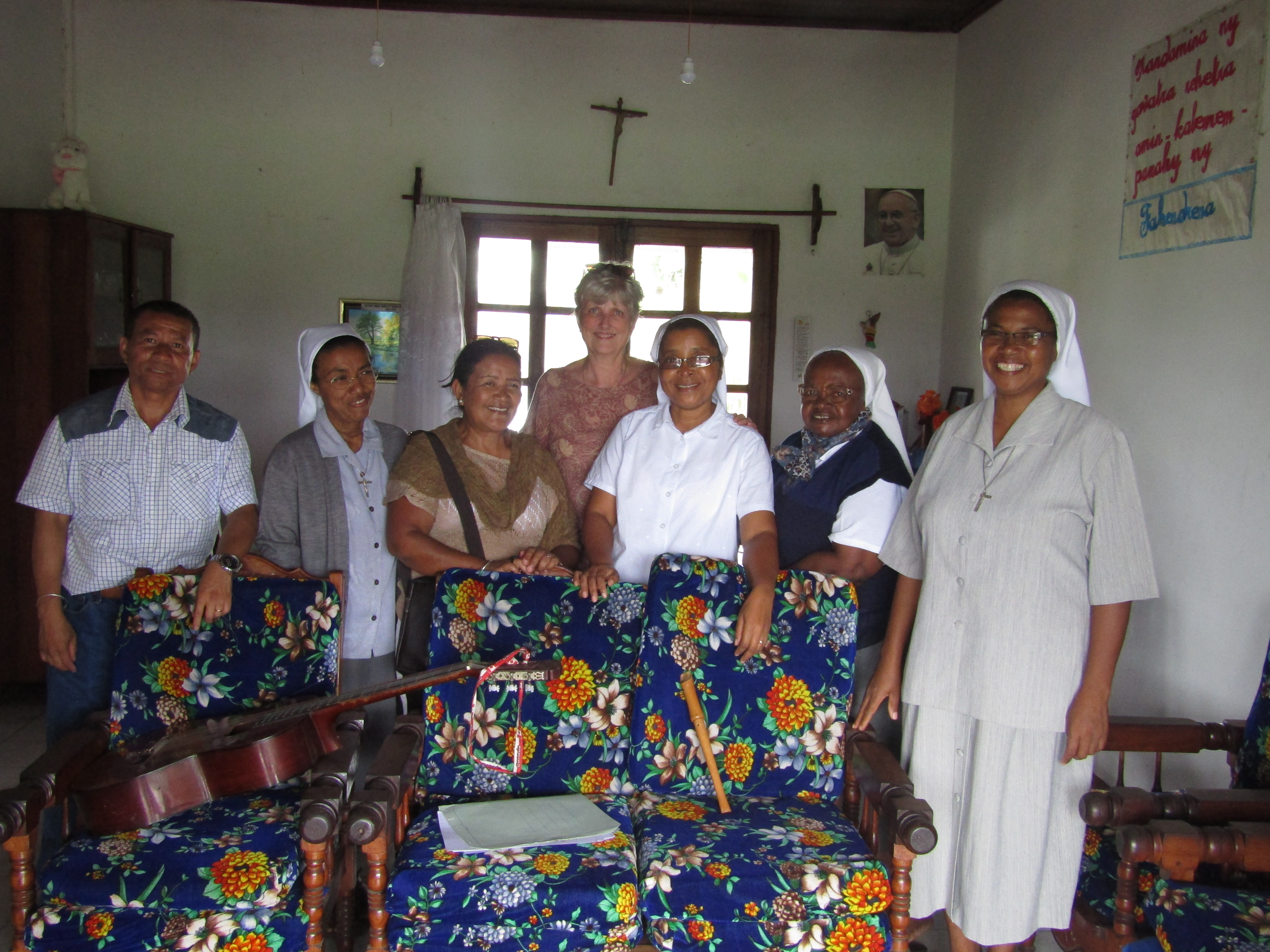
My team mates decided that the local hotel would not do for someone as sick as me and took me to the convent and handed me over to the care of the nuns. And care they did! They prepared a room for me, two buckets to accommodate expulsions from top and bottom, put a tray with toast and a thermos with hot water for tea next to my bed, lit a candle and bade me good night. they probably also said a prayer for me I suspect. they forbade me to leave my room and use the buckets. No shame. I had a good night.

I was woken up by the singing of the nuns this morning and the sound of a 100 birds. I already feel better. The bug is gone.

Out in the periphery

All healthy again we embarked on another adventure after the sisters released me. Although they told me that taking the ferry to the next health center was very uncomfortable, I told the team, worried about my state of health, that I was fine and that we should go.

The 15 kilometer road to the ferry took us an hour. It was like an undulating sand path, about the width of two cars, every valley was a pool of water. And so we went at about 10km an hour swish/splash/swish/splash occasionally interrupted by straight stretches in 2nd gear. When we got to the ferry I asked where the ferry was, seeing only what looked like an embarkation. Then I was told that that was the ferry itself – a square piece of wood planking of about 6 by 10 meters put on top of 5 metal boats soldered together at a right angle to the platform. We were advised not to take the car as it would make the trip longer. And so we pulled out two of the small stools that my team mates had bought along the road and positioned ourselves on the wooden platform.

It took the battery of our rental car and much banging and clanging with spanners and other tools borrowed from the little snack bar to get the motor started. It may have dated from the turn of the previous century, making lots of noise and spewing black smoke.

We could see why the health center had never seen anyone there from the ministry – it took a lot of conviction to go there, basically two days of travel from the center.

When we arrived a small boy walked us to the health center where we were greeted by 4 colorful flags with the words LDP+. And then there was Dr. David and Filipine who is in charge of the dispensary (called a dispensatrice here). The health center was plastered with enormous challenge models, including a stamp and the signature of the doctor at the bottom to show these were serious documents.  Dr. David had focused his challenge model on DTCHib vaccinations (= Diphtheria, Tetanus, Pertussis (whooping cough) and Haemophilus influenzae type b) moving the rate from 45% of the village children to 75%. He did better than that, and covered 96% and has ambitions to go to 100%.

He told us his vision for the center (which by the way has a good reputation even in the town across the river from where we had started): CSB2 Vert (Basic Health Center type 2 Green).  He had started moving towards that vision by planting fruit trees and flowers. The fruit trees each had an LDP+ flag attached to their protective reed mats.

We interviewed him outside and he talked about how he had mobilized the community, got a traditional agreement (called a “dina”) with the local authorities that would require parents of non-vaccinated children to pay a fine. He organized a team of traditional midwives, created an LDP+ football team and got the president of the village council to help spread the word about vaccinations. He obtained a fridge from the district health office by asking for one rather than complaining (“I now ask, in written form, rather than complaining”)

And once again we asked about personal transformations and he cited his changed relationship with his daughter (who was there to witness). The dispensatrice also told us she had changed and was less strict with the villagers when they had done something wrong, like not protecting their vaccination booklets against the rain (it rains a lot there). Now they are doing this even if is not strict with them. She made them understand. The booklets are now kept in plastic envelops.

Inside his office there was another art piece with the letters LDP+ and the text of a song he composed next to it. He and his daughter sung it for us. I recorded it and took a picture of the Malagasy text which I will get translated. It was lovely. He had also made a raffia weaving for me as a gift with LDP+ woven into the mat above the name of his village.

By the way, the toilets were spotless – a rarity in these places.
Relationships

I have been reading Nora Bateson’s Small Arcs of Larger Cycles. It is a collection of short essays she has written over the last 5 years or so. She also made a film about her father, the scientist Gregory Bateson, which I promptly ordered. It should be waiting for me at my return.

The essays are of the kind that make you think and that change you. Much like the tree book (The Hidden Life of Trees), I am changed by this one again. I am changing my vocabulary. I have become suspicious of words like ‘solutions.’  We ought to know by now that the problems that catapult poverty in our living room are not solvable from the mindset we have. It was Einstein who observed that problems cannot be solved from the same mindset that produced them. This quote is often cited but the deep meaning of it seems to be lost.

The mechanical, engineering mindset (every problem has a solution) is deeply anchored in our culture and it is easy to be sucked into its promises of engineering a better world. Yet I know that a better world cannot be created using an engineering framework simply because we are not made of steel and bolts.

Our world can only change when the relationships change, which is exactly what we found when touring this far flung area and visiting the teams that participated in the leadership program. Here is what Nora Bateson has to say about this:

“Within the great whirl of life there is culture; in culture there is language; in language there is conversation; in conversation there are two beings; in the beings there are frames of perception and, in their communication, a kaleidoscope of unpredictable repatterning.”

Although our challenge model, a kind of logical model, is a tad too mechanistic for me, it has served as a vehicle for people to establish, renew or fix relationships that make trust possible where mistrust was rampant. It is the only thing, in my mind, that can save us.

Comfort

I am back in the capital and enjoy the comfort of the nice boutique hotel Tamboho. No more zebu body parts. Instead there are luxury items such as Cesar salads, red wine, omelets, internet. But the coffee is worse and the pollution is worse – my throat is hurting again. Too me this proves that I am allergic to ‘Tana toxics.’

Across from the hotel is a small shopping center with a Shoprite, a homeopathic shop (homeopathy and plant-based beauty and healing is big in Madagascar), a few salons, a pharmacy, some clothes and shoes stores and a spice store that sells Malagasy soaps, oils and spices in attractive little containers for double the price at the market, even the tourist market.

On the second floor is a food court which provided a nice alternative to the hotel’s small menu which changes only once every year (it actually just did). I eat at the hotel when I have a great need for foie gras and crème brulee. The food court is for oysters, sushi, quiches, salads or Lebanese food, sandwiches and smoothies.

Further down there is the cute baby clothes store where I go each time to buy yet another set of French fashion dresses for Saffi. Although she has more dresses than she will be able to wear I can’t help myself. They are the kind of dresses for show, not for playing in the mud.

I was dropped off at noon on Wednesday at the hotel, after the 1200 or so kilometers on the road. I spent the afternoon doing body maintenance: a pedicure, a haircut, a nice lunch, a nap and a massage. I caught up on my emails, on writing and on digesting the many impressions from the amazing trip I just made.

On Thursday the team came back together at the MSH office to plan our next moves, after I leave Madagascar. There are many moving parts and much at stake. My team is reaching high and wants to include the First Lady. She is the patron of  CARMMA which stands for the Campaign for the Accelerated Reduction of Maternal Mortality in Africa. The campaign was launched by the African Union in May 2009. Our leadership program is supposed to further accelerate the campaign here in Madagascar. It would be a great honor for the teams selected to present, but the protocol to make this happen is daunting.


January 2026
M T W T F S S
 1234
567891011
12131415161718
19202122232425
262728293031  

Categories

Blog Stats

  • 137,107 hits

Enter your email address to follow this blog and receive notifications of new posts by email.

Join 76 other subscribers