Archive for the 'On the road' Category


Multivariables

I usually join our wheelchair training team when the practical clinical and technical work is done. Together we then teach the managers or supervisors of the participants in the just completed training how to run the wheelchair service in a way that supports the new skill set of their staff so they can start practicing right away. We cover everything from demand generation, organization and patient flow, finances, fundraising, monitoring and evaluation, managing change and staffing, while also helping them to understand the big picture of wheelchair service delivery.

We don’t always get the right people in the room. I had been forewarned about how hard it was to engage people and get them to speak out. Sometimes it seems that the only inducement to come to this kind of training is the per diem – the daily allowances that serve as a nice complement to, probably very low salaries.  It makes little sense for people who are already at their usual workplace but they demand it anyways. We follow strict US government guidelines, but people try to wrangle more out of us. This is what my colleague M has to deal with, over and over.

It is the per diem curse that haunts many of us and that has contaminated what we would consider a drive to learn. Like in other places, I assume this drive is there, with curiosity as its signpost. But there are only a few that show this.

It is complicated to teach the management course: there is a script that I find hard to stick to as it is a PowerPoint lecture-based set up. Especially on the first day there were many blank stares and people getting hopelessly tangled up in very basic math. Add to this that the slides we project are in Lao script and the tangle of wires and ear buds and mics for the simultaneous translation, teaching these classes can be quite unnerving in the beginning, even when one knows the topic very well.

And then there is the culture: a communist party culture superimposed on a highly stratified society and the trauma of the Vietnam War. Altogether it makes for a challenging teaching experience. It takes me about two days to get the hang of it and establish the kind of relationships that allow us all to relax and enjoy the opportunity of working towards something all of us deeply care about.

Then, after the management training was done we had a stakeholder meeting, bringing together key movers and shakers who are invested in pushing the wheelchair agenda forward, as part of a broader commitment to implement the UN Convention of the rights of people with disabilities.

Usually we have two days for this event but this time we were given only one day. For this meeting there is a script too but I never follow it as these kinds of meeting are too contextual to allow for a cookie cutter approach. I do have developed a kind of formula and then riff on that: where are we now? Where do we want to go? How did we get from here to there? Who is leading and coordinating efforts after today?

The complications of how to do small group exercises when the set-up is for simultaneous translation is something I had not fully grasped during the design phase. We managed anyways, reminding me that ‘where there is a will, there is a way.’

Haunted memories

Other than our short daily drive to work, I didn’t get to see much of the city. In the tourist brochures I saw pictures of all the beautiful things I could or should have seen – I suppose it requires going here as a tourist. I also learned, a little late, that I had pronounced the name of the capital all wrong. It sounds more Chinese than French (wiet chan).

The one tourist stop I did see was the COPE museum of the Vietnam War’s sad legacy of unexploded ordinance (UXO) and mines. The museum receives a constant stream of tourists which we saw passing by our training room, located in a large complex dedicated to people with disabilities. The rehabilitation center also receives a constant stream of requests for artificial limbs and wheelchairs for people who were mostly (or currently are) innocent bystanders of this devastating war.

One of our participants is from the northern part of the country, from the Hmong tribe which is present in a wide band below China. Thousands of Hmong were recruited by the CIA to fight the communists in Indochina during its ‘Secret War.’ As a result they were persecuted and many fled to Thailand and other places further away, like Minnesota. Anne Fadiman wrote a beautiful book (and intensely sad) about the latter group and the resulting culture clashes between two medical world views.

The young gentleman told me that his father recounted to him the horror stories, experienced while he (the father) was still a child. That generation was severely traumatized by memories of bombs falling, killing squads in the jungle and the dangerous Mekong crossing. His grandfather didn’t survive. He does have relatives in Minnesota and his uncle wrote a book about crossing the river. When I googled this I came across more nightmare memories. The Vietnam War is still very much alive here.


Bodyworks

The part of Vientiane where we are lodged is awash with small restaurants and massage places. At the end of the road, snaking along the Mekong River, is the daily night market (6-10PM). It is a poor cousin of Bangkok’s weekend market, full of cheap Chinese wares and some local handicraft.

During one of our evening strolls looking for a restaurant we found a boutique hotel (Ansara) that we should have stayed in. Its lovely French restaurant offered set menus and good wine for a reasonable price. Across the hotel we discovered (with some help from Trip Advisor) a very professionally run spa. We started to visit it daily. Upon entering one receives a thick menu book with choices. I tried the one hour leg and foot massage which ended with a neck and shoulder massage, thrown in as a bonus. I would have liked to propose to the diminutive masseuse to come home with me.  I had my body scrubbed for an hour with the promise of a sense of (cell) rejuvenation – one of the few options available after dinner. The chief masseuse was very strict about ‘no whole body massages (nor sauna) directly after dinner.’

And for our last day I chose the sports massage which was delivered with more force than seemed possible given the size of the masseuse. Now, more than24 hours later my muscles are still wondering what happened to them. That was it for massages in the short time I was there.


Indochine

As we landed in Laos, I couldn’t help but think what would have happened had I not divorced P in 1979. Just before he died last year he became consul for Laos in the Netherlands; he had lived some years here.  How different things would have been: no Sita, no Tessa, no Faro, no Saffi. I would not have gone here on a business trip, but I would have known this place.  I wouldn’t have minded living here for a bit, but there are no regrets.

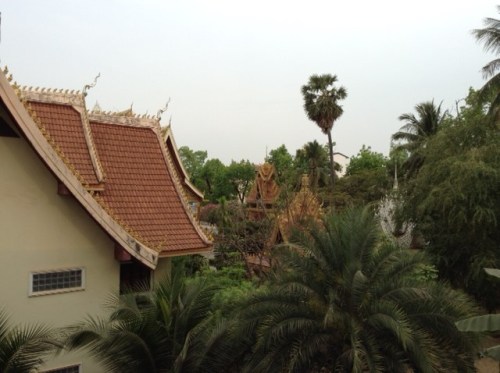
I was whisked away from the tiny airport in an elegant van to our boutique hotel. I look out over a temple complex with fantastical roofs.IMG_1842

I joined my colleagues who have already spent 2 weeks here, training staff of rehab centers how to properly prescribe and fit wheelchairs: a physical therapist from the Philippines, a colleague from our Arlington office who looks after the very complicated logistics and an occupational therapist from Israel. The latter is now on her way home, her job done. The three of us will stay. We have done this training and aligning of wheelchair stakeholders together before: twice in the Philippines, in Mongolia and in Cambodia.

It was a nice reunion which we celebrated at a French café. We had quiches and ‘pain de mie’ with Norwegian salmon.  Vientiane is very French; we are in the old French ‘Indochine,’ after all. Government buildings have their Latin script names in French.

Our departing team member got to choose the venue for our farewell dinner. She picked a restaurant already tested and approved, especially for its frozen chili margaritas. It is a social enterprise restaurant, where unlucky kids turned lucky served us a most wonderful meal.

New year, old ramblings

We celebrated the Iranian/Afghan New Year, nawruz, at the Museum of Fine Arts, followed by a lovely dinner at Ariana, an Afghan restaurant on the outskirts of Boston, with our longtime friends and ex-colleagues. We have Afghanistan in common, among many other things. They are preparing for a trip to Holland and so we put all the celebrations together, spring, travel, happy retirement (they, not me), new year, crocuses and daffodils.

For the first time in months I pedaled to Quaker Meeting – with all the travel I miss a lot of Sundays and when I am home for a change we go to NH or Easthampton to see our kids and grand kids. Our silent worship was tested by a gentleman with a giant vacuum cleaner or polishing machine, which led to some interesting thoughts and messages about sucking sounds and what polishing (both of these) can do for our psyche.

Spring, a day early because of leap year, started with a snowstorm. It was a gentle one, at least for someone who didn’t need to get on the road. It left, possibly for the last time, everything around our house soft, white, round and silent. But it was all gone within days. The earth is warming, spring is coming.

I worked hard and fast on reviewing facilitation guides that badly needed some changes. It’s not my kind of work – attention to detail that stresses me out, but I had made the commitment both to myself and to others who had to deal with would-be facilitators being flummoxed. It’s done now and I rest my case.

Resting is what I need very badly right now, after only an hour of sleep on the plane ride to Japan. Still, I can’t complain – I was able to cash in one of my four upgrade certificates – Delta’s thank you for my frequent flying. I killed the time by listening to Joyce’s Ulysses while trying to master knitting two socks at the same time, and starting at the toes.  The two combined required serious concentration. The socks are practice socks, bright yellow cotton, just about Saffi’s size. Ulysses is read by a formidable actor which makes it worth my while, even though I couldn’t possibly say anything coherent about what I listened to for the last five hours.

Ulysses was the favorite book, and Joyce the favorite author, of one of my classmates in 11th grade. He was way too mature for us 16 year olds, talking about Joyce in a way I will never able to do. Both he and his sister became authors – the germs planted then, between the classics, read in their original languages, and the 100 year old willow tree that we circled around, talking about deep stuff, during our recess. Walking in ‘the hortus’ was a privilege for the older kids in our Latin School (Gymnasium), the younger ones circled around and around on what was essentially a parking lot.

It was under that tree that I was first exposed to someone rambling about Joyce. Reading (or listening to) Ulysses was on my bucket list. Now I understand the rambling, but still not what Ulysses is all about.

Swiss memories

We drive, daily, along many supermarkets of the national chain Migros. This too brings back many memories from my childhood vacations in Switzerland. I remember how, in the 50s, Dutch yogurt (plain only) was delivered in liter or half liter glass bottles, predating the tetra packs and plastics of today. But in Switzerland at that time you could get small containers (waxed cardboard with pastoral scenes, plastic later) with fruit yogurts. I remember the excitement of going shopping and selecting the flavors.

Switzerland was also the place where I got meningitis. It was 1961 and the end of the school vacation. We stayed in a rented chalet on a hill and above an ice cold brook.  The headaches started a week before we were supposed to return. They got so bad that I couldn’t tolerate even the slightest sliver of daylight, the curtains drawn all day. My mother, a medical doctor, recognized this was not an ordinary headache.

I was admitted to the hospital in Einsiedeln after being diagnosed with bacterial meningitis. My mother got a room in town. She sat outside my window, reading or knitting. Because I was highly infectious she couldn’t be at my bedside for the first few days. For that same reason I had a six bed room all to myself.  When my father and brothers left to return to Holland at the end of the school vacation they could only stick their heads around the room and wave goodbye.

My most vivid memories are the three-times daily penicillin shots in my bottom (I screamed each time at the top of my 10 year old lungs) and the sweet rolls and lukewarm tea which made me nauseous. I handed these to my mom through the window. I developed a penicillin allergy, probably because of the mega doses, that also may have saved my life.

The hospital was run by nuns and was a first (and only) experience with nuns, having been raised protestant. I was intimidated by them and tried to avoid them as I could. I refused to call for assistance when I had to pee and did so in the sink at times the nuns where least likely to come in. I did this with great trepidation because I imagined that being discovered would unleash a fierce reaction.

After the penicillin had kicked in and my piercing headaches were over the experience was not bad. I had nearly died which was interesting and gave me a good story. I got to fly back to Holland, in a noisy Swissair Caravelle airplane and was waved goodbye and given flowers by the family where my mother had boarded. When I arrived home my brother Willem had decorated a slide of brown bread with sprinkles, lined up around the edges in the shape of a heart, and ‘welkom thuis’ written in the middle.

And then I got to go to school, which was already in full swing, and got a seat in the front of the class, with the instructions from the doctor to be gentle on my brain, which I interpreted as ‘not think too deeply.’ I remember struggling with that advice, straining not to think while thinking hard about how to not do that, an impossible task. Now I wonder, diid the doctor really say this or did my recovering brain made this up?

Memories

There are more memories from my 3 month stay in Geneva, after my marriage with Peter in the winter of 1975. He was so excited about his new job at UNHCR and busy with his orientation. When we drove by the headquarters on Monday, on our way to ICRC’s headquarters I realized that he never took me to meet his new colleagues and see the inside of that building that would be his anchor in Europe for years to come.

While he was away I roamed the streets of Geneva, bored out of my mind and very unhappy, having given up my former life as a psychology student and a highly coveted internship place at a prestigious family therapy clinic in Leiden. We stayed at an international place catering to foreign students, a high rise on Rue des Paquis, with tiny apartments with just the basics for living: two small burners for cooking, to small rooms with  narrow twin beds, and 2 cups, plates, saucers, forks, spoons and knives, 2 pans and sets of flimsy towels. Downstairs was a cafeteria where I would take my meals, feeling lost in a crowd.

I bought a bike and explored Geneva until I had covered each centimeter of the city. Soon I had visited all the musea, watched all the movies, but such lonely excursions just made me more depressed. A Czech refugee who also lived in the place took me under her wing once she discovered that I was a fellow, albeit not quite legitimate, psychologist. It was thanks to her that my last few weeks in Geneva were bearable. She took me along to a lecture by Jean Piaget at the university of Geneva, and other classes. Watching Jean Piaget in Geneva and meeting Anna Freud in London are still one of the highlights of my early psychology days.

Eventually I returned to Holland after Peter left with his best friend, by car, to Beirut. This was to have been our honeymoon but Beirut was no longer a family post and spouses were not allowed. At least, that is how we both took it. Thirty three years later, when I was posted in another non-family post, I realized that we probably could have gone together, with me unofficially, and paying my own way. I think I cried all the way home; and then I was back in Leiden, picking up the thread I had dropped earlier.  Now, looking back, I can see that the marriage was doomed, already then.

Wet bear

Because of the 2016 Auto Show in Geneva all the hotels in and around Geneva were booked. We managed to get an AirBNB apartment for the three of us for our first night in Geneva.  After that we had to go far away to find beds for ourselves and the 13 ICRC folks who had flown in from far and wide. We are lodged at the outskirts of Lausanne and are bussed, every day, to the ICRC training center at the other end of Geneva, a one hour ride.

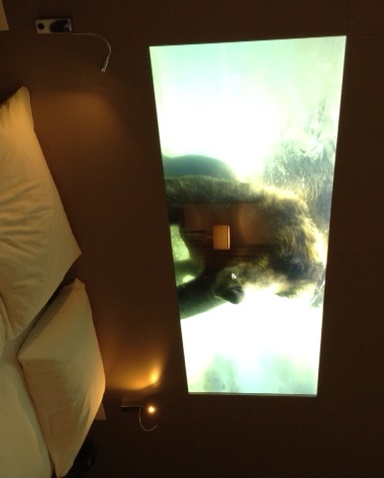
Our hotel sits forlornly between highway overpasses and parking lots. It is betting on a big stream of tourists to, what will be, the biggest Aquarium in Europe, according to the writing on the wall that separates the hotel from the unfinished aquarium shell. The brandnew hotel is all aquarium-themed, including its name, Aquatic. The colors are blue and turquoise; the pictures above the beds are backlit aquarium pictures, as if you have part of the aquarium right in your room. My colleagues have calm pictures of water with or without fish, but I have a picture of a giant bear, its snout prominently displayed above my head and small pieces of organic material (salmon?) floating in the otherwise clear shallow stream. The bear is submerged, walking on the riverbed, looking for things to eat. It is rather creepy.Aquatic-bear

The ICRC training center is located in an old cloister on a gentle slope overlooking the lake, surrounded by apple orchards and vineyards. The white topped mountains of the Swiss and French Alps form a seductive backdrop, bringing back memories of ski adventures in my teenage and young adult years.

I have been taking advantage of the gastronomic delights of Switzerland: cheese for breakfast, lunch and dinner in a variety of forms: ‘raclette,’ fried little ‘tommes vaudoises’ (the pungent local cheese) with a crusty outside and runny inside, rösti, yogurt, and Bircher muesli.

Dance while everyone is watching

The second part of my Dutch program was a dance performance in which my big brother had an important role. He is more of an improv dancer but this was the real stuff, with choreographers who made him adhere to strict routines, until he wasn’t. Sometimes that was a good thing and his spontaneous addition was incorporated into the program, making it better or funnier, but sometimes he was told to try harder. All the dancers were over 55 years and the show was about aging – memories, loss and love. The oldest dancer was 80. It was a remarkable performance, receiving a standing ovation, especially from those in the same age bracket.

I was exceedingly proud seeing my brother dance and move across the stage with such energy and suppleness. At this same age, some 30 years ago, my father had entered a nursing home, recovering from a second stroke, his life about over.

It makes me ponder the lifestyle choices we made and make. I see many of us boomers – I am just on the tail end – realizing that the carelessness with which we treated our bodies some 40 years ago was irresponsible if not outright stupid. For some it is now too late. The lucky ones are looking for redemption in yoga, exercise, dance, personal trainers, diet changes, and abandoning all that’s addictive; and if they are not, they probably ought to.

The after party was a (mostly) family affair with two of my brothers plus wives, my nephew and his wife and my friend A. We had a wonderful dinner in a small Italian restaurant. It was one of the happier moments of this most recent trip, and doubly worth all the hard work in Rwanda and the long plane trips.

Nostalgia

All of yesterday I walked down memory lane. I arrived in Amsterdam around 6 AM after a long trip that started at 1PM in Gisenyi, a three hour ride up, down and around a thousand hills to Kigali, a long wait at the airport, a 35 minute flight to Entebbe, an hour refueling wait and then the long run to Holland. With about 4 hours of sleep I entered the cold and clammy air of the polder where Schiphol is located in a bit of a daze. It’s home and not home anymore.

S. picked me up, and brought me to her lovely house, that, although right under coming and going planes, looks our over a large lake. I had a real breakfast, real coffee and outlets to recharge all my batteries. At the end of the morning I took the train to Leiden to meet with some of the women with whom I started my studies in Leiden in 1970. It was a slightly delayed reunion after 45 years. My trip to Rwanda has made my participation possible.

The experience of walking from the station (entirely unrecognizable) to the (still unchanged) center of the city is hard to describe. There was the restaurant where I last saw my first husband, some 6 or 7 years ago; both he and the restaurant are gone. The roads that crossed here are gone, both literally and figuratively.

There were dreams and plans and hopes and then everything slipped away, making room for new dreams and plans and hopes, some realized, some abandoned, some adjusted to new realities. For me this meant: a different husband, a different country/continent and language, a different profession and a different application of what I studied here. At one point this was a place where I had expected to live forever – how different everything turned out.

I am used to being a tourist at home, or rather at old my homes, and so this was no different. I ducked into my leather coat to handle the cold, noticing how no one wore gloves and many were lightly clad, as if it was a cool fall day. I have lost my ability to deal with the bone chilling cold that is not about low temperature but about wind and clamminess. I take New England snow storms over this anytime.

We met up with a few for lunch in a lovely restaurant; more coffee but also yummy Dutch fare like a ‘broodje met kaas’ (brown bread with cheese) and ‘karnemelk’ (kind of like buttermilk). Afterwards we strolled to the old and ugly building of what used to be the male students’ society clubhouse with which we were merged in 1971. For that we had to leave our elegant old mansion on Leiden’s main canal, a shift that many never accepted.

When we entered the building, made of concrete slabs and enormous wooden beams, it smelled of stale beer, just like all these years ago when we first entered, shy and uncomfortable. The building itself, its large halls and committee rooms are made to withstand large crowds of beer drenched and rowdy twenty-somethings and lots of testosterone. Its indestructibility also makes it the biggest eyesore in the city that stands in sharp contrast to our most elegant women’s clubhouse that still sits so prince(sse)ly on the canal, no longer ours.


January 2026
M T W T F S S
 1234
567891011
12131415161718
19202122232425
262728293031  

Categories

Blog Stats

  • 137,119 hits

Enter your email address to follow this blog and receive notifications of new posts by email.

Join 76 other subscribers