Archive for the 'On the road' Category


Just trying

We stayed in a comfortable hotel, with good beds, a pretty good kitchen and a shower that worked exactly as intended. My ride from the airport, to our training center each day and then to the airport again was easy and rather painless, considering Kinshasa’s traffic reputation.  Things worked as good, or better than in most other African cities I have visited recently.  I was spared all these experiences fellow travelers to the DRC complain about. I guess I was lucky. But on my way to the airport I got a glimpse of that other Kinshasa.

Just before we were supposed to leave with two physical therapists who were heading home to Lubumbashi, my colleague M who hands out per diem was called out of her room to sort out a problem with paying the bill. Then I got to see the effects of our per diem policies: we give people several hundred dollars to cover their expenses: meals, laundry, drinks and incidentals. It was probably a month salary if not more, and all that given in hard currency. Everyone went on a shopping spree. Then, when the hotel presented one of them with her bill of nearly 200 dollars there was panic. She didn’t have that money and was looking expectantly at my colleague M. to sort it out. I told M to remover herself from the scene as it was not her problem. Besides, the Congolese are very good at ‘se debrouiller’ a wonderful French term that basically means ‘figure it out.’ It took a good 45 minutes for things to be sorted out, eventually with the help of a friend who had come to the rescue. Even then, already past departure time, there was a disputed laundry charge. I vowed never to share an airport ride with local folks who haven’t paid their bill. And then, when we were ready to leave the other fellow traveler had wandered off. It was good we had calculated a large safety margin to get to the airport.

On the road we were stopped by two policemen in orange vests and the words ‘Police’ written on their caps and uniform. One walked over to the driver’s side and demanded that our driver open the window. The policeman indicated with his hands that he wanted to see the driver’s papers. I am glad I was not driving as I would have rolled down the window – I learned early in life to obey people in uniform, or else dire consequences await me. But our driver completely ignored the policeman, staring straight ahead as if he wasn’t there. Then the policeman started knocking on the window but our driver kept looking straight ahead, waiting for the lights to change; and when they did, he pulled away. To my surprise there was no angry reaction from the policemen. They probably stopped another car and tried again. I suppose this is how they supplement their no doubt meager police salary. Just trying, I suppose.

Traffic on the busy congested road is like a modern ballet of cars. There are no lanes, although the occasional mid-road barrier does create some left/right traffic order. But 180 degree turns across the length of the road are common and all the sides of busses and camions are scratched and dented. Our driver expertly wove in and out, making swift turns to occupy any small opening and crawl forward.

The last few miles to the airport is different: a six-lane highway with very little traffic; beautiful empty sidewalks, sun-powered lights and no sign of the petit commerce, the little stalls, shops, moto-taxis and pushcarts that fill the sides of the earlier section of the airport road – I assume it is banned in this modern part of the city. I could have been in the US. I suppose it is possible to modernize roads but it looks weird; soulless and cold, uninviting, un-Congolese. The airport is also brand new; yet the architects forgot about electrical outlets and Wi-Fi. One wonders how this is possible in a country that runs on cell-phones?

There are taxes to be paid at the airport. I know the drill: 50 dollars for this and 5 dollars for that. But the clerk asked for another 20 dollars. He used some complicated reasoning when I asked him how that figured into the 55 dollars I had already paid. The taxes are in Congolese francs, he said, and because of the exchange rate I had to pay more. Yet the receipt was in dollars. Luckily I knew the exchange rate, 900 francs to the dollar; for an extra 500 Congolese francs (= a little more than 50 US cents) he wanted 20 dollars. He told me he was patient and could wait for me to fork over what had, in the meantime, become 10 dollars. It was his bad luck that I was also patient and could wait as my flight wasn’t leaving for another 3 hours. When I mentioned to him that we were really talking about half a dollar he accepted my single dollar bill, stamped my receipts and I was cleared. It was a win-win of sorts: I paid and had my receipts for the 55 dollar taxes and kept 19 of my 20 dollars, he pocketed 50 US cents, and we both stayed within the laws of the land. Not as much as he had hoped, but still – these ‘tips’ can add up I imagine, with hundreds of foreigners coming through in a day. Just trying may be worth the risk of getting caught, if such a risk exists.

The airline employee who checked in a passenger next to me also accepted a handshake containing some bills– for what, I wondered? An upgrade? After the transaction she checked the bills and, showing no sign of surprise or disappointment, slipped them into her uniform pocket. I wondered what the take was after checking in several hundred passengers each day, and whether business class would be full.

By the time I arrived in Kinshasa the technical training was done and the capacity and coalition building began: for one day representatives from relevant government agencies, organizations of disabled people, local NGOs and representations from international NGOs and donor agencies came together to learn about the importance of appropriate wheelchairs and start thinking about how to get policies and supporters in place to advance the (signed and ratified but not implemented)  UN Convention on the Rights of People with Disabilities here in the DRC.

The last two days of my short visit were dedicated to imparting the principles and practices of managing a rehab center where wheelchair services are either already provided or will soon be provided. The purpose was to make sure that these centers would run according to the international standards for such a service as developed by WHO. We co-trained with Congolese colleagues who are also in the senior leadership program that we work on with Yale University in parallel. They were fabulous and much better than us, foreigners for obvious reasons – they know the context, they have years of experience running a rehab center, they are trained in proper wheelchair fitting and they are passionate about advancing the agenda of wheelchair provision in the DRC. I told them they could run this program on their own, without outsiders, and I meant it.  Not only did they know their stuff, they also managed the sessions within the prescribed time; the participants were also very disciplined, a good start for a management training. Each day we started and ended exactly as planned. This doesn’t happen very often in my experience; and here we were in the DRC!
Changed lives

I joined my colleagues around dinner time, straight in from the airport of Kinshasa. I arrived just in time to say hi and bye to two physical therapists from Zimbabwe and Kenya who had accompanied the advanced training in wheelchair fitting. They were leaving, tired and content. I would have been too if I had so directly changed the lives of several families with severely disabled children and some adults as well by providing them with a chair with all the supports to let that would allow them to participate a little more in ordinary life.  One boy of about 9 with cerebral palsy spent most of his waking hours in a room; and because he couldn’t sit without support he would squirm on the floor and look at the ceiling. When his mother left the house she put him on his back, as if he was still a baby. I watched her with the boy on her back, his movements uncontrolled and jerky – but she remained still and straight. It was another one of those moments where I counted all my blessings.

I learned from my colleagues who did the training that the mother rarely took him out as she was fearful of the comments, gossip and disdain from her neighbors. He was lucky that he had been selected to be fitted with a chair – a win-win arrangement for all: the students got to practice their skills and the boy and his family would be able to experience a more normal life.

On the road again

A colleague of mine calls the AF salon in Paris her CDG office. I tend not to work here but rather relax and eat as there is much good food to be had.

I spent the day preparing for my trip while Axel was the official photographer at the Manchester Club’s annual golf tournament in Peabody and so we said our goodbyes in the morning.

Axel is not a golfer but there are two golf courses that make him wish he was one – this one in Peabody and another one in Jackson New Hampshire up the road from the valley golf course – he prefers the one higher up where we have skied in the past.

Axel being unavailable to drive me to the airport our friend Andrew jumped in, saving me, and the American taxpayer, a taxi or bus fare.

I tested a new chemical to knock me out during night flights and it worked beautifully; it is like Nyquill but without the medicine. As soon as we had departed it kicked in. I woke just before we landed. Managing sleep during this trip is important as I choose the last possible departure date – leaving no time to catch my breath before it is show time in Kinshasa. I have no regrets – this last summer weekend was perfect – I would not have missed it for anything in the world – I have missed too many perfect summer days this year.

Home and hospitals

I have returned to beautiful Lobster Cove. I got the requested business class upgrade for the 18 hours in the air from Manila via Tokyo to Detroit.  In Detroit I found out that both Axel and my granddaughter were in the hospital. Both were being examined to determine why they weren’t well. Axel had a spell of something (but heart attack was ruled out) and Saffi was listless and had had diarrhea for several days. Sita and Jim were back again at the hospital they so detest but what else to do?

Axel was dismissed before I landed in Boston but Saffi is still a patient. The hospital won’t let newborns go home until they have gone through an entire list of tests, including spinal taps –as per lawyers’ instructions we suspect. So far, none of the test has been positive and she is looking better.

Tessa was summoned to Logan to pick me up – it’s good to have children look after their aging parents – and take me home. Axel rode along, dismissed from the hospital just about when I took off from Detroit.

We had a Chipotle take out meal. Axel made a margarita took accompany the meal, which I drank too quickly. Going to bed was a good thing to do anyways. I had gone through a 36 hour day compressed into one day: I got up at 4 AM in Manila, arrived at 4 PM in Tokyo and then again at 4 PM in Detroit. I tumbled into bed at 9:30 PM and slept until deep into the morning. It is wonderful to be home.

Old

I observed the first day of the management training that is provided as part of the WHO wheelchair service training package from the sidelines. My Filipina colleagues ran the day in a mixture of Tagalog and English. Not everyone of the participants actually manages a rehab center, some are in charge of developing national policies. This makes it challenging to cater to everyone’s needs. But the trainers are doing a great job.

Not having slept well the last few days I resolved to go to bed early, and treat myself to a facial to get sufficiently relaxed beforehand. I was suckered into getting the anti-aging treatment, which is double the price of a regular treatment.  I am sure my 26 year old colleague was not given that suggestion. Have I now entered that category of old and credulous people who pay extra for the silly promise of looking younger? My brain told me this was poppycock but I bought the package anyways. When it was time to pay, as if to convince me I had chosen well, the beautician pushed a mirror in front of me. Frankly, I thought I looked old and tired.

On the way back to the hotel I stopped at the supermarket to stock up on dried mango for the return trip. There was one line dedicated to retired people. I decided I looked sufficiently old (and tired, though not re-tired) to be allowed in that line which was also populated by a string of young girls. When the cashier saw me she told the girls to step aside and let me through. Old indeed!

Birth of a society

The second wheelchair stakeholder alignment or consultative meeting is over – it was the primary reason for me being here.  Although my task is not done, the hard work is over. Tomorrow we start the managers training meeting for rehab center directors and other people in managerial positions from the government, the national health insurance program, private sector and charities. I will get to serve mostly as a supportive coach to the Filipina trainers; they left me just one session to conduct, on Planning for Financial Sustainability no less!

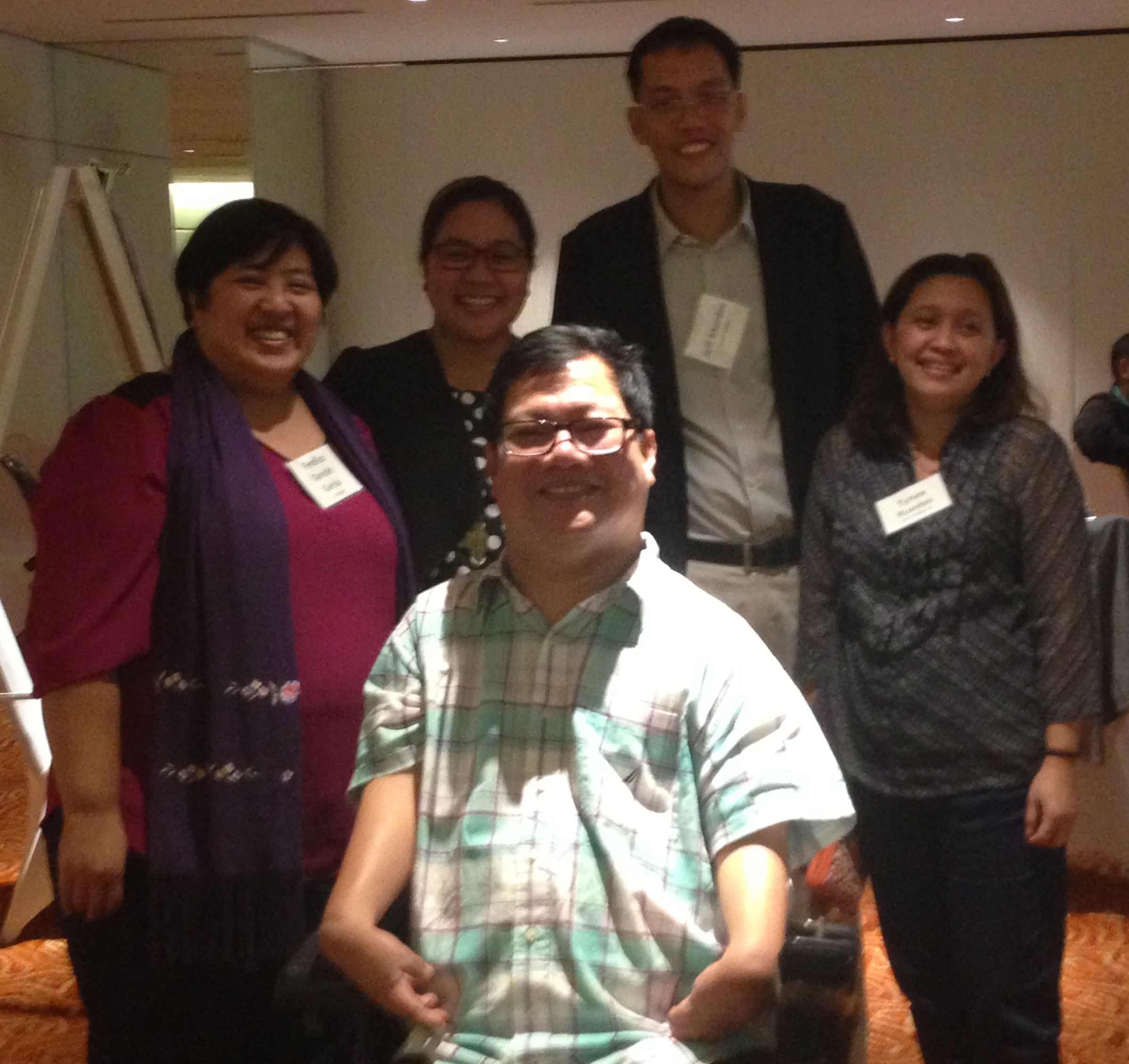
This afternoon I served as a midwife to the birth of the Philippines Society of Wheelchair Professionals. The first part of the day was hard labor, but then in the afternoon the baby slipped easily into this world. The birthing process was participative and exciting and left spirits very high, swept even higher by a group photo accompanied by Queen’s “We Are The Champions.”

I had asked for nominations for candidates to form a transition committee that would help shepherd the Society into its postnatal period, until such a time that it is strong enough for formal election of its officers. Ten people were nominated or nominated themselves; two of them declined, seven of them did a less than one minute stump speech and eight were on the ballot. Everyone voted for five candidates, a somewhat arbitrary limit informed mostly by practical considerations and my experience that teams of 5 are often more effective than larger teams.

While Maggie counted the votes, the 60 or so participants and soon to be members of the Society created three drafts statements built up from the ideas of each and every individual in the room. After the election results came through, the five members of the democratically elected received their applause and set down to their first task as Transition Committee and fashioned the mission statement out of the key words that the group had identified from three drafted statements. Transition_committee-PSWP

And while the Society’s mission was being created, the rest of the participants brainstormed possible objectives and settled on four, an easy process of convergence as the glue among the participants had already set, in spite of quite divergent individual agendas and concerns.

Maggie gave me a brief refresher on hash tags and @ signs and supervised my first Instagram postings on this newly born society and its first pilots.

A research team from JHPIEGO, a Johns Hopkins affiliate, invited everyone to dinner to share the results of a consultation they conducted on Monday morning – a nice example of synergy between organizations who sometimes compete and sometimes work together, as we did here – both of our programs funded by USAID.

I ended this great day deeply tired but very happy and treated myself to a massage in the hotel spa. Unlike the sketchy spa in our previous, much more upscale hotel, this spa was great and open till midnight.  My massage was splendidly done by Nellie, who I might visit one more time before it is time to return home.

Wet Sunday

Sunday the remains of the latest cyclone hovered around Manila. It was a day to stay indoors and take care of other assignments, read and take naps. I decided to take a late breakfast but that was a mistake; everyone and their brother, and especially little overweight brothers, milled around the various self-service stations in random movements. The description of the breakfast arrangement is priceless: a showcase of a live interactive kitchen and the intent to “make your gastronomic adventure more festive.” Today I am going to try breakfast at 6 and visit station 7, the kimchi and other fermented foods station.

During a few dry spells I took a walk in the neighborhood of the hotel. It was Sunday and therefore quiet for a change. We are near the UN and the University of the Philippines faculty of allied health services and the university hospital. The buildings hint at past grandeur but it is gone now. The Radium and X-Ray Therapy Institute had known better times, its function chiseled into its grand façade.

When the mall opened I checked out eyeglasses but found little reason to purchase an extra set here. The prices were only slightly lower than in the US. This is true for many of the brand name offerings at the mall which clearly caters to the well-heeled citizens of Manila. Only the nail and spa places are a bargain for us. After the pedicure a facial and massage is still on the program.

Two women who had just flown in from the US joined us for dinner. One is from Johns Hopkins University who will share the findings of a research study about wheelchairs. The other is from the US Cerebral Palsy Foundation and arranged her last minute flight, this event being too good an opportunity for her program to meet with key stakeholders to miss. We went out to the Seafood Market restaurant, recommended to us by both the concierge and the reception staff, a short walk from our hotel.

The restaurant turned out to be quite a dining experience. When entering the restaurant one receives a supermarket shopping cart and then helps oneself to fresh fish, displayed on ice, vegetables and fruits. When done the cart is wheeled into the kitchen and a short while later the contents of the cart return to the table transformed into a most wonderful meal.  For about 20 dollars each we had sweet and sour fish, scallops, jumbo prawns and a mountain of stir fried greens. For dessert we had picked mangoes and watermelons which were delivered to our table prepped for easy eating. What a concept!

Work, eat and play

It was a nice reunion at breakfast where I found both my US colleague and my Filipina co-conspirators – the same team I worked with in Cambodia earlier this year when Massachusetts was still covered under lots of snow.

I love breakfasts in Asian hotels because they serve both Asian and western breakfasts and I get to sample a lot of different foods. I started with sticky rice rolled in some sort of leaf, eaten with caramel and roasted coconut. Then I had a crepe, again with caramel and this time with banana slices, and of course lots of fresh fruit.

After breakfast we reviewed our plan, divided roles and I started to prepare for the sessions I am running. M. and I went to the mall for lunch and to hunt for flipcharts but we got sidetracked after an overdose on Japanese food – M. had a facial and I had my toenails done in a nail spa that reeked of toxic liquids but made my nails presentable again.

It is weekend here and in the rainy season, or maybe any season, it is mall time. The place was filled with Filipinos who are visibly doing well. But on the way to the mall you have to dodge the street urchins, some younger than Faro, who have already learned the rules of street life. A young mother held on to the littlest of her brood of four, five? I wondered about her story. It was a very sad and disturbing sight, just steps away from the good life.

Later I met a new member of the team,  a young Mexican physical therapist who was one of the trainers of last week’s intermediate wheelchair fitting course. She is also representing the newly founded International Society of Wheelchair Providers, supported, like all of us here, by the American taxpayer via USAID. We plan to lay the foundation this week for a local society, and possibly future affiliate of the international society.

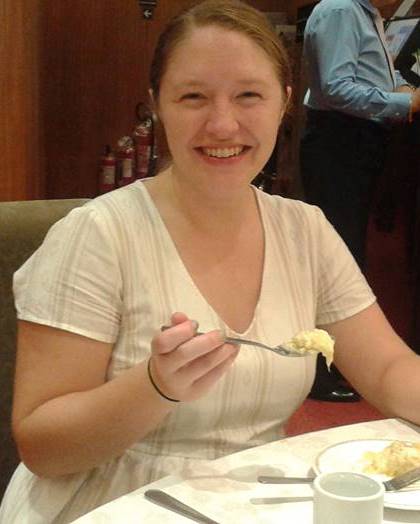
For dinner (there is always a reason to eat here) we went back to one of our favorite places during our last visit, a shabu-shabu restaurant (akin to Mongolian hotpot). We had our Filipina colleagues do the ordering to avoid the fish lips and other weird edibles that M. and I ordered last time, not knowing what was what. For desert they had brought the fruit durian. I was amazed that the restaurant was OK with us bringing in our own dessert, and, even more amazing, something that had a rather pungent aroma that wafted through the place as soon as the Tupperware container was un wrapped. We all got to try a piece – not bad actually, until the burps set in. We also got to try malang, another tropical fruit, small white globules, a little like lychees, that made a very nice ending to the meal, and that may also have contributed to the not so great burps.Maggie-and-durian

A case for women

One of my many fun assignments is to direct MSH’s contributions to the Japanese Women Leadership Initiative. This role has gotten me involved in activities of the Boston-Japan Society. Axel and I attended its annual gala some months ago. This time I was invited to a luncheon that was attended by the economic affairs representative at the Japanese consulate in Boston. The purpose of the (sushi) luncheon was to bring together various women who have senior positions in Boston’s academic and civil society community and provide some insights on how to increase the role of women in Japanese society.

The Japanese Prime Minister has put women empowerment high on his agenda. Only a small percentage of women occupy senior leadership positions in both the public and private sector. A study investigated why this was the case and pointed at a complex set of interacting variables that are at play in just about any society: cultural practices and values, government policies, organizational policies, the educational system, the opinions of men and women, fathers and mothers in particular, and the near total absence of mentors and sponsors to encourage women to get into, and stay in the workforce in career track positions.

Education is obviously not the issue as the literacy and enrollment rates for both genders are high. It is what happens after school that appears to discourage women to embark on a career.

And now, some 36 hours later, I am in Japan, waiting to board my next flight to Manila. There I will be working on another one of my fun assignments: getting the world more responsive to people with mobility challenges – one wheelchair at a time; a wheelchair that is well fitted to its user and the environment in which he or she lives, and an environment that is accesisble to all its citizens, walking or rolling.

A long wait

And so I spent Saturday morning, tired from the interrupted sleep and distracted about Sita, with my friend A and his wife at a lovely beach restaurant, relaxing, eating fish brochettes and drinking fresh pineapple juice. We talked about his plans to start a rehab center in Cameroon and how to get ready for the big jump to actually set it up. It would mean leaving his paying job with ICRC and risking the savings from friends and family, his salary and savings, career for the sake of a dream. I encouraged him and added bits and pieces from our course to the conversation. I have never taken such a jump and am not sure I’d have the courage. But then again, I pointed out, just about everything around us, except for the sand, the wind, the flora and sea, started as a glint in someone’s eye. I pointed at his latest model iPhone, yes, that one too. It also carries the message that you don’t get to the supermodel right away, so start small to show that one can deliver the dream in reality. It was a wonderfully inspiring conversation. I promised to support him in whatever way I could.

We left for the airport in the hotel shuttle. A few miles before the airport we encountered a huge crowd of cars (with the opponent of the President at the head, who had apparently just come in on the plane I was to leave on). He was followed by thousands of followers, in cars, in trucks, on motorbikes and on foot. Many were dressed in orange, the color associated with Dutch football fans, playful and dedicated. But these people didn’t look so playful. They stared at us, white folks stuck in the crowd in our little bus that could easily be upturned. I kept hoping that the generally good natured Togolese would stay that way. Still, it remained unsettling to find oneself in an immense crowd of people. I know crowds can easily go from friendly to nasty – we see this over and over on the television.

There was no visible presence of people representing the law; no uniforms anywhere in sight, only self-appointed traffic regulators with whistles in their mouth. But then, as quick as it started, the parade had gone by us and we resumed our trip to the airport. Our very alarmed French passenger let out a sigh of relief. I fear that in the excitement I dropped my travel (smart) phone on the floor. That my phone was missing I discovered too late after having gone through all the security check points. The receptionist at the lounge was not helpful and refused to let me use her phone to get in touch with the driver.

The phone was supposed to receive the signal that the baby had arrived. Now some unknown person has gotten that message, unless the phone is still in the bus but I am not counting on seeing it ever again. I can only hope that whomever found it, if not willing to part, will erase all names and phone numbers. If anyone who reads this gets a sketchy call from Togo, beware. It is not me.

And now I am waiting to board my flight from Paris to Boston. It will be about 14 hours before I will see the new baby. It seems an eternity.


January 2026
M T W T F S S
 1234
567891011
12131415161718
19202122232425
262728293031  

Categories

Blog Stats

  • 137,129 hits

Enter your email address to follow this blog and receive notifications of new posts by email.

Join 76 other subscribers