Archive for the 'On the road' Category


Moving up & about

This morning we checked out of the hotel to move into phase two of our stay here. We are going from a three star to a five star hotel, moving up from a run down (but not unsafe) commercial neighborhood to a near oceanfront high rise surrounded by a shopping-mall, countless Pacific Rim restaurants and night clubs.

Our friendly wanna-be posh three star hotel was perfectly fine although the doors to our apartments (a kitchen, living room, bathroom and bedroom) were a bit too flimsy and some elementary things like bedside lamps and outlets missing. The place is awash with uniformed staff, all very friendly and well trained to serve. As if there weren’t enough people to serve us, there are hospitality industry trainees everywhere; all young women, petite, gorgeous, and well groomed. They stand in bunches at the reception, at the business center and in back of the training room, always smiling and saying hello every time you pass by them. They wear name tags that say ‘trainee’ underneath their cute or exotic names (Twinkle, Apple, Berneice (no typo), Fernyl).

I was wondering how they learned during their internship. I never saw them doing anything; they were always just standing there with their hands folded figleave style. And yet, when I asked them questions about their school, exams and internship they appeared to be quite advanced in their studies. They are learning by standing around and observing. It is one way, I suppose, to learn about ‘serving the customer.’

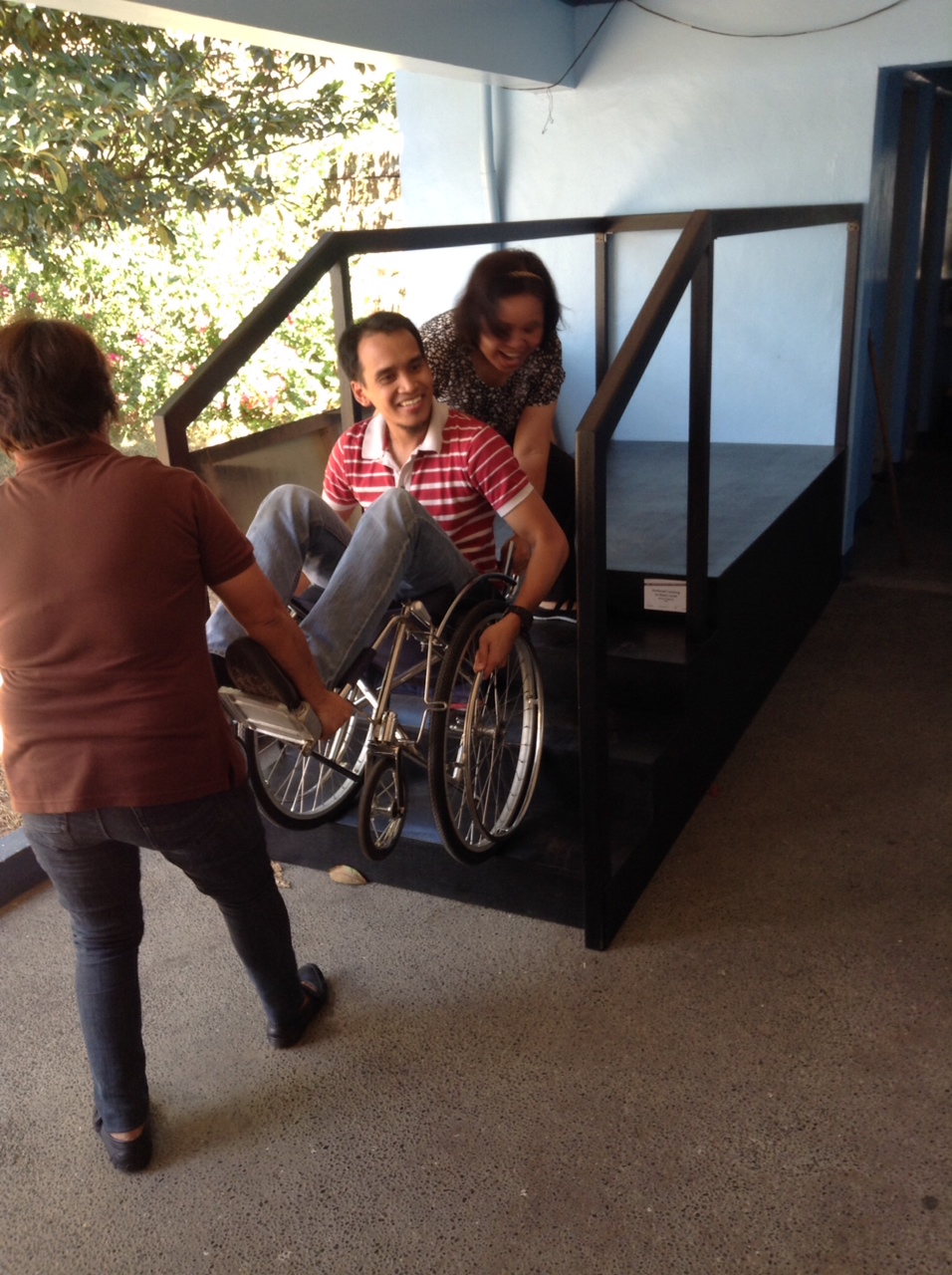
Our exposure to Manila, which we already knew is not the Philippines, has been very limited. The first two days of the wheelchair workshop kept us inside a windowless conference room. The practicum is taking place the remaining three days at the premises of a social enterprise located at the edge of Metro Manila. The place is run nearly entirely by people in wheelchairs. The core business is wheelchair manufacture and rehabilitation. But they do much more than that and the enterprise is constantly looking for employment opportunities for its graduates with the message that people in wheelchairs are perfectly capable to participate in the economy. Some grow hydroponic lettuce which is sold in the market; others provide data entry services for a Japanese company to name just a few of its income generating activities.

The wheelchair providers in the course are very animated as they apply their skills to real life challenges and dilemmas such as ramps and stairs. They also have to test their skills on people they don’t know, assessing them and then choosing the best chair and adjusting it for a perfect fit. People are excited as they learn things that are relevant to their job and important for their clients. It’s a very good course.pressure sore reliefup the stairs

Lunch at the practicum venue is less fancy than at the hotel. We eat what the kitchen prepared, still copious but served camp style. This is not a place for vegetarians. Pork seems to be the source of animal protein of choice (at least for Christians) and is prepared in a thousand different ways: knuckles, skin with layers of fat alternated with meat, pork bellies, chops, rinds, ribs,etc. Second place is for fish, usually deep fried – a little greasy for breakfast. And then of course there is always rice.

Zoned out

The flight from Detroit to Nagoya took about 15 hours. It felt like an eternity; only the two hours that I slept went quickly. I was lucky to have garnered an aisle seat, albeit it way in the back of a very full plane, a double decker Boeing. I was one of many people who had asked for a wheelchair. This meant that an army of wheelchair handlers were waiting for us at the jetway in Nagoya. With the dozen or so cleaners who descended on our plane it was quite a crowd that welcomed us, with deep bows, smiles and words of welcome. The Japanese have this way of making you very welcome.

The wait in Japan was short, so was the last leg of the trip, a mere three hours in southwesterly direction. After the orderliness of the Japanese airport experience, Manila was the opposite – the worst airport in Asia said the hotel driver with a smile as if he was proud of the qualification (I am actually not sure it is true – the experience was comparable to old Delhi airport).

It seemed like all the jumbos from Asia and Europe had landed in Manila at the same time. Hordes of people thronged towards the immigration booths and filled all the empty spaces around the luggage carousels. The wheelchair was a godsend as I was able to sit through the next two hours, which is how long it took to get through immigration, waiting for luggage in a huge, hot and cacophonous hall and then waiting for the hotel pick-up bus outside in a traffic jam of luggage carts in the hot and humid night air. By 1:30 AM Monday morning (12:30 PM Sunday Boston time) I tumbled into bed, 29 hours after I left home.

And now it is the end of Monday here in the Philippines while the day is just starting at home. We observed day one of a five-day training for wheelchair providers, the program for which I designed a deck of training of trainers cards a year ago. I did not experience much of the Philippines, having been most of the day in a conference room that only has the illusion of daylight (yellow fluorescent lights behind opaque windows). Outside it was overcast and raining which I discovered when getting out to acquire a simcard at the local Mini Mart. This was not a great experience because of poor customer service combined with me being impatient.

The highlight of the day is yet to come. I scheduled a 90 minute massage after dinner. The challenge is staying up until 7:30. If I succeed I surely will fall asleep during the massage.

Legs

I am back on the road, waiting for an early morning flight to Detroit, then Nagoya and then Manila. I am flying backwards in time zones until I am 13 hours ahead again – it remains difficult to wrap my head around this.

I have requested wheelchair assistance again, mostly because I cannot quite handle the long walks from gate to gate. Not knowing the places I will land, other than Detroit, this seemed like a good idea; besides it was a great experience last time, this zipping by long lines and all these hidden elevators.

Unlike the last trip, when I had an orthopedic boot on and crutches, and looked the part, this time I don’t look the part unless someone very alert notices my new rocker bottom sneakers that help with my gait. But those used to be advertised for butt firming, so who would know?

I felt a bit like a cheat when I sat down to wait for my wheelchair handler in a specially designated section of terminal A. I felt even more like a cheat when it turned out that my handler looked like he had had polio as a child, with a very crooked leg.

I learned that he was from Ethiopia. His bad leg was not the result of polio but, what we would call here medical malpractice; a leg poorly set after he broke it at the age of 8. He was living in a rural area and I could just imagine the kind of healthcare he received. He had had several operations, none of them seemed to have made things better, possibly worse. His leg will never get right. He told me it didn’t bother him anymore and that he could walk fine without pain. That made me feel better, and less embarrassed about being pushed by a limper.

He too, like Khin I wrote about yesterday, got his visa through the lottery and just received his American nationality. He is in the process of getting his wife here and then, he smiled, there will be children!

Khaki

Before my departure for the airport I was called to a debriefing at USAID. I had not seen the US compound since I left nearly two and a half years ago. The sight (and site) was astonishing. We are building a city inside a city, more city than it was before. Several enormous buildings have gone up to house God knows who and what. Maybe the short termers will finally get proper rooms rather than the hooches they sometimes had to share with several others.

Once inside the section across from the embassy, the place had turned into a city with lanes, balconies on the two-story hooches gave the place a flavor of New Orleans if you imagined the balconies to be wrought iron rather than plain metal. Enormous 16 x 32 feet (?) photographs of the most beautiful places in America adorned the (now painted) concrete walls and you could pretend you were looking out over a misty coast of Maine or sunny Hawaii. I wonder whose idea that had been; whoever it was had recognized that some things of beauty were badly needed to save the souls of our compatriots making difficult decisions from a place that was steeped in ugliness, having little to do with the inherent beauty of the country that hosted them.

The entrance to the US compound was thick with melting snow mixed with mud, the famous Kabul khak. By the time I arrived at my seat in the airplane I had left a thick trail of chunks of mud and my shoes, boot and pants had taken on the color of khaki (named after the Dari word of mud, indeed). I cleaned them up with kleenex in the plane’s bathroom, a messy affair which had to be repeated in another bathroom in Dubai.

I managed on my own the trail through various security checks (none as stringent as getting into the US compound) until we arrived in Dubai where I had requested assistance as the walks can get rather long. A young Nepali man wheeled me through backstage doors, with security waving me through without having to take my boot off. I felt a little undeserving of the sympathy but it was nice nevertheless to transit so painlessly.

And now I am in Amsterdam waiting for the homestretch to start. I hope to outrun the snow storms that are raging around the east coast as I am not interested in any further delay to my homecoming.

Inflamed

I am in my fifth day of a miserable cold, laryngitis, sore throat, cough, sinus pains and what not, hence the absence of posts. Having another inflammation in my arm (a tendinitis that probably came from being on crutches) makes for nights as miserable as the days.

I spent this last week in Afghanistan voiceless. Still I ran a full day event on Sunday, which probably set me back a few days as I thought I was on the mend but then relapsed. My co-facilitator did fine with me whispering on the sidelines. It was actually a good test because he will run the next event, six months from now, on his own, passing his new skills on to another. That’s how it should go.

Being voiceless is a terrible experience because it is only then that you realize how much you have to say. May be if you have always been voiceless you don’t know any better and assume you have nothing to say.

I am under the wonderful nursing care of a colleague who was much better equipped with medicine than I was. I left my entire medicine kit at home; it must have gotten moved out of the routine somehow. And obviously getting sick was not part of the plan.

I am imagining the wars that are going on inside me at a cellular level; now so much better informed about how that takes place from reading The Great Influenza.

I had to skip some fun stuff towards the end of my visit, such as a Friday lunch at M’s new apartment, a visit from my wool supplier who had wanted to bring me a sweater, no doubt knitted by one of his wool widows, seeing my friend F from Pakistan who happened to be in town and saying goodbye to other dear friends. I also had to cancel a last visit to S’ family and the girls’ school. Hopefully I can make up for this a next time as there are some signs that I may be asked to come back, so I consider these simply postponements.

And now I am preparing for my departure; suitcase packed, a last morning in the office to say my goodbyes, departing after lunch for a debrief at USAID and then to the airport and on my way home, still sick as a dog but buoyed by the prospect of home and family.

Voiceless

With the bulk of my work done I promptly got sick; as soon as I had said goodbye to my guests on Wednesday night I could feel the laryngitis coming. When I woke up I was voiceless.

I went to the office for two meetings, weathering a snowstorm that left about 8 inches on the ground. I had promised to show up at lunch time for our ladies lunch which would have been a reunion of sorts. But I probably should have stayed in bed.

My participation in the meetings was stressful as I couldn’t really express myself other than in a croaky or whispering voice. At 1 PM was back at the guesthouse and in bed with a warm water bottle, wishing I was home.

I slept for 16 hours, waking up every few hours, and starting Friday still without a voice. On Sunday I am on again for a one day event which will be rather challenging without a voice.

I spent the day between the couch and my bed, too good to be in bed, not good enough to do anything meaningful. Finally at 3 PM, fever abated, cabin fever up, I went with one of my house mates on a drive by tour of Kabul to see Kabul under half a foot of snow under blue skies. The snow softens Kabul’s hard edges except where it has turned into mud.

Afterwards, back at the guesthouse, I watched the movie Kandahar, to stay with the theme of voiceless. It depressed me and got me back into bed.

Straight lines

We finished the last day of the leadership and advanced facilitation workshop which ended with each provincial team preparing how they will roll out the program once back home. They used particular templates which they copy out of a book; everyone was scrambling for a ruler to make straight lines. Even though I told them this was not some architectural drawing contest, the lines have to be straight. May be we should print the templates on plastic next time so they can simply fill in the blanks; it would save some time of the preparation for show time – the time for a gallery walk where each team can both show and comment on the other teams’ products.

The time estimates I had received from my colleagues yesterday for the pieces they were to run were off; this happens everywhere in the world and it puzzles me. These facilitators are experienced, they have done many sessions, and going over time is quite common. So why can they not estimate how long something will take? Is it because they calculate the time they think they need but do not include the time needed to engage others in conversation. Maybe at the root is the lecturer mindset. Lectures are predictable; they start when the prof walks in and are over when the prof walks out, whether on time or not.

Sometimes the trust fall finds me falling, and what was designed goes into another direction; I discover I had assumed something about my co-facilitators, that they understood the rationale for having a gallery walk instead of plenary presentations. In those instances I get a little bossy, especially on last days when there is a hard stop. When lunch comes at 1 we need to be done; after lunch are the closing words and the certificates.

The certificates threatened to pose a problem; a workshop can go entirely south when there are no certificates at the end – it’s the first response we get when we ask about expectations. Certificates are hugely important for reasons I don’t quite understand – after all these people are doctors and have academic certificates on their walls – more valuable I would imagine than the ones handed out for attendance at this or that workshop.

In the middle of the morning I was told that the certificates were stuck at the ministry where the official who has to sign them had closed his door and didn’t want to be disturbed. Anyone higher up in the hierarchy doesn’t have to respect this, but my colleagues are lower and therefore stuck. Somehow it got resolved, like so many issues here get somehow resolved.

We all got what we wanted, except a few people who wanted more money for their lodging, hoping I could resolve this (I could not); then they got on the plane and went home, hopefully not too disappointed about that money and happy because of the certificate. Nothing is a straight line here despite everyone’s best efforts.

Stickless

I am now walking around without crutches, or sticks as the Afghans say, a literal translation from Dari where crutches are called ‘sticks of wood,’ which is what they usually are, if that.

In the morning when I get up my ankle feels great. I can even walk without my orthopedic boot on, nearly normal two-legged again. But by the time I come home from a day of facilitation my ankle is sore. My improvised icing device is a small bottle of water that I put in the freezer in the morning and bind around my ankle when I come home.

The nerves are still in disarray – touching some part of my ankle produces small electric shocks while other parts remain without sensation. I am beginning to suspect that some of the three deck screws damaged the nervous system – hopefully not permanently but I know that nerve damage heals very slowly, if at all. For now both of my feet have compromised nerves – a daily reminder of the crash.

At night I prop my foot up on a pillow next to the ice bottle and that is how I fall asleep. The sore ankle urges me to go to bed early, sometimes as early as 7:30 PM. This means I am making very long nights, 9 hours sometimes. I follow my body’s instructions, assuming it knows best.

At the guesthouse the cast of characters changes nearly daily – some Johns Hopkins professors arrived to teach hospital administrators while our TB team is on its way out; the DHS reconnoitering team will leave after the weekend and a batch of pharmacists will take their rooms. I am the constant, at least for another week when my 5 weeks are up. A week from now I should be making my way to Dubai, incha’allah.

Rules

We completed the section of the workshop focused on getting people familiar with the content of the new and improved leadership development program. It was a hard nut to crack, to cover 491 pages in 3 days. The best I could do was to reduce the sense of intimidation people may have felt when they were given a bound copy of the thick facilitator guide. I wanted them to make friends with the hefty tome. Some got too intimate and the poorly bound document fell apart – a sign of things to come?

All of today consisted of practica – twelve pairs of accomplished or would-be facilitators selected a 45 session each and then, in three simultaneous sessions going on in three different parts of the conference floor, facilitated their peers. The last 15 minutes were spent on feedback.

Again, much was done in Pashto and Dari but I got the general gist of the feedback and it was good. One set of session instructions (on priority setting) suggested to ask the women in the group to list the desirable qualities of a husband. The teaching notes says “ask the men to sit on the side and observe.” The two rookie facilitators were puzzled about this exercise (the lone woman left after lunch) and it took a bit of back and forth to change the exercise and ask the men what qualities make for a good wife. The group brainstormed the qualities and I was pleasantly surprised that education came first, then religion, then beauty and lastly wealth.

My Afghan colleagues pretty much run the show now, with the most senior (and my former direct report) taking the lead. I want the team to be able to run this workshop again (and they can) at a later time as repeats are needed: someone’s cousin died and he dropped out; another was sent to Iran on a moment’s notice and left after day 1; another had to wait three days for a plane to take off from Herat because of heavy snow fall (it was exactly 9 years ago that three of my young colleagues perished as the plane they travelled in from Herat to Kabul should have stayed on the ground).

These dropouts (and some drop in again) challenge our certificate rules. Our facilitation team agreed yesterday that the cutoff line to receive a certificate of attendance would be a minimum of 3 days of attendance; a very senior doctor is pleading with each of the facilitators to make an exception for him as he missed the first three days through no fault of his own. But we simply cannot grant a certificate of attendance when there was no attendance. Our compromise is to create a special certificate for him that indicates attendance at the two days that he will have been with us. We will sign it ourselves since it’s too late to go through the government circuit of signatures of a higher order. I am not sure whether this will be acceptable to him but it will have to do.

Out of the comfort zone

Just like yesterday day we continued to spend more time today than budgeted for each and every session. Yet no one but me seems to care, at least not now. However, I know that at the end when filling in their evaluation people will say (a) we needed more time (true, we always do) and (b) the facilitators didn’t stick to the agenda.

In small groups the participants simulated sessions they are to conduct in the future with the authorities in the provinces and those who have to oversee the technical quality and serve as coaches – a new concept. I circulate muttering to myself ‘trust fall, trust fall,’ and summonned my Afghan co-facilitators to pay attention to the conversations in the small groups to make sure people are learning the right things from their practice. But my co-facilitators are a little like mercury, rolling off in this and that direction to attend to various other things that come up – some urgencies that popped up without warning as well as those that were not urgent months ago when we discussed the program by email.

I introduced the concept of getting out of one’s comfort zone and today they did. There was great unease about having to discover things for themselves rather than have everything spoonfed via powerpoint presentations. I told them we do that with babies but they are not babies – a metaphor some understood and liked (they grinned and nodded their heads – these are the people I have worked with for years); others may have been insulted by this simile but I will never know.

There is a degree of learned helplessness that we, the providers of technical assistance, have created ourselves. If you are told often enough that you don’t know things then, surprise, you don’t think you know things and need to be fed with a spoon.


January 2026
M T W T F S S
 1234
567891011
12131415161718
19202122232425
262728293031  

Categories

Blog Stats

  • 137,160 hits

Enter your email address to follow this blog and receive notifications of new posts by email.

Join 76 other subscribers