Archive for the 'On the road' Category


Music, birds, wolves, guns and roses

Our provincial health advisor from Jawzjan province had arranged for a dinner outside Mazar in a place we should have seen by daylight. It was the country house of the father-in-law of a friend of his; a large piece of walled land with a simple mud brick building with a veranda as wide as the house on one side.

Surrounding the house were bird cages with parrots, small colored birds and at least 20 kawks all feathered down for the night. Kawks are the fighting partridge-like birds that you see everywhere in small rattan cages, frantically circling their small space till the next fight.

There was also a wolf, people said, and we walked around the grounds in the dark to find it. It turned out to be a German Sheppard tethered with a frayed rope to a tree. An adorable fluffy puppy was kept in a crate. The puppy will grow into a huge fighting dog. The owner of the house supposedly likes animals but I think he also likes to fight.

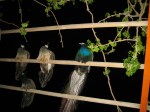
Following our host with a flashlight we stumbled over small dikes, through rose gardens, past an empty swimming pool, under the almond trees, a grape arbor with four magnificent peacocks resting on top, and back to the house where the rest of our party had already installed themselves on the flat pillows around the beginnings of a meal.

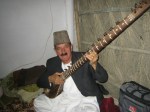
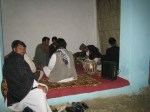
At the head of the ‘table’ sat an elderly gentleman next to a slighter younger man with a pockmarked face. They were the musicians summoned to enhance our pleasure. As it turned out they are famous in Afghanistan, Hadji Bahawaladin, the tambour nawaz and his table side kick. They are more often seen on stages inside and outside the country playing to large crowds. Our host knew them and has asked them to play in this very intimate setting, just for us.

The older of the two played the tambour, which I always thought were drums; but here a tambour is a kind of zither with a very long neck; the younger man played two full-bellied drums (table) that had a remarkable range of tones. He tuned his drums using a hammer to push small wooden blocks all around the drums up and down under the tense straps that held them in place.

But first we ate: qabuli pilaw, yoghurt, fried fish, kafta kebabs, salad followed by apples and oranges – a fairly standard menu. There was little talk; eating is serious business here. Then, after our walk around the grounds and after the dinner remains were cleared we sat down for an extraordinary and intimate concert. Only at the very end was there some dancing by a few of the resident staff and finally by our own guys, including one of the provincial health advisors who turns out to have a talent for singing.

And with this our trip to Mazar has come to an end. We headed home in a small twin engine over the snow capped mountains again and in less than 45 minutes were back on the ground in Kabul. Alain and I met Axel at the Flower Street Café in Qala Fatoula for a lovely lunch outside.

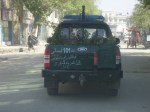
We drove back to Karte Seh behind a Police truck that was filled with roses – that’s what this place is all about: guns and roses.

It was too late to go to the office after that; we spent the rest of the afternoon and the beginning of the evening playing backgammon and scrabble outside until it was too chilly. It’s nice to be home again.
Stories

All morning we are hearing stories. Some made us happy, like the one from a ENT doctor who impressed the (German) funders of his clinic with the achievements that he accomplished after he went through our leadership program. He was even given a scholarship for a course in India.

But then the story, at least as told by him, turned sour. When the German organization discovered that he had a received a colleague of mine from the US who had interviewed him about his clinic’s success and highlighted the leadership program (we try to create leaders, and since this looked like one, we took some of the credit), his scholarship was withdrawn and he was asked to resign [I am sure we are missing some of the fine nuances].

Now he is deputy provincial director and leading there to his heart’s delight. This includes telling the governor about the Challenge Model while diagnosing his hearing problems.The ENT doc and his team proudly showed us all the initiatives they had taken which had resulted in an impressive array of public health achievements: number of patients showing up with dog bites at the clinic per month reduced from 40 to 0. For this dogs had to die – until the public is better informed, slaughterhouses removed to outside the city limits, losing fighting dogs not turned loose and pet dogs vaccinated. All this is part of their leadership project, for the long term.

They also increased vaccination of pregnant women to avoid tetanus, deliveries attended by skilled birth attendants, increased compliance with hospital infection prevention procedures and antenatal care. We all cheered; and not just for this team but for all the other teams that had produced similarly impressive results simply by changing their behavior.

A team from Balkh Province was invited to participate since they are our host. But Balkh is not a USAID-funded province and thus is not benefitting from our leadership programs. It is part of the arrangement between the European Union, the WorldBank and USAID: the 43 provinces were assigned (on what basis I don’t know) to the three funders. Balkh wants what the others get, and so we told them to talk with their chiefs and chief funder.

Each of us got some ‘easy’ (read ‘safe’), some difficult and some dangerous provinces, according to the conditions at the time of the agreement. That situation has changed a bit since then and the US is increasingly taking on provinces and health centers that were not in its initial portfolio. The EU and WB have not always taken kindly to these incursions. But, like the case of the Germans, one wonders, aren’t we all in this together to help Afghanistan?

The sad stories have mostly to do with security: friends killed by Taliban, death threats, not being able to wear a suit and a tie when travelling from one province to another, drugs being stolen and health personnel resigning to save their skins. We were also disappointed that a quick escapade that Alain and I had planned to the river further north that separates Afghanistan from Uzbekistan was nixed by our security people. They thought it too risky for us and, by extension, risky for our Afghan colleagues. And so we stayed in the basement all day, observing the workshop and our dynamite facilitator team.

Trying

After my first good experience here with the internet it stopped and didn’t come back for the night, nor the next morning; As a result I was not able to post an entry yesterday even though there was much to tell. And there certainly was no chance of putting the wonderful pictures up that I took during our tour yesterday later afternoon.

Alain and I took the facilitator team out for dinner to a restaurant that was recommended, the Kefayat Clup. It is a large complex that would have been called a pleasure garden in Babur’s days. Several halls, restaurant and even a coffee shop surround gardens and walk ways.

Outside one of the restaurants are the now familiar 6 by 8 feet carpeted eating platforms with their sitting (tushaq) and leaning (balish) pillows. We found it too cold and instead opted for sitting in the empty restaurant with a large and centrally placed flat TV screen and harsh fluoresecent lights; it was slightly less cold inside, the only redeeming feature.

The food was great: kabobs, manto, homemade yogurt, spinach, rice and ‘shepards’ salad (any dish labeled as a shepard dish indicates that it was and can be put together quickly).

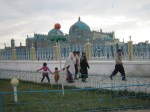
Colored lights outside outlined the shapes of trees (real) and giant flowers (not real) shaped like daisies and tulips. The tulip is everywhere: embroidered on ancient textiles, knotted into carpets, as giant shapes on top of the mosque, in advertisements for cell phone service. The tulip came from these parts of the world; the Dutch only exploited the commercial opportunity it provided by perfecting its shape and colors to match the whims of the buying public. But nature had given the tulip to the people here first; they just left it small and wild.

Back at the hotel I finally had to figure out the bedding arrangement. There were two small beds and one large one. Each had a mattress with a scratchy tweed-like cover, then a curtain-like shiny piece of cloth put over that and then there was one sheet, all slightly smaller than the mattress. Folded at the foot of the bed where a few of the giant and heavy Chinese blankets that are ubiquitous here. It was a little too cool to do without them.

I pulled the cover over me and its warmth quickly dispelled any thoughts of all of the hotel customers before me who had slept under the same cover. I marvel once again how easy we humans adjust to change – we may not like it, but we have no choice. That’s how things go here.

I was up early and joined Ali in the large meeting room in the basement where he sat in the half dark reading the book that we wrote at MSH some 5 years ago about leadership development. It is in its third printing now and we hope to have a Dari/Pashto version sometime in the future.

When Afghans have breakfast they ‘eat tea’ and so I was invited to do so. Breakfast, served on long tables, consisted of two kinds of breads, one small and savory and the other large and sweet with black cumin seeds sprinkled over them. The breads are served with small saucers of jam and cream, foreigners’ cream they call it, but this foreigner, who otherwise loves cream, declined.

Breakfast, as most other communal meals I have observed in Afghanistan, is hardly a social affair – everyone eats in silence and fast – as if it is nothing more than a biological requirement.

Treasure

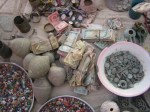
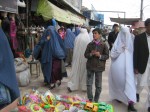
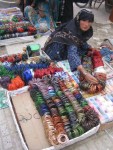
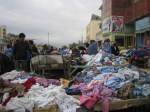
Alain and I asked for a tour of the city while it was still light. We drove to the enormous bazaar and then got out and joined the throngs of shoppers, walking through the sometimes narrow, sometimes wide streets of the bazar, with one of our hosts and guards in front of us and the others in back.

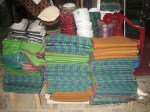
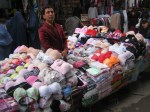
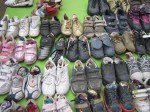
A good part of the market is taken up by merchants in second-hand (European/US) clothing and shoes. After that came the market for shiny women’s textiles before the bazar where men get their ‘Karzai’ coats, their woolen wraps, their hats, their scarves, their long Arabic dresses, and Punjabi outfits; less shiny than the women but exotic nevertheless.

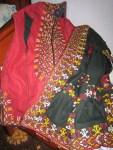
I wanted to bring back one or two of the Turkmen embroidered ‘chapans, stiff coats with long sleeves that have more of a ceremonial function than having arms in them.’ The Turkmen embroidery is the most striking part of the wedding dress that Sita bought in Lebanon. I had some fantasy of cutting one up and making a matching tie for the groom.

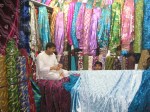
Our hosts led me to a shop that had what I was looking for, hundreds of them, stashed away between thousands of other exquisitely embroidered pieces of clothing and bedding. It was hard to choose from the collection. I don’t think I could ever put scissors into these coats to turn them into something else, least of all a tie.

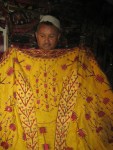
When the shopkeeper indicated that one of the coats was 8000 my colleagues asked, Afghanis or dollars, jokingly [8000 Afghanis is about 160 dollars – 8000 dollars is 8000 dollars]. The shopkeeper told us he actually had an 8000 dollar chapan. Everyone wanted to see it. He climbed on a rickety stair and pulled something wrapped in Ikat cloth from a pile of nondescript items. He unwrapped it as if it was a newborn baby. Inside was coat in perfect condition with the finest embroidery on yellow silk. The manufacturing date was embroidered at the bottom: 1915. The museum quality coat was made for and worn by an Uzbeki Prime Commandar nearly 100 years ago. We let him wrap his treasure up and put it back where it was waiting for the day that someone would gladly pay those 8000 dollars.

Mazar

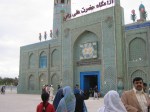
It was a little over 30 years ago that Axel and I had visited Mazar-i-Sharif and Balkh Province. At that time we had come here using a combination of public transport and hitch-hiking. It was fall and the colors were magnificent.

That trip was a little less costly than our 300 dollars one way flight with the UN plane. At that time we could have lived on that single fare for an entire month. But we never saw the magnificent snow-capped mountains that stretch between Kabul and Mazar. The plane provided us first row seats to this spectacular landscape.

We are lodged in a rather odd guesthouse that is clearly not catering to westerners. Signs and names are all written in Dari, including the name of the hotel. If it is appealing to any foreigners it would be Russians. The second language on the guesthouse business card is Cyrillic. This is no surprise as the old USSR is not far from here.

The place looks like some builder got a hold of pattern books with architectural flourishes from the oddest places, and then copied and distributed them pell-mell across the building and its various add-ons. The prevailing colors are pink and pastel green, except my room which is tinted pastel yellow and violet, like an Easter basket arrangement.

To its credit (and my surprise) the guesthouse has wireless (it works for a while); to its discredit the bathroom turned out to be without towels, soap or toilet paper. Someone had to go out and get it and came back with two brand new towels, 2 new toothbrushes, a big bar of ‘luxury’ soap, a large tube of toothpaste and a small bottle of anti-dandruff shampoo. Ask and the universe will provide.

When we arrived at the hotel at least 40 pairs of (men’s) shoes were outside the door. It looked like a second hand shoe market. I put my shoes among the others. My small clogs were hopelessly out of place between all the large and pointy shoes. But then I discovered that there was a separate shelf for the women’s shoes inside the entrance – a small shelf; after all how many women use hotels? As with anything else here women have a separate place for just about everything, even their shoes.

And so we all walk around the hotel in our socks or slippers – it feels a little intimate, as if you are among family. And in some ways I am – there are many people here I have known since early 2008 when I started working with the provincial teams. We are in this unusual and enviable position that we have the resources (thank you American taxpayer) to bring the provincial teams together not just once, not just twice, but every year at least a few times. As a result we are developing deep experience, deep knowledge and repeated skill practice rather than the usual shallow exposure that people get in one-off workshops.

When the program for the day was over the facilitation team started their end-of-day huddle and did all the things, and more, that I taught them a long time ago when I was still part of the team. But now I was excused, as all was done in Dari and it is their show, not mine anymore.

First Class to Kabul

Captain Courtney flew us back to Kabul and invited me in the cockpit for the duration of the flight while Axel got pushed forward to sit in business class, right in front of the president of JEICA.

I flew on the navigator seat where one week before Oliver North (yup, from Contra fame) had made the same trip as the host of Fox News ‘War Stories.’

Courtney and his co-pilot explained every dial and gizmo in the cockpit and answered all the questions I had wanted to ask for so long. The 737 cockpit is just a little more complicated than the Piper Warrior cockpit am familiar with; a few more dials and doodads.

Contrary to the heavy rains that were predicted it was sunny all through the flight. It was neat to experience life in the cockpit for the two plus hours of the flight. I can see that it can get a bit boring after you are at cruising altitude and we talked about the two Northwest/Delta pilots who missed Minneapolis by 150 miles, last summer. It is easy to lose track of time high up in the big void.

As we came closer to Kabul I learned about the drones that fly over Kabul (and presumably Afghanistan) that are ‘driven’ from somewhere in Nevada and that have a wingspan between 3 and 22 feet. Some of them are armed with missiles. They do appear on the radar so that you don’t fly into them as you navigate into Kabul.

We were directed to the jetway upon arrival because we had some Japanese VIPs on board. Their security stopped us all in our tracks until they retrieved some of the Japanese travelers who were back in economy.

The celebrations for Afghanista’s Nao Roz (new year) were in full swing when we arrived which had clogged up the traffic big time. The only unclogged road was the one over Television Mountain which allowed us to see up close the people dressed in their finest going to and from the mosque.

At the house we found that the gardener had planted 10 more rose bushes. The grape vines are pruned and the pear tree is in full bloom. We had a sundowner on the terrace and sniffed the wild mountain zatar (thyme) that we had brought back from Lebanon in a futile attempt to hold on to this dream vacation we just finished.

Rested and refreshed?

Our departure day was as glorious as the day we arrived. We spent the remaining hours, not with a massage as planned, but by walking one last time around Hamra, and sitting down for a latte in the sun at a sidewalk café. We sms-ed with the kids who were playing checkers at Frankfurt airport, who were also whiling away the hours before the last leg of their flight home to Boston. We made our last purchase, cardamon-laced Arabic coffee, to remember this week and then headed home.

The flight to Dubai was crowded and hot and by the time we left the plane I felt the opposite of the refreshed and rested self I was supposed to be and not at all ready to resume work tomorrow.

We had found the Nihal hotel on the internet. It appears to be in the Chinese-Indian section of town, if there is such a thing. It would explain the planeloads of Chinese we had seen at the airport. Not just Chinese but also Philippinos, Bangladeshis and others who, we assumed, come here to work. The economy must be picking up again.

After checking in we walked around the neighborhood and had an 11 PM meal at the authentic Chinese restaurant; this as opposed to the Chinese-Indian restaurant that is in our hotel. Remembering our large ice-cold draft beer on our way in, a week ago, we ordered beers. One of the young waiters whispered something in Axel’s ear he pretended to understand. Soon we did, when the waitress brought a plastic juice jug and two small teacups in which she poured something foamy. Beer was, once again, forbidding, at leas in this restaurant.

We had a great meal of sizzling hot beef and a mystery ‘special seafood’ soup with all sorts of unrecognizable things floating in it but it tasted great. The wait staff was young, and, as they told us in broken English, from all over China, and ‘no, they were not all part of the same family.’ The place was rather well staffed and the kitchen was full of cooks cooking amidst much steam and huge flames dancing around the giant woks. Yet there were very few people in the restaurant actually eating. That it was authentic was obvious since most of the patrons were Chinese.

And now we are at the airport for the last leg home. At check-in we heard that captain Courtney is taking us there so we feel in good hands, especially knowing that the weather forecast for Kabul is ‘very heavy rains’ for the next four days.

Meeting the dress

Before this momentous event we drove up with Monsieur Joseph at the wheel to one of the few remaining spots with cedars in Lebanon. The road was winding and scary at times and made Tessa sick. I am sure the sickness was exacerbated by Monsieur Joseph’s broken French and English and the way his thumbs drummed on the steering wheel. We also had to ask him not to light up, a bad Lebanese habit that, although slightly diminished in the last 30 years, still kept astounding us: drivers behind the wheel, salesladies behind the cash register and tough looking guys in places that say ‘No Smoking.’

When we finally arrived at the Cedars National park we found it covered in snow and locked – no one there. Shivering (wrong clothes) and with snow falling on our heads, we hiked up the road to find an opening in the rusty barbed wire fence. Only Sita, Jim and I ventured through the hole and worked our way down a slippery hill to the oldest cedar in Lebanon, one that was somehow overlooked when the Great Temple was built in Jerusalem.

According to the small sign that that Rotarians of the Chouf put up it was 3000 years old (or 10000 or 1000 or 30000 – someone had altered the printed plate); old, in any case, with a circumference of 16 meters.

Eventually the main gate was opened when a lady of some import arrived with her South American visitors and called the right guy. We sent Monsieur Joseph to retrieve Tessa and Axel who were already walking down the road so that they too could see the old cedar. Everyone hugged the tree to catch some of its life force for longevity and then everyone went inside the small hut and hovered around the, for us familiar, diesel stove with a cup of hot mint tea, complements of the Lebanese Park Service.

To the great disappointment of Monsieur Joseph we declined to see the palaces on the way down to the coast. One of those, Beiteddine, used to be an obligatory stop when people came to visit us here all these years ago. When I left Lebanon I swore I would never stop at the place again. Sita had already seen it during her short visit to Lebanon last year it and the rest was OK skipping the sight as the hours towards departure ticked away; there was some last minute shopping to do. ‘Oh,’ sighed Monsieur Joseph, ‘shopping, why?’

We had him drop us off at our place, unloaded our picnic implements (we had had this fantasy of spreading a blanket under one of the cedars and have our French bread with Camembert and white wine while looking out over the faraway Mediterranean Sea); instead we ‘picnicked’ in the car on the way home.

Just around the corner from Bliss Street it happened: Sita met her wedding dress. It stood in the window of a store called Elissar and Other Stories and was made from fabric from Central Asia: Uzbek, Chinese and Turkman. It cost more than my entire collection of dresses ever owned but the two had fallen in love. She tried it on and the battle was lost. It’s on its way to Haydenville now and we all agreed it was spectacular; one of a kind and, most importantly, Jim liked it.

Tessa bought a narguileh (shisha, hubbly-bubbly, water pipe) that was not made in China – not easy to find – for her Steve and everyone carried at least one shopping bag with stuff to take away from Lebanon. We went back to the Wellington bar in the Mayflower Hotel to toast to the best family vacation ever, and to three couples, us celebrating our 30th anniversary in a few weeks, Sita and Jim to their upcoming wedding and Steve and Tessa to many more good years to come and a more understanding employer.

We had our last dinner with Birgit and Alistair who were all packed to go on their ski vacation in France. And then we said goodbye to the kids, all teary and sad. They should be in Frankfurt now drinking large steins of beer and eating sausages while looking wistfully at the photos and the dress.

For us, the vacation isn’t quite over yet. We have one more morning in Beirut that may include a massage to relax our muscles that are sore from walking so much. After that, we too will hop in a taxi and head for the airport to fly in the opposite direction from Haydenville.

By car and foot

We sent the progeny off by car to see the southern coastline and visit Tyr while we spent the day by foot in West Beirut.

We picked up the CD with the results of my MRI at the American University Hospital. It came with a diagnosis from Dr.El Merhi who mentions a gap filled with fluid, signal intensity, atrophy and shoulder joint effusion. I don’t understand what it means but it sounds a little ominous. We are sending it off to Boston with Tessa and wait for instructions on what next.

We walked around for hours in the city, looking for things that cannot be easily found in Kabul, or can only be found in places that are off limits, like the bazaar. This included buttons, espresso cups, a map of the region we live in and a cookbook to teach our cook how to reproduce the fantastic Lebanese meals we have had here.

We also each had a haircut. I had the fastest haircut ever. In the 15 minutes I was in the salon I never got to find out whether my coiffeur was indeed named Jacques (I assume all male hairdressers go by the name of Jacques). He complimented me on my hair. I told him it was my father’s and sent a quick thank you to the heavens.

Axel went to the barbershop around the corner. It was the same he frequented 30 years ago. It had not changed a bit. Only Jack, the then barber had gone and now lives in Torrence, CA. It was Mr. Philippe who cut his hair. And not only his hair, also his beard, eyebrows, nose hair, neck hair, everything!

At the end of the day all of us, including Alistair and Birgit, went out for Sushi in Achrafiyeh and enjoyed a great meal together. I paid the bill out of the pot of money that is replenished every week I am in Kabul with ‘danger pay.’ That’s what it is for.

Tourist-3

If our trip to the Jeita grottos was about nature’s ingenuity, yesterday’s trip to Baalbeck was about man’s ingenuity and what you can do with free labor.

We walked around the massive stones and pillars for hours; first with our guide who looked liked uncle Paul, or, with his sunglasses on, like our Manchester neighbor Bill. Then, after lunch and on our own pace, now more knowledgeable, we went back and toured the site once more.

Just as I remembered from my last visit there, some 33 years ago, we were practically the only tourists. The only other flock we spotted was a busload with Japanese but they were in a hurry and disappeared quickly to their next destination.

In English that took some getting used to our guide explained both the socio-cultural and architectural context of what we were seeing. We marveled at the 1000+ ton stones that were sitting in places that nowadays would require enormous cranes.

The whole complex is a study in patience: the large temple complex took several 100s of years to complete and by the time the last pagan decorations were to be carved Christianity arrived with its own symbols and so the carving stopped. New images and symbols were called for.

Some of the granite pillars had come all the way from Upper Egypt: again, all this is possible with patience and lots of free labor.

For lunch we went easy and chose from a series of prepared dishes in an unassuming local place. There was no wine as we were in a predominantly Moslem region of Lebanon with many of the outward appearances of conservative Islam.

We talked Sita out of buying a Hizbollah tea shirt but she did manage to get a laminate plate with the image of the disappeared Moussa Sadr who never got off the plane he took to Trablous in 1977. In that part of the Beqaa Valley he is still very much present.

On our dizzying ride back over the Lebanon mountain range we stopped at the Ksara Winery that produces the wines we have been drinking. We were too late for the wine tasting and tour but not too late for buying. We bought a few bottles to replace the ones we had consumed at Alistair’s with maybe an extra to take back to Kabul and sneak through customs. We did buy a small bottle of arak because we have this fantasy of sitting on the terrace of our house in Kabul on a warm spring evening in the near future, recalling memories of our Lebanon trip.

The culinary highlight of the day was our visit to La Creperie, a restaurant that is perched on a rock overlooking Jounieh’s harbor in Kaslik. The restaurant is owned and run by Fadi who is the father of my MSH colleague Mayssa. Mayssa and I share a love of Lebanon and so I was introduced to the restaurant some time ago and a visit was on the program. But each day our lunches were so enormous that we did not need an evening meal.

After our simple and small lunch yesterday the timing for dinner at La Creperie was right. We were chided a little to have waited so long (4 evenings) for our meal there. But our explanation was accepted and our reasoning had been right, one should fast most of the day before going to La Creperie.

We were given the royal treatment in every which way as Fadi pulled out all the stops to give us a ‘taste’ of what his restaurant has to offer. We stretched our visit to over 3 hours munching on this then that galette, this then that crepe, liberally accompanied by Bretagne’s best Cidre. The meal was completed with fruit and coffee accompanied by a small glass of a local triple sec called Orangealina that is produced by another fine Lebanese wine estate, les Tourelles.

It was Lebanese hospitality at its best. We were treated as family. This also meant that there was no check at the end and an exhortation to visit again soon. We happily agreed to do so. It is one other reason to bring us back here. Last night’s was probably the most extraordinary eating experience we have ever had here or anywhere else.


January 2026
M T W T F S S
 1234
567891011
12131415161718
19202122232425
262728293031  

Categories

Blog Stats

  • 137,290 hits

Enter your email address to follow this blog and receive notifications of new posts by email.

Join 76 other subscribers