Archive for the 'On the road' Category


From groentesoep to imperial suite

The economic turndown also showed itself on the plane leaving Amsterdam; it was only half full. Once again I had an entire row to myself after my neighbor moved to the row in front of us. That was a good thing because for the 30 minutes that he did sit next to me he imbued the entire row and especially his seat with the smell of Dutch groentesoep (vegetable soup). The pungent smell lingered for a long time after he moved. I have nothing against vegetable soup, I like it, but as a smell on humans it is not so great.

We left Holland a little later than planned because the plane could not disconnect itself from the jet way – as if some mechanical umbilical cord tried to keep us from leaving. It took two batches of mechanics jumping up and down something to shake us loose.

While flying over the Alp and the Mediterranean I watched Oliver Stone’s ‘W’ and was most intrigued by the senior leadership team scenes. I think it would make good discussion material for such teams about what it means to lead at the very top. As a psychologist I was also drawn into the parental dynamic and wondered how much of world affairs is influenced by powerful sons (or daughters – but there are less of those) who feel the need to prove themselves over and over again and show their dads, dead or alive, that they are worthy human beings, while breaking things along the way. The book I just finished (We Were the Mulvaneys by Carol Oates) is about the same topic. I think I have never quite disengaged from my original professional ambition to be a family therapist; a person who I believe does the world’s most important preventive work.

I have observed this dynamic up close and nearby but the harm that can be inflicted on others in the process is usually contained and mostly local, unless of course the family produces a future president of the most powerful nation in the world. In that light Obama’s story is just as interesting.

In Khartoum we refueled and I watched the day turn into night in no time; as a northerner this short twilight is always a surprise. I much prefer our drawn out process and the slow transition from light to dark and vice versa.

The last part of the trip gave me just enough time to scan the bulk of the background documents that I had been saving into one ‘to read’ file. I am lucky that Liz is already there and can brief me on the lay of the land and all the things she already found out after a week in Addis. She’s known as a super productive worker; I have already noticed that.

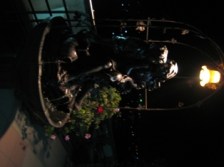
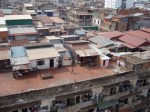
We landed in Ethiopia exactly at the appointed time and I was out before Kalid the driver, who was sent to pick me up, arrived. He intercepted me just as I was about to get into a taxi. I arrived at the hotel and was given what appears to be the imperial suite, a three-room affair with a huge terrace where you could hold a party for fifty people. It looks out over the red light district below and a good chunk of the city. ethiopia-005It has several gurgling Italianate fountains with cast iron lovers and vines, a gas terrace heater like you find in cities that use terraces all year round even when cold. There’s more: a vending machine, a gas grill and about 5 outdoor furniture sets (large round tables and chairs) plus a swinging settee. I have a strong suspicion that it is not just for me. In fact, when we did a workshop in this hotel during my last visit this is where we had our coffee breaks. But now, late at night, all is quiet and I am here alone.
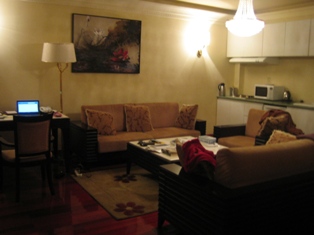
ethiopia-006Inside there are two large flat screen TVs, one in my (king size) bedroom and the other in the living room with kitchenette with its well stocked refrigerator (drinks only), four burners, microwave, 8 kitchen cupboards with only the most essential china and silverware for two, and a granite counter top. There is also a fake fireplace with a plastic log, also of the Italianate style. These Italians surely left their marks here. And finally I have fairly good speed wireless. All this for 60 dollars less than the US-government allowed maximum rate so I am actually saving money for the American tax payer. A flyer on my desk of the hotel group that, I suppose owns this hotel invites me to ‘bring my exhausted sole & depart singing…’ So stay tuned.
Gloom and room

The world economic crisis is showing up in the gloomy graphs on the front of the Dutch newspapers and in the empty plane to Amsterdam with room to spare. I have rarely had an empty seat beside me on my twenty years of Atlantic crossings. My first two flights in 2009 allowed me to sleep, fully extended over 4 seats as if in a bed. This is when a good thing is actually a bad thing.

And so I had a good (half) night sleep, full of dreams. The only one I remember is that I was about to receive a visit from some official who was coming to my house to extend a permit for something that was up for renewal and for which I had to show my continued proficiency. I knew I had to bone up on procedures or rules that contained precise numbers that I had forgotten. Somewhere in my (childhood) room there was a booklet that I needed to review before his arrival; but I couldn’t find it and the search became increasingly frantic. And then the beverage cart came through and released me from my anxiety, offering me watery tea in a Styrofoam cup and a tiny cereal bar that is supposed to taste like apple.

Axel drove me in to work yesterday morning. He had an appointment with the brain injury doctor. The visit was a routine check up and things are going in the right direction. But I did notice he forgot his wallet as we got into the car and is easily distracted when he remembers things he should have done/taken and did not – mostly small things, usually with little or no consequence, that show that his executive function is not quite where it needs to be. In spite of this handicap he appears to be handling the complex and complicated job of chair of the town’s community preservation committee remarkably well. But then again, if you work in town you can pretty much leave your wallet at home.

At work there was one more all-morning meeting with our evaluators, this time less powerpoints and more conversation that showed our virtual capacity building portfolio. I have seen it expanding over the years, seen colleagues learn their way into this, including myself in the area of virtual facilitation, and realized as I listened to their presentations that we have come a long way and have much to be proud of.

At lunch time Morsi, Jennifer and I took our intern Nuha out to lunch to celebrate her last day with us, or maybe it is ‘mourn’ her last day. Nuha and I have gotten quite close since we met less than a year ago in the BU course, she a student, and I the professor. We have introduced each other to our respective worlds, hers a world populated by women in a desert kingdom, mine a New England one that includes a lush Lobster Cove, trips in small planes and eating apples straight from the tree.

Nuha showed us pictures of camping out in the Riyadh desert with her female relatives, including a video of singing around a campfire. I have an open invitation to visit her when she is back in Riyadh and participate in such an event. It looks like fun but definitely would require some intense work on my Arabic before I go as it will be a total immersion experience.

The tent is not like what I thought hearing the word; in her world a tent is a like a huge Bedouin tent, permanently set up in the sand on the outskirts of the city, that you can rent if you don’t have your own, and all you do in it is sleep as the days are too hot to be inside and the evenings too cold (close to zero Celsius) and so you sit outside around a fire – it is the desert after all.

I have nearly finished working through my 10 Pimsleur Persian lessons during my commute to work and decided to check with my Afghan colleague Saeed whether I am actually learning something that people in Kabul can understand. He told me that people would notice that I spoke the language of Iran rather than Afghanistan but they would understand me. The problem is that I would not understand much of what they would be saying to me as the words are quite different. I now imagine that the difference is something like between Portuguese and Spanish, where the Portuguese can understand the Spanish speakers but not the other way around. Thus, getting an Afghan tutor is becoming more important now to help me make the adjustments in my newly acquired vocabulary.

And now I am in Amsterdam, waiting for my next departure, just a couple of hours away, first to Khartoum and then Addis.

In transit (last leg)

Worst it is, indeed. Although the flight is not full I am seated in a middle seat of three. Luckily I am separating a couple and end up with the aisle seat after all; so much for having platinum status. Yet the flight attendants keep coming by to see how the couple is doing (“you are travelling a lot with us!” she exclaims to the reunited couple, and asks if they are seated right, and I wonder ‘What about me?’ but then I remember I am a code share guest, a NW frequent traveler albeit on a KLM plane).

There appears to be a new subservience from the staff to the frequent flyers and I wonder whether directives have come down from the top to treat the most frequent flyers extra special, what with the economic downturn, you don’t want to lose those.

The seats seem a little closer each trip I take. Now even my small computer no longer fits on the tray table once the gentleman in front of me reclines. I try to type in a rather contorted way for awhile and finally ask him to un-recline. He is nice and sits straight.

I read more about the Khmer Rouge and thank my lucky star for having been born half a world away. The book gives me a new perspective on sitting in a crammed space and I realize it is not so bad after all.

I am no longer grimy because I took a shower, washed my hair and put on clean clothes for the last leg of my trip. After 14 hours in the sky and 8 hours of waiting in various airports I needed that.

The last 7 hours seem not so bad anymore. This assumes that we will depart on schedule – not entirely to be taken for granted as I look at the snow flurries and dark clouds hanging over the polder and moving in fast with heavy winds.

Now it’s time for some phone calls and then back in line.

In transit (middle)

As it turned out several hundred people decided to fly to Dubai from Bangkok in the middle of the night – not one seat was empty, despite the fact that one hour later another 777 was leaving for the same destination.

Landing in Dubai is delayed. We have to make a big circle over the city when another airplane is not vacating the runway in time for us. A go-around in a 777 takes a lot longer than one in a Piper. The last minutes of long flights like this are already tedious and endless, and now the go-around extends the agony by some 15 minutes.

It’s a long walk from terminal 3 to terminal 1 but it feels good to stretch my legs. I pass several smoking lounges which look like holding pens with people crammed into small spaces that are opaque with smoke; if you enter in one of those places you will get first, second and third hand smoke all at once; as a passerby I get a few whiffs myself since not everyone smokes inside the pens. I am glad I abandoned the habit long ago.

And now I am in the KLM lounge waiting for the next leg of my trip and am treated to a Larry King interview with the ex-governor of Illinois who is still in la-la-land (“I hope to wake up one morning and everyone realizes it was one big misunderstanding.”)

This is the schizophrenia of my life when traveling: from the poverty of Cambodia to the obscene luxury at Dubai airport where all the information counters are about ‘enhancing your shopping experience,’ rather than telling you where you can get your next boarding pass; from the warm fuzzy feeling that comes from working with people who fight against poverty to the disgust of seeing or hearing about people whose brittle egos need power or money or both.

I am told the flight is not full. I asked for an empty seat next to me but that has never worked and so I prepare for the worst.

In transit (beginning)

Room-less I scout around the hotel lobby for a plug so that I don’t have to use up precious battery time for the long trip home that starts in an hour. I checked out of my room at noon time after doing all my reports and emptying my mailbox so that I can start with a clean electronic desk when I get home.

Prateek came to pick me up for a last Cambodian curry lunch and a last tour of Phnom Penh which included a visit to the mall to replace the socks that got lost in the free laundry at the 12 dollar a night hotel. This mall is the hotspot for Cambodian teenagers; they hang out, date, go roller skating and eat American fast food on top of a noisy six-story building. If you make it past the throbbing crowds of teenagers you actually have a very nice view of the city and its river.

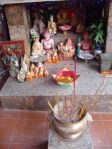
To balance the new with the old we also visit the hill that has given the city its name, with its temples, shrines and statues and countless places that can hold bills, incense sticks and other offerings that keep this place and its visitors in good shape. There are monkeys on the hill that escape into the city and walk across the various cables that crisscross above the streets as if they are in the jungle. I have never seen urban monkeys. Only the tourists pay attention to them.

At the airport I buy one of the many books I now want to read about this country, a biography of the bad guy (Brother Number One) by David Chandler. I had not expected the variety of books about the dark period at the well-stocked airport bookstore. Many of them are first person stories but these are not what I am interested in. I select the biography because I am curious about the personal history and how it intersected with what was happening on the world scene. I read about one fifth of the book on the short hop to Bangkok.

Emirates is at the uninteresting concourse where I have a long wait, sans lounge access, seeing both AF and KLM depart long before my flight, going straight where I want to go. But first I have to go to Dubai, my 6th visit in 3 months. I am already tired, feeling sweaty and grimy as if at the end of various long transits but I have only just started my long journey home. I keep my fingers crossed for an empty flight – why would anyone want to go to Dubai in the middle of the night?

Luxe and leisure

I have a gravlax croissant and coffee for lunch in the small area in the Phnom Penh hotel lobby that is cordoned off for tea and pastries – as if to pay homage to Axel’s ancestors. But it is also to give in to a desire for coffee, even bad Nescafe, after having been coffee-less for 10 days and living on an entirely Cambodian diet. I like variety and the sandwich plate in the showcase seemed to offer just that.

I have returned to luxury, to a hotel that costs 5 times as much as my luxury room in the province and it is luxury indeed: no mosquitoes and geckos on the wall, a real bathroom with a full bath, internet and a mini bar (extra charge of course) – and down one floor all sorts of massages to choose from plus a bunch of restaurants. I think I’ll go for Japanese tonight.

We had our final meeting with the team in the provincial capital in which we celebrated once more the significant accomplishments of the last two weeks and gave ourselves another round of applause. I handed out my usual small symbolic gifts and received two real gifts in return, one for myself and one for Axel. Then Leonard focused the team on what will need to be accomplished in the next 6 weeks.

Back in Phnom Penh we met at the fortified USAID embassy in the center of the city to brief our funders on the accomplishments of the last two weeks and make promises for the next 5 months and then it was time for a second round of goodbyes. There are no plans for me to come back here as I am not in any budget but I wouldn’t mind another visit to this country, and, as Leonard reminds me, I haven’t tried the fetus-in-egg yet (plus a few other insects).

I rewarded myself with a massage by Nika at the Seeing Hands place. For the price of six dollars she gave me an hour long massage, exclaiming ‘Oh!’ each time she found another set of knotted muscles. Nika is 33 and has been blind since she got measles at the age of 1. The Mary Knolls Sisters send her to Japan to learn massage and English; as a result she speaks English with a Japanese accent. Stacked against the wall of her small room are several tomes about massage in Braille; a Braille version of the poem ‘The Gift’ is tacked on the wall – not framed of course. She massages me expertly even with one hand when she answers her cell phone.

The tuk tuk driver brings me back to the hotel and points at the Raffles Royal Hotel that we pass on the way. “The very special person room costs 2000 dollars,” he says. I wonder what this means to someone for whom 100 dollars is probably a fortune.

And now a leisurely evening in luxury – sushi, sake and a long warm bath.

Done

Leaving my computer at the reception desk to let it download emails at snail’s pace, I ate by myself last night since my team mates all had other plans. The restaurant was awash in noise: a bunch of totally unrestrained young children running around and screaming at the top of their lungs, a loud family party that was spread out over three tables with much drinking and falling and braking of bottles and a TV that was set at high volume showing a Chinese drama, whimpering women, bad men and all; a dining experience with much distraction.

The young men who is the night attendant on my floor in the hotel is studying a mimeographed paper called ‘Leadership and Communication,’ in English. I flipped through it. It’s theory that comes from the US. I’d love to sit and chat with him about what he is learning but the period in which we are both in the hotel and awake is very limited. Many of the young people on our team are also studying in the weekend, after work hours. There is a tremendous commitment to improving oneself through study.

For the last time we pile into the car for the 60 km drive to Chamkaleu, three people in front and four in the back of the pickup truck. We arrive with mopeds streaming in from all sides and once again we start exactly on time. The discipline here about arriving and ending on the appointed time is striking; it helps that this is a society of early risers and there is little traffic this far out in the province.

Nara from the provincial health department opens the day with a morning reflection about what we did yesterday. This is where not understanding a word is a handicap. I am trying to get the facilitators to adopt this practice of reflecting regularly but it is still very new and the responses from participants superficial (question: what did you learn? Answer: leadership!). I explain that the role of the facilitators is to make explicit what is implicit, to have people notice how their feelings and moods are affected by design and methods; to help them articulate vague and unexpressed feelings of engagement into actionable lessons about how alignment around a shared vision can mobilize otherwise inert and passive people.

I struggle behind the scenes to get the translations of the results that each health center has committed to produce in the next five months. We are looking at flipcharts with script that is already undecipherable for me, made more incomprehensible by words crossed out or added. Even for the best English speakers this is not easy; a word by word translation leaves me with multiple meanings. I seek a kind of precision that is hard to get, even in English, as I try to wean people from imprecise abstract language that is copied from highly conceptual documents and has little meaning to people who do very concrete work.

I can see the pieces falling into place for the facilitators when I notice that one has improvised a session that is not in the notes and should have been, logically connecting one session to the next. From time to time I check on translations especially when the group is suddenly energized. I have learned in the past that such surges are sometimes caused by the (real or perceived) expectation of goodies coming in from the NGO or donors. People spent much energy on making of lists of things they want to have (and be given). The idea is to stimulate people’s creativity and encourage them to look for the resources that are already there with people’s energy among the most precious and least well managed of them all.

The last session before the break is Covey’s circle of influence. This is interesting because it is so very American in its key assumption: the only thing you can control in life is your own behavior, attitudes and, in principle, your thoughts. This society knows a thing or two about control and so, not surprisingly, the central belief is challenged and needs some digestion. Bunthoeun leads the discussion with great verve and a booming voice that reverberates so loudly through the sound system that I take refuge outside the classroom. He was told earlier that he scares the more timid women and needs to speak more softly to the females. I am told he is trying after he gets feedback from his peers.

For lunch we go back to the same restaurant which has more wonderful soups, vegetables and fish ready for us but also many flies. It is hot again and some of the food is too and so my face gets red. They are worried that something is wrong with me and I explain it’s my northern skin, unused to heat of any kind but nothing to worry about.

There are a few features about eating here that I like at lot, one is the large beer mug filled with hot water from which you retrieve your eating implements, forks, spoons and chopsticks. The other is the young women that walk around with large bowls filled with rice and spoon more on your plate as soon as you finish. People eat huge quantities of rice – it’s always the centerpiece of the meal.

The afternoon starts with an ice breaker, as each afternoon has, accompanied by much laughing. The provincial chief has arrived to be with us in the afternoon. The session he was going to facilitate has come and gone without him. I am curious what will happen next, since we had announced earlier that he is on the facilitation team. He jumps in at the end of the session about sphere of influence and gives an example that has to do with drinking. It’s a message about being a role model and controlling one’s own behavior and not succumbing to group pressure – a rather unusual message in this part of the world I gather, but received with applause from the group.

In the meantime Leonard is busy preparing our presentation to USAID tomorrow afternoon and so we have to recreate the vision in English, from pictures and Khmer words. I create a new mind map. It has the same content but is organized a little tighter in four categories: staff, services, environment and sustainable results. We carefully pick words that can be found in the picture and resonate with our funder.

In the meantime Rany is doing an exercise about listening that is always an instant success in Africa and needs very little explanation. Here it’s different. Rany needs to demonstrate the exercise twice and explain it in great detail. I am puzzled by the difference and explore with Leonard, in the back of the room, the patterns he sees in Cambodia that he already told me about two years ago in Nepal. Some concepts and tools are picked up much faster here than in Africa while others require considerable effort. People ask questions or make comments that surprise me and that no one has ever asked before (‘what if you don’t want to listen’? Or, ‘people are used to being interrupted by cell phones, what’s the big deal’?)

But in terms of energy I have found my match in this country, or at least with this group of facilitators. They have boundless energy, like I do and they are doing much of the work I usually do, freeing me up to write long entries in my blog and reflecting on what I am seeing happening here.

We end the first workshop and my task here with formal speeches and then the 60 km drive back again. We ‘debrief’ over dinner that includes singing and incomprehensible dancing, in an open air restaurant with bugs everywhere and geckos feasting as much as we do. Everyone is happy, proud, relieved and exhausted. Although I still don’t understand a word of what people are saying I am happy and proud too and enjoy watching these people I have gotten very close to these last two weeks, thinking ‘this is what people ask for when they say they want to live in peace and happiness.’

Summits and marathons

I have crossed a psychological divide. No longer looking up at the hard to reach summit (we’re there), now I am looking down to the return to base camp. This part of the journey includes the passing of the baton and the many long flights it will take to return to my favorite place in the world. A message from Axel tells me that among all the things I have to let go is also the fantasy of flying straight from Bangkok to Amsterdam. I will leave Dubai for Amsterdam just when the direct flight from Bangkok to Amsterdam touches down at Schiphol airport. It’s too complicated to change my return and potentially very costly. I do feel a little abandoned by my headquarters. I put all these feelings on my hand and blow them away. Next chapter.

And so now on the down trip I find myself less interested in immersing myself in the Cambodian experience, there is a pulling back. I have decided to skip tasting the medium size egg fetus. I am also getting tired of sleeping on hard beds, having a shower that leaves my bathroom completely wet (there is no tub, the shower is simply mounted on the wall) and the difficult email access that has me sit on a hard wooden bench early in the morning in the dark between sleeping staff or late at night, in a mosquito-infested lobby for hours. Someone sent me something very large and it is clogging up the works. I left my computer in the lobby for a couple of hours over dinner but nothing of the 23 MB came through. I have to remember to change my download settings to save myself from such grief.

Going downhill is not quite the right metaphor, nothing is going downhill; energy among the local facilitator team is going up and so is their confidence. It’s more like the final mile in a marathon, not that I have run the real thing, but I imagine that this part of my work is what it feels like when a runner enters the home stretch.

Today Be and the provincial director of MCH are running the morning session about personal and organizational mission and vision. It is complex conceptual stuff. They have struggled hard to grasp it themselves and are just a few steps ahead of the people they will be teaching. It’s an act of courage on their part. They are very prepared, and very anxious. How anxious is illustrated by Be’s dream which she recounts over her ‘pang’ (bread) and ‘jam’ breakfast: she dreamed that she was standing in front of the group and everyone stood up and walked out.

When it is her turn to lead the piece about personal vision I recognize the Khmer word for dream (samai) – but this is the good kind of dream, the aspirations we carry in our head. She gets everyone to close their eyes and takes them on an imaginary visit to the future. There is some giggling as this is all very new but Be confidently encourages them to go to this new place in their heads. I think she can do this because she has a big dream herself that we have been exploring, for practice, over the last few days. Nobody walked out.

I keep thinking about the dreamless (or nightmarish) state that many of her generation have been in for so long, especially between 1975 and 1993 – a long period of hopelessness, violence, dread, loss, grief, anger and deep sorrow. Like Afghanistan, this is a place that could use visions of hope that things can change rather than yet another assessment of the problems people have. This is always where I clash with professional planners or experts who start with problem identification. I am thoroughly convinced that it’s a bad starting point for change in a traumatized place as it breeds feelings of discouragement, powerlessness, and victimhood. Be writes down the saying from Proverbs (where there is no vision, people perish). This country knows about this first hand. It took the Vietnamese to drag them out of their nightmare and keep them from perishing entirely.

At the opening session yesterday Um Sithat said that this workshop may feel like a very cheap workshop because there are now powerpoints and there is no LCD projector. People nodded their heads in agreement. Now they are discovering that there are more engaging alternatives to this most common mode of workshopping. Time passes quickly as people talk about their hopes and dreams for the young people of Cambodia.

We say goodbye to Naomi who is off in a taxi to Phnom Penh to depart early on Friday. The rest of us go to the same restaurant where a large bowl of cabbage noodles soup is waiting for Naomi so she doesn’t have to open a can of beans and Pringles. But she’s gone and so we eat it plus all sorts of other dishes, including one with chicken innards I don’t care that much about. Rany asks for a doggy bag because there is much food left over – it is literally for the stray dogs at the District Health Office that she has adopted. Rany is the kind of dog lover who isn’t put off by scruffy beggar dogs like I am. She feeds them and they love her for it.

It’s hot now, and humid; a little hotter each day. After lunch I am tired and something in my stomach is rumbling, probably from Naomi’s cabbage soup. My deepest wish is to lie down and take a nap but we have arrived at a critical junction where the foundations for the centerpiece of the program are laid: each health center team is to select a short term victory (a SMART result) to which they will make a commitment in this program. Each team will be asked to show their accomplishment in 5 months. If they get it right, it will show that something significant will have changed as a result of their leadership and management skills. If they get it wrong we won’t be able to determine whether there was a change or not and our program ends up in the dustbin of the world’s well intentioned capacity building programs, fun, exciting but without any impact on what people actually do.

The exercise is intense with me coaching two levels at the same time: the participant teams and the facilitators who are learning as they go which means that sometimes participants get contradictory advice, leaving everyone confused. We struggle through literal Khmer translations that can mean several things, verb and noun at the same time, blurring the lines between strategy and outcome. There is no one on one translation which makes my task even more challenging. The facilitators are getting tired but they remain keen on ‘getting it.’ Me too and so, once more, we soldier on.

A welcome break offers us small packages of banana leaves with surprises inside. One with a coconut pumpkin mélange, the other with an opaque jello substance with yet another surprise inside, something made from sweet beans. There is also corn on the cob (steamed), tamarind pods and pottrea, a small plum like fruit that tastes like apple.

We end late, too late which means driving back in the dark, not a good idea here. Everyone is exhausted and the 60 kilometers back seem to go on forever. Tomorrow is the last day. We’ll do better.

Letting go

In the parking lot of the hotel is a camper with stickers from various Latin American countries, and France. It is inhabited by a French family, consisting of a dentist, his wife and their two children in their early teens. They are on a four-year around the world tour, homeschooling the kids and exposing them, quite literally, to the world. After their dinner in the restaurant they retreat into their camper which is surrounded by a crowd of locals who stand or sit on their haunches around the vehicle. You can see them wondering in their mind what this is all about. I am given a business card with the family’s website. We talk in French. He apologizes for being a little behind in his postings. That makes at least two of us writing about our adventures in Cambodia. They’re leaving for Vietnam tomorrow.

We’re off early to get to Chumkaliu on time. The restaurant isn’t even open and I wait between the sleeping bodies of the receptionists and guards, lying on stretchers around me. I use the time to fill up my inbox, which takes awhile. The breakfast we ordered isn’t ready at 6:15 AM as promised and we have it packed up because we have to leave. Leonard drives us, claxonning loudly through clusters of motorbikes, kids walking and biking to school and dogs.

When we arrive many people are already there. Half of them have already been exposed to what we are going to teach them in one of the three events we have done so far – some, including the big chief from the province have now been part of the introductory session three times. For the facilitation team it is their fourth time.

We go through the usual opening protocol which I now know by heart: the highest chief is called to take his seat at the front table – applause accompanies him. The table is decked out with a baby blue satin skirt and pink rosettes at the corners, a flower arrangement next to the microphone in front of him. Then Naomi’s name is called (Dr. Naomi) and she moves in position, applause again, and then it’s my turn, applause. Naomi is asked each time to say a few words before the official opening by the chief. The microphone has an echo that reverberates around the small room. It reminds me of the chocolate salesperson at the Topsfield Fair who uses his microphone to gather a crowd. I fail to convince my team to put the microphone away since it they have convinced themselves that they cannot be heard in the back. I suggest they check rather than assume but after four tries I give up. And then, suddenly, they stop using the microphone, after I stop pushing. Something about yielding.

I am getting a bit distracted about my flight back to Boston because I discovered, rather late, that I am routed from Bangkok via Dubai to Amsterdam while there is a direct flight out of Bangkok to Amsterdam that will save me half a day and a two hour wait in the middle of the night in Dubai. It’s a little detail I missed in the hurried last-minute travel arrangement before I left Boston on January 9. In the meantime I learn from the head office that the travel agency that issued the ticket has gone out of business and my request is not an emergency. I decide to send an email SOS to Axel to see what he can do – it’s in his own interest as he would get me back half a day earlier and slightly less exhausted.

For lunch we go to a local restaurant; lunch was already ordered and shows up instantly: spicy beef that makes our eyes water and ginger-fried fish. Naomi has brought a can of vegetarian beans (including a can opener) and a can of Pringles which she offers to everyone. I pass and indulge in the dishes put in front of us. There is much joking about the junk food but some try.

After lunch we start with the Cambodian version of Simon Says; here it is Angel Says. There is much laughing. The enthusiasm, anywhere in the world, for such games tells me that adult don’t get to play silly games as much as they would like. For some reason in workshops it is OK to do this.

The rest of the day proceeds exactly according to plan. I am letting go, shedding tasks one by one. They are being picked up by Leonard and the team; the freedom this creates makes me yawn and I realize how tired I am. I run the feedback session for the last time and hand the baton over to Leonard and urge everyone to take notes throughout the day and do what I have been doing till now. This leads to a conversation about status and how to get feedback to people who are higher in status. The positive feedback is easy but the suggestions for improvement are a little bit trickier. I ask the senior staff if they can make requests for getting feedback. They say they want it. I suspect it will remain difficult.

We drive the 60 kilometers back, us in the ADRA pick up and several of the facilitators on their motor bikes – it takes them over an hour each way.

Practice

I woke up this morning from dreams about Cambodia’s messy past, a result, no doubt, of reading about its complicated history over dinner last night. There are no heroes it appears and too many villains. That this country now looks and feels as it does, peaceful, more developed than some African countries I know, is a miracle. But I gather there is still much that has not been set right and there forces temporarily dormant or still brewing under the surface that can mess up things again.

The dreams contained images from prisons in Cambodia, hospitals in the US and my childhood home and street in Holland; the connective tissue between those images vanished instantly in the glare of my single bulb fluorescent light.

For breakfast I pointed at a line on the breakfast menu that said ‘rice noodle.’ There was no mention of meat of any kind and therefore could have fooled a vegetarian, until it was put in front of me with three giant knuckle joints piled on top of the broth and noodles. I gnawed my bones over the soup as well as I could, trying to pry the small chunks of meat out of the joint and eating around the equally large chunks of fat.

Be, who is of my generation and one of the older people on our team, joined me on my walk to the office for our last day of preparation. It gave me one more opportunity to do some private coaching. Be asks the best questions and keeps me on my toes. As an American Cambodian she is also my cultural interpreter, deeply committed to the rebuilding of her country. She left in 1979 and tells me stories about her return in the 80s and how scary the place was then. Her mission in her retired life is to rebuild what was good about Cambodia before the KR and teach young people the good habits that she feels have been lost. She wants to start a small school on a plot of land she already bought. We practice the Challenge Model on her situation and everyone helps her think through how to get from ‘here’ to ‘there.’

We have government people with us today. This in itself is a victory. The vice-director from the provincial health department has asked to be part of the facilitator team, and so has his MCH director. We also now have on the team the chief health official from the district that we will be working in. All this is a direct result of the two alignment meetings we have held. We have one day to get them up to speed. And so it becomes a very intense morning and afternoon of just-in-time coaching and then trying the session out on ourselves. It is rather counter cultural, this learning while doing and not being perfect but they seem to take it in stride. Each round of practice increases everyone’s understanding and confidence a little bit more. They throw themselves into the exercises with great gusto and there is none of the embarrassment or hesitance that I sometimes observe within myself and my colleagues when we practice on each other back home.

It is an exhausting exercise though. I dash from one threesome to another as they read the notes and prepare their flipcharts. We role play bits and pieces of the session in Khmer and English until I read the body language that tells me that the right Khmer translation has been found and the concept or process understood. Then I draw back, inviting them to practice on one another and give each other feedback and advice on how to make the session better. I guess what keeps me going is to see the enthusiasm with which they absorb and explore the new ideas I am putting in front of them; just as I am reacting to the new dishes and bits of Khmer language people put in front of me here. More and more I believe that the essence of many of the exercises is to provide frames and language in which their own (and tomorrow their participants’) experiences can be poured.


May 2026
M T W T F S S
 123
45678910
11121314151617
18192021222324
25262728293031

Categories

Blog Stats

  • 141,177 hits

Recent Comments

Edith Maxwell's avatarEdith Maxwell on Boosted out
Sallie Craig Huber's avatarSallie Craig Huber on Rays for real
Lucy's avatarLucy on Probabilities
Olya's avatarOlya on Cuts
Olya Duzey's avatarOlya Duzey on The surgeon’s helpers

Enter your email address to follow this blog and receive notifications of new posts by email.

Join 78 other subscribers