

When we arrive no one is there, the place is locked up. Sokleang makes a few phone calls and we sit down at a picnic table in the shade to wait. Um Sithat unrolls a large banana leave that has sticky rice, beans and pork inside it. A strip of the banana leaf is used as a knife to slice the log, like a jelly roll. The impromptu meal is completed with the small tangerines that are ubiquitous here and apples. It’s a rather filling meal in between breakfast and lunch and I only eat a small piece – it’s a creative variation on Latin America’s staple of beans and rice.
People arrive on motor bikes and the place is unlocked. It is the office of the Operational District’s Heath Office. Inside is a large open space with small cubicles on the side for administrative staff. We have the conference room in the back where double desks are set up with a collection of chairs clearly scraped together from everywhere. It’s rather tight and it will be hard to move around, but I’ve seen worse.
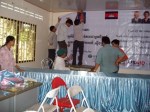
Everyone gets busy hanging up the large banner that has been printed for the occasion So far, each event has had its own banner. I wonder what happens to all the used banners since they are rather specific to one occasion. Maybe they get sewn into handbags or they become refugee tents – the material is rather sturdy plastic, a bit more refined than a blue tarp.
I look for the women’s toilet and cannot determine which is for men and which for women. I suppose I can check and go in, since the men’s toilets (here and everywhere in the developing world) tend to stink of piss while the women’s toilets tend to be a little cleaner (women wash their hands more often and flush toilet more often than men – this from empirical research). I ask Sokleang and she shows me the difference in the script. Both toilets are labeled ‘room for’ so the first few letters are the same. Only the last 2 are different and I memorize the difference by noticing that the letters for women are the same as for men plus some extra flourishes and curlicues. Instead of women being made out of men as our Christian creation story tells us, here women are men plus something more. I like that.
Once the banner is put up there is nothing else to do; we had planned to work here but there is no electricity. It is turned off on Sundays. MSH could learn something from this. It’s a very effective way to keep people from working on their day off. And so we drive back. When we pass rubber plantations I ask for a stop and an explanation. I have never seen rubber being tapped and it is very different than I thought. It comes out white and then becomes black when it hardens. The tapping is a variation on maple sugaring, but even more low tech and ingenious.
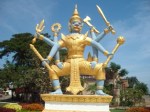
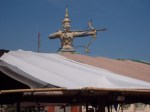
Back on the road everyone is getting into the game of finding local Cambodian scenes that illustrate the practices of managing and leading. Sokleang and I already collected 5 of the eight that we need and now we have some more help. We decided that organizing is best captured by the organized vegetable gardens being watered. It takes a bit of scouting around to find the right place because we are too late for the early morning watering and too early for the one in the afternoon. Then there is the implementing statue; the town has a brightly painted one. And finally, on the way to the hotel to drop me off for lunch Buntheoun notices a statue shooting an arrow, “focusing!” he exclaims and we stop for yet another picture. All we need now is a scene that represents planning and another for monitoring and evaluating; we have some ideas for those.
Back at the hotel I find the restaurant closed and the town is ever sleepier than yesterday, except for the fire crackers going off everywhere since it is New Year’s Eve on the Chinese calendar. I am referred to the restaurant on the main drag where we ate the first night and where you can get a naked goat cut off at the knees. I go for something simpler, soy chicken and fried spinach – it looks recognizable and appealing on the picture. I notice that the omnipresent shrine is quite elaborate today with an entire roasted pig, including a knife stuck in its back, an offering for the New Year I suppose.
On the way back to the hotel I pass by half open shops with entire families either sitting on top of a table or on the ground, around countless dishes, or, where lunch is over, stretched out on the ground or loungers, relaxing. At the hotel entrance the young receptionist is sitting with two friends, blowing up condoms. He manages to explode one and it sounds just like a fire cracker – lots of giggling when I indicate that I know it is not a balloon, but I also notice that it should not have exploded at the size it did.
During my siesta I prefer to watch a Cambodian movie rather than the bizarre CNN documentary on luxury goods producers and how they suffer from the recession. The Cambodian (and sometimes Chinese) movies appear to be made according to a standard script: love stories in which the women squeak, whimper and cry and the men thunder, fight and maim, all in the most wonderful costumes. The voice of the women is always the same and seems independent from the actress who opens her mouth. You don’t have to understand the language to get the plot.
When the lunch break is over I take a mototaxi to the ADRA office and we work through the first day program and divide roles. Some of the facilitation notes turn out too confusing and I take whole sections out and simplify others after trying to explain for too long, a signal that things are too complicated still. I am fed more exotic fruits I have never seen or heard of (sapodilla, and something even the dictionary didn’t know), one even more delicious than the next. I ask if Cambodia may have been the Garden of Eden in the distant past.
After receiving instructions on how to get back to my hotel (2nd cross road right, fourth left) I walk and discover after awhile that Smraach has been following me. I invite him to walk next to me instead and we continue our walk together. We practice each other’s languages; Smraach’s English is very limited and he does not participate in our English conversations even though he sits through all of them as a member of the team. He teaches me how to say that I don’t speak the Khmer language (and I teach him how to say the same for English) and then we count the cross streets in Khmer and part, he right, I left, on cross street number bram-muy (6) which is literally five-one, not nr.4 as I was told.
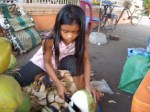
I buy a coconut from a little girl who handles the machete like an expert. She is of an age that would not be trusted with such a sharp implement in my world but here she is not only cutting coconuts but also renting her cell phone to various customers, taking the money like a died-in-the-wool sales lady, all very adult. I think she is at most 10. The coconut has much more juice it in than I expected and I carry it back to my room for a snack to see me into the new year (and keep me occupied while staying awake through the firecrackers).
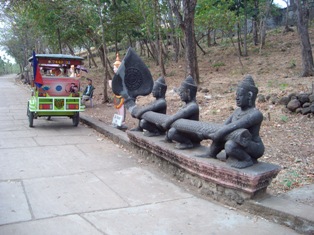 , The legend on how this hill, and the higher one next to it, came into being speaks to women’s deceitfulness and cleverness and men’s honesty and stupidity. The men and women built separate hills in a competition about height that would end at daybreak. The women lit fires which fooled the men into believing it was daybreak and they stopped working. The women won. The moral is that deceitfulness wins and women are good at that while men are honest and dumb (and lose). I think the story was made up by men. In this, as most other parts of the world women rarely win.
 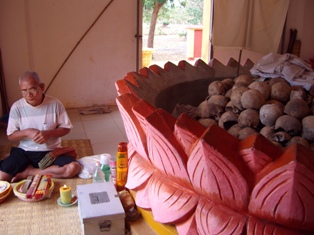 An old caretaker sits by its side and receives our offerings on their behalf and blesses us. He talks for awhile with Sokleang about how he managed to survive the dark years. I think it involved deceitfulness and cleverness (and so he won). The place is very peaceful now. “It was peaceful then too,” said Sokleang, “because there were no more people, just the birds. The people had all been deported or killed.” From time to time she tells me things about that time. I have a thousand questions that I am afraid to ask. Sometimes she answers one, but rarely spontaneously, without me asking.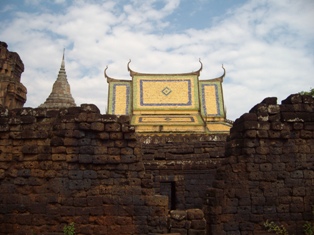
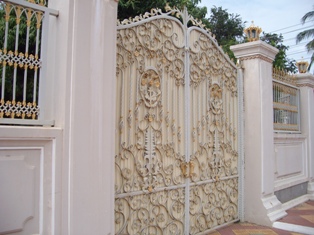 , shiny tiles, smoked glass picture windows and balconies everywhere. I learn that many of these McMansions are owned by American-Cambodians, people who presumably made it in America. I wonder what ‘making it in America’ means and I doubt that, back in the US, we grant them the kind of status that they enjoy here.
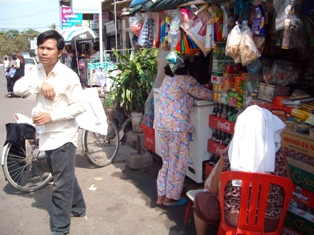
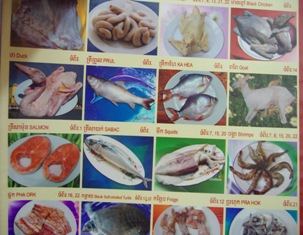 I wondered whether I would get the whole thing if I ordered that. There were pictures of naked ducks and chicken, one the usual color, the other, a black chicken, its color an unappetizing grey, served on large plates. There were also pig innards tied into a sort of bow, and various kinds of fish, followed by pages and pages of soup dishes. Krisna helped me navigate the menu and ordered something for me that he likes a lot, a bright green sour soup with spicy beef. He asked me ‘how sour?’ and ‘how spicy?” and I replied ‘a little’ of each. In situations of uncertainty like this I always go for medium.
 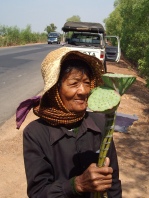 She held the lotus stems and seedpods like a bouquet. I only knew them in their dried form as used in flower arrangements with the seeds missing. These were green, just picked and the olive sized seeds still firmly in place.
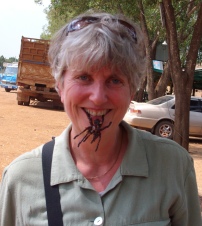 Prateek had told me about them. A young woman offered grilled ones on a tray while live spiders were wriggling in a bucket by her feet. They were rather large with bodies the size of a bottle cap and about 3 inches in diameter. They tasted very much like soft shell crab, a delicacy for me, so I had another one while Naomi and Leonard were busy documenting what they considered either an act of courage or lunacy. And there was more. As soon as I had finished eating the spiders the cricket lady showed up. This time I had only one, which was also tasty, although these three little snacks left me thirsty because of all the salt.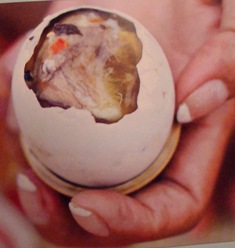
 It seems that slowly we are all converging on one meaning for one word or concept. Instead of a 10 minute explanation for one English word, we are now getting it in a couple of minutes and I take that to be a good sign. We have covered all the basic concepts and terminology and are ready to practice the exercises that go with them. This is how the facilitators are slowly easing to the front of the classroom.
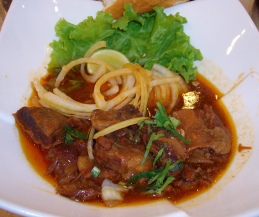 Before Prateek showed up I tried another new breakfast, this time something with tender beef in a spicy orange-brown sauce, served with French bread. There is a breakfast menu that says ‘Breakfast Menu’ in English but what follows is writtten in Khmer and Chinese. Aside from the indecipherable script there are also symbols after some of the menu items that I’m curious about, like a perching bird and a rose. They are like the pictures of chili peppers that indicate spicyness (one, two or three) but I can’t figure out what birds and roses stand for.
 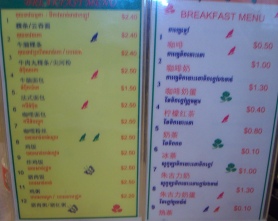 I have started to ask the waiter to bring me something I haven’t had yet. After breakfast I worked for a few hours on stuff that has nothing to do with Cambodia but needed to get off my to do list.


Recent Comments