On March 6 I should have left for a two week trip to West Africa. The trip was postponed which was both a relief but also complicating my life and reducing my first quarter earnings by a considerable amount of money.
It was not a difficult decision to make. Imagine being on a jumbo jet with a few coughers or sneezers and maybe even someone with a fever. Canceling a trip costs money and so people get on a plane when they shouldn’t. I was trying to imagine the public health officials at Niamey International Airport as we stream out of the plane and one, it only takes one, person turns out to have a fever – would we all be quarantined at the airport? Would we have to camp out there, or only the people who can’t afford a hotel? I decided that I didn’t want to find out how that would work.
Axel had planned a trip to Washington DC to see some friends while I was away – and maybe enjoy some spring time which is still so far away for us here in Massachusetts. Since my schedule was all cleared for my West Africa trip I decided to join him.
After a failed start on March 7, (Axel forgot his wallet), we tried again on Sunday, International Women’s Day, with a woman at the wheel!
We drove to DC in our new car, an electric blue Toyota RAV4 Hybrid that we leased after our Subaru lease was up. After nearly 40 years of being a Subaru family we stepped over to the competition for the simple reason that Subaru didn’t have any hybrids within our budget. We are now the owners of an SUV, I am embarrassed to say. It seems nearly everyone is now driving SUVs; the carmakers must have listened to Americans who seem all to want big cars – this makes being in a small car increasingly dangerous. Our new car feels like a tank.
New to the Hybrid experience, we competed with each other about who got the highest ‘eco’ score, a feature we don’t really understand yet, but higher seems better. We drove to DC on one single gas tank, which is no bigger than the one in our Crosstrek, which would have used two.
I started the new year without trips on the horizon, at least in the near future and for paid work. Rather than being a source of worry these blank calendar pages have been a delight. Staying home, getting up whenever I want, going to the gym whenever I want, going to bed whenever I want, no more ‘school nights’ – I love it.
We are settling in for the long cold winter after the holidays and after a short trip to Holland to have our annual Old & New Year’s dinner with my siblings and share our good wishes for 2020 with them in person. Holland was cold and clammy with the high humidity and cold. Even though not as cold as we are used to in New England, it is the kind of cold that chills the bones. We visited with friends and family, celebrated the year’s good things, ate Dutch, Swiss and Indonesian meals and snacked in between on fries, herring, drop and other sweets. All this added about 5 pounds to our girth that we are still trying to lose.
Our days back home have taken on a quiet rhythm now that the PT sessions are over and we are done, mostly, with the frantic pre-holiday schedule. I have only a couple of coaching commitments left, after one of my clients felt confident to let me go. A good thing I suppose. I am finishing up one last contract with MSH for work in Bamako and Niamey before it gets really hot over there.
The India work is still ‘in the works,’ so to speak, with no clarity about when it may move again. I orchestrated my second proposal (as a free agent), and produced something reasonably compelling in three days, bringing together a team from three continents (Asia, Africa and North America) to contribute to a larger DFID project that aims to help independent media in 3 countries, in Asia and Africa, to stay independent and do their good work. It’s a very long shot, but it was fun to lead the effort using WhatsApp, Google Docs and Hangout. Most of the team members had never met before – it’s a trust fall if ever I saw one. If, by some miraculous or heavenly intervention we are selected I have some teambuilding to do.
My two creations
Choosing our colors
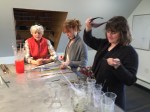
In the absence of travel Art has moved up from its fourth position to number one. Sita, Tessa and I made glass swizzle sticks, a delayed Christmas present, in our local glass workshop, the Bubble Factory in Essex. We are ready for summer and swizzle our G&Ts with our creations. Axel came along to document the creative process. In the meantime Axel continues to perfect his technique of printing on silk, remaining in his geranium phase, making large pieces, more stole than scarf.
Enjoying doing Art as a family I promptly signed us all up for a fall weekend course at Snow Farm in western MA. Sita, Tessa and I will be making wooden spoons and Axel will take the Monoprint class. At the end of that weekend we will be celebrating Sita’s 40th birthday.
In the meantime, Sita and Tessa continue to make me proud. Sita with her extended networks of extraordinary people who are actively changing the way we work and talk, and have gotten very creative in transforming loose groups of individuals into communities. She gave an interview that articulated better than I could, how this happens. Tessa was the only one heeding our Christmas rule of only home-made gifts, and showered us all with the fruits of her cooking talents: burnt onion jam, pickles, tomato sauce, elderflower syrup, chili oil, macaroons, truffles and fudge brownies. She’s picked up more clients for her graphic design business which means less time for cooking and baking.
Who knows what cosmic and spiritual overtones were involved in my traveling home on the shortest day of the year while actually experiencing that day as the longest day.
For me Saturday the 21st lasted 34.5 hours (24 hours plus the time difference of 10.5 hours). It is as if I had violated some universal law about days lasting 24 hours, and was punished accordingly: coming out of the plane with inflamed sinuses and waiting for more than an hour for a suitcase that never was on my plane.
On the Delta app there is a way to track your luggage. It will tell you where it has last been seen. For two days it said ‘loading onto flight DL405 to Boston,’ even long after that flight should have arrived here.
You can also get a map of where your missing suitcase is. The little suitcase icon (my suitcase)was sitting right on top of the roof of the CDG airport terminal 2. It sat there on Saturday, it sat there on Sunday and now it still sits there although the tracker itself has indicated that my suitcase was loaded (no longer ‘loading’) on today’s flight to Boston.
The baggage handler chief told me yesterday I should not count on getting it before Christmas as customs will keep unaccompanied luggage between 8 and 24 hours before releasing it to the Delta man or woman who, I am promised, will drive it to Manchester.
I am trying to be cool about not having my bag yet, but couldn’t help ruminating and catastrophizing about not ever seeing it again – making lists in my mind about all the stuff inside it, including a few Christmas goodies.
But things are lightening up with the latest information on the baggage tracker, the sinus problems have gone away, I went for a swim yesterday having a lane all to myself, and managed to keep up the tempo in this morning’s spinning class, despite not having exercised or stretched for two weeks.
I am now in the area in Mumbai (New Mumbai) where there are lots of engineers. I gather it is a desirable place to establish headquarters. I can tell from the many 4 and 5 star hotels in the neighborhood. There is less traffic, it’s more open/less crowded than in Mumbai proper. There are shopping malls for, what I imagine, the young and monied educated elites like to have close by. It’s a modern side of Mumbai. Reliance, the big company that appears to have its fingers in countless economic ventures has its corporate HQ here. I am going to have lunch there tomorrow, with my Indian team mates and one of their clients. I am being presented as one of them.
The hotel is not quite the Holiday Inn. It has fewer stars than the international business hotel chains in the area. But it will do for one night, and the price is right. It also has a spa with reasonable prices. I got talked into an immediate massage by the owner of the ‘Pink Door Spa’ who told me excitedly that she is going to start a branch in Manhattan (there are relatives to implement this ambition).
She recommended I wait with dinner (not good to be massaged on a full stomach), and talked me into a 60 minute Lomi-Lomi massage. Lomi-Lomi would relieve my tension and bad feelings. How did she know about my bad feelings about the motor cycle tour operator I wondered, and then handed over my credit card. I got an immediate 15% off, without asking. I think Mondays maybe slow days.
I can’t tell one massage apart from another, and sometimes wonder whether the masseuses can either, as the massages all seem rather similar. Except, that is, for the one where one is bathed in at least 2 liters of oil or have a slow drip-drip of oil on one’s forehead.
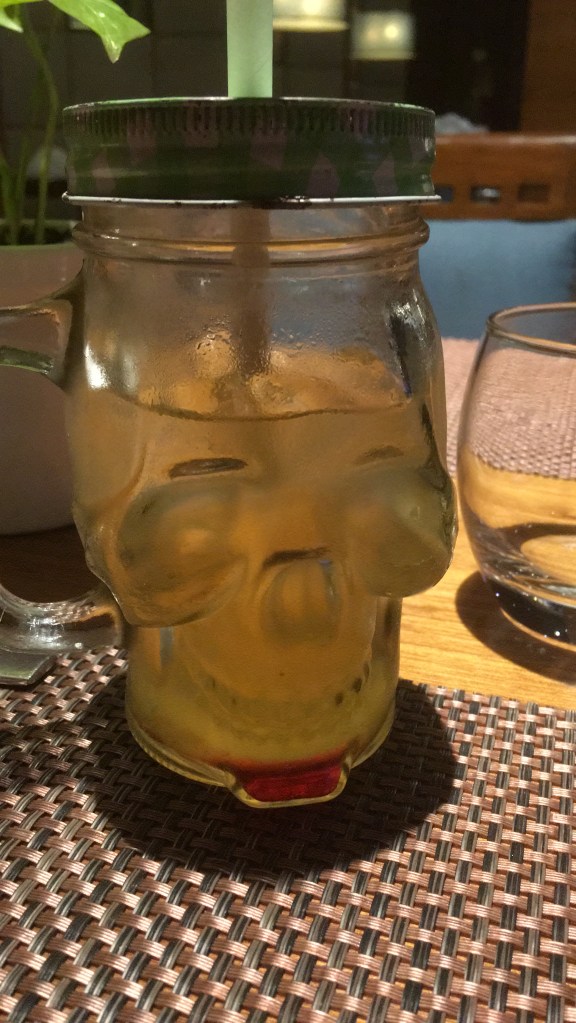
After my massage and the recommended glass of water and cup of green tea (“you will feel hungry by then!”) and not knowing the neighborhood, I opted for an in-house dinner. In a fit of ‘I earned this’ I ordered a cocktail, the only one without syrup or sugar. It was served in a skull shaped glass (or is it a dog?) with a rusty screw cap and a paper straw through a hole in the cap. It tasted like really bad medicine. I did not earn that, but by now I had spent my alcohol money.
The hotel’s main dining room’s claim to fame is fish and is named accordingly: “Something Fishy.” But there was nothing fishy about the restaurant. I had my best meal yet: two giant tandoori baked prawns and a garlic naan that did its name honor. I think I am going to be sweating garlic from all my pores for days.
When I walked into the restaurant the waiter to guest ratio was about 10 (waiters) to 2 (guest, myself included). After a while more guests came in, and more waiters too. I settled into a warm corner in the over-cooled dining room. From my corner perch I had a good view of the comings and goings of waiters and staff.
Decades ago, with an MSH colleague, since deceased, we played a game in a restaurant in Lesotho: spinning yarns about the other guests. We giggled until we were red in the face. I had so much fun spinning these yarns, partially because I was taught to never to judge people on their appearance – which is of course what we did, unapologetically. It felt rather naughty and irreverent. Although it is more fun to do this with someone else it’s still a great pastime when dining alone. On my right was a dour looking German or Swiss guy (an engineer no doubt) who washed down his meal with only one beer (Swiss then?), hardly ever looking up from his smart phone. No desert. Then entered a group of 4 middle-aged paunchy Indians and one young Anglo-Saxon. Everyone drank whisky on ice, except the young man who drank German beer; once I heard him speak I settled on the Saxon part – a German engineer, just out of school (although when he smiled he looked older, maybe 35).
I made him to be on his first trip to India, and watched how he related to his Indian table mates. At first, he was quiet but after two beers he was gesticulating wildly with his hands. I imagined he was telling what the Indian engineers needed to do to solve a sticky engineering problem. The Indians watched him politely, smiled now and then and stirred the ice cubes in their whiskeys. They were going to pay the bill, and they were here forever (unless they were going to emigrate to the US).
Watching the imagined drama being played out at this table reminded me of one of my many sins – talking too much about what I (thought I) knew to be true. I did not always read the signs of polite listening very well. I know a bit more now (I’d like to think). Although I will be presented as a wise expert coming from far away (some of it true), I will have to walk a fine line between the wise, the expert and the novice (on India certainly) . I brought Ed Schein’s Humble Inquiry to remind me about curiosity and not knowing.
I had wanted to join Sita and Axel to their Paris conference, a meeting that would have been of great interest to me, but I waited too long and the cost of a ticket jumped from 900 to 3.500 dollars. Out of curiosity I was looking for the cost of a ticket to Mumbai, which was half the price. I am learning these days that waiting for last minute price reductions is old school – this doesn’t happen any longer: prices go up to astronomic heights starting about a week before liftoff (and I wasn’t willing to buy a cheaper ticket that required traveling to Paris via Istanbul or Dubai).
I decided to take a trust fall and buy the Mumbai ticket in the hope that we can dislodge the stuck proposal I made with my Indian team to the the government of Uttar Pradesh. Since my team mates live near Mumbai I decided to fly there and meet them for the first time in the flesh, contract or no contract.
No sooner had I sent my itinerary to them that they told me that one of their clients was looking for someone like Sita to help with an event. Would I be interested in joining the team? Of course I would!
And so, on December 6 I will take off for an Indian adventure I cannot even imagine quite yet. It cannot fail because I finally get to meet my Indian team mates – I’ll stay at their house and then we scheme from there. Whether we will make it to Lucknow is at this point not guaranteed. Our client there is hard to pin down on dates. If we get to see her and put some more oomph into our proposal, it would be the cherry on the cake.
But that is not all. There is this fairly recent ritual of the new year’s dinner with my siblings and their partners at one of their homes, in Holland. My brother got very ill, earlier this month. He spent over a week in the hospital where it was touch and go. He is now home, still ill but hopefully on the mend. The annual New Year’s dinner is planned for December 28 at his house. How could we not be there? This time I did not wait and clicked on the ‘purchase’ button for two tickets to Amsterdam at the end of the month. We will spend the transition to 2020 in Holland.
South Africa wasn’t the last trip of this year after all. Friday evening, I will leave for India and then right after Christmas Axel and I are off to Holland.
We had our first day of easing into the pace of work here – courtesy visits to the ones in charge and getting the team together to discuss what they want from our visit. We integrated their ideas with ours and will provide them with an agenda tomorrow that we will hold lightly to respond to needs that surface.
We started them on conversations with each other about what they have been able to accomplish in this difficult work context and what they are struggling with. I watched to learn something about the team dynamics and noticed they are not listening to each other. I had already learned about this through our ICRC colleague, but watched it close up today.
None of the rooms that we had hoped to have were available. It amazes me the things we take for granted, like meeting in a nice place with chairs for everyone. Not here, the only place available was the windowless stockroom with hardly any room to maneuver and not enough stools (forget about chairs) to accommodate everyone.
Later we met in the PT exercise room after having dragged the benches from the waiting room and an odd assortment of stools and chairs pulled from all over the rehab center. It’s a tile clad room and with everyone talking loudly over each other I had a hard time hearing everyone. I’ve got to have that hearing exam when I get back, as my hearing is definitely not what it used to be
At the end of the day, just before the sun disappeared behind the river we arrived at the beautiful terrace of the Grand Hotel. It’s the place to watch the sun set and enjoy beer, brochettes and frites (again). Why the architects who designed our hotel (also on the river) did not think a terrace overlooking the river would be a major competitive advantage is something that escapes me. The Grand Hotel, even though it’s apparently not a place one would want to spent the night, fills its enormous terrace with people who stay after the sun has disappeared to eat and drink. Our hotel has an ill positioned, unattractive and unused terrace that looks in the wrong direction. And even if it had been positioned in the right direction, the view would be obstructed by barbed wire, military folks and a kludged together pizzeria and barbecue place. There aren’t even tables and chairs for guests, unless you stand there for a while and they drag out one table with one chair for you.
We were joined by our colleague’s Flemish husband and their 9 year old daughter who speaks 5 languages. She is a citizen of the world if I ever knew one, at ease in cultures as different from each other as Sudan, Bolivia, (Flemish) Belgium, Catalonia and now Niger, all in her nine short years.
We sat on the same terrace where I sat 32 years ago in my second year at MSH, 1987. At that time we drank the conjoncture, (Niger) beer, watched thousands of bats fly out for their nightly feeding frenzy, and followed the camels and cars traversing the bridge to return home. Tonight, there was no conjoncture beer, much fewer bats (and many more mosquitos as a result), no camels and lots of cars. Things have changed a lot and some things not for the better.
I learned that the last brewery was taxed out of existence, not just putting all its workers out on the street but also putting the hundreds of little eating places where people would go for cheap beer and brochettes out of business as the imported beer is now out of reach of the people who frequent those places. It seems like another infuriating example of religious fanaticism with a very short horizon – maybe something on our horizon if our president has to step down?
Back at the hotel I could not get my room key out of the lock. I called the reception who sent a man up. As soon as he arrived the key came out. I quickly put it back in because I didn’t want to let him off the hook so easily. And indeed, he was not able to get it out. He told me, ‘just a moment,’ and went back down. I assumed he went to get something like graphite, but no, he came back with a foot long insecticide spray can. If he had intended to spray into the lock, he could not since it was occupied by the key we couldn’t get out. So he sprayed around the key, as if it was a lubricant. Of course it didn’t solve the problem, only added bug spray to the other fragrances wafting into my room from the tired and mildewed carpets in the hallway. At least I won’t have bugs in my room lock tonight, that’s comforting to know. Eventually the key came out but neither one of us knew the magic formula. I am pretty sure it wasn’t the bug spray. Just a lucky jiggle.
Labor day signifies the end of summer. We already knew it from the shift in the air, crisp at night, no more need for fans or AC, and the days agreeable warm. We still occasionally swim in the cove, when we are not too busy with the management of stuff. This is why getting rid of stuff is so liberating – less management, more time to swim.
Whenever we can we take meals, breakfast, lunch, cocktails, sitting just above the beach. We have created a little eating corner with the bottom of an old bench and two chairs left behind after a party earlier this year, when the summer was just starting (sigh). I both love and hate this time of the year: love because it is Lobster Cove at its best, hate because winter is coming.
I have put the finishing touches on a weekend in April on the island of Schiermonikoog, way over at the most northern-eastern point of Holland, close to Germany, surrounded by the Waddenzee, loosely translated as the ‘Flats sea,’ a part of the North Sea that empties with the tides. It will be a family fest, a ‘Vriesstock or Vriesenpalooza’ as my nephew calls it. Axel and I will celebrate our 40thanniversary surrounded by our dear and noisy Vriesendorp siblings, those of their children and grandchildren who are around next April. We will show up with the 8 of us and it will be Faro’s and Saffi’s first trip to Holland.
Among the many things we are carting to Sita this weekend are Dutch books, so that the language barrier will not get in the way of the kids playing together and our son-in-law Jim can say and understand more that the word ‘paprika snippers,’ which he learned on his very first trip decades ago.
Our car could be mistaken for one that takes stuff to their kid’s dorm. But a look inside shows that it is filled to the gills with things that have accumulated after the student experience (mine and Sita’s): desk belonging to her great grandfather on which I studied for my final high school exams in the spring of 1969, books, photos and CDs from Sita’s school and early employment years, blankets from West Africa, an old map of China from the Cabots who left their stuff in the house we live in, to decorate Faro’s room – he will be the only one who can read it.And after that Tessa gets to pick up her stuff and we should finally be relatively free, free enough to empty one side of our office to install a heat pump and we can be warm this winter, and cool next summer. Free at last!
We have a new roof. Roofers bring large dumpsters. After all the roofing detritus was dumped there was plenty of room for more. Our roof expert told us that we had too much stuff in the attic of what is now our combined office. The structure was not built to hold boxes and boxes of school materials and childhood treasures and CDs of our daughters, plus boxes and boxes of old administrative papers, letters and postcards from Axel, his parents and his former loves, clothes for dolls, for babies, for grownups, countless yards of African fabrics, dishes, moth eaten camel and cow hair rugs, saddle bags, mementos, and boxes and boxes of books: French books, African books, Lebanon books, yearbooks, Dutch books, and magazines that we once thought worth keeping.
Discard from roof and memory lane
And so we embarked on an exhausting trip down memory lane, which included countless steps up and down from the attic to the basement and back, aggravating our muscle and tendon problems from which we are now recovering.
Peter Walsh, whose book, Let It Go, we first borrowed from the library, then bought as we figured it was an important reference manual, guided us on our journey. What is a treasure, what is a toxic memory? Much as we did some months ago when we threw out all the papers and cuttings and letters related to our plane crash, now we threw out, without second thoughts, dismal papers and photos and magazines about the years we lived in Lebanese which was at war.
I threw out my entire collection of Dutch literature, closing a door on that part of my life. I had put adds on the website for Dutch people in the Boston area but got no response. I knew I was not going to re-red them and knew no one who would want them.
We made piles for the thrift stores in our area, for the Waring School (all the French books), and the higher end (and pickier) resale boutique in our town, the Stock Exchange. The rest piled up in our office to take to our daughters, including my grandfather’s desk on which I prepared for my final school exams in the spring of 1970. Tessa and I had a facetime session going through all her artwork portfolios, a tedious exercise but it thinned things out considerably.
We found a carefully wrapped up and preserved lot of baby clothes, they were Axel’s. I recognized some from pictures preserved in small photo albums, also in those boxes. They are vintage 1940s. There was a story there, a sad story of the siblings that never came, yellow clothes in case the baby was a girl. I carefully washed and ironed them and then hung them in the grandkids room closet. Not that I would want any kid to wear these clothes today but I simply couldn’t throw them out. I did check the vintage baby clothes offerings on Etsy and eBay but noticed there was a glut (though very little from the 40s). I think these clothes are most interesting for textile artists who can turn them into something beautiful. I will ask around to find people who may want to do that.
I offered up to the dumpster a collection of conference briefcases that I had once hoped to attach to a wall in my office as they were all locally handcrafted and some quite beautiful. But the idea was rejected and I had packed them up, for what? So much of what was up in the attic was there because we thought they were treasures but we learned from Peter Walsh that very few items are truly treasures, the others simply labeled as such because we didn’t know what to do with them. Out they went.
When the dumpster retrieval man showed up I asked what happens to all the detritus and discards as I was feeling badly about what we were adding to a landfill. He told me it gets sorted and only stuff that cannot be recycled (sadly: plastics) goes to the landfill. Metal, paper and wood is separated and recycled or burned (hmmm). And there we stood on the now liberated driveaway, looking up at our new roof that we will never have to replace again (our kids will) and then taking in the opened up space in the attic.
When I was 10 or 12 I used to borrow books from the library about the lives of accomplished women like Marie Curie, Florence Nightingale. I think I inherited a gene from my maternal line that assumed men and women were equal and deserved to be treated equally and could do anything that the other sex could do (men could knit sox and sew clothes and women could be captains, and train conductors). This wasn’t the prevailing opinion in the 1950s in Holland. Only boys played soccer or cricket. Women doctors were rare except in well baby clinics and as teachers of hygiene (which is what my mom did). Most of the mothers of my schoolmates stayed at home, and those who had started university studies stopped them when they got married.
Mari Popova, in her book ‘Figuring’ tells the stories of several accmplished women who lived in the 18th, 19th and 20th centuries and whom I had never heard about. All these women, astronomers, artists, mathematicians, inventors also bucked the trend: they were told to get married and focus on children and home.
I am curious about these women who have veered from the path that convention prescribed. My mom did that, both my grandmothers did that.
To this day I am fascinated by women who dare to run for president of the United States, who take on powerful industry lobbies because of the damage they do, who call out abuses that have gone unchallenged. During my early morning exercise bike rides, I have been listening to Michelle Obama, Melinda Gates, Hillary Clinton and Elizabeth Warren telling their stories and making history (her-story) in the process.
Two things have struck me in all their stories: they all got to the place where they made history (her-story) because they found (recovered) their authentic voice, never silenced by convention and/or powerful men. They also are (and may be this is a typical feminine trait) driven to understand other people’s lives – empathy is the word they all use.
In my various neuroscience classes I am learning that empathy isn’t actually as great as people claim. If I empathize with someone who is not in a good place, my brain chemistry micks the other’s and I risk getting into that not so good place myself. Better is compassion, which is a combination of empathy (understanding the other, standing under the other’s reality) and action (“how can I help you?”).
With the democratic primary campaigning in full flight I am looking for candidates who show compassion with proposals for action, anchored in understanding (empathy if you will) that are actually realistic and realizable.
From often windy and overcast and drizzly Scotland we are back in daily 10+ days: blue skies, no or light breezes and temperatures that the Scots would consider too hot but we feel are just right.
After no exercise (other than walking a lot) for two weeks, I resumed my daily swims in Lobster Cove waters that are as close to warm as it gets.
Before I go in the water I scan the mouth of Lobster Cove for fins, white fins. Great white sharks (one or many I don’t know) have been spotted nearby. Since we already have had a 45 feet whale in the cove (granted, it was dead), why not a great white shark?
I swim with goggles because I want to know what is going on beneath me, which is why I don’t like dark muddy ponds or the open waters outside the mouth of our cove.
Lobster Cove is fairly clear these days. I can see the green crabs fighting with each other. Fine, let them kill each other, after they have eaten all the baby mussels it serves them right!
I just finished Maria Popova’s opus magnum (Figuring), all 550 pages of it; a book I plucked from Sita’s eclectic collection of books, and have been carting across the Atlantic and back.
Popova (whose ‘Brainpickings’ I have subscribed to for several years now), has created something best described as a tapestry of words. Using diaries and letters as her main source, she took me into the lives of some extraordinary women who choose paths of great resistance over prescribed social conventions. They were all pulled by an innate force that knew of their talent. What obstacles, what bigotry, what bias they all had to deal with. And I wonder about all the women that were not able to muster all that courage, or weren’t supported by some remarkable and enlightened men (fathers, lovers, publishers, colleagues); how much talent was lost?
One of the last creative geniuses Popova writes about is Rachel Carson. I think a lot about Rachel Carson as I step into the waters of Lobster Cove, and watch, like a voyeur, what’s going on beneath me; the creatures that eat each other, wondering about the white shark that would eat me. Rachel Carson saw with great clarity, all these years ago, that you cannot interfere in ecosystems without expecting consequences: the killing of seals (they open lobster traps) led to their protection, which led to seal overpopulation which attracted sharks, first the smaller ones until word reached the larger ones that there was good food to be had along the Massachusetts coast. So what are we going to do now? I know what I am going to do now: I am going to re-read Carson’s Silent Spring.



 Sylvia's Journal
Recent Comments