Archive for the 'Uncategorized' Category


This side

There are three sides to this world: this side, the other side and in between this side and the other side.

On this side something good happened as Tessa turned 31 during this year’s long holiday weekend. We started celebrating on Friday night just the three of us at a restaurant in Gloucester. In the morning I thought about that momentous event when Tessa made her way into the world, remembering it as yesterday. Tessa arrived while the remnant of burned croissants was still lingering in the air. Axel had put ‘heat-only’ croissants in the oven of the birth center.  The oven thought it was getting cleaned, locked itself while the temperature increased to 500 degrees Fahrenheit. This activated the fire alarms and brought the firetruck out with screeching tires and probably a hefty bill for the hospital; it should have replaced the oven. Did tiny Tessa smell something was awry? Nothing in her life shows she did, unless it is her obsession that everything should be right.

The festivities of this 31th birthday continued in the morning with our birthday ritual – a festive table with all the tchotchkes we can find in the house standing to attention around the plate of the birthday girl, flowers on the chair, cards and presents. A brief interlude followed to prepare for the annual birthday bash at Lobster Cove: tents, a keg, fireworks, barbecue, potluck, fire on the beach, silent disco, late night fishing and eating it the next morning, cooked over the still burning fire with fresh eggs from Steve’s and Tessa’s Ladyland Farm chicks. Tessa counts among her friends a highly sought after DJ who reserves this event in his full appointment book year after year.

And then from 2Pm onwards people trickle in, accompanied by the gear they need: fishing rods, canoes, kayaks, tents, fireworks and booze. The latter two I don’t care that much about but I usually retire before they get activated.

That was on this side of the world

Eater’s digest

My brief vacation in Holland was nearing its end. I drove back to the center of Holland to my professor brother and experienced typical Holland weather: sun, rain, hard rain, light rain, sun, endlessly repeating itself in short cycles. There is an app that many Dutch people have on their phones. It is called ‘’buienalarm’ which means ‘rain shower alert.’ It is a handy app when you live in the lowlands.

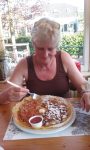
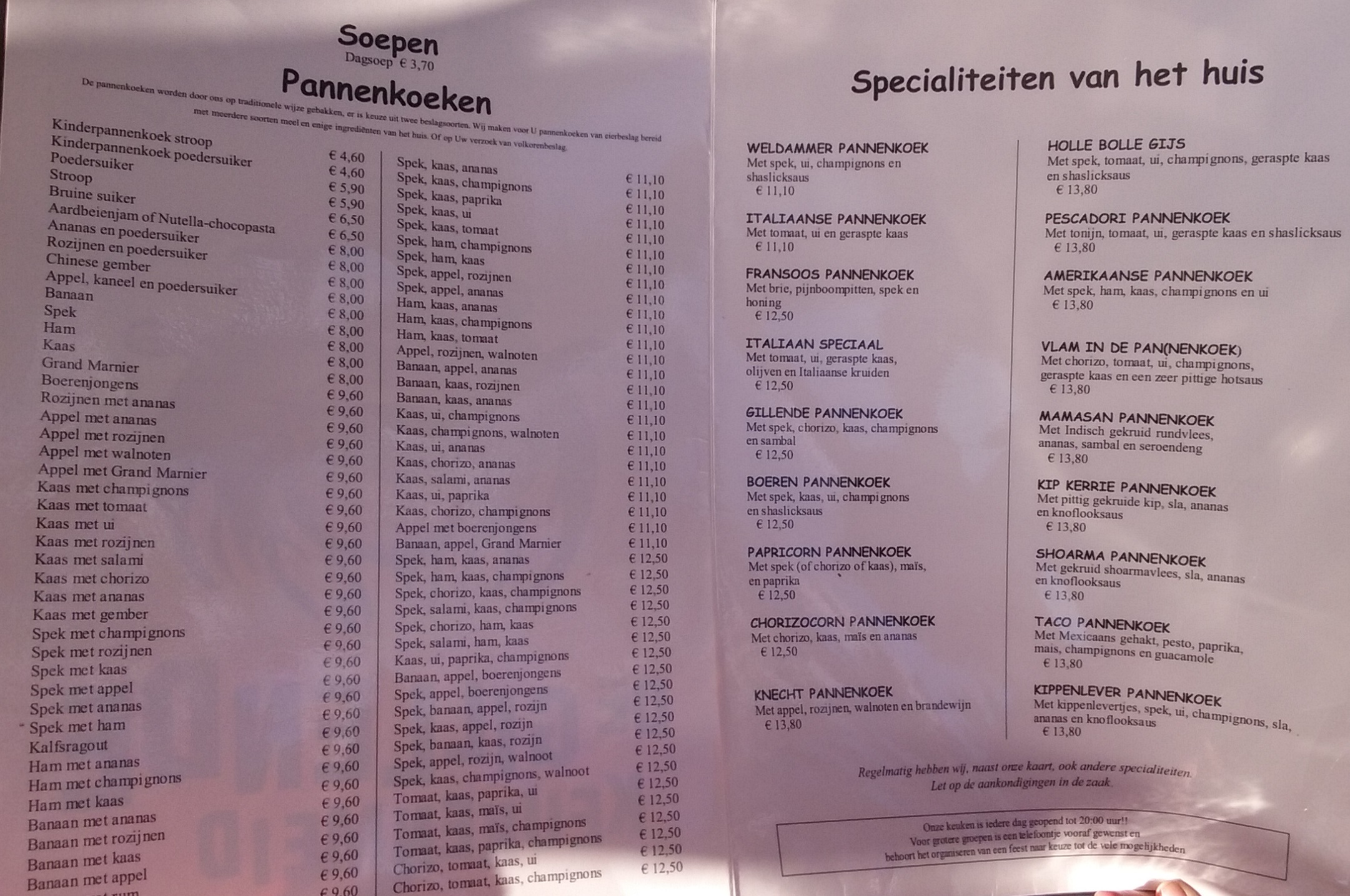
I managed to squeeze into my short Sunday afternoon: a visit (in the rain) to Amersfoort centre, eating a new haring by the tail, accompanied by a ‘zure bom’ (sour bomb, a large sweet pickle) and a large pancake at a traditional pancake restaurant. In Holland pancakes are eaten for dinner not breakfast, and come with just about any topping you can imagine. I had two halve pancakes (this for people who cannot make up their mind): one half was called ‘the shrieking pancake’ (chorizo, bacon, cheese, mushrooms and sambal oelek) and the other half was called the farmer’s hand and included apple, raisins, walnuts and brandy. The two halves made for a whole pancake that took me till next morning to digest.

I took my brother to Schiphol the next morning, both as good company during the crowded commute into western Holland where most of the jobs are, and as a guide through the unfamiliar network of highways. At Schiphol he took the train to his office in Amsterdam and I handed in my rental car and spent the next few hours waiting for the delayed flight back to Boston. I decided once more that an upgrade was worth the money and the miles and got seat 2A which made the return trip quite pleasant.

pannekoeken1

pannekoeken2

?

pannekoeken3

?

?

?


Nostalgia

On Sunday mornings most of not-church-going Holland is asleep. With a borrowed bike from a neighbor we biked into the quiet city of Emmen, hoping that the gate to the old abandoned zoo would be open, but it was not. Nothing was open. My friend called someone she works with as a volunteer and asked if she could come by for a visit. Unlike the rest of Emmen the couple was awake, and to my surprise, elderly. We had coffee and talked about religion, mostly or exactly because they have turned away from religion. And here I sat with a nice Muslim girl who volunteers through a Humanistic Society. In Holland everything is possible. I had a lovely time getting to know this active and activist couple in their 80s who had become friends of this young Afghan woman – they are part of a network that she had created around herself to help with a difficult transition. I was proud of my fellow Dutchmen and women.

We left to find the gates to the old zoo open. The new zoo is now a little outside the town, rechristened WildPark and based on the American model of a zoo with a whole lot else to do, hoping to attract crowds from all over Western Europe. This poor city, in economic decline, could use a few visitors with money to spend.

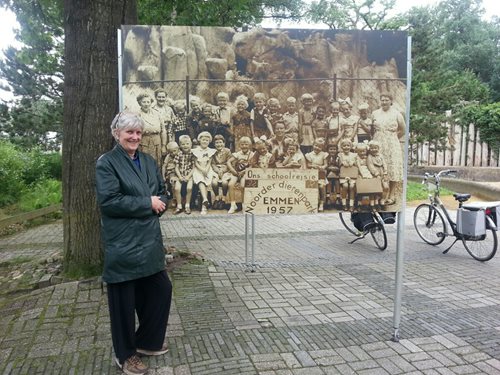
We peddled around the sad old zoo that was the destination of countless school trips in the 50s and 60s. I posed in front of a large photo of a class with their teachers made in 1957. It could have been my class. I have a picture just like that. Of course for us in the west the Northern Zoo was too far away – we went to Artis, Amsterdam’s city zoo, or maybe to Rotterdam’s zoo although that one was already too far away.

emmen-zoo

We biked along the meandering paths, past empty spaces that once housed monkeys, elephants, giraffes, bears, and other exotic beasts that are now, presumably, roaming more or less wild in the new park.

The things that count

Once in a while you get news that puts everything in perspective. Sita and Jim’s brandnew niece, hardly 7 weeks old, has been diagnosed with a terrible birth defect and is undergoing her first operation today at Boston’s Children’s Hospital. It’s a condition that is more common in Asia than in the US, rare here, a chance in thousands, a case of really bad luck. She is undergoing a procedure that was developed in Asia. It is probably one of many surgeries she will need in her life. It is both scary and very sad.

The baby would not have lived long had she be born in a developing country, so we should count ourselves lucky, but we don’t know what’s in store. I am thinking about the pain and worry of her parents and grandparents, two sets of which we share with Faro and Saffi.  It is rearranging all the things that I thought important and worth fretting about.

Community and presence

I enjoy working with people who don’t know that you can get a lot done with 80 people in two days. One woman from Uganda said, after we collectively defined what integration meant in about 20 minutes, that this exercise would have taken them days or maybe even weeks back home.

When people express wonder, amazement and appreciation for the facilitation, they don’t realize that they are commenting on the design. Facilitation is very easy if the design is solid, even for newbie facilitators (maybe not easy but doable). Facilitation is very difficult if there is no design, even for experienced facilitators.

I believe the appreciation comes from having one’s voice heard or seeing that space is created for the quiet voices.  Those whose voices are always heard, and often too much, don’t usually express such appreciation. They sometimes bristle at the structure that I impose.

“Everyone participated!” say the ones who want to hear everyone’s voice, as if they can’t quite believe it.

For me this is simple and never a surprise; people participate because there is no way not to participate. The only people not participating are those who are doing something else on their phone, tablet or computer, or are taking calls outside the room. To reduce these absences, I periodically sweep through the room and close computers or turn over smartphones that are being used for some other purpose than the meeting. I do this with a smile. Some people thank me for it, some get defensive (“I was looking something up!”) and some get a bit prickly. people learn fast. When they see me coming they put their phone down so I don’t have to do it for them. I am acting like an old fashioned teacher, people recognize that quickly. It works.

In the development world I work in, I often hear people say ‘value for money.’ It is also one of MSH’s strategic priorities. Yet we are surprisingly tolerant of meetings where half the people are not present, even though the limited development resources that we always complain about, have been paid to physically bring them in. I think I know why we tolerate this kind of behavior: we are uncomfortable confronting people, especially those higher in the pecking order. Under the guise of being polite, we actually collude with people who are not polite. If we are saying we want to do something together, then shouldn’t we all be present together? I sent those who cannot be present out of the room.

Despite all the kudos and raves, I didn’t even feel that this meeting was as good as it could have been – there were a few disconnects, speakers who came in for their session, unaware of what the group has already discussed and defined; the schedule was rather full leaving little time, too little time, for serious discussions and reporting back.  Because of that, running late from the get go, unrealistic expectations were not examined and thus, there were disappointments at the end. Some critical voices were missing and there were too many wishes and wants resting on different agendas that had not been sufficiently confronted. Hierarchy and seniority always gets in the way, here and everywhere else.

Still, I was pleased with the productivity, the expansion of the community of activists and the good energy in the room. Things could have been improved with more time for dialogue, more focus, scribing and music. I hope there is a follow up where we can do this.

Rituals

Today was Memorial Day, and it rained. This rarely happens. We showed up when the seaside ceremony was already in full swing. This is for the navy, I imagine. A wreath is thrown into the water from the back of a motor boat by a uniformed man. The wreath is attached to a thin white string. I guess this is to fish it out of the water afterwards when everyone is gone, and, hopefully, give it to someone to hang on their door. I am sure in the past the wreath was simply tossed into the water and then left to drift wherever the current took it. But the environmental police must have put a stop to that. It is still a ritual and it is the ritual that counts, but I liked that there was an unscripted part to the ritual.

Every year I sit (with occasional standing) through the ceremony which after the seaside part is done at the cemetery, where Axel’s ancestors lie as well. We had spiffed up the graves of his grandparents, parents, aunts and uncles and now also one niece, with geraniums.

This is our personal (pre-)memorial day ritual. When we are done with the planting we take a little rest on Grampy, Grammy and Ester’s’s grave and drink a toast to all. We thank Penny and Herman for life given to us and then we dribble a little bit of vodka over the grave stones. Axel’s grandparents were teetotalers but their offspring were decidedly not and so we hope the elders don’t mind this little bit of vodka.

This year’s ceremony was held at the legion with major parts left out because of the inclement weather. The master of ceremony told us to imagine the parts of the program that couldn’t be done indoors, like the salvos, the marching, the school band and the taps. As a result everything was done in no time. We shook hands with some folks and I had to ask Axel, who’s that and who’s that? I got introduced, as I am always on this day, to the same people again. I can never remember their names or their faces.

And then I get to vent to Axel, also a ritual because I do it every year, about the glorification of war and the death of our men (and now women) in uniform. I do understand the rituals and the commemoration – thinking of people who died in uniform, and I like the small town community feel, but I could do without the military flavor and the presence of all these uniforms.

What bothers me in particular is the idea that they died for an ideal. This may have been true for WWII but I can’t find the noble goals in all the other war that came afterwards.  I hear people say that those who died, died for the ‘American flag and everything it stands for.’

To me, all those who died (this includes the enemy as well who were alegedly just as patriotic and fighting for their own noble goal) did so because of the psychodynamics of their leadership, the ones who waged the wars; those few men at the top, all driven, in one way or another by childhood traumas, egos under assault, hurt pride and having a surfeit of testosterone.

What were we fighting for in Vietnam, exactly? Having just been there and seen the particular flavor of communism that allows Vietnam to sign the biggest trade deal ever with America, one cannot help wonder what all the fuss was about, a ‘fuss’ that wreaked havoc, both here and there. Why? Because a beloved American president figured it was better to stay put in that part of the world to uphold his image of being tough on communism until after his hoped for re-election. But he didn’t live to see the day, and then everything spiraled out of control. I firmly believe that our messes are for the most part self-inflicted; this is true for individuals and the spheres they govern, whether families or whole countries. Just watch Trump.

Birthday assemblies

For the second or maybe third time in a row I am missing Faro’s birthday. Early June seems to be traveling time – though I suppose every month is traveling time these days.  We decided to spend a good part of Memorial Day weekend with Sita and Jim so I could give Faro his present. As it turned out, I also got enlisted to assemble his parents present to him.

Our present was a little nostalgic – a scooter.  Not the dinky little foldable one with the tiny wheels, but one with air tires. It looks like the scooters that were around when I was a child, except much fancier. It has handbrakes (my brakes where my feet) and a skull and crossbones on the step plate. It came in a box on Thursday and I assembled it under the watchful eye of Axel and Woody and with the help of a martini and some wrenches.

Scooters, in my youth, were called “autopeds” or a “steps” though sometimes we called them “autosteps.” They are actually neither autopeds nor steps as there is nothing auto about the propulsion. It’s actually very hard work, especially when going uphill (no uphills in my childhood), and even more so when Faro decides it is much more fun to stand on the plate and let Oma do the ‘stepping.’

We spent two very hot days in western Massachusetts, sometimes wishing we were on the eastern seaboard and cooling off in Lobster Cove – it would certainly have been several degrees cooler there. But Western Massachusetts is an attractive place to be. We (including Sita) sometimes fantasize about renting out our house on Lobster Cove for oodles of money and getting a small place in western MA. The fantasy is postponed until I don’t have to commute to work anymore – maybe within the next 5 years.

For kids Sita’s neighborhood is wonderful. There is Look Park in Florence, with its train rides, picnic areas and playgrounds. There is also the river with its perfect river beaches and swimming spots that have enough of a current to stay relatively clean, a sandy bottom and little fish to chase after.  Faro has been going to swimming lessons, a Christmas present, and I was curious to see his progress, which was not as great as I had hoped.

Faro’s parents gave him a Bucky climbing structure that needed assembly. We worked on that with sweat dripping down our brows – it was a little bit too hot to do so in full sunlight – but we persevered and had it up in less than 24 hours.  The structure is about 10 feet wide and 6 feet tall. Faro got the hang of climbing on to the lower parts in no time, still a little anxious about swinging like a monkey. I would have loved to have a climbing structure like that when I was his age. We used trees instead.

Sylvia birds

Sita had given us a walk with a bird expert for Christmas. It was one of those wonderful ‘experience’ presents that she is good at finding and giving. I had taken the day of to cash in our gift.  On this beautiful spring day we met Ben, our guide, at the Mass. Audubon Joppa Flats Education center, a structure that had not existed when we lived in that area.

After we exchanged our dinky little binoculars with two more serious ones borrowed from the center , we set out, first by car, to Plum Island, stopping along the way when he heard a warbler sound. Ben knows birds by their song. They are hard to see in the foliage and the flit from branch to branch so fast that it is hard to find them with our binoculars.

There were other birders looking for the warblers and they exchanged information and clues, using a language I hardly understood. I learned that the warblers exist in many sizes and colors, some weighing as little as 3 grams, less than a nickel, and others as much as 10. The colors vary by sex and age. It was hard to remember all these details, but that is why we have bird books.

The walk made me realize how much live is going on around us, invisible but audible. The bugs eat the juicy new leaves of the trees (warblers like to hang out in oaks), the birds eat the bugs and cross fertilize and we are all the better for it.

That night I dreamed of birds and my bilingual brain was searching for the Dutch name of warblers. I woke up thinking that I knew but when I looked it up I had been wrong; my sleepy brain had found the Dutch word for chickadees (koolmees) but not warblers, which turned out to be a ‘tuinfluiter’ in Dutch. Tuinfluiter means, literally,  ‘garden whistler.’  In the process of my research I discovered that the warbler belongs to the genus ‘Sylvia’ – this must be my bird.

Self-generating tasks and sore muscles

A week ago I was flying back from Holland, with a tremendous urge to see my grandkids. We were going to see them this weekend. But the potatoes that we had ordered from the Maine Potato Lady were beckoning and we postponed our visit to next weekend (Memorial Day weekend).

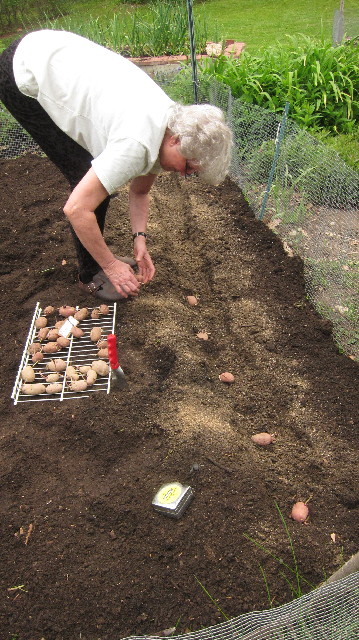
The potatoes had arrived while we were away and had not received the care prescribed on the information leaflet tucked in with them. They had developed thin leggy sprouts and were screaming out to be planted.

Planting, we knew, required preparing the garden. It was one of those self-generating tasks: before you know it you are looking at a long list of to dos that aren’t half as much fun as the planting.  A large pile of Essex Gold was deposited on the lawn and needed to be scooped into wheelbarrows, spread over the garden and then dug in – all heavy labor which mostly fell on Axel.  It is now two days ago we did this and the muscles are still very sore from bending and scooping and pushing and pulling.  I am beginning to think we ought to pay someone else to do this for us.

While we in Ha Long Bay and kayaked and hiked and biked, a young couple from Belgium told me they could not imagine their parents (presumably our age), could do what we did; that made me feel good. I thought about my parents when they were our age. My father would not have been doing what Axel did because he was already dead at 70 minus two months. My mother might have been weeding, which I think I can do until my nineties if I live that long, but probably not the loading of a wheel barrow with heavy dirt.

I cut back the raspberries, fed the shallots, garlic and asparagus and pulled up anything I didn’t like. And when that was done it was time for our houseplants to go on vacation. This meant more wheelbarrowing, more lifting and cleaning the sticky stuff that gets deposited on our plants by the end of the winter, and not just our plants: on the floor, curtains, woodwork and furniture. This too was a self-generating task.potatoplanting-2016

Utopias and maltopias

When I am waiting for planes or in doctors or dentists offices with internet I often go to the LinkedIn site and scroll through all the names that are suggested.  It is a bit of a trip down memory lane as the algorithm digs deep into my past and finds people I haven’t seen in decades. Sometimes I sent of a whole slew of contact requests, just for the fun of it.

One woman, who I had met when I was still active in the Company of Friends circle of Boston, decades ago, accepted my contact request. I didn’t even know her that well. Her accepting my invite led to a series of email exchanges culminating in lunch at a restaurant near my work place in Medford on May 18.

I learned that she was a child of China’s Cultural Revolution. She told me how she was forced to do criticize her parents (scientists) and complete obedience to the system.  Now, all these years later, deep into her adulthood, she is still battling the remnants of this brainwashing.  She got a degree in Astro-Physics from one of the world’s most famous universities. But the stars are not the object of her seeking these days. She studies people and this is what we talked about.

Here, in front of me, was yet another victim of a large scale social experiment that went south. I have read inside stories from the Khmer Rouge experiment, and, on my way home from Holland, finished a book (Pauper Paradijs) of a social experiment done with good intentions but going completely off the track in Holland in the 19th century.  By putting poor people, drifters and others not fitting in, in a colony up north in what was called the Dutch Siberia. The experiment lasted a few generations and did terrible damage to people whose great-grandchildren are now trying to unravel the story of their ancestors; all in the hope of abolishing once and for good poverty.

This story, or rather piece of his-tory, belongs into the collection of ‘Social Experiments Gone awry on a Large Scale,’ where it lives with the Cultural Revolution, Hitler’s racial improvement experiments, ISIL’s religious experiment, the Khmer Rouge’s return to the land experiment and many others.  Utopias turned Maltopias.

The causal reasoning about how life works, how poverty and economic growth happens that led the architects of these plans so hopelessly astray, is alive and well in the run-up to our presidential elections. Aside from our capacity to harm each other with intent, we may have an even bigger capacity to harm each other with the best of intentions.


January 2026
M T W T F S S
 1234
567891011
12131415161718
19202122232425
262728293031  

Categories

Blog Stats

  • 137,136 hits

Enter your email address to follow this blog and receive notifications of new posts by email.

Join 76 other subscribers