Archive for the 'Uncategorized' Category


Tourists again

This slideshow requires JavaScript.

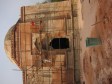
We finally got to be tourists and visited, at long last, Humayoon’s tomb – another magnificent piece of Mughal architecture. We arrived early and had the place nearly to ourselves. Things start late in Delhi – the city wakes up when in Kabul we already have a quarter of the workday behind us. We just left when over a hundred noisy school kids overran the place like a swarm of bees.

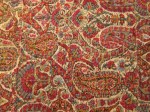
Humayoon’s tomb and the walled garden have been restored, much like Babur’s garden in Kabul, with the help of the Aga Khan Trust, the former project puny compared with this one. The educational exhibit showed how the Persian carpet designs (for indoors) mimic the outdoor designs for gardens. The crossover was illustrated by the picture of a carpet from Mashad with gardens on top and the geometrical design of the Persian ‘charbagh’ garden at the bottom. The word paradise, we learned, comes from the Persian words paira daeza, meaning walled garden.

We visited a part of the National Museum until our feet hurt and we felt like taking a nap. From the textile exhibit we learned the various kinds of embroidery, printing, and how gold was applied to cloth. Once again the Persian legacy was everywhere, from the gold threaded textiles to the miniatures depicting Babur and his entourage.

I returned to the tribal areas market and the exhibit on Indian landscapes so Axel could enjoy it as well – but the mounting heat and our aching feet soon led us back to our hotel where we collapsed.

For dinner we made reservations in a lovely restaurant with the very appropriate name of ‘Magique’ in what seems to be a newly developed area of the city – called the Garden of the Five Senses. We ate outside in a garden filled with lanterns, candles, flowers and trees – indeed a garden to delight at least three of our senses (sight, taste, smell) – whatever was supposed to delight our auditory senses was drowned out by being located right underneath the flight path to Indira Ghandi International Airport.

Freedom from johnnie

At 7:45 (PM) exactly Axel was discharged from the hospital after I paid the 5000 rupees not covered by our insurance. The amount included a $100l copayment and the cost of his toothbrush and toothpaste, his flexible tip thermometer, a ‘records charge’ and a consultation from the dietitian. It wasn’t until his last meal that I met her and told her he actually liked Indian food (she had assumed all foreigners didn’t) and a records charge. The actual bill was 40.000 rupees or thereabouts which is less than one thousand dollars. This explains medical tourism.

It took another hour to get his discharge instructions and receive his medicine (against Kabul dust, allergies, antibiotics). Only then did the nurse take out the line into his veins and then we were free.

On our way out I pointed out some of the extraordinary artwork – an entire wall of the hall to the elevators was covered by religious images, in stained glass – first there was the Ohm sign, then Jesus, then a holy man I did not recognize (Moses?), then Allah Akbar in calligraphy and finally the elephant god Ganesh. I wondered what the stern looking Afghans thought when they saw Allah’s name right next to Ganesh.

The hospital was full of Afghans who came to seek the kind of healthcare that doesn’t exist (yet I should say) in Afghanistan. This medical tourism by the middle class and even the poor is what bothers Karzai and his minister of health. They want to do something about this and we are often asked to help.

We splurged on a taxi, rather than a tuk-tuk, into the center of New Delhi and headed for a bar that served wonderful Thai food alongside cold beers and cocktails – something we thought about in the hospital during our three long days there.

Since we didn’t know until late in the day whether Axel would be discharged or not we had planned to postpone our return to Kabul by one more day. As it turned out all the flights on Saturday and Sunday were booked which means we have another three days in Delhi and Axel gets to be a tourist after all.

More hospital fare

The hospital is getting pretty stale – all Axel’s meals, lunch and dinner, are the same; no interesting Indian food. The TV channels are also a bit limited. We are beginning to suspect that the blue sticker on his admission form meant ‘foreigner – treat accordingly.’

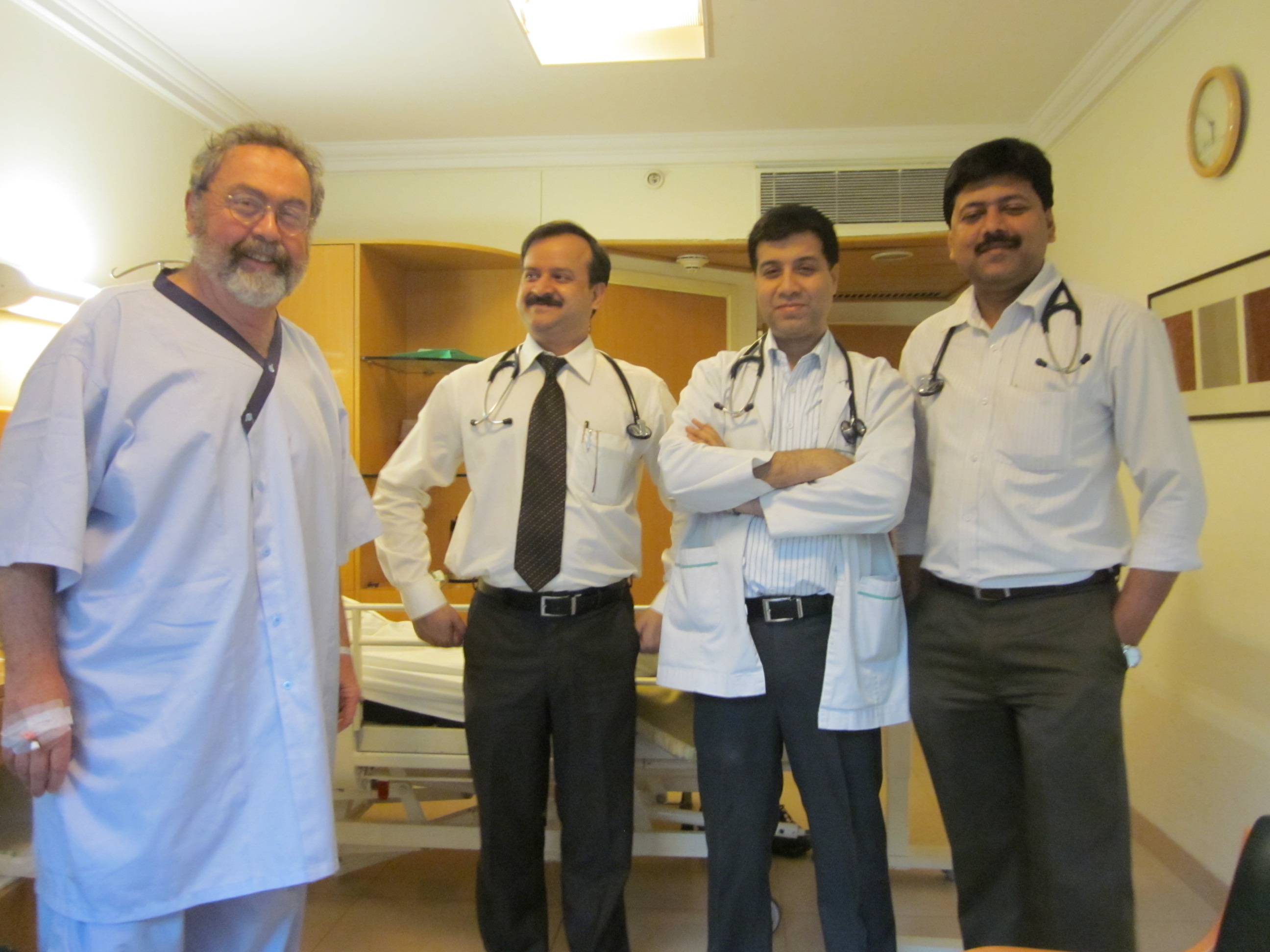
Today I happened to be in the room when the doctors (he seems to have three consulting doctors who seem always to be together) showed up for their morning and afternoon rounds. In the morning they stood, looking down on Axel who sat on a low chair, with their arms folded. It was clear who was up and who was down. Later in the day when they returned for their afternoon rounds Axel offered them chairs which they didn’t take, and so Axel stood up to minimize the up/down thing.

Later he was taken down to see the ENT doctor in the outpatient department. The attendant wheeled Axel in front of the busy waiting area, facing the outpatients as if he was going to give them a lecture – in his striped johnnie. Everyone stared at him. Here patients are really patients with very little concern for their psychological safety and privacy. I suppose in a country as full as this one such matters are trifles next to all the life and death stuff that is going on here.

I have been sitting in the stark hospital room. Luckily it’s a private room – he got upgraded after waiting most of the day in the emergency room for a double to open up – which never happened. I read and cross-stitch most days but today I left him for a long afternoon nap and made my way to the Indira Ghandi National Centre for the Arts.

The Centrer had put up a show of the ‘seven sisters.’ This refers to the six states in the far northeast – Sikkim among them – that have more affinity with their other neighbors than with India. The day program was rather limited because of the heat to small stall selling local handicrafts. In the evening, when Delhi wakes up, it gets a bit more interesting with dances and other performances.

Some of the wares for sale looked more like South African crafts and textiles than what I would have expected in this part of the world. One of the states, Nagaland, even sounds as if it should be in southern Africa.

There were few visitors which probably had to do with the temperature, 33 degrees Celsius, which made it tiresome to put one foot in front of the other. On my way out I stumbled on a magnificent exhibit called Oriental Scenery yesterday & tomorrow – two sets of matching views, one aquatints made by Thomas and William Daniell, 200 years ago, the other photographs of the same venues and from the same vantage points by contemporary photographer Antonio Martinelli. Aside from the magnificent images it made me realize that exploring India is a lifetime proposition.

We are once again changing our departure date although we won’t follow the ENT doctor’s advice to stay for another 2 weeks. We expect to be flying back to Kabul on Saturday since the (other) doctors could not say for sure he’d be discharged tomorrow (Thursday).

The ENT doctor had an intern sitting by his side who was from Kabul. He knew exactly what Axel was talking about when he referred to the ubiquitous Kabul dust (khAk) and the havoc that it had caused for Axel’s upper respiratory system.

Delhi hospital adventures – day 2

I visited Axel last night until the hospital appeared to close down for the night. For dinner I went down to the lobby where there is a Subway shop and purchased my very first (ever) Subway sandwich from a helpful shopwallah who explained patiently to me there was a system to putting together a Subway sandwich, going from step one to step four. I order chicken ham expecting both chicken and ham but ham but chicken ham was one thing unrelated to pork.

I took a tuktuk back to the hotel, the little motorized rickshaws that have a turning radius of about one foot. He drove through back alleys and over what seemed sidewalks, past tents where religious celebrations took place that made him laugh, or happy or both. He spoke no English but we managed to get back to the hotel in no time for a couple of dollars.

In the morning I was back at the hospital carrying two coffee lattes up to the patient. The allergy diagnosis has been discarded and now it is simply a bronchial infection that is being treated with frequent doses of antibiotics and a periodic nebulization that is done by an old and noisy machine. The doctors still say ‘a couple of days’ before they think it will clear up.

At naptime, after lunch, I walked over to the shopping center up the street. To get to this glitzy side of India I have to walk past bins overflowing with garbage and a bunch of kids looking for scraps of stuff that is either edible or salable. The stench is horrendous. On the medium strip cows move around lazily, nibbling on the occasional weed that other cows had left untouched.

Next to Axel’s hospital is an Ayurvedic hospital, complete with an emergency department which makes me wonder how Ayurvedic medicine would treat an emergency. Outside the hospital wall are life size pictures of patients receiving copious doses of oil in a variety of ways, making me even more curious. How would they treat a bronchial infection?

I wandered around the very fancy and medium fancy back to back malls looking for a place to eat and stumbled onto a sushi place. I figured I better have sushi now before the oceans are contaminated forever with Japan’s nuclear fallout and sushi restaurants will become extinct.

We are getting phone calls from our daughters. They have lifted Axel’s spirits. Although he is sick, he is well enough to be bored by the hospital routines and the food (exactly the same so far for lunch and for dinner). I brought him my leftover pizza and a tiramisu to liven up his dining experience. Only a nice glass of red wine was missing.

New adventures

[another delayed post from Sikkim] We had a rather quick exit from our lovely Gangtok hotel, faster than we had planned because our plane left two hours earlier than we thought. We had to skip our last leisurely breakfast among the orchids.

Instead we received a boxed meal. And then, the car we had thought was fixed, was not. Our guide hastily arranged another car, not quite as comfy, with a railing to hold on to as if we were going for a roller coaster ride. It could have been – 100 km down the Himalayas to West Bengal’s plains where the airport is and, once again a drop in altitude of about 6000 feet.

We did the ride in a little less than 4 hours. Luck had been on our side; the old car held up well, there were no accidents on the road and it was Sunday so the traffic was light. We were told that once in a while there are drunken elephants holding up traffic where the road intersects a nature reserve down in the plains. Our guide told us stories about having to wait for hours to let the elephants rampage at a safe distance. They come out of the forest and go into the village where the local millet brew is fermenting. They like it a lot and then get drunk. The villagers must have gotten wiser and the brew is less accessible now.

We flew back in a very full Spice Jet to Delhi where a different set of clothes was needed: 33 degrees (Celsius) during the day and in the mid twenties in the evening. We met up with our two reporter friends we had met on our way out in Kabul airport. They had made reservations in a lovely Italian restaurant where real wine was served rather than the Indian substitute that didn’t quite make it to our standards for good wine.

The next morning instead of setting out for some sightseeing, Humayoon’s tomb among other things because we didn’t get to it last time, we decided to make a quick stop at a medical facility to have someone examine Axel’s lungs because he continued to have breathing problems. And then things took a different turn. Axel spent the entire day in the emergency room, first for the check out and then, once the doctor decided he needed to be admitted, waiting the rest of the day for a room.

I spent most of the day by his side, experiencing a day in an Indian emergency room. After noontime things started to pick up, one emergency after another rolled in, with tons of relatives, sometimes wailing, sometimes somber, sometimes resigned. One of Axel’s neighbors, someone’s elderly mother, after heroic efforts by at a large cast of medical characters to save her, was eventually wheeled out with a sheet over her face. It was not a peaceful death although I don’t think she was aware of the many tubes and wires that were used to bring life back to her. I am glad it wasn’t my mom.

And so we are prolonging our stay in Delhi, changing our return trip to Kabul to Friday. The doctor suspects a lung infection and an allergic reaction to Kabul’s dust (the latter did not surprise us) and prepared us for at least a 2 day hospital stay. Humayoon’s tomb will have to wait again.

Here’s a picture of Axel’s hospital dinner.

Catching up – 2

We had a late start because we wanted to, and could, sleep in for a change. Once we got on the road we had car troubles and had to wait for a replacement car. Thus we skipped the sightseeing and went straight to the monastery where the American/Sikkimese parents of the headmaster have their simple lodgings, dad being a lama and both needing simple lifestyles to support their school-founding and school-running habit.

Waiting for lunch we walked several times (clockwise) around the large stupa that was built to honor the late rinpoche, listening to M’s stories about her Calvinist upbringing and its intersecting with her husband being a Buddhist and the son of lama himself.

We then followed her through the labyrinthine monastery up their quarters where a simple and delicious lunch was served. Over our meal we talked about the school, theirs and SOLA, living in Afghanistan, the art and science of teaching and the social mission we are all pursuing in our own individual ways.

Monastic living, though simple as I had expected, had some surprises: wireless internet connections, all the monks having Macs with Sikkimese fonts and prayer books digitized, internal phone lines and a gift shop where offerings were resold and various Buddhist paraphernalia for sale. We bought prayer flags and two amulets; one for mental clarity for Axel and an all-purpose one for me as we are now in the female-iron-rabbit year, a risky one for someone turning 60 in 2011. We also wanted to buy the ‘protection against weapons’ amulet that was listed on the 180 item catalogue that offered protection against just about everything including angry gods and water spirits. But they didn’t have the weapon one – it’s not one that is commonly sought in this peaceful little kingdom.

We said our goodbyes with an invitation to come back anytime, something that Axel is already contemplating. On the way down the hill we visited the Institute for Tibetology – housed in a Tibetan style building and filled with various treasures such as a series of Thankas (silk and brocade painted scrolls) describing the life of Buddha and various local deities, statues, old prayer books in Tibetan and other languages and ceremonial implements.

We had ourselves dropped off in downtown Gangtok where crowds were standing here and there in clumps on the pedestrian MG Marg mall watching TVs displayed in shop windows as Sri Lanka and India were vying for the World Cricket Cup. And then the later afternoon showers started again and Axel got drenched again.

We knew that India had won the world cup when all hell broke loose outside our hotel, firecrackers, gongs, drums. We are happy for India but I still don’t understand a thing about cricket.

Catching up in Delhi

The next couple of posts are a little behind the times. Incessant rains in Gangtok had disabled internet access. We are back in Delhi now where it doesn’t rain and the internet connection is very fast.

[April 1]Every morning we look out of the window of our greenhouse hotel room and see clouds (behind the very happy orchids) and every morning we hope for the best. During the day the clouds lift a bit, come down a bit, parts of the cloud cover lights up as if to suggest that the sun is right behind. But it is no more than a tease because in the afternoon the clouds move in with a vengeance, as if the clouds of all of Sikkim congregate in Gangtok, and the rains come, monsoon type rains.

Unperturbed by the cold, in his crimson robe with his arms bared, a monk sat all day at the entrance of the school ringing his prayer bell and reading his prayer books. Attendants at the front and back sides of the school kept two very smoky pine fires going to bless the laying of the second story cement floor of the new wing in back of the school. This was done by hand by 65 workers, male and female, carting heavy bags of cement up and down planks, first in their regular clothes and then, after the rains started, in blue tarps fashioned around them as if they were company-issued raincoats.

When the monk left everyone in the school was coughing from the thick pine smoke that had encircled the school. Axel’s poor lungs, still recovering from Kabul, where particularly affected. We had hoped to send along some prayers for blue sky and, maybe, even a glimpse of the snow covered peaks, to no avail.

We had been invited to open the daily assembly and did so with a slide show about Afghanistan. We tried to show the parts of Afghanistan that don’t make it into the news. But here in this far corner of India such news hardly had reached people. The students knew more more about Alexander the Great, Timurlane and Gengis Khan than about 9/11 and its aftermath. In fact, only two students in the 7th and 8th grades we taught later that afternoon knew what 9/11 referred to.

We showed pictures of traditional music (and played it), handicraft, landscapes, flowers, architecture, woodstoves and city scenes. We had checked out the books about Afghanistan in the well endowed school library and showed the students who wanted to learn more. And then we gave our presents to the headmaster (the woolen wrap I had borrowed yesterday) and a piece of traditional embroidery to put on their wall.

Before our afternoon class we sat in some more classes (math, report writing), we met with teachers to learn how they assess reading levels and had lunch with the math teacher. And then we prepared for our class. We had been given two class periods with the 7th and 8th graders, a mixture of restless and sullen kids (“are you really up to this?” asked the headmaster with a hint of concern in his voice).

We sat in a circle on the carpet and discussed our slideshow, then one essay by one of Axel’s students about the differences between American and Afghan schools which we then turned into a discussion about Taktse International and government schools in Sikkim. One significant difference between the former and the latter was the absence of corporal punishment –still common practice – about which we heard some grim tales later from the adults.

In the second period we studied another essay written by another SOLA student about her mother’s mistreatment by the Taliban and her parents’ underground school. It led to a wonderful conversation about standing up to power, non violent action and the power of education, and then of course to Ghandi.

After our class we were shown around the grounds by one of the visionary trustees who infected us with his inspiring philosophy and plans for the school’s future which at some point merges with Sikkim’s future. His Buddhist outlook on the future was both practical and energizing and made the small muddy steps from here to the next minute, the next day, the next year and the next generation utterly sensible and doable.

He showed us the cows and the cowboys who use half of the cowshed as their primitive living quarter. One was making tea on a traditional mud fireplace that is not that different from those I have seen in other parts of the world. He offered us each a cup of sweet milky tea while we watched the two other cowhands turn straw and cut greens into a mush for the cows. A one week old calf was sitting in the middle of the path through the cowshed and looking at us with bewildered eyes. Slightly older calves were lying down at the other end, wiser and more at ease with their small world. The cows now provide all the milk for the schools. Leftovers go to the poor.

One valley in back of the school was filled in through natural landslides and is now a near full size soccer field. In this hilly country such things are rare. The basketball court has just been completed and a volleyball court is in the works. Further away from the school are terraces where organic vegetables are grown, a new addition, also with the hope and prospect of a self sufficient school kitchen garden. A farming/cooking club for the older children was just introduced (alongside a knitting club, a sport club, a computer club and a cinema club).

After school we went into downtown Gangtok to the shopping area, modern and full of cheap Chinese goods. By then the downpour truly started. We walked the steep streets up the hill in the pouring rain with Axel wheezing behind me. We arrived, totally drenched, at the old house of one of Sikkim’s notables families, now converted into a guesthouse, for a final farewell dinner with family and friends of the American/Sikkimese family that founded and runs the school along with one of their trustees who helped Axel dry his clothes with the help of a hairdryer. It was the first time we observed an actual stove (wood fueled) in Sikkim, a rarity obviously.

We tried the local brew, ‘chang,’ which is served in a wooden beaker with a bamboo straw. It is filled with fermented millet grains over which hot water is poured over and over again. It is a bottomless sake-like treat that, we were told, can either make you very drunk or very sick or both. We loved it and stayed both healthy and sober. We were served yet another wonderful meal that had little to do with the Indian cooking were are familiar with, including the very American chewy browny at the end of the meal.

We are starting our last full day in Sikkim, once again, in the clouds.

School time

We spent all day at the Taktse International School. We followed a class schedule, mathematics with Miss S. in 5th grade, reading with another Miss S. in 4th grade, writing with Miss O. in 7th and 8th grade. We sat on the carpet with eager 4th graders, in rows or in circle, calculated profits and losses and made sentences with difficult new words (melodious, profusely).

And while we were in school the clouds pulled in along with the rain while the temperature dropped. Unlike Afghanistan there is no heat source anywhere – the source of heat is body temperature and the right clothes. It is hard to believe that all these people live here at 7000ft through winters and snow with no heaters. Like the Afghans people walk around barefoot in flipflops and plastic sandals.

We had brought an Afghan wintercoat for our host, the blanket type wrap. I gave it to him and then asked it back to keep me warm. Most everyone else wore wintercoats. I was utterly unprepared for the cold and the rain that followed. All through the last half of the day and the night it rained as if it was monsoon time. The roads where drenched when we drove back over muddy tracks in a car that has no four-wheel drive. We looked anxiously up the hill, fearing landslides. Later our host told us that landslides happen during monsoon time and not now.

The only living creatures happy with the humidity were the orchids. I can see why they thrive here.

We took Ashley and Jack, Tessa’s friends and schoolmates, temporary teachers at the school, back to our hotel for a gourmet meal, something they don’t often have. They started their nine month tour of Asia with a three months stint at the school, to get grounded. In May they are off further East to return to the US in November. We also watched Sita’s classmate in his headmaster role. It is wonderful when friends of kids become good company for the parents, interesting and impressive young adults with whom we share some common history that revolves around the Waring School, first the one in the west, in Beverly, and now the one over here in the east.

Zigzags

I would not recommend Sikkim to people who have a fear of heights or who get easily car sick when there are too many turns. We traveled a mere 75 km in 5 hours, winding our way down from 7000 ft to 1000 ft, then back up to 7000 ft, then repeating the sequence once again, hence the five hours.

We said goodbye to our hosts this morning and were once again festooned with the now familiar cream-colored ‘safe travels’ scarves. Our hosts also gave us a beautiful turned wooden container out of which the traditional beer is sipped through a straw.
They did recommend that we not try this beer as it is not only very strong but also known to make people who are unaccustomed to the brew, very sick.

It was hard to say goodbye. We have every intention to come back. It is the perfect place to hang out for awhile and write a book or sew a quilt or some other big project like that. I can’t think of a more peaceful place in the world; the perfect antidote to Afghanistan.

We drove off in the rain and the clouds which made us happy to travel along paved roads (mostly paved as it turned out). We stopped at the first pass to have a Nescafe cappuccino, then at another to have momos (dumplings) and spicy potatoes before arriving at our destination, Gangtok, Sikkim’s capital city.

Compared to rural West Sikkim East Sikkim is bustling and noisy. There were even noises up in the sky; a helicopter brings people in from Darjeeling; folks who don’t like or have no time for the zigzagging roads that lead to Gangtok.

We drove through a few towns that had large Indian flag banners tied to posts and houses in anticipation of a victory over Pakistan in the World Cricket Cup. It is a bit like the USA hockey team playing the USSR team in the olden days. But things are not looking good. Axel watched a few minutes and found the Indians behind. A message flashed across the screen ‘this is a game, not a war,’ to remind people that losing from Pakistan in cricket is not the same as ceding Kashmir.

We are staying in a hotel that is built in layers against the mountainside (hillside people would say here). In between the rooms are thousands of flowers, orchids, azaleas, primroses, snapdragons. Even the inside spaces are filled with flowers. It is not clear what this place is first, hotel or nursery.

This slideshow requires JavaScript.

At school

After breakfast we walked down the hill to the small village where our host teaches in the rural Grade 1-4 government school. We walked for about 45 minutes downhill, a drop of about 2000 ft. It was a sensation our bodies could not remember, rather painful after walking just a short distance. Once down we realized we would never be able to get back up. Most of the road was asphalted but the last few hundred feet down were not. If the rain started early even our car would not have been able to take us up. Luckily our hostess had noticed this and summoned our driver down to pick us up a few hours later.

Our hostess walks the 2000 feet up and down every day, half an hour each way, six days a week. She does this on slip-on sandals and takes the very steep shortcuts between the hairpins. We concluded that with the home grown organic food and the daily walks she and others like her must live very long and healthy lives. From our high perch in Sikkim most of the rest of the world suddenly looks very rotten.

We found the 64 school kids standing in four neat rows in front of the school building, each row headed by their class captain facing them. We were received, once again, with the now familiar cream-colored scarves and a bright ‘good morning’ coming from 64 high voices. The assembly routine was repeated for our benefit as we had just missed it when we struggled in on our last legs.

There was the national anthem, followed by the pledge of allegiance (to the Indian motherland and righteous living), something in a language we did not understand and then everyone was dismissed to their respective classroom.

The headmaster, a native from a village elsewhere in Western District, who came from a family of teachers, received us in a simple office that was decorated with pictures of Ghandi, Nehru and other fathers of the nation that has so little in common with Sikkim.

After that we were given the run of the school spending quality time with each of the classes. This was a little awkward because the level of English rudimentary but the students stood up politely each time we asked a question and then stared at the ground or giggled at each other.

As soon as we pointed at something on the wall, the English alphabet, the Nepali alphabet, the numbers or a chart with letters and words, the children broke out in spontaneous, collective and rhythmic recitation of whatever we pointed at. They knew how to do that very well.

With grade 2 we sang ‘I am a little teapot,’ ‘Twinkle, Twinkle,’ and other old English favorites. Then they sang a song their teacher had surely learned in her missionary school about God who had created ‘birds, trees, fished and me and you.’ Each time they sang the work God they pointed up at the sky. They then repeated the song in Nepali still pointing at the One Up There.

In class four they spoke English a little better but they were still too shy to say much of anything that would have helped to have a conversation. And so I showed them pictures from two schools in Afghanistan. We wondered later what these kids would be telling their parents later today. Some, the teacher told us, had never even been to the town of Peling perched above their village on top of the hill from which we had descended.

When I asked the fourth graders what they wanted to become they replied with the only two professions, other than farmer, they know of: doctor or teacher. I asked if anyone wanted to be a pilot but they stared at me blankly. They didn’t know what a pilot was. There are no planes flying overhead here, where would they go? The closest airport is in another state and about 6 hours drive from here, or, a more familiar way of counting distance, at least a two-day walk. Then I realized one feature about this place – there are very few sounds of the modern world that have penetrated this far – only the car and the motorcycle and the occasional TV.


May 2026
M T W T F S S
 123
45678910
11121314151617
18192021222324
25262728293031

Categories

Blog Stats

  • 141,173 hits

Recent Comments

Edith Maxwell's avatarEdith Maxwell on Boosted out
Sallie Craig Huber's avatarSallie Craig Huber on Rays for real
Lucy's avatarLucy on Probabilities
Olya's avatarOlya on Cuts
Olya Duzey's avatarOlya Duzey on The surgeon’s helpers

Enter your email address to follow this blog and receive notifications of new posts by email.

Join 78 other subscribers