As part of the cleaning up I was confronted with the many stations I traveled through during my career. Many memories were released by combing through the physical reminders of more than 40 years of learning, teaching, mentoring, and coaching. These had accumulated on bookshelves (about 30 linear feet) and in filing cabinets and folders. I invited a friend and erstwhile (younger) colleague of mine who followed in my footsteps to come and help herself. She came and carted of several linear feet. Each book, each article, each notebook floods me with memories. But I am now fully retired because of Elon Musk and his chainsaw with which he tore USAID to shreds. There is no going back. Whole bookcases have been dismantled. Dutch books, including my childhood favorites (Saskia en Jeroen, Pinkeltje, Jip en Janneke) went to my Dutch friend in Baltimore who has grandkids that understand this language which my grandchildren, regrettably, don’t. Another batch of French OD and leadership books is waiting to be shipped to someone still at MSH who teaches in the French speaking world. All that makes for a lot of farewells and business for UPS.
As I was cleaning out and finding items that I used during my career, I couldn’t help to reflect on the role of technology and electronics and the enormous leaps that happened during my worklife. When I started my career in public health in the early 80s we did have computers which I thought of as advanced at the time. Looking back it is laughable how little capacity they had: the original IBM PC in 1981 had 16KB of RAM, the Commodore had a whopping 64KB of RAM and my Apple IIC ran with less than 48KB. It was enough to write reports and occasionally play the Lemonade Stand game. We worked with large ‘floppies’ on an Exxon computer at my first US job at AVSC in New York. Later those floppies became smaller and eventually they became small hard plastic. My South African friend Kurt called these ‘stiffies’ which raised eyebrows of an American librarian.
And then came travel in this new era of technology. Our so-called portable computers were not portable, a colleague cvalled them luggable. It was not something you took on a plane. Besides, these were shared computers, used only as needed, by several colleagues. And then came the laptops. During a trip I made to Zimbabwe I impressed my colleagues by taking apart the telephone wire casing in my hotel room and connect my computer ‘s modem to the color-coded telephone wires. I have no idea how I did that, especially since I was a bit of a Luddite at the time. But that was a big shift. After that I traveled with a laptop, speakers and even a printer, which filled half my suitcase. I experimented with any new thing, like having access to a music library on my computer (MusicMatch) and playing songs through small portable speakers instead having to bring a pile of CDs and sort out a hotel’s audio system. Over time travel also became easier because we no longer needed printed tickets which, if you didn’t get them on time, would cause a panic. All our data would from now on be in ‘systems’ which has downsides that are becoming increasingly visible and menacing these days. The age of innocence! For years I had my social security number on my checks which I used for everything, and were thus seen by many eyes before credit cards took over. With AI that can even impersonate our voices, I am very concerned about the society my grandchildren will inhabit as adults.
In these earlier innocent days, none of today’s concerns were on my horizon. In the 2000s thumb (or flash) drives shoved the floppies and stiffies aside and took over. At first they had capacity of 8MB, huge compared to the earlier computers. By the time MSH provided its travellers with these tiny technology wonders, they had already expanded their capacity. I kept my 256MB Kingston thumb drive which I could wear on a lanyard around my neck. These drives made it possible to move data from one place to another. Of course, in a great example of mimicry, we exposed ourselves to viruses by plugging our thumb drives into computer sockets of unknown purity, or the reverse, and then discovered these computers or thumb drives were infected with viruses that transferred quietly into our data or our computers. Crash.
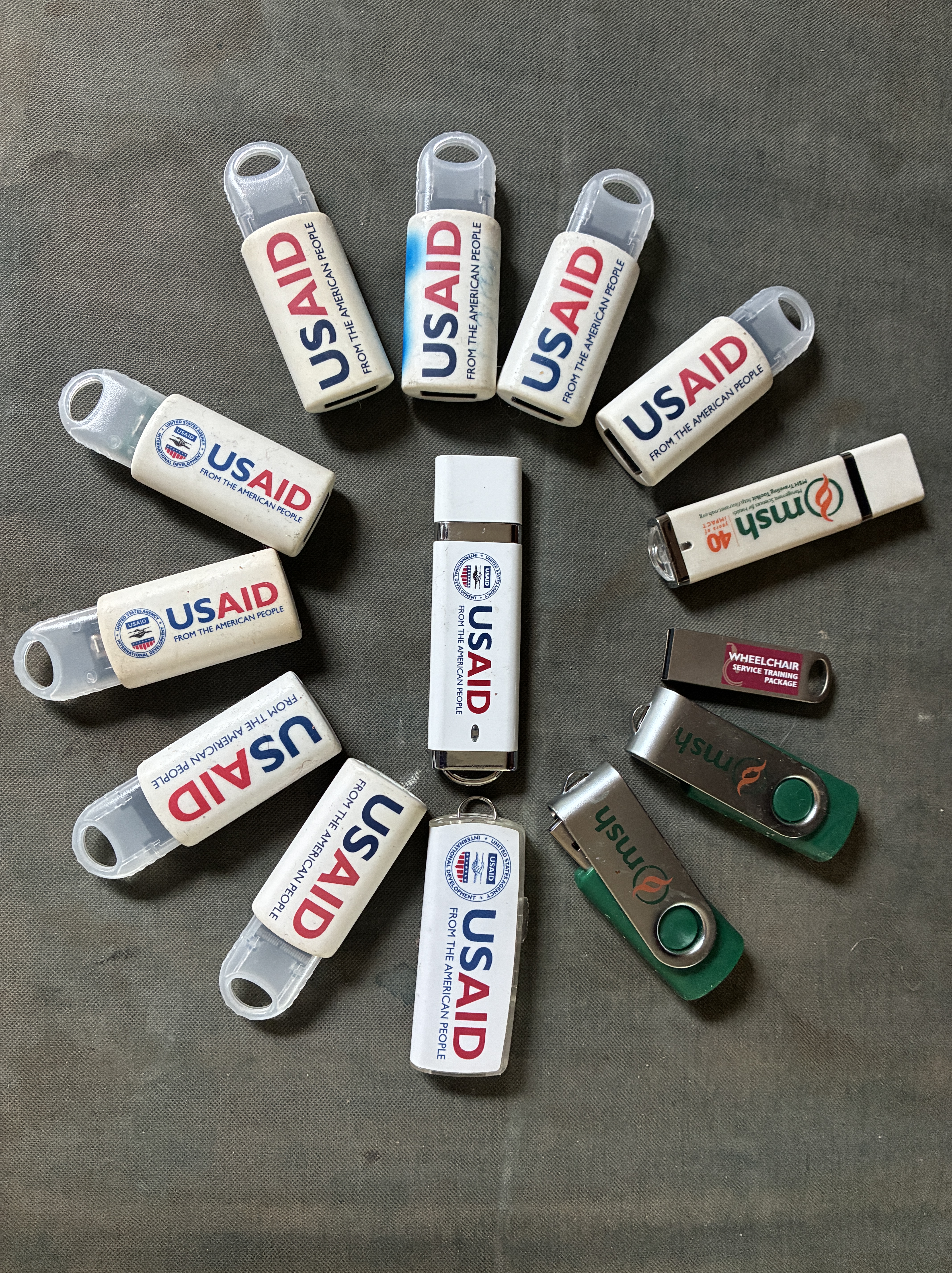
Over time I accumulated a bag full of thumb/flash drives. Many of them with the USAID logo on them. Finding these in the back of a drawer brought a flood of memories and sadness. But also gratefulness for what I was able to do and what my younger colleagues were forced to give up. All these drives are being recycled. I decided not to check what is on them. I don’t want to know.


0 Responses to “The last station of worklife”