When my trip to West Africa was postponed, most of us were indeed thinking of temporary postponements, not cancellations. But how quickly things changed.
Between arriving in DC and leaving everything seemed to be upended – VUCA times indeed: volatile (yes), uncertain (yes), complex (yes) and ambiguous (yes). Our daughters felt we were socially irresponsible to even be away from home, ride the Metro, visit musea. We didn’t think so. They rolled their eyes – baby boomers were not taking the corona virus seriously – we thought we were safe and careful. Sita took her kids out of school – I didn’t see why. Now I do,
We are humbled of course because we didn’t see the Draconian measures coming, but also proud that we raised kids who are more socially responsible than their parents.
We have friends who overwinter in France who are now imprisoned in their AirBnB. Europe is locked, as much as one can lock an entire continent. Now our much anticipated trip to Holland to celebrate our 40thanniversary is hanging by a thread. The hotel manager and I are in contact about whether to cancel or not. He wrote me, “if you don’t know what to do, it’s best not to do anything.” We will go one week at a time – but even that may be too slow, the landscape seems to change by the day.
I have already canceled our AirBnB and plane trip to Grand Junction where we were to attend the wedding of a dear friend at the end of May. The couple canceled rather than postponed the event. They made a trip to their townhall where there were pronounced husband and wife – no party, no honeymoon. Oh, all those disappointments, or as John Adams wrote in his diary: “Griefs upon griefs! Disappointments upon disappointments. What then? This is a gay, merry world notwithstanding.”
On March 6 I should have left for a two week trip to West Africa. The trip was postponed which was both a relief but also complicating my life and reducing my first quarter earnings by a considerable amount of money.
It was not a difficult decision to make. Imagine being on a jumbo jet with a few coughers or sneezers and maybe even someone with a fever. Canceling a trip costs money and so people get on a plane when they shouldn’t. I was trying to imagine the public health officials at Niamey International Airport as we stream out of the plane and one, it only takes one, person turns out to have a fever – would we all be quarantined at the airport? Would we have to camp out there, or only the people who can’t afford a hotel? I decided that I didn’t want to find out how that would work.
Axel had planned a trip to Washington DC to see some friends while I was away – and maybe enjoy some spring time which is still so far away for us here in Massachusetts. Since my schedule was all cleared for my West Africa trip I decided to join him.
After a failed start on March 7, (Axel forgot his wallet), we tried again on Sunday, International Women’s Day, with a woman at the wheel!
We drove to DC in our new car, an electric blue Toyota RAV4 Hybrid that we leased after our Subaru lease was up. After nearly 40 years of being a Subaru family we stepped over to the competition for the simple reason that Subaru didn’t have any hybrids within our budget. We are now the owners of an SUV, I am embarrassed to say. It seems nearly everyone is now driving SUVs; the carmakers must have listened to Americans who seem all to want big cars – this makes being in a small car increasingly dangerous. Our new car feels like a tank.
New to the Hybrid experience, we competed with each other about who got the highest ‘eco’ score, a feature we don’t really understand yet, but higher seems better. We drove to DC on one single gas tank, which is no bigger than the one in our Crosstrek, which would have used two.
I started the new year without trips on the horizon, at least in the near future and for paid work. Rather than being a source of worry these blank calendar pages have been a delight. Staying home, getting up whenever I want, going to the gym whenever I want, going to bed whenever I want, no more ‘school nights’ – I love it.
We are settling in for the long cold winter after the holidays and after a short trip to Holland to have our annual Old & New Year’s dinner with my siblings and share our good wishes for 2020 with them in person. Holland was cold and clammy with the high humidity and cold. Even though not as cold as we are used to in New England, it is the kind of cold that chills the bones. We visited with friends and family, celebrated the year’s good things, ate Dutch, Swiss and Indonesian meals and snacked in between on fries, herring, drop and other sweets. All this added about 5 pounds to our girth that we are still trying to lose.
Our days back home have taken on a quiet rhythm now that the PT sessions are over and we are done, mostly, with the frantic pre-holiday schedule. I have only a couple of coaching commitments left, after one of my clients felt confident to let me go. A good thing I suppose. I am finishing up one last contract with MSH for work in Bamako and Niamey before it gets really hot over there.
The India work is still ‘in the works,’ so to speak, with no clarity about when it may move again. I orchestrated my second proposal (as a free agent), and produced something reasonably compelling in three days, bringing together a team from three continents (Asia, Africa and North America) to contribute to a larger DFID project that aims to help independent media in 3 countries, in Asia and Africa, to stay independent and do their good work. It’s a very long shot, but it was fun to lead the effort using WhatsApp, Google Docs and Hangout. Most of the team members had never met before – it’s a trust fall if ever I saw one. If, by some miraculous or heavenly intervention we are selected I have some teambuilding to do.
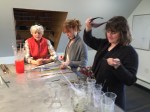
My two creations
Choosing our colors
In the absence of travel Art has moved up from its fourth position to number one. Sita, Tessa and I made glass swizzle sticks, a delayed Christmas present, in our local glass workshop, the Bubble Factory in Essex. We are ready for summer and swizzle our G&Ts with our creations. Axel came along to document the creative process. In the meantime Axel continues to perfect his technique of printing on silk, remaining in his geranium phase, making large pieces, more stole than scarf.
Enjoying doing Art as a family I promptly signed us all up for a fall weekend course at Snow Farm in western MA. Sita, Tessa and I will be making wooden spoons and Axel will take the Monoprint class. At the end of that weekend we will be celebrating Sita’s 40th birthday.
In the meantime, Sita and Tessa continue to make me proud. Sita with her extended networks of extraordinary people who are actively changing the way we work and talk, and have gotten very creative in transforming loose groups of individuals into communities. She gave an interview that articulated better than I could, how this happens. Tessa was the only one heeding our Christmas rule of only home-made gifts, and showered us all with the fruits of her cooking talents: burnt onion jam, pickles, tomato sauce, elderflower syrup, chili oil, macaroons, truffles and fudge brownies. She’s picked up more clients for her graphic design business which means less time for cooking and baking.
Who knows what cosmic and spiritual overtones were involved in my traveling home on the shortest day of the year while actually experiencing that day as the longest day.
For me Saturday the 21st lasted 34.5 hours (24 hours plus the time difference of 10.5 hours). It is as if I had violated some universal law about days lasting 24 hours, and was punished accordingly: coming out of the plane with inflamed sinuses and waiting for more than an hour for a suitcase that never was on my plane.
On the Delta app there is a way to track your luggage. It will tell you where it has last been seen. For two days it said ‘loading onto flight DL405 to Boston,’ even long after that flight should have arrived here.
You can also get a map of where your missing suitcase is. The little suitcase icon (my suitcase)was sitting right on top of the roof of the CDG airport terminal 2. It sat there on Saturday, it sat there on Sunday and now it still sits there although the tracker itself has indicated that my suitcase was loaded (no longer ‘loading’) on today’s flight to Boston.
The baggage handler chief told me yesterday I should not count on getting it before Christmas as customs will keep unaccompanied luggage between 8 and 24 hours before releasing it to the Delta man or woman who, I am promised, will drive it to Manchester.
I am trying to be cool about not having my bag yet, but couldn’t help ruminating and catastrophizing about not ever seeing it again – making lists in my mind about all the stuff inside it, including a few Christmas goodies.
But things are lightening up with the latest information on the baggage tracker, the sinus problems have gone away, I went for a swim yesterday having a lane all to myself, and managed to keep up the tempo in this morning’s spinning class, despite not having exercised or stretched for two weeks.
A little after 6PM I said goodbye to my friends and their cousins who had just moved into another tower of the same apartment complex and were still unpacking. They promised to be unpacked by the time I’d be back. They too now feel like part of my new Indian family as is V’s cousin in Lucknow.
At 6PM my ariport driver announced himself. My friends had calculated 5 hours from their door to the Mumbai airport. This turned out to be exact. The one hour to get in and then out of Pune was included in those 5 hours. From the city limits of Pune to the city limits of Mumbai is only 150 kilometers but the average speed is not quite what it would be in the US.
The driver was warned about the speed cameras posted along the highway by R’s cousin-in-law, who showed the driver the kind of picture you get sent in the mail when you are caught. He had been driving a little too fast to my liking when he drove us to the Pune airport last Sunday. He heeded the warning and drove prudently this time.
Mumbai airport’s departure hall is very fancy on the outside and glamorous and efficient on the inside. If the airport authorities can match the arrival experience, India’s vision (to be among the three most desirable tourist destinations in the worlds), may actually materialize.
The lines for the immigration were long but the booth were staffed. And now I knew also about the senior line. I was given a pass to the lounge which was also enormous, befitting the number of travelers, and well stocked with food and drink of any kind.
Once in the plane I discovered to my dismay that I was sitting right next to the young couple with its toddler, the same one I thought so cute in the security line, but not anymore now. They took what would have been the empty seat next to me and so I find myself in a full row with a toddler, while before me on the left was another toddler and behind me on my right an infant. Such companions for a 9 hour flight! The babies took turns being unhappy, and when we landed they were all unhappy at the same time.
AT CDG I snagged an empty shower and an appointment for a complimentary Clarins massage, available to customers of the Air France lounge who arrive early enough to get one. It wasn’t anything like the Shirodara oil drip but it was good enough, with a hand massage thrown in for good measure and a sample of a Clarin’s product as a goodbye gift.
The upgrade for which I had been waitlisted (and with four open seats in B-class should have gotten) didn’t materialize. A very apologetic chief flight attendant told me I should have been upgraded, but that apology came a little too late as we started out descent into Boston. Everyone blamed the French and the AF and Delta systems not comunicating. I have heard this excuse for the last 20 years or so. One would have thought that this technology glitch might have been fixed by now.
My suitcase did not emerge from the belly of the plane. I waited for about one and a half hour, bolstered by encouraging text messages and uplifting emojis from Axel. When it was just me and a handful of other travelers standing around the belt, hoping against all odds, I faced reality, declared the missing bag and we headed home. I collapsed into a miserable heap and went to sleep for several hours before having a glass of wine, sitting by the fire in our cozy home. It had been an amazing trip until I left Indian soil, and now all was well again, in spite of the missing bag with its Indian sweets that may or may not survive a cold night.
About 6 kilometers from where my friends live, beyond the outskirts of Pune, is the Tanman Ayurvedic research center, associated with the International Academy of Ayurveda. That was the last item on my ‘checking the boxes’ list – an Ayurvedic massage; not just one, the Tanman massage but also the Shirodara, where a copper container with hot oil angles over your head and drips the hot oil on your forehead. It advertises as a stress and tension reducer, which it did so well I fell asleep.
All slippery and oily I was led to a steam box where I nearly fell asleep again. My therapist (Chief Therapist said her name tag) was Blessy, a young woman whose husband I later met and who was also a Chief Therapist.
For the final moments of the ‘treatment’ that I had signed up for, I felt like a queen with a personal attendant. She helped me as if I was too old to do things for myself – I could have taken it as an insult but I loved it. She walked me across the slippery floor, soaped and then rinsed my body under the shower, washed my hair, toweled it dry, combed it and helped me put on my clothes. At the end she planted a kiss on my chin and embraced me tenderly.
There are people in residence here, living in small cottages. There is also a restaurant that is open at all times for breakfast, lunch and dinner. I heard one woman ask when it was lunch time. The junior doctor, who had checked my tongue, my weight and my blood pressure, told her, ‘when you are hungry.’
Currently there are two American women and two Spaniards in residence for treatments. These can take anywhere from a few days to several weeks. After an initial consultation (done by email for non residents), the senior doctor(s) make a preliminary diagnosis, draw up a treatment plan and indicate how long it will take. That’s when you buy your plane ticket. Once you are here a physical exam will finalize the treatment plan and confirm the length of the required stay. You might decide to change your return date at that point.
The center has an organic farm, lots of cows (a particular breed important from Rajastan – Tharparkar Desi cows), yoga in the morning and evening, a number of senior and junior ayurvedic doctors who are available for consultation and all sorts of treatments for all sorts of ailments.
There is a treatment of 7-15 days for arthritis I would be interested in (ankle, heel, knees, finger joints). The length depends on the source of arthritis. It could be related to osteoporosis (a longer treatment) or to toxins in your body (less time), or other causes. We are all uniquely configured and uniquely responding to what we eat, our habits, our sleep, our environment and our digestion (agni).
In between treatments, yoga, meditation, walks and meals you can take Ayurvedic cooking lessons, learn about herbal medicine, buy Ayrvedic products. And, if you are tired of peace and calm, get a cab into Pune for coffee, alcohol, processed food and polluted air.
I can think of some people who could benefit from a week here.
There are many things one should eat when in Lucknow. Axel had done the research and sent me a list of 10 items. One of them is Tunday kabab, a small patty, crisp on the outside and mushy on the inside, made from goat meat. V is vegetarian and so is her cousin, so they watched as R and I ate these at the top floor of a shopping mall that, to his regret, served no alcohol. It is the kind of snack that would pair well with a beer.
The Royal Café, where we ate the night before, has several branches across town. We picked a different one for a late lunch. We ordered several varieties of ‘chaat’. These are savory snacks, usually sold and eaten on the side of the road. To me they looked very healthy (yogurt, potato, spices) compared to American snack foods but my friends told me they weren’t. This (and all the sugar I ate) would explain why I have gained 2 kilos .
We ordered a bunch from the special ‘chaat’ menu and shared them, followed by Royal café coffee which was even better than cappuccino – foamy milk, coffee of course and then some secret ingredients.
After that we looked for the vests that had been promised to the neighbors – we visited a few shops. I am traveling light this trip and refrained from adding to my shawl and scarf collection – but I must admit I saw some from Kashmir that were made from the finest wool, or beautifully embroidered. I was tempted but resisted.
We decided we would try one last shop before giving up. The Khadi Emporium, across from a Catholic cathedral and school, had the coveted vests for women and men. I served as a model, we took a picture, sent it to the neighbors, but they said no and we gave up. Now we had checked all the boxed for the day.
We returned to our hotel and selected some sweets from another Lucknow ‘must see’ which happened to be conveniently around the corner. The sweets and cookies were for the neighbors, and some of the more photogenic ones (decorated with silver foil) to take back home.
And then it was time to leave for the airport. The flight was not as late as the outbound; still, we didn’t get home until 2AM. Now I have one more middle of the night flight, early Saturday morning at 2 AM and then I have one week of regular nights until we miss another night on a flight to Holland for our annual New Year sibling dinner.
Having completed our work in Lucknow on Tuesday we had all of Wednesday to do whatever we wanted. Our plane back to Pune was not leaving until late on Wednesday. There were a few things we wanted to do, some boxes to check off: there was the sightseeing box, a shopping box and a food box.
For the sightseeing we chose to go to a Mughal complex, the Bara Imambara It is an impressive complex of poorly maintained buildings. It is monumental and elaborate. We dawdled for a while in the outer courtyard because my friends felt that me having to pay ten times as much as them to enter was exorbitant. I didnt mind, I am used to paying a lot more than locals. I think it is fair to charge foreign tourists more.
I cut the knot of indecision by saying I wanted to see this Labyrinth that was part of the structure. We learned later from our guide that the labyrinth was not intentionally made as a labyrinth but rather a construction side effect.
First, we had to take our shoes off to get inside the building where tickets were sold. It was cold, overcast and the stone floors were hard on our feet, and by extension, all the other lower body parts attached to my feet.
A short stocky men approached is and began to guide us, without asking if we even wanted him, but it was good as he told us things we couldn’t have guessed. The ground floor has three giant and very high-ceilinged halls: the Chinese Hall, the Persian Hall and the Indian Hall. Each had a different decoration on the ceiling, geometric three-dimensional designs that, according to our guide, represented Chinese plates in the Chinese Hall, something else in the Persian Hall (the biggest of the three) and a melon in the Indian Hall. The now black and white decorations were at some time gold and silver but, according to our guide, ‘the Britishers’ had taken all that away.
Small openings high below the ceiling betrayed that there were people up there, and thus ways to get there. Those were openings along some of the labyrinthian corridors in back of the walls. If I had known how many steps up and down on cold hard floors we’d have to navigate I would probably not have entered. By the time I realized this it was too late, and we were high up ducking our heads, going up small steps, around corners, and down, occasionally passing the openings we had seen from below. These openings were large enough for an adult to get through and tumble down 5 stories – no barriers to hold anyone back. By the time we got down I needed a hot bath and a massage – but then there was more, our guide insisted, and we saw more extraordinary architectural features that allowed those on the inside to spy on those outside, unnoticed; and more steps up and down but now with our shoes on.
Outside the entire complex were lots of auto- and horse-drawn rickshaws to take tourists to ‘chickan’ factories – this is a special kind of embroidery made on men’s and women’s clothing for which Lucknow is famous. An unhappy looking horse took us up to one of these production places where an equally unhappy looking woman showed us how she did the embroidery. We did the thing the Dutch are famous for, of ‘kijken, niet kopen’ (looking, not buying).
The driver took us along a few more Mughal buildings, among them the Darwaza Rumi, two enormous gateways on both sides of a long avenue. By now our guide was gone and what there was to know had to be obtained from the internet. There were many more buildings with intricate architectural flourishes. These building too were unhappy looking, taken over by squatters and vegetation.
We went to Lucknow to show our wares. We did that today. Our proposal now may have some more hands to push it along.
Much like at the university last week, now too we were dealing with a lot of moving parts, VUCA time again: until we started we did not quite know who was going to be in the room, other than that we’d have elected and career professionals in the room, an uncommon combination. We didn’t know when we would actually be able to start and how much time we had.
The participants to this experiment, acknowledged as such at the highest levels of the department, had come by car from Agra, a three and a half drive through the fog. Some arrived earlier than others, so we had a conversation about expectations. Most told us they were summoned, leaving real expectations to our imagination.
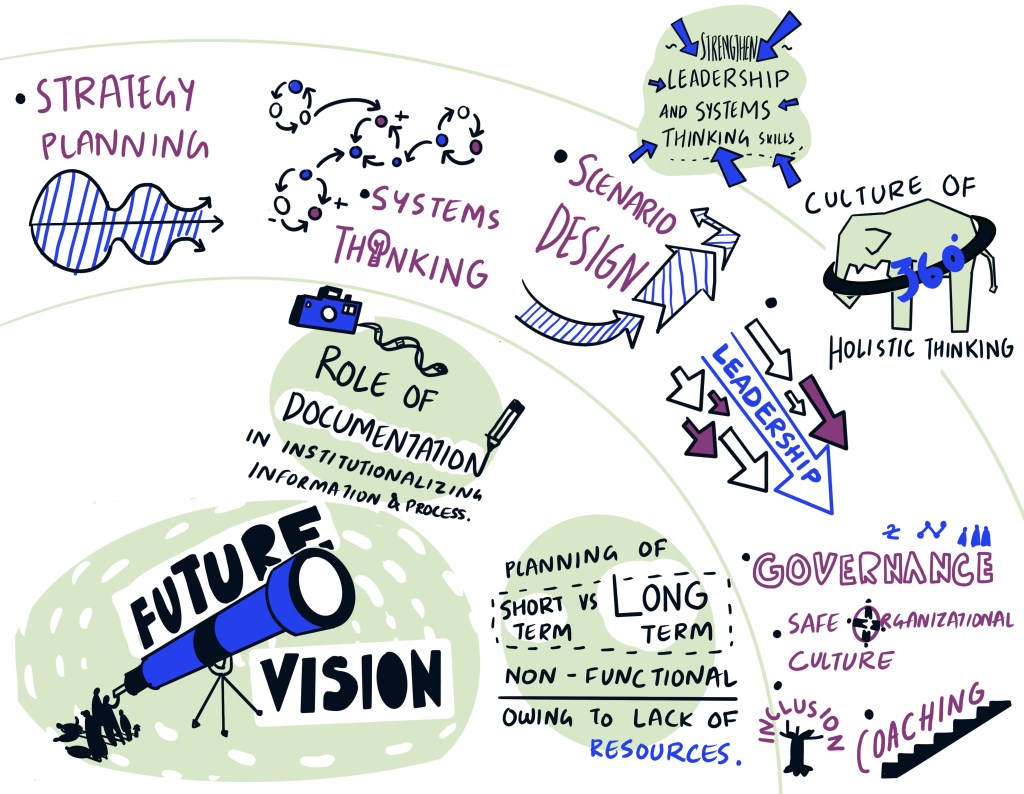
We had asked a graphic artists who we had put on our bid, whether he could create four visuals that represented four buckets of findings that we created out of the raw interview data from Ghaziabad. We told him we couldn’t pay him, and that it was an investment, just like all of us have been investing in this proposal. He did a superb and JIT job.
The morning we arrived in Lucknow, after our sleepless night, R scouted around to find a printshop nearby. They printed the four images on flipchart size (A1) boards. These we then used as small group conversation starters. We did this for two reasons: one to find out whether the challenges and skill sets that were relevant in one municipality would resonate with elected and selected officials in another. The other reason was to show people a way of interacting with each other to make sense of ‘data’ – the things we had learned in Ghaziabad.
I am happy to say there were no PPTs, even though the conference room was superbly set up for that (a giant screen and all the cables built in) and everyone expected them. Instead we asked for a whiteboard to take notes. There was none when we arrived, but now there is a whiteboard screwed into the wall of one of the department’s brandnew conference rooms.
The day before the event we prepared and iterated several possible designs for an unknown number of participants, unknown starting time and unknown length of the session. My team mates made it clear that, no matter what, I had to establish my credibility first. They are my cultural interpreters so I listen seriously to what they say when it comes to culture and habits. Of course, we are taking some liberties with what people expect and are used to (like PPTs and sitting down all the time). After all, we are challenging the status quo and in particular habits that get in the way of UP reaching its very ambitious goals.
And so I did establish my credentials, helped by our client who introduced me and mentioned the various countries I had worked (including Nepal). I think that helped too.
I shared some of the latest trends and concepts and approaches in leadership and management development, drawing heavily on all the things I have learned from my subscription to WBECS since I left MSH. Then my team mates took over and led conversations, in two parallel small groups, focused on the information in the visuals. All this was done in Hindi. It was clear from the beginning that our program is going to have to be done in Hindi – some people were comfortable in English but most were not. Conversations in Hindi were so much more animated than in English. That evening I downloaded the Hindi program in Duolingo on my phone.
Although the session we had designed veered significantly from what actually happened yesterday, our plan turned out to be robust – we had focused on the outcome we were after, rather than a blow by blow time chart. We wanted to give people a taste of how we do capacity building and collaborative planning and problem solving. We wanted people to leave feeling hungry for more of what we had to offer (this they did). We also wanted to validate the challenges and skills sets we had identified as critical (they were).
We ended the two hour session with lunch. After a family photo in the enormous courtyard of the brand-new building, everyone was ushered into the office of the principal secretary of the department. Our client had decided it was good to work the iron while it was hot and have the participants provided immediate feedback to the man at the top. We were asked to join (after they had discussed we know not what) and I gave a brief overview of our approach and philosophy. As we were told before we arrived, the PS would give us 15 minutes. It was like clockwork. Something really remarkable is going on here that is very different from the well worn stories people tell about Indian government bureaucracy.
We understood that the feedback would essentially open or close the door to our proposal that is currently lingering somewhere. In our final debrief with our client it was clear that we had the thumbs up. It is true that we had been a little concerned when some of the (more powerful) participants had said we hadn’t given them any solutions, only focused on problems. Our client told them, with a wink and a twinkle in her eye, that this had not been the intent of the session and, in order to get to solutions, the department would have to pay us. And this is where we took our leave. We’ll be in touch, she said.
We celebrated the efforts and good vibes of the day in restaurant that served Babur’s food. It was as if I was back in Afghanistan, except for the Indian rum (Old Monk) that accompanied my meal.
From my fourth floor hotel room I watch two men pick through a 6 foot garbage dumpster. Five dogs stand around them. One man stands inside the dumpster, the other on the outside. Both are barefooted. The dogs get thrown scraps from time to time and wiggle their tales, as if saying, more, more.
The men are sorting through the garbage which is now half inside and half outside the dumpster. This, I think, is one of the challenges of city government. But I am wrong. After breakfast I see they are still at it, but now they are cleaning up the mess they made: all recyclables are in neatly tied up in plastic bags, a plastic drum with something else is being covered; a metal oil drum is placed on their cart, looks like it has food scraps (the garbage container is next to one hotel and across from mine).
The men have swept the area clean, now wearing hotel slippers and flipflops. I understand later that these may be cleaners to whom the city has outsourced its recycling program. Several hours for one small garbage dumpster – I wonder how many of these people are employed and what they make. But cheap labor is of course in abundance here.
When I join my team mates at the most amazing sweets (and other things) restaurant next to our hotel I see that the streets have been swept clean (somewhat) – the green and clean Lucknow banners I have seen all over the city, starting at the airport are not just clichés. There is action and, clearly, money, behind the initiative, and it is not just ‘green for a day.’
Later I learned from one of the local elected officials that her ward in Agra muncipality (the one where the Taj Mahal is located) has won first prize in ‘cleanest ward’ in the entire state (remember, a state with 232 million inhabitants!) – this is no mean feat. The reward was 25 lakhs (about 35.000 USD) , an interesting amount, to further improve green and clean in Agra.



Recent Comments