Archive Page 20

Redhead capital

Axel is in ancestral lands. I am in the neighborhood of mine, now buried deep beneath the North Sea but that was thousands of years ago. Axel’s link with Scotland is closer. His maternal grandfather was a red-haired Scott who passed that gene to his mom (recessive) who passed it to him (red beard only) who passed it to Tessa with her copper tresses.

We expected to see many redheads when we first arrived on Tuesday but we saw none. We started to count. By the end of Tuesday, when we tumbled exhausted in our bed, the tally was only 1. By then, all we had seen was the airport and the Portobello section of Edinburgh.

On Wednesday we continued the count as we made our way in to Edinburgh. During those moments that the sun shines, the redheads stand out. Our lunch waitress was red. By the time we were done with lunch we had counted about 15 redheads who had passed us as we were sitting in one of the rare moments of sun on an outside terrace. Once we started walking around we stopped counting because they were everywhere. 

Our waitress told us that 34% of Scotts have red hair. It turns out she got that slightly wrong:  DNA research on the British isles, and particularly the south east of Scotland, has found that about 40% of the population has the gene for red hair, though  that doesn’t mean they have it.  The numbers of actual red heads differ. There is a lot of boasting between Ireland and Scotland about who has the most redheads – one or the other claims to have 10% of the population, the loser with only 6%. A quick search on Google however,  indicates that most agree that Edinburgh is the red head capital of the world. 
Scotland Holiday

We are in Scotland now. We exchanged Manchester at its summer best for a cool, rainy and cloudy Edinburgh. After a short flight from Boston we arrived mid-morning just when the sun was (kind of) peeking out from behind the massive cloud cover. It’s a familiar climate – like Holland, probably a bit worse. 

The Exchange home we will be inhabiting for the next two weeks is lovely. We can see the bay over the roofs of two more rows of houses that separate us from the beach at the most eastern end of the Portobello promenade. A big deck and decent size garden will be nice once the sun comes out (not in the next few days, unfortunately).

We exchanged leftover monies, some very old British and Scottish pounds, for real money at the bank (except for the 20 Shillings piece from 1964 which is worthless now). We had our first encounter with a singularly uninformative and unhelpful bus driver who gave us no change from a 5 pound note (sorry ma’am, exact fare only) for dropping us off at the wrong stop. 

Around lunch time things got better. We got eggs, ham, bread, some beer and a bottle of wine at a local Co-op. After messing up the self checkout, the co-op staff who came to our rescue, gave us several ideas for out of town outings, written on a cash register receipt, and pointed us to a place for lunch. It was a nice contrast with the dour bus driver. 

The recommended lunch, Espy on the Promenade in Portobello, was exactly what we needed. We sat outside (according to locals it was warm, 68 degrees), drinking great beer and enjoyed watching the activities on the wide sandy beach (mostly dogs and kids). We noticed no one was swimming. This was later explained by an electronic signal that said the water quality was poor (we suspect the water temperature was also poor). It felt a bit like Holland (especially seeing only clouds hanging low over the water) except that there was a city across the bay (Edinburgh) and hills on the horizon. We were served by a young man from Australia who had studied aeronautical engineering at Purdue University in Indiana, where Axel studied as well (Indiana, not Purdue).

We paid a price for all the walking we did (having no exact change for the bus fare back and underestimating distances).  Back home we watched a video on how to get the knots out of our leg muscles and relieve our sore legs and ankles. We sat across from each other on the small Ikea couches (in this Ikea-furnished house) massaging our legs with ‘Tranquil Chamomille’ oil. Axel is better at this than I am – he has done it before and is treated by the guy from the videos so he knows the drill. I got impatient quickly. 

I brought my ukulele. I have stopped taking lessons in order to focus fully on my violin. Without a teacher to hold myself accountable to I figured that taking it on this trip would impel me to keep playing. I now use my computer teacher (Yousician), who I pay 10 dollars a month to help me get better.

This morning I watched out over a rather bleak and wet garden (thinking with a sigh about sunny Lobster Cove) and reading a very funny introduction to a guide about pubs in Edinburgh. Being a rainy day today (and tomorrow and the day after), I see at least a few pub visits in our immediate future.

Holiday

We are now, what the Brits call holiday makers. We exchanged Manchester at its summer best for a cool, rainy and cloudy Edinburgh. After a short flight from Boston we arrived mid-morning just when the sun was (kind of) peeking out from behind the massive cloud cover. It’s a familiar climate – like Holland, probably a bit worse. 

The Exchange home we will be inhabiting for the next two weeks is lovely. We can see the bay over the roofs of two more rows of houses that separate us from the beach at the most eastern end of the Portobello promenade. A big deck and decent size garden will be nice once and if the sun comes out (not in the immediate forecast unfortunately).

We exchanged leftover monies, some very old British and Scottish pounds, for real money at the bank (except for the 20 Shillings piece from 1964 which is worthless now). We had our first encounter with a most uninformative bus driver who was singularly unhelpful and gave us no change (exact fare please!) from a 5 pound note for dropping us off at the wrong stop. 

Around lunch time things got better. We had a wonderful lunch at the Promenade in Portobello,  overlooking the wide sandy beach, drinking great beer and enjoying weather that the Scots said was warm (68 degrees).  It felt like Holland except for the views across the bay and the hills on the horizon. We were served by a young man from Australia who had studied aeronautical engineering at Purdue University in Indiana, where Axel studied as well (Indiana, not Purdue).

We paid a price for all the walking we did (having no exact change for the bus fare back and underestimating distances).  Back home we watched a video on how to get the knots out of our leg muscles and relieve our sore legs and ankles. We sat across from each other on the small Ikea couches (in this Ikea-furnished house) massaging our legs with ‘Tranquil Chamomille’ oil. Axel is better at this than I am – he has done it before and is treated by the guy from the videos so he knows the drill. I got impatient quickly. 

I brought my ukulele. I have stopped taking lessons in order to focus fully on my violin. Without a teacher to hold myself accountable to I figured that taking it on this trip would impel me to keep playing. I use my computer teacher (Yousician), who I pay 10 dollars a month to continue the teaching job.

Plans for two

In the middle of our celebration of life, all 34 four years of it, with Tessa I received news that a colleague from my early days at MSH had stepped out of life while he still had plans, hiking up Mount Denali. That left his wife alone with those plans. Poof, no summit, not ever again.

I remember, when my parents were in this phase of their lives, hearing from them that this or that friend or family member had died, some suddenly, some shortly or long after being diagnosed with this or that terminal illness. Now this is happening to us. Mortality playing peekaboo, now you see me now you don’t. 

I am thinking about all those people left behind with plans that included the person who left. These plans now need to be re-fitted for solo adventures or thrown out. I think about people who moved or re-modeled their houses to be able to live out their final days together, more or less independently but without having to do stairs, hard chores. Now what, live there alone?

We have many plans that include both of us. One of them we hope to get started this fall: to move our bedroom downstairs and turn the G&T porch with its heavy winter windows into part of that bedroom, with a summer porch attached. No more removing of the weighty windows in June, but yes to the G&T (winter and summer). Would that still be fun without my life partner, I wonder. The line in John Lennon’s Beautiful Boy (“Life is what happens to us while we are making other plans,”) comes to mind. And here I am, with a suitcase full of plans for two.

Older

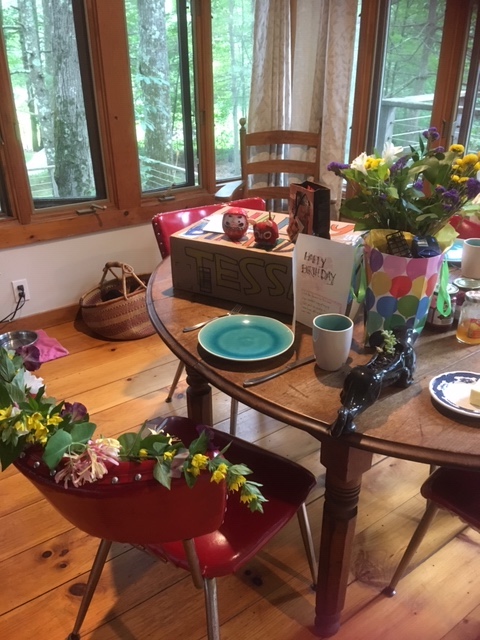
Today is Tessa’s birthday, a momentous day 34 years ago.  The lore of that day includes Axel burning the croissants we had brought to a crisp in the birth center’s oven which had clicked shut to self-clean. The smoke summoned the fire brigade. All this while I was in labor or resting with a baby on my belly. That I cannot remember.

This is the first time we are celebrating Tessa’s birthday in her own house. I got up early to collect the flowers necessary for decorating her chair. Our daughters and their families have added a new habit by adding various tchotchkes found around the house (and for the kids, their favorite toys). But the first order of business this rainy morning was finding the flowers. There aren’t as many here as there are at our house because the chickens eat most flowers within their reach. I found enough to do the chair.

And now Tessa is one year older. According to one Google search (quoting an unnamed study), she is entering the last year of her youth. Others claim that middle age or middle adulthood starts at 40 or even 45 – at any rate for our daughters middle age is coming into view. Imagine that!

When she was very little I wondered what it would be like to have grown up children. I couldn’t really imagine that, immersed as we were in the demanding tasks of childrearing.

At that same time I found my parents rather old.  And now we are these old parents ourselves, though I am not sure I daughters see us as old the same way we did way back when.

When I look at pictures of my parents’ age group at the age I am now I see old people, dressed in old-looking and tired looking clothes. When I go another generation back I see 50 year old grandmas in rocking chairs. Times they are a-changing.

We feel still rather young, even though we are what the French call our ‘third age.’  Is there a fourth, I wonder? Some years ago I decided that my aspiration was to reach 130 years. Then, one day, someone said that she felt sorry for me, as she noticed my joints are already problematic now. This led me to revise my aspiration downward a bit.  It’s 95 in my retirement money needs calculator, so it will be somewhere between 95 and 130. By then all my joints should be titanium.

Exchange

The day after I returned from South Africa, the work at home picked up to a frantic pace. We had 5 days left to get our house ready for 5 total strangers to move in for a week. We started preparing for that earlier this year by tackling the big projects, such as rehabbing the bathroom upstairs, cleaning kitchen cabinets, decluttering. Now, with only a few days left the to-do list had ballooned to 50 tasks – mostly small, but all consuming.

On Thursday, by the time we closed the doors behind us, just hours before the family would arrive, I was exhausted, but pleased. The house looked like a dream. I would have killed to come from the Colorado mountains and (having arrived in the dark), and wake up to Lobster Cove at its best on a 10+ day. 

The home exchanges this summer (there are 3), are a pilot for something more serious – a paid for summer rental while we retreat to a (much cheaper) summer rental further north or west. This we see in our not too far future. While our house and surroundings are being enjoyed by others, we are moving in with our daughters, three days in Easthampton and four days in New Hampshire, where, for the first time ever, we will celebrate Tessa’s birthday (July 2) in her home.

Attunement

A trip to South Africa took 7 days, nearly half of which was in transit. It’s one of those endless flights (from Atlanta to Johannesburg), where you have to remind yourself that the flight will eventually end. I tried to get myself upgraded on the way out there (failed), but succeeded on the wat home. The return flight was nearly 16 hours, two hours longer than the outbound one. Still, even in B-class the flight seemed endless.

I worked for just over a day with a dis-attuned team. I like the word dis-attuned better than all the other labels (dysfunctional disarrayed, problematic, toxic), because there is the promise of music in the word. Dis-attuned suggests that the team is not in harmony, each playing their own tune. During interviews with each before my trip I explored what music they were trying to make, what was on the sheet music in front of them. Once I knew, I could understand the dis-attunement. They were playing altogether different tunes. No wonder the melody didn’t come through.

The retreat was partially about the team getting its work done and partically about its leadership, collectively and individually. I have simplified my definition of leadership – a leader is simply an aware human being. Being aware applies as much to myself as to the other. It means that we can catch ourselves when our intent and impact don’t match. Being aware means that we recognize when we are sabotaging ourselves, when our egos get in the way. Being aware also means that we see the humanity in the other, behind the labels, judgments, professional persona, representative of this or that class/tribe/organization/culture, etc.  

Working on all this is how we spent the day and a quarter. When I left to fly home, on the interminable long flight to Atlanta, then Boston, the team was at least able to hear the tunes the others were playing, not quite attuned, but a little bit closer.

Nearly ’round

There is a circle in the making. It’s turning out rather big, but not quite round, and not even a real circle as it isn’t closed. It is more like my 3 year old granddaughter’s attempt at a circle, the two ends, not ends when you think of a circle, coming close to each other, or maybe intersecting, missing their mark of becoming a circle. 

This is how my professional life tries to become a circle. I started re-reading authors who I had to read in the first few years as a student in psychology, people like Kegan, Klein, Freud, Bowlby, Adler, Erikson, Skinner, Thorndike. All of them had shaped the field of psychology and so I had to learn about them and then there was always a test. I did pass all the tests because I was good at memorizing. During the first few years of my study there were no videos, no collaborative projects, no experiential learning except for Physiology 101 where I had to dissect a frog, and stand on a block that was pulled from under me while a camera took the picture of my falling to record my reflexes kicking in.

The lectures, with 149 other students, in giant lecture halls were didactic, my studying was based on memorizing facts and frameworks. Development in pedagogy since then recognized that this was learning in an incomplete way. Facts and theories, without getting them anchored in personal experience, simply float away over the year. For years, I wondered whether I had wasted 7 years by picking a study that I could not use in my professional life as a program officer in international development. But that turned out to be a premature conclusion.

45 years, after my studies began I was offered an opportunity to learn to become a coach. I was hardly enthusiastic. I always had liked to work with groups, as a teacher, a trainer or a facilitator. Coaching individuals didn’t appeal that much to me. But the offer was too good to let pass – my employer was willing to pick up the tab, and so I said yes.

Learning to coach is first and foremost a learning journey into the self. It required for me to become aware of my behavioral patterns and determine which ones were helpful and which ones were not if I was serious about coaching.  Coaching individuals pushed me into a new orbit of learning and re-discovery. And so, 7 years after this journey started, here I am re-reading classic texts from my psychology studies and connecting the dots. I am recognizing that the call for vulnerability from Brené Brown is great, but it is not for everyone as I am learning in my early ventures into group and team coaching. And now I am on my way to South Africa to explore and discover some more.

Convergence ahead

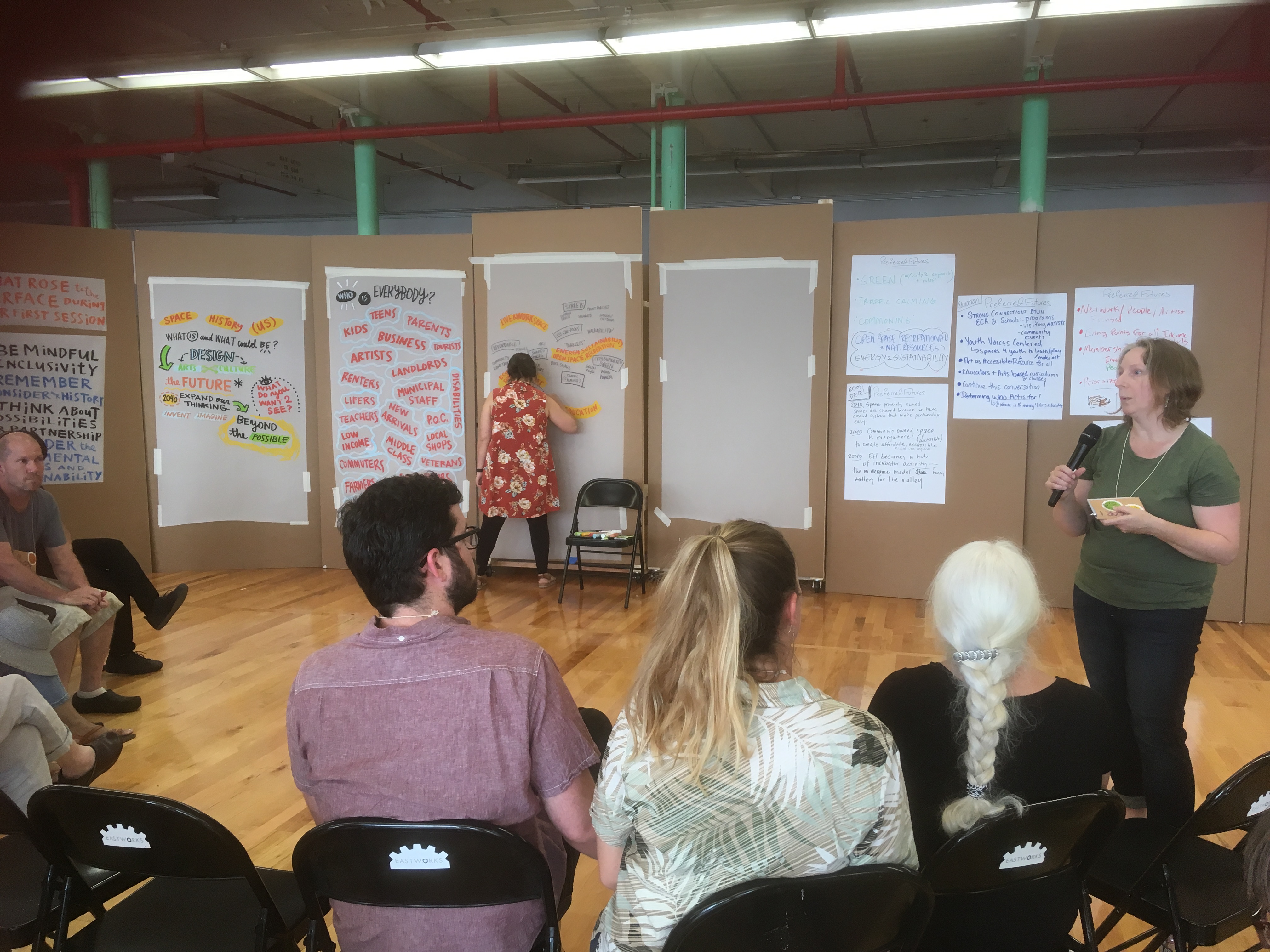
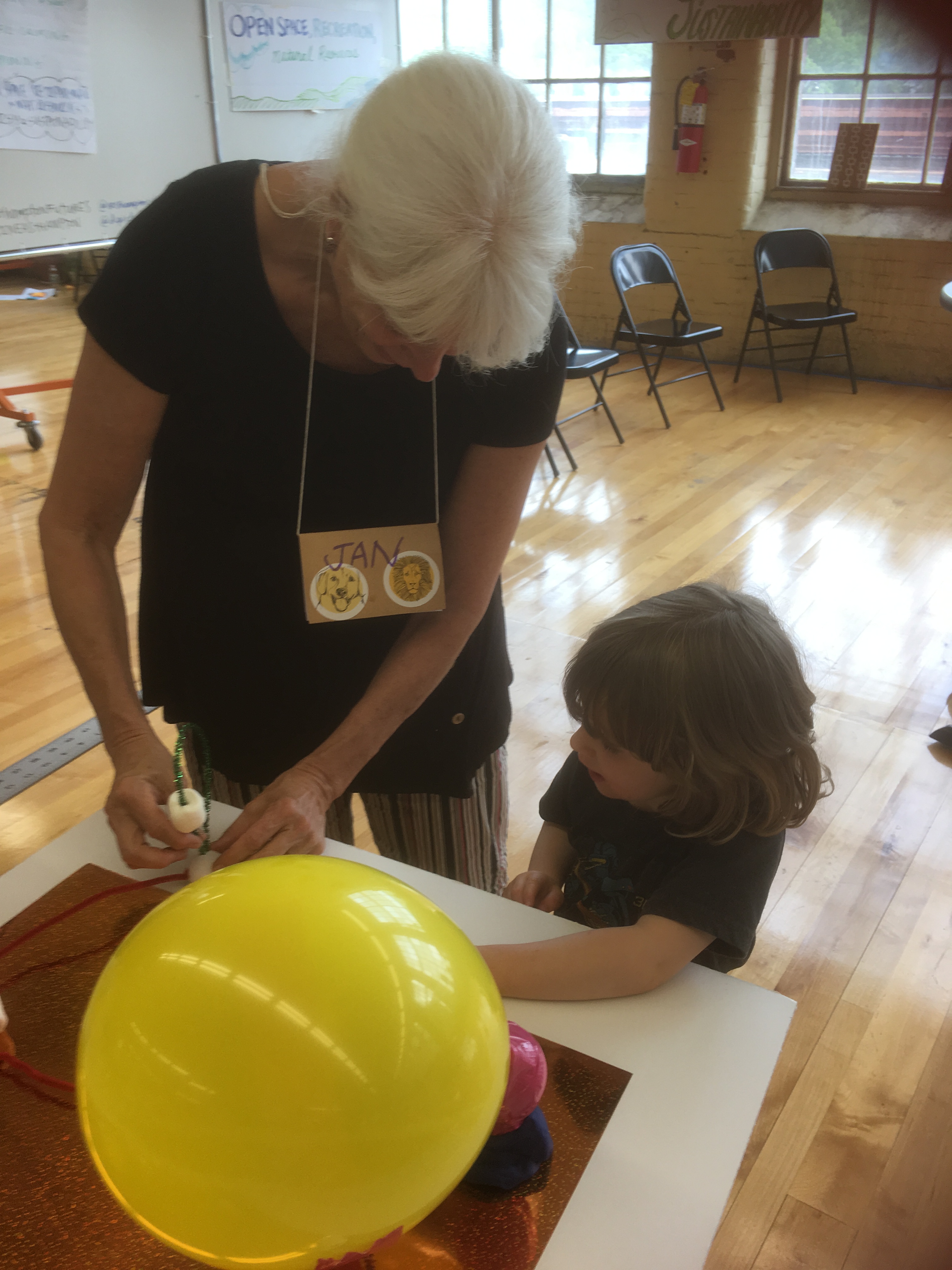
Yesterday we completed the second in the series of Easthampton Futures, working in and with the space created two weeks ago, and perfected on Friday. We spent most of Friday getting the space ready, checking off the multiple tasks, made the necessary purchases and got to know our fellow crew members for this event.

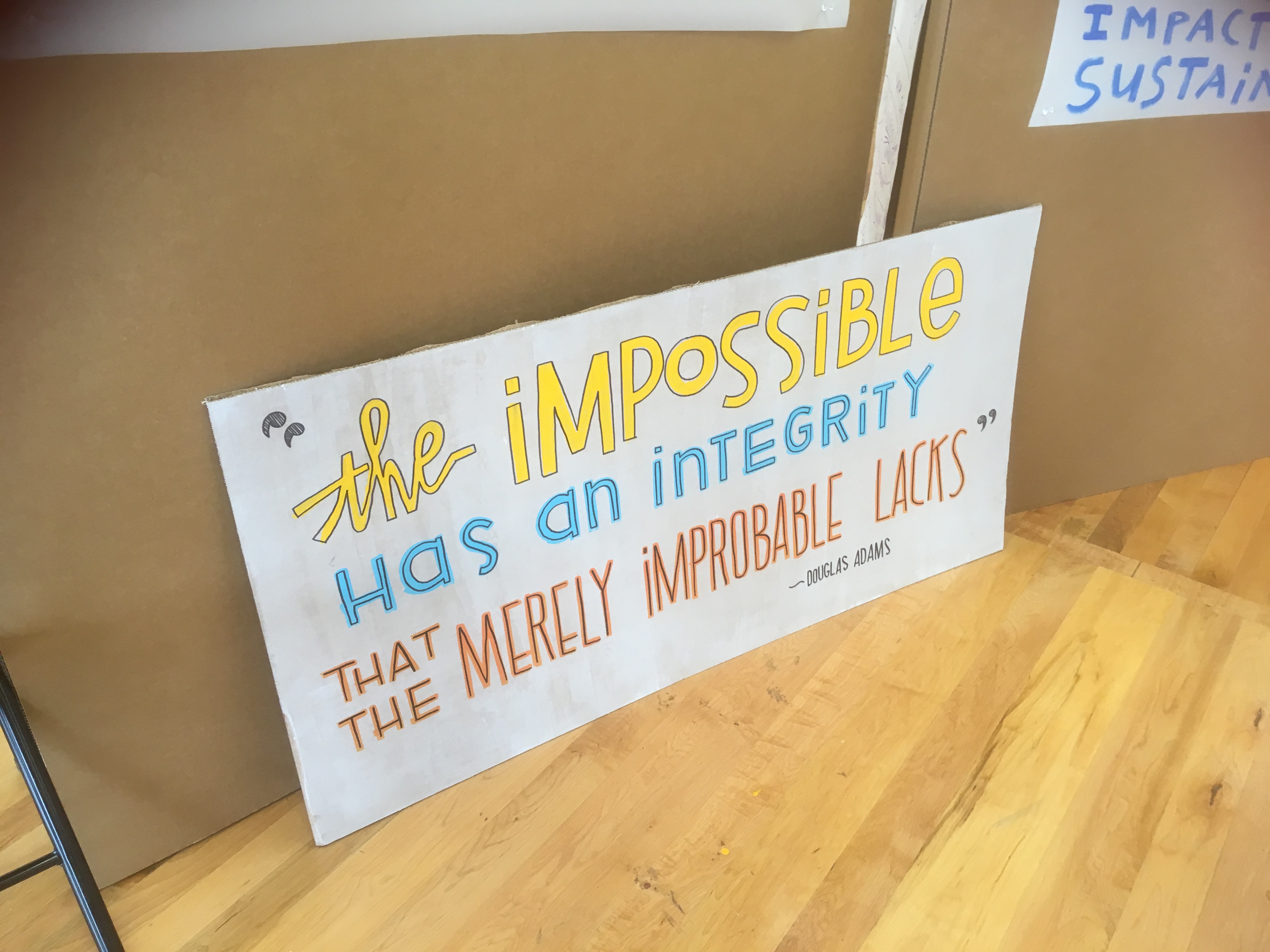
If the first session was about discovery and sensemaking, this one was about possibilities and prototyping, initiating the shift from divergence to convergence: we worked down from a 60000 foot view of a preferred future to about 5000 ft, making the contours of possible paths down to the valley more visible.

I was a little disappointed in the turnout. I had hoped that the buzz created by the first event would propel more people towards Eastworks – the converted mill building where all sessions take place. It was, just like last time, a glorious Saturday after a week of rain. Given the dismal spring we have had so far, I cannot blame people to want to be outdoors rather than indoors thinking about the future. It is the one time that we think of a sunny weekend day as a problem.

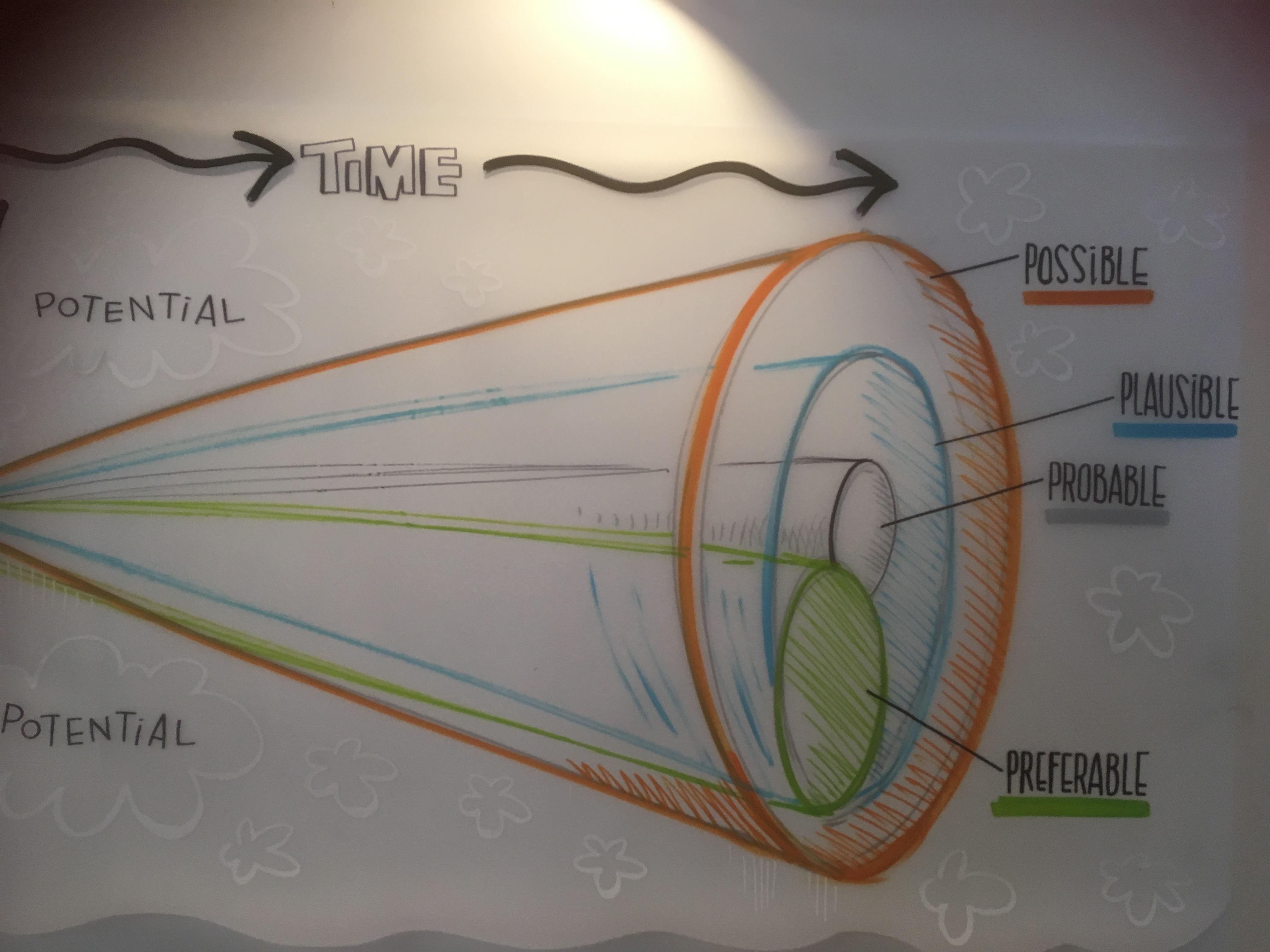
Still, it was an inspired and energy-filled day during which I daresay, everyone learned at least one new thing. I learned from than one. Sita introduced all of us to a framework (the Futures Cone) that is a huge improvement on the way I have most often seen ‘futures’ envisioned (essentially a linear extrapolation from the present, or what sometimes goes for a prediction). By the way, the only people I know of who have ever successfully predicted the future were Da Vinci, Gordon Moore (Moore’s Law) and Kurzweil. The rest of us earthlings have done so rather poorly.

The Futures Cone is a tool to help think about possible futures, plausible futures, probably futures and preferred futures. I led a small group, using this tool, to think about these various futures as it related to the intersection of arts & culture on the one hand, and space, environment, resources (natural, energy, human, etc) and sustainability on the other. We spent 45 minutes building on each other’s ideas and easily finding a convergence towards a series of paths forward. It was such a productive conversation that I cannot imagine how we’d gotten to a similar place in any other way.

Session #2 – Agenda

Coming together

For someone raised on a diet of languages (6) in high school and then further nourished on behavioral (Pavlovian & Skinnerian) psychology in university, the recent advances in neuroscience and epigenetics has led me through some spectacular French doors into a landscape that rivals Versailles. Not a professional landscaper or neuroscientist, I am wowed by the beauty of what I see, by the surprises when I stumble on a new perspective, without understanding the intricate and unimaginable complexity of what went into the creation of all this wonder, our neural system. 

My newly acquired academic credentials, if they can be called such, come from webinars, online courses, MOOCs and books. I have become an avid student of everything that sheds light on the complex and often hard to understand behavior of people. Why do people do things that create exactly the consequences they don’t want? Why, when they know what is good and not good for them, do they postpone action that would lead to better health, more joy and more love in their lives? 

Life is made up of cycles, and I find myself cycling back to things I had to read in university. The fights between Freudians and Kleinians in mid 20thcentury London seemed of little import at the time. Having been brought up, after WWII, in a pretty harmonious family, with parents who loved each other deeply, how could I relate to childhood abandonment theories, trauma and such? Now I feel drawn back to the readings that meant so little to me, and which I now realize are classics because of what they brought to the surface. That what happens early in children’s life becomes a driving force (for good or bad) in that child’s adult life. 

What’s puzzling to me now is why I picked psychology when I knew so little about it, had no self-awareness and knew only two psychologists. These were the father and mother of my classmate Edith in grade school. Her mother was a child therapist and had an office (at home) full of toys, doll houses, lots of dolls. When I first laid eyes on that office I said to myself, that looks like a fun job. I want to be like that. Even though, at 13, I had no idea what psychology and therapy were all about.  Edith’s father was an industrial psychologist with an office next door. His office was a typical office with a conference table and lots of binders and folders and books. I think I may have seen it once and never returned as it was boring to a 13 year old. Now 54 years later I am struck by the merger I am finding myself in the middle of: the merger between understanding a child’s early life experience and how these then play out in and out of the office. Edith’s parents influenced me deeply. Edith herself went into a direction that had nothing to do with what her parents did. She studied potatoes.


September 2026
M T W T F S S
 123456
78910111213
14151617181920
21222324252627
282930  

Categories

Blog Stats

  • 144,177 hits

Recent Comments

Olya's avatarOlya on Pocket rollers
Edith Maxwell's avatarEdith Maxwell on Boosted out
Sallie Craig Huber's avatarSallie Craig Huber on Rays for real
Lucy's avatarLucy on Probabilities
Olya's avatarOlya on Cuts

Enter your email address to follow this blog and receive notifications of new posts by email.

Join 78 other subscribers