Archive Page 201

Lefty goes to Bar Harbor

It was my first time flying since the Hudson River trip and my surgery. I left my sling in the car; it would take up too much room in the tiny cockpit. I took the left seat on our outbound flight with Bill making his left arm and hand available to do work that required right arm strength, such as putting in flaps. Since Bill also put in the frequencies (another right hand activity) and wrote down our journey’s progress, my only right hand/arm activity was handling the throttle which does not need much attention except to settle at cruising altitude and when coming in to land. In the left seat (when flying with Bill) the left arm is the one that works hardest.

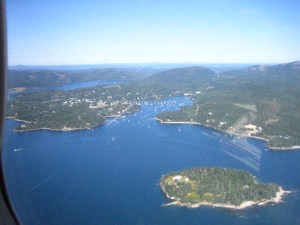
Bar_Harbor_1The conditions for flying were perfect: no wind, little (air) traffic and clear skies especially over Maine. We followed the coast, cutting across islands here and there as we went further and further east. We landed at Bar Harbor airport for a brief break. Ground control asked every incoming plane how long people planned to stay and everyone said ‘till Monday’ – except us, we barely stayed half an hour and because of that were parked between two jets. For us the plane is not a method of transportation but a vehicle to enjoy the beauty of northeastern USA and a way to keep our brains finely tuned.
Bill flew back and gave me his fancy camera to click away. I must have made nearly 100 pictures. My tiny old PowerShot makes poor snapshots in comparison. Clouds had come in from the south and we flew back below them. I watched the pattern of light and dark on the ground reflect the movement of the clouds above, quite beautiful.

Instead of swimming in the full cove, Axel had decided that it was time to organize his thoughts about Afghanistan on his website. Wherever he goes people express strong opinions about what we (the US) should or should not be doing over there. So now he has added his own opinion to this cacophony. I liked his piece.

Anne and Chuck showed up later afternoon with bags of mussels. We used to be self sufficient and pick our own. I could not imagine going to a store and buying them when they were available for free in our back yard. Before our accident the cove was endowed with a enormous mussel bed; last summer we noticed it was gone. Maybe the owners of seafood-serving restaurants who would show up now and then and cart mussels away by the bucket are responsible for our empty cove; more likely it was one or more winter storms at low tide that scraped the cove clean. Sigh.

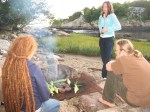
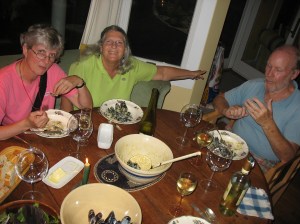
musselfestWe had a mussel fest preparing each batch with a different sauce: first Isabelle’s sauce with plenty of cream, wine, shallots and mustard which, like a thick and slow stream of lava, adheres to the shells inside and out as well as the mussels. Eating mussels this way is a slow process that requires much licking and bread to soak up the good stuff.
The next batch was prepared by Anne who poured liberal amounts of honey-dijon cooking sauce over the mussels, which left a good amount of liquid at the bottom, also requiring much bread; and there was more but I can’t remember as we ate plate after plate after plate.

We concluded the evening by sitting in front of our new fireplace and hearth – we have it on every night now, to make up for the nights of the coming winter when we will be sitting in our Kabul rooms in front of smoky old diesel-fueled bukhari stoves.

Stewards

My knitting and sewing material, plus an exercise ball, some 100 licorice tea bags and a good stash of licorice should be on their way to Dubai right now and onward to Kabul tomorrow, if everything is going to plan. I dropped a full suitcase off at Alain’s house in Belmont. When I turned around heading home I joined the avant-garde of the big Labor Day exodus into vacation lands further north.

The carpal tunnel doctor must have been among these vacationers because when I showed up for the appointment he was not there. This wiped away the fantasy I had nursed to leave for Afghanistan with the next diagnostic step (an EMG) completed. That would have made it possible to have the surgery during my Christmas vacation, if so advised. Scheduling such things during my short leave around Christmas is unlikely. So I will go one step at a time with only one step completed before my departure.

My work these days consists of combing through the draft work plans of my three teams in Kabul. It is detailed work which is not my forte, and thus somewhat stressful. It also requires sitting in front of a computer which is hard on the body, especially the mess of traumatized muscles in my neck and upper back. I finally had to resort to chemicals to manage the discomfort.

I had my second PT appointment and my arm and shoulder feel so limber this morning that I could easily forget to put my sling on. The range of motion is improving rapidly. I can do things I am probably not supposed to do without any discomfort, such as hanging a (small and light) picture on our newly painted living room walls. I do it when Axel is not watching. The urge to move everything back to normalcy and into the empty living room is hard to contain. Now that the hearth is in it feels completed, yet we are still waiting for the cabinet maker to put in the bookshelves that we had forgotten in the original design some 16 years ago. So there will be more sawing and hammering and normalcy will have to wait and my office will remain a storage room.

We attended a cocktail party with town officials at Woody’s to say goodbye and thank Nina, a member of Axel’s Community Preservation Committee. As chairman of the committee he has benefitted greatly from her contributions. Nina has one rule for committee meetings: at 9 PM she gets up and leaves, saying that a one hour meeting should be a one hour meeting. It has kept everyone on task and left more time for the guys to get a beer afterwards in the local pub.

Axel will soon be leaving this committee as well and he is still looking for a person to take over the chairmanship. Serving on town committees is usually considered a thankless and pain-in-the-neck job; yet there they were last night, all people who do this with (mostly) good humor and much dedication. Community stewardship still exists and I am happy and proud that Axel is one of these stewards.

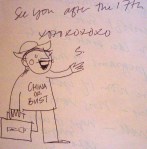
When we returned home I could stay up just enough to say ‘hi and bye’ to Sita who arrived with Jim for a short night. By now she is at the airport waiting to board her flight to points further west, on her way to China. She will return in 12 days via San Diego, just in time to see me off to points further east. She left us a nice good bye drawing, as she always does; she is, after all, an illustrator.sitabye

In order

The banking system works again! After more than four weeks of filing papers, answering questions and waiting for various checks and assessments to be done, we finally signed the papers for a loan. It’s funny how we, who own property that is worth 10 times the size of the loan, are subjected to this sort of scrutiny while risky ventures were cooked up without much of a thought in the bank’s back room.

We now have access to money to pay the bills that are heaping up in direct proportion to the number of workmen in and around the house. The line of credit could have bought us an entire house when we started with home ownership, some 25 years ago. Now it will get us only a septic system and some long overdue maintenance.

Tessa and Steve are beaming – life is good to them: parents who fix up the house with a new septic system, a new coat of paint and a new fireplace and beautiful stone heart, and then leave for Afghanistan for a year.

More doctors’ appointments are filling my days. Yesterday I visited the ear doctor because of another defect that surfaced during my physical, a hearing problem I wasn’t even aware of.  Since there is no obvious cause for it that can be ascertained without cutting, we decided to leave things alone as the hearing is not affecting the quality of my life. Today I am seeing the hand doctor to take a look a my left fingers and hand to figure out what causes the persisted tingling and numbness that wakes me up at night and stops and starts without any pattern. In the meantime I continue my physical therapy, faithfully doing my exercises, to get the right shoulder back to normal functioning; one more week of sling.

The departure for Afghanistan is now like a waxing moon; everyday a little more of the reality of that departure shines in my face. A small suitcase is packed with sewing and knitting materials, an exercise ball and the Dutch goodies my brother brought last month. It will precede me to Afghanistan with my colleague Alain who is leaving tonight for a quick visit. I am also filling up boxes with books I will need and taking them to Cambridge, one by one, for shipment. In the meantime, things in Afghanistan remain in flux and I have to remember that anything I ship out I may never see again. It certainly is one way of getting rid of superfluous (but nice to have) stuff.

Fresh

I used to work on the Afghanistan project as a short term consultants and occasionally steering things, very lightly, from a distance.  Now I am on the upper deck so to speak and discover the intense back and forth that happens behind the scenes. It is fascinating and intense.

Between my work hours and those of the Kabul team we cover about 19 hours of the 24 available. I am usually at my computer very  early in the morning and stop around dinner time; the Kabul team comes on board just when I go to bed, around 10:30 PM, and quits when I come on again.  I considered for a moment to change my working hours and do a night shift rather than a day shift, to be more in harmony. But missing out on these beautiful days in Lobster Cove to catch up on my sleep would be a shame.

It’s work planning time in Kabul and I am reviewing Excel spreadsheets with lines and XXs. Why we think that long lists of activities in tiny typeface can accurately represent the work we need to do is a mystery; more of a mystery is that we keep using this format despite the stress and despair that usually accompanied work planning.

I solve this problem by always changing the lists into mind maps and I have a nice piece of software that helps me do this (MindManager). This way I can manipulate levels and make sure that the details contribute to the higher level objectives.

Another problem I encounter is that work planning terminology is like a local dialect;  people use different words to mean the same thing or, more frequently, they use words without thinking about what they really mean, the most problematic ones being ‘output’ and ‘outcome.’

And then there is the issue of habit. There is a default in planning that is powerful to change: the cut and paste of the previous plan, making it as routine and easy as possible where it should have been a deep conversation that starts with ‘why are we here?’ or ‘what do we want our legacy to be?’ and ends with scrutinizing the activity lines to make sure they get us there.  I am introducing this discipline and am waiting to see the response. I already got one: ‘a fresh new dialog’ that I am bringing to this project. I like the word fresh – stale is not good for the body and soul.

The sling/shelf contraption is doing bad things to my trapezoid muscles and the many smaller muscles in my upper back, neck and shoulders. Things were already a mess before the sling (whiplash from the accident that I doubt will ever go away) but this is not helping. Sitting in front of a computer also doesn’t help and within an hour of the start of my work day my shoulder and back muscles were burning from overuse. I took the sling off and did not put it on all day and requested an emergency massage from Axel (which he expertly delivered). I added to that an expert massage from Abi later in the day that did much to relieve the discomfort.

Progress

We made big progress yesterday with several of the things that have been a big headache the last month. The most elderly of our cars, a 13 years old Subaru with 250.000 miles, was certified for another year. It proudly displays its 2010 window sticker.  We had not expected this. It will help with the selling before we go.

Axel completed painting the living room and, after 8 months of camping out, we started to move things back to where they used to be. Normalcy is what I want, I told Axel. I am anxious to move stuff out of my office which has more the look of a storage place than an office.

We made a fire in the new fire place. It was both a test (no smoke came out of unexpected places) and a dream come true – this is what we had in mind when we ordered the new fireplace a year ago. It’s been a lesson in patience. The work is not done yet around the fireplace but that is, at this point, minor change. It was lovely sitting in front of the fire and then being able to simply close the fireplace doors and go to bed. In the past we had to carry smoldering logs through the house and throw them out in the yard and then extinguish the fire by spraying it with a fine mist of water.

And finally, I received my official terms of assignment, my new TOA as it is called in our jargon. The work in Kabul, even from a distance, is ramping up. Because of Ramadan, phone meetings are now late at night rather than early in the morning. My first meeting with my colleague Steve and my boss started at 11 PM and lasted till after midnight. It is good they could not see me yawning as I am still on Ghana time.

The meeting generated many tasks in addition to much learning. It’s tricky to manage 3 teams from 8.5 time zones away but we are all trying. The big complicating factor, especially for work at the central ministry level, is that the dust has not settled from the elections, and may not settle for awhile. This means that we don’t know whether we will be working with the old and familiar cast of characters or an entirely new crew. Still, we have to submit a comprehensive work plan to our funder, the US government, before the end of the month.  Work planning has never been my strength and as an underling my work planning experience at headquarters was not something I relished. But now I am overseeing three large teams and I have to encourage those who find it similarly draining to soldier on.

I like working at home, in charge of my own schedule, and being around Axel.  Best of all, Lobster Cove is beautiful these days. The early fall/late summer days are of the 10+ variety: clear blue skies, perfect temperatures and brilliant colors all around. Although I am anxious to move to Kabul and be with my colleagues, I am acutely aware of this most gorgeous environment I have to leave behind.

In the neutral zone

Yesterday was my first day at work on my new job. It was an odd sensation because at first sight nothing had changed: Monday is my telecommuting day. But instead of telecommuting to Cambridge, I telecommuted to Kabul.

That this state of affairs was neither here nor there was obvious from my dreams: I was on my way to Baghdad, a long journey by foot with much baggage. Axel and I ended up in a transition place, a camp of sorts. Someone remarked that they smelled an overheating battery and that is when I discovered I did not have my black backpack, the one I usually take to work which has my computer and an extra battery in it. I experienced a sense of loss and tried hard to imagine doing my work without that backpack and its tools inside.

Bill Bridges had dedicated his life to helping people navigate transitions, so, in this time of transition, I go to him for advice. Bridges taught me about the neutral zone, the time after the ending and before the beginning. In the circus this is the moment when the aerialist lets go of the trapeze she was on and before she catches the other one. It looks like a free fall and it feels like one but it isn’t. The new trapeze is on its way.

Bridges suggests I think through my transition by focusing on my stuff and what I want to do with it. He calls it ‘Guidance for Moving.’ Even though I don’t have a moving allowance, it’s a good mental exercise and it helped me to interpret my dream. Air shipment is for the important things I will need at my new location immediately. By sea I ship the things I want to take along but that are not as important as those requiring fast transit. I will put in storage all things I don’t want to discard but that I don’t want to use just now. And then there is disposal: the things that it is time to get rid of and leave behind.

In the Cambridge office I already disposed of 22 years of files and papers that I have not looked at in years. It was a little scary but also a relief. With my Cambridge office emptied, someone else moved in and I don’t have an office anymore. This makes my home office the locus of my transition. I get to work from there as much as I want, enjoying my last three weeks of Lobster Cove during one of the most beautiful times of the year. I surely will miss that first sight of Lobster Cove when I get up in the morning, always dazzling, rain or shine.

Yesterday was also my first visit to the physical therapist. She took measures and wrote down numbers and percentages about my range of motion. She commented that it was pretty good and that the incisions had healed very well. I received my first set of instructions: back into the sling (for another 2 weeks) and 4 sets of exercises, with icing in the evening, just before bedtime.

Fits and starts

The return flight had a few glitches. Not the kind that can easily be fixed by one person because they are ‘system’ glitches. But what is ‘the system’ when you try to fly home?

The Ghanaian Delta staff valiantly tried to load the plane to New York without the help of computers because ‘the system was down.’ I found throngs of people in front of the Delta check-in counters, a full two hours before departure. It was a good thing I had checked in online and printed my boarding passes on hotel stationary. As a result I breezed through check-in and formalities and bypassed the crowds. Still, the people at the gate did not believe that my ordinary piece of paper, the seat assignment section ripped off along the non-existing perforated line, was actually a real boarding pass. This self-service check-in is clearly not a common practice yet on that side of the Atlantic.

Check-in without the help of computers can be done but the manual system is rather slow and flawed. As a result the boarding process was hopelessly chaotic because most people had not received a seat assignment. The plane left an hour and a half later than planned. It was a lucky day for at least 35 people who were pushed forward into the large but empty business class. Among them was Gloria, one of the senior managers with whom I had just spent 3 days at our retreat. It was her lucky break at the start of her vacation.

There was a different kind of chaos awaiting us on the other side of the Atlantic – a traffic jam at JFK which kept us searching for a spot to park and then waiting for a people mover, the funneled buses on retractable stilts. One people mover parked at the rear of the plane which disappointed all the people in business class, especially those who had found a seat near the front door in the hope of being the first out of the plane. Just when we had all moved to the back of the plane, waiting for another bus, one showed up in the front. The mass of people heading for the back door turned around and rushed back to the front door as if the tide had turned and eb turned into flow.

All in all it took over an hour from touch down on the runway to stepping inside the Delta terminal. There was much stressing around me, and we had not even gotten to the city itself! Many people had missed their connections. Not me, I had four hours of waiting ahead of me and so it did not matter where the waiting took place.

Arriving at the Delta terminal at JFK does not show America at its best to first time visitors. The place is grungy and not very welcoming. The TSA lady, asked to do a body search on me because of my sling, inquired what the thing was. I answered that it was a sling, as politely as I could. She then asked me to stick my arms out. I told her my arm was in a sling for a reason and that I could not raise my arm. This was a new concept. After making sure there were no traces of explosives on the contraption I was admitted to the inner departure sanctuary for my next flight.

More glitches as we waited to unhook ourselves from the jet way. Our 10 PM flight was ready for take-off at 11 PM precise. Axel was waiting for me in Boston; it was now close to midnight. There was one more glitch: something big (an accident or a mega construction project) on 128 South had closed the highway and we were ramped off to find our way through exurbia back to 128  a few exits further south. We arrived home after midnight and I tumbled into bed, beyond tired, around 1 AM. It was a fitful sleep but a happy one after this very long day. I am home again with my honey.

Last day

Saturday is for rest, in principle; as is Sunday. But this Sunday is for travelling back to Manchester by the Sea and yesterday was for finishing the work of this trip and the last day of work of nearly 23 years of work at MSH headquarters. It hasn’t quite hit me, but it is momentous.

I completed our report as far as I could get and in the late afternoon we met to complete the missing pieces. In between we played with friends. Jacqui was one of them. I met her in Rajindrapur last Decemer at the BRAC conference and we clicked, as they say. She is from the UK and her husband is from Denmark. His job here has earned them a CD license plate. I am not sure it helps them much in traffic jams but maybe it helps in other ways.

Jacqui was the chief of party of one of the USAID projects that has just ended and did not win the follow on project, against all expectations. This means that Jacqui is free now and available on the labor market. This is good for MSH.

Jacqui was one of the lucky people who got to chat with the Obamas during their visit here in Ghana. Laterwe met with Barbara who also shook hands with our president and his wife. Everyone agreed that the Obamas visit was spectacular and special in addition to being a lot of work and, traffic wise, a pain in the neck. Barbara told us there was a baby (Theresa) sitting on the lap of her parents near the family planning station, who was picked up by the president (presidents do this sort of thing) and that this baby is now referred to as the Obama baby. Maybe the parents should consider a name change (Obamia? Or simply Michelle?)

After a lukewarm Nescafe capucchino-wanna-be, Jacqui took us to a shop to get one of the many designs of cloth with Obama’s photo in large ovals. She also took us to a small shack-like store of a long-term resident Swedish seamstress whose unusual designs told us something about her unusual mind. We had not expected to go shopping and so the prices exceeded what was in our purse.

At the end of the morning Jacqui left us to return to her family and we pursued our (re)discovery of Accra. I found the Lebanese silversmith I had first visited with a colleague some 8 years ago. We spent a lot of time in the store that is like a living room with thousands of lovely and not so lovely pieces of silver jewelry, hiding in a regular house off the main shopping street. I practiced my rusty Lebanese and bought a few pieces to be gifted away. Lunch was across the street, Lebanese of course.

And now it is time to zip up the suitcase, pay my bill and say goodbye to Diane and Ghana, for a while.

Habit

Ghana_SLR 161At 6 AM the car park outside my window is teeming with people carrying small and big bundles. Taxis and small buses stand ready to take people wherever they want to go. It is Saturday morning and time to travel. I am told that much of this travel is to relatives far and wide to attend funerals and weddings, events for which people are spending more than they can afford and go deeply into debt.  William has told me about this disastrous social trend that drags middle class people below the poverty line. Apparently it is the Christians more than the Muslims who engage in this Ghanaian version of keeping up with the Joneses.

Like any gathering of people, it is also a good place to sell stuff or to preach; both are happening in a cacophony of voices, colors and sounds: it’s pure eye candy. I try to capture it on my small low performing camera. Where are my daughters with their equipment and skills when I need them?

William drove us back to Accra after the completion of the retreat, more or less on schedule. The HR director and the DG joined us at mid morning, something we had hoped but did not want to believe until we actually saw them. They arrived just when the participants, in self selected teams, had made commitments to take a small bite out of a series of huge challenges, observed during the visits we made earlier, in cross functional teams: one group took a bite out of the human resource challenge, another out of the resource management challenge, another sat down to tackle infrastructure challenges, a fourth team took on quality assurance and the fifth team decided to get their own house in order to improve the functioning of the national health insurance scheme. All challenges are enormous and represent nearly intractable tangles of interests, agendas, stakeholders, schemes, models, languages, and a history of piecemeal and failed attempts.

We call these leadership projects that give senior leaders a chance to rehabilitate themselves in the eyes of those working at the operational level and improve their management and leadership skills. It is opportunity to show that they can make a difference for the levels below that keep pointing fingers at them. There is a tendency to want to take on everything at once and cover the entire country, in the process making the task so difficult that everyone gets paralyzed or feels so impotent that any action feels risky. This, I believe, is the cause of much of the inertia that we see and that people complain about.

I also believe that the inertia comes from not seeing it; everyone else does the same. I provoked the participants a few times on their passivity when their team members did not show up at agreed upon times. No one took action; no one called his or her team mates, even after dropping a few hints. People want to be congratulated on being on time themselves; when I told them it doesn’t count until their teams are complete there was this vacant look on their faces. It made me want to wave a large flag in front of them, shouting, ‘anybody home?’

They all say they want to change this habit they consider dysfunctional. But it is lodged deep in their cells.  It will take an enormous and sustained effort to dislodge it. As Mark Twain observes: “Habit is habit, and not to be flung out of the window by any man, but coaxed downstairs, a step at the time.” We did a lot of coaxing these last few days.

Many of my observations about senior leaders were confirmed by my friend Seth who is now high up in the ministry of education. He happened to be in the neighborhood of our hotel yesterday and we met in the hotel bar and talked about his new role and his past history with the regime that is in power again. Seth and I met at a conference in Zanzibar some 3 years ago and have stayed in touch. He will be one of my sounding boards for my theories about senior leaders, since he is one himself.

I am disobeying doctor’s orders and slept the entire night without my sling. I can’t stand it any longer. The physician’s assistant had told me some weeks ago that he usually lets patients take the sling off at night after four weeks. In two days it will be four weeks. I let my body guide me: the discomfort is less without the sling than with it.  I can move my shoulders in several directions without any pain.  I assume this means it is not frozen, something I was worried about.

Make-do/can-do

The chaos of getting 22 people off in 7 cars to 7 different destinations as close to 8 AM as possible did not materialize. Our Ghanaian colleague Philip had been fretting over getting this right, not an easy task, and then everything was right. At lunch time everyone returned and the field visits had been completed without a hitch, with spirits high. There had also been some bonding across organizational divides; there is nothing like sitting together in a car going over bumpy roads. It reminded me of a field visit I made with a bunch of family planning professionals from all over Francophone Africa in Benin. We travelled over bad roads for 700 km, from early morning to deep into the night. We sang songs for hours, told jokes, changed tires and pushed the car out of mud; we became friends for life!

I accompanied two gentlemen from the ministry of health and we were  expertly chauffeured by driver Valentine over roads that had lost their hard top here and there. Although our destination was not far, it took us exactly an hour to get to our destination. We were warmly welcomed by the midwife in charge, just outside the Labour Ward where some hard work was being done by two women who had reached their term. No husbands were present – labor, even with an extra ‘u’ is women’s work.

Over the next couple of hours we chatted with various employees and explored the buildings and rooms that were part of the health center. The senior leaders were told to present themselves as students, counter cultural for sure. There had been much concern before the visit about whether this was possible and shouldn’t we surprise people. But none of these fears came to pass, as I knew from experiences elsewhere.

The health center consisted of the main block with wards and consultation rooms, a block of dilapidated staff quarters, an incinerator, two containers that houses the generator and the ambulance, a block of rooms for specialized services and something that was referred to as the ‘new’ building, a large unfinished structure in a corner of the compound. Work had started some 8 years ago but they had run out of benefactors or the benefactors had run out of money.  Inside it did not look like a new building anymore.

A matron who had been taken out of retirement had settled into one corner of the building overseeing a makeshift recovery ward. The ward has two beds, one covered with two crib mattresses instead of an adult mattress, a bench and a crib. ‘It’s not enough,’ she said. Sometimes she has to ask the least sick person to move over to the hard bench. We were all inspired by her commitment, passion for her work, concern for the community and can-do attitude. She surely was able to make something out of nothing. Asked about her retirement, she answered that she was too good and too strong for that and that she plans to continue working under contract as long as she can.

Throughout our tour the accountant accompanied us, pointing out the places where resources would make a difference and places where they themselves had made a difference in the absence of a response from their own employer, the government of Ghana.

At the family planning clinic we found the nurse talking with one of the outreach workers, a young man who does vaccinations as well as HIV/AIDS outreach. We asked the nurse to teach our driver how to put on a condom. He was a good sport and demonstrated at the end of the lecture that he had understood everything well, from hand washing to opening the package and rolling the condom down on a wooden model; all this done with great care and clarity and a good dose of humor.

On our way back to the hotel we stopped at a tiny community health center staffed by community nurses. We learned much about the reluctance of the (very poor) local people to be referred to the next level health center and how this has led to true telemedicine: the nurse in charge calls the physician assistant, who is the person in charge of the referral health center  (the one we had just visited ) who coaches her trough his cell phone on how to give care that he would have given. It is not ideal but she learns from this and the patients benefits; another form of can-do/make-do.

I interviewed three young community nurses who are entering their second year after 3 weeks of practical work. They had just returned from their community outreach rounds, checking up on the vaccinations of babies and mothers. Their eyes sparkled and their uniforms were spotless but brown; the coveted white uniforms are not for them until they pass next year’s exams.

After lunch we compared notes among the seven teams, using appreciative inquiry as our approach: what had they seen that was inspiring, touching, surprising (in the positive sense) and life-giving (literally and figuratively). What we heard stood in sharp contrast to the supposed incompetence, low morale, mediocre care, inertia, drug supply problems and poor management that we are usually being told about by the top people in the ministry, people like the ones  we had in the room.

We were encouraged by the interest and enthusiasm from our participants; there is no more coming and going and, aside from things like punctuality, everyone is fully participating and deeply involved in the program.  I provoked them around the punctuality issue. There is much denial about their own behavior and they are rarely confronted, except by their bosses, who probably don’t manage themselves very well either. There is also much inertia and little sense of collective responsibility. A few individuals are proud, and want recognition for being on time and ‘sticking to the norms.’ Yet there is no action to make sure their whole team is present, even after several hints. Although Americans are culturally considered individualists, and Africans collectivists, when you look closely you see that the educated elite has drifted far afield from the collective sense of duty and responsibility, may be not in their words, but surely in their actions.

We ended the day with two exercises, one called the Helium Rod, which we fabricated out of flipchart paper, and the other about shared vision, using a gadget that we also constructed out of material found locally. Experiential exercises are still a novelty here. It is one place where we can put a mirror in front of the participants and show them what they actually do, as opposed to what they say they should be doing. In a place where senior people don’t ever get direct and honest feedback about what they should be doing differently, this is the only way to confront people so they can see what they need to work on. Intellectually they buy this, but there is a sense of impotence when it comes to action.

Today the rubber will hit the road. In a reflection about the effect of the appreciative inquiry many expressed concern about it being a bit artificial and not contributing to the solution of problems. The problem-focused approach to work and life is so deeply entrenched, and so pervasive that it has become embedded in their very cells and doing anything else feels wrong. We told them we will get to these problems later but first wanted to establish a solid foundation of knowing what is going well so that this can be supported, enhanced and extended.

Today we will focus on their challenges. We will put them to work, in teams, on analyzing how they can remove obstacles they observed in the field. I have a premonition that they will find ways to push the responsibility for solving these problems further up the chain, thus reinforcing the practices that firmly keep in place the roadblocks that everyone can list in their sleep and that have been identified in countless reports for as long as I remember but that no one feels empowered to tackle.


April 2026
M T W T F S S
 12345
6789101112
13141516171819
20212223242526
27282930  

Categories

Blog Stats

  • 140,904 hits

Recent Comments

Sallie Craig Huber's avatarSallie Craig Huber on Rays for real
Lucy's avatarLucy on Probabilities
Olya's avatarOlya on Cuts
Olya Duzey's avatarOlya Duzey on The surgeon’s helpers
svriesendorp's avatarsvriesendorp on Safe in my cocoon

Enter your email address to follow this blog and receive notifications of new posts by email.

Join 78 other subscribers