Archive Page 208

Powerless

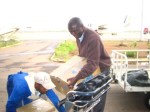
We flew in an old Fokker 50 up north. It’s an old workhorse but it got us there safely. We descended straight in over Lake Tana. The lake looks muddy from above; brown-red from the runoff off the red earth around it(we are in the big rain season). The lake is dotted with bright white pelicans. Bahir Dar is a provincial town. It reminded me of Kisumu in Western Kenya, also situated on a lake, on the other extreme of the same volcanic rift.

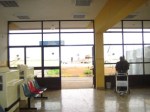
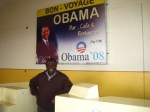
The small airport is a throwback to the days when there was no such thing as airport security. People wander in and out of the building; no uniforms or metal detectors. A large billboard with a smiling Obama advertises for the Obama Café and restaurant in town. I would have liked to have lunch there but unfortunately it had closed.

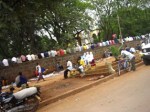
We were greeted at the airport by a colleague who is in charge of regional operations. He had hired a driver and car for us which we can use as we please. After settling into our hotel, we asked driver Abraham to show us the town. It is small and consists of a rectangle of paved roads with dirt roads in between and hundreds of little shops. In the middle of town is the large church with hundreds of people dressed in white sitting and standing everywhere to follow the services which continued throughout the day.

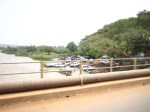
The town is bisected by the Blue Nile; on one side of the bridge was a small café built on stilts over the river while on the other side of the bridge the Nile served as carwash. The bridge is guarded on both sides by two lone military men.

Everywhere in town we saw graduates with mortarboards and gowns with colorful sashes, accompanied by proud parents and siblings. They had their pictures taken at the church, at the lake and at the monument that memorialized those who had risen up against the Mengistu regime. The other happy crowd in town consisted of newly married couples in their noisy and gaily decorated motorcades that came by every few minutes into the evening. A happy but power-less place this town of Bahir Dar.

Over lunch of grilled fish from the lake and the traditional mounts of meat on injeera I grilled Pierre-Marie about his unusual life style: as my MSH colleague he is a program manager and public health physician but he is also a traditional chief in a small town in Cameroon. Technology makes it possible to be those two things at the same time: his advisors who rule on his behalf during his absences check with him on decisions via email and the town has a website so he can peek in via the internet.

Access to the internet here in Bahir Dar is a problem. After lunch we surveyed the local internet scene. Because the electricity in town is out today this means there is no internet access at any of the internet cafes, except one with its own generator. We check it out. We patiently wait for the pages to load and give up after about 15 minutes. We pay 70 cents for our combined half hour of access. I managed to get one message out to Axel that access will be problematic this week.

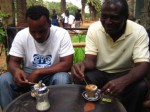
No electricity also means that the espresso machines don’t work, and thus no macchiato. But Abraham knows about a generator-powered machine and so we do have our one macchiato of the day, for 30 cents each.

When night falls the only two things lit are the huge bright blue sign of the Amhara Development Association Head Office that shines straight into my room and the hotel’s restaurant which is powered by a generator. I have two small stumps of candles in my room which won’t last long. Asking for more candles downstairs requires a drawing – English is definitely a weak second language here.

I have a feeling that this is going to be a long week.
Up and dark

This was probably my most boring 4th of July. I missed being in Manchester, watching the parade and having the wonderful 4th of July plein air lunch at the Makowskis. Instead I spent the day in my hotel room, watching TV whenever the electricity was on, and when it was not, the clouds, the rain and the few people outside through my window. I played solitaire and read Dawkins’ irritated tirade about the God Delusion.

I emptied my mailbox down to the last 3 emails and since everyone is busy celebrating the 4th, no new emails came in. I packed my two suitcases and a small travel bag to take to Bahir Dar – the suitcases stay behind in the hotel – while I watched the Matrix, a movie I would never think of renting or watching in the US. Here I can simply mute it when it gets too exciting. I needed Axel or Tessa by my side to explain what was happening.

Dinner with Pierre-Marie in Don Vito’s was probably the most exciting event of the day. We know the menu by heart. It has not changed in years. We ordered the same thing: mushroom ravioli, salad, a glass of wine and a macchiato served by the same girls with orange blouses. They must be working at least 14 hour days since they also serve us for breakfast in the morning.

And now it is some ungodly hour on the 5th of July which is still the 4th in the US. It is pitchblack outside except for the nightclub decoration and cars coming and going. The musci is thumping along insanely loud downstairs, probably at its peak (it is 4 AM). We are off to the airport with all the other people heading to the graduation ceremonies in Bahir Dar. I hope we are early enough to secure our reserved seats.

Cultural

The fourth of July started with loud-thumping music seven stories down from one of Addis’ premier nightclubs, conveniently located in our hotel’s basement. The action went on until the day started, around 5:30 AM. It’s America’s birthday but few people would know here.

Liz left on the Lufthansa flight to Frankfurt last night. Pierre-Marie and I have the day off before heading out very early tomorrow to Bahir Dar. We have no connections at the US embassy and so we will pretend it is an ordinary Saturday.

Yesterday morning we reviewed the notes of the workshop that starts next Wednesday, demonstrated a few more sessions and hope for the best. The local team is ready to take on the work of developing (health) managers who lead in Ethiopia. We will watch them run workshop #1 and provide them with support and feedback. After that they are in charge. It is a just-in-time orientation that has worked well in Nepal, Swaziland, Ghana and Cambodia. We have active teams busy in all these places, all on their own with only occasional support, by email, from me.

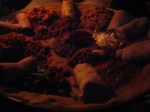
In the evening we were taken out to a cultural restaurant, a uniquely Ethiopian phenomenon, omnipresent throughout the city. It was my third such experience and that is enough for now. You sit on low chairs around a small table, eat the sour-tasting injeera bread dotted with heaps of meat prepared in various ways. ET_dinnerThis included raw meat which Liz politely declined. Eating vegetables is not part of the experience. I am told that vegetables are for poor people who cannot afford (much) meat. I haven’t eaten this much meat in a long time and am craving fresh fruit and veggies.
Singers enliven the eating experience. The first singers were either male or female, clad in tiny pieces of leopard print and other cloth that would be entirely out of bounds in my future home of Afghanistan. Halfway through the evening the singing and dancing became ‘cultural’ which means tied to specific regions of the country. The government is encouraging the resurgence of tribal pride in ways that makes the younger generation, raised as Ethiopians, and often of mixed heritage, very uncomfortable. They have seen the consequences of tribal pride in neighboring countries and it scares them.

The female dancers are stunningly beautiful in their traditional outfits. The men appeared to be made of rubber. During one of the tribal dances my neighbor points out to me that these men would procure male genitalia as wedding presents to their brides. These were cut from hapless travelers who crossed their territory. I am glad that we have evolved a bit as a human species. There are still a lot of things wrong in the world, but I don’t think this type of cultural legacy is OK.

The cultural restaurant experienced is a bit tainted for me because of the expectations that visitors, especially foreigners get to embarrass themselves publicly by dancing opposite one of these rubber people. I dread the moment when the dancers start to scan the audience and begin to pull people to the stage to dance with them. I tried to make myself small and never look the dancers in the eyes. I went to the bathroom at a strategic moment and in doing so avoided this embarrassment. Liz and Pierre-Marie did not but I missed seeing them dance.

Back at the hotel the red carpet to the nightclub was out and the music had started. We said goodbye to Liz and withdrew into our rooms, trying to shield ourselves as best as we could from the loud thumping of the deep base tones coming from down below.

Buffed and polished

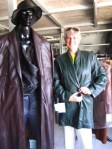
Because of all the schedule changes and Liz’ departure tonight we treated yesterday like a Saturday, a half day of work and the rest playtime. Early in the morning, before the office car arrived, we took a rickety taxi to the other side of town where the leather factory is and bought the leather good we had fancied and put aside last week. Even though I felt a little guilty about the amount of money we dropped there, Liz convinced me that we had actually supported the local economy. I can only hope it was not a Chinese owned factory, a real possibility. The Ethiopians here say that the Chinese are taking over by consuming their women and their chickens.

Even if it was a locally-owned factory, I was still wondering about the social impact of my purchase. I watched the Story of Stuff the other night on YouTube and am trying to be a little more conscious about buying stuff. For one, I was wondering where the runoff went of the chemical processes used for converting the hides into soft colorful leathers. I can only hope that it is somewhat regulated (am I kidding myself?). The factory is located in a neighborhood with other factories surrounded by small houses behind walls and narrow unpaved roads. Would anyone know the cancer rates in this part of town?

The rest of the morning Liz oriented all of us about the various management tools that MSH headquarters makes available to our field projects. I listened with my new hat on, as a director for management and leadership and thus a potential user of such tools. I imagined getting Liz to come to Kabul and do the same there. She’s very good at it and knows the management tools better than I do.

We had lunch at one of our favorite café/restaurants that is conveniently located above the Boston Spa. We had changed our Saturday appointments and spent the entire afternoon being scrubbed, buffed, polished and massaged. Now Liz is ready (and pretty) for the long plane ride home and I got some of my stiffness massaged out of my tangled and knotted tendons and muscles. My feet were sanded down to soft baby skin and my toenails painted a deep dark red.

In the middle of our beauty treatment the electricity went out, a fairly common occurrence here, rain or shine. It is hard to imagine a spa in the US functioning without electricity but here no one seemed very perturbed by it. I am glad I had selected the color of my nail polish before the lights went out because doing that by candlelight in a windowless room might have produced some surprises. So we ended up having our nails painted in the dark. The nail technicians had done this before; our nails came out perfect.

Pierre-Marie had no part in this very feminine entertainment and only joined us at night for dinner. He was actually working, interviewing candidates in Kinshasa for his other project launch in the DRC.

Surprise!

It’s July 2nd in Addis, Tessa’s birthday. Back home she still has to sleep through the night before the festivities start. It was 24 years ago that Tessa arrived amidst the smoke of the burned croissants in the locked oven of the Beverly Birth Center! Congratulations dearest Tessa, you are nearly a quarter century old.

July began with rain, just as in Massachusetts. All those low clouds were beginning to get to me but the clouds lifted and we saw sun and blue sky for the first time in days.

Just when we were ready to celebrate the completion of the training of trainers and move into the implementation phase with the first important meeting on Friday, we received word that the whole program in Oromia region was off. ‘Sorry, not a good time,’ said some underling on orders from up high.

We sent a heavy delegation to the health office to inquire and find out what was behind this order. But the underling didn’t know much and the bosses were in meetings. We don’t known whether the program is postponed or cancelled altogether.

This surprise came after countless inquiries months ago to make sure the timing was right. One of the things we (the foreigners) learned is that this period is the end of fiscal year and therefore planning (and spending budget leftovers) time. You’d think that that could have been known some time ago. There are also other events organized by other agencies. This is where we trip over each other.

The disappointment also provided an opportunity to experience the first workshop together, in Amhara, rather than in two parallel teams. It is a nice idea in theory but not everyone can be there on time because the planes and hotels are fully booked as it’s graduation week at the University in Bahir Dar. Nothing is going to be easy.

Liz has decided to go home – she was supposed to coach the team in Oromia and we don’t need three coaches in Amhara. This works out well for her because she’s needed back home. I will miss her, not just for sharing the spa experience on Saturday (male colleagues are not so much into spas), but also because I would like to hand over some of my work to her as I clean my desk for Afghanistan.

Sans pizza

Nightlife is active around the hotel throughout the night. It is a good thing I usually sleep well but occasionally I wake up and wonder who is out there being entertained by those who earn their living that way. When I get up early in the morning there are always a few stragglers down below, night creatures who appear to dissolve in daylight, then re-appear when it gets dark.

Yesterday we spent the entire day practicing how to monitor and evaluate the leadership work. We use real life examples of leadership-driven change projects that we have gathered over the years. I think it was an eye opener for our new facilitators who are more used to focus on individual transformational work – good work that is notoriously weak in showing anything tangible as a result.

Today they get to practice sessions that they will do for real on Friday when we are really launching our program with what we call a senior alignment meeting, an attempt to get the bosses on board – at least the ones that show up (something we have no control over).

It has been raining ever since we arrived and were told to have brought luck (i.e. rain) with us. The rains are like monsoons and drench the city, leaving huge puddles wherever the roads are not paved and overwhelm the drainage on paved roads. As a result the electricity goes on and off, a problem that everyone seems to take in stride and which shows up in poor internet connections and the inability of restaurants to produce pizzas.

My longtime friend Youssouf from Burkina also showed up in Addis, even staying in our hotel. Liz now is the only non French speaker. Occasionally we slip into French and Liz gets to experience a little bit of the total immersion that she will throw herself in when she comes back to the US and heads to Dartmouth for a 10-day French intensive course. Youssouf and Pierre Marie know each other of course. In their company I experience that special ‘je ne sais quoi’ that makes working in Francophone Africa (something I have not done for a long time) so wonderfully appealing.

Liberation/conservation

During my early morning writing routine I watched a BBC documentary about the Kabul skateboarding club, Skateistan. It was founded by an Australian skateboarder who introduced the sport to marginalized youth in Kabul. The images were those of another Afghanistan than what we usually see: young boys and girls on skateboards, parents cheering them on from the edges of the skating rink and foreigners walking around freely in Kabul. The images lifted my spirits.

More spirit lifting happened during the day as we embarked on our new leadership development program with the local consulting firm CALD (Centre for African Leadership Development), a new organization founded by five enthusiastic leadership developers. We selected CALD out of a field of 7 respondents to our RFP. Our instincts (and their descriptions of themselves) appeared to be accurate.

I mostly hovered in the background and supported my colleagues and the new team by providing feedback, context and stories about sobering and uplifting experiences elsewhere. It is one of the more satisfying roles for me to play as I marvel and enjoy seeing others embrace what has become practically a way of living for me. The enthusiasm and energy were palpable. I do believe that I am in the business of energy liberation (leadership) and conservation (management).

Before I went to bed I watched the BBC again to suddenly hear a familiar voice and see a familiar face, that of our Beirut days house mate Peter from the UK. In the 30 intervening years he has become an energy intelligence specialist and participated in a heated discussion about oil transactions in Kurdistan. As an English teacher kicked out of North Yemen in the late 70s, arriving on my doorstep in Beirut, I would have been hard pressed to imagine him in a suit and tie commenting to the world on middle eastern oil.

Rain

While Soros explains to his Aljazeera interviewer that any blog site is a media site rather than a technology site [I have the odd feeling that this is significant] I try to make sense of my very bizarre dreams about scientists and salami. Maybe the dreams were triggered by the wonderful Italian food that we had last night at Don Vito’s and watching the Discovery channel for too many hours.

It rained most of the day. It reminded me of those rained out Sundays that make you want to snuggle up with a book in a chair by the window. In my case that book is my Kindle with its collection of books to choose from. If I am not in the mood for one I can simply toggle to another.

My colleagues moved out of the fancy Sheraton and into my more reasonably priced hotel with its much larger rooms, big balconies, free internet and breakfast. It’s easier now; we were able to meet as a team without need for taxis, and divided the workload for the next three days.

Pierre-Marie got the top level apartment with its newly installment Jacuzzi tub and the 45 feet terrace; I am one floor below, with two balconies and a regular bathtub; the same kind of room as Liz, one floor further down. This represents exactly our places in the MSH hierarchy.

Through facebook I discovered that my longtime friend Anne was also on mission in Addis. We met for dinner and caught up on news about families and work. Later in the evening I noticed another friend coming this way. What’d I do without facebook?

The good life

I decided to forego the macchiato five floors down and instead had my cup of Nescafe and instant oatmeal. This allowed me to linger in my pajamas for a good part of the morning.

At about 11 AM Liz picked me up for an outing into town. First stop was a leather factory. Leather is a big thing here which I could have figured out since they eat so much beef. On the outskirts of town, in the factory’s shop, we found racks full of coats and bags of the softest leather. I am not much of a leather person but some coats were hard to resist, especially at the prices advertised. Liz emerged with a elegant jacket that appeared to have been made for her, such a perfect fit. We will return next week to make the final decision about some items we asked them to put away for us.

Next stop was the coffee place, Tomoca, where we had our first macchiato of the day, coming out of an enormous espresso machine. We sipped our coffee from the tiny cups while breathing in the wonderful smells of freshly roasted coffee beans. Liz will take back the coffee beans I ordered while the ground coffee will come along to Kabul as a treat to anyone who has been living on Nescafe too long.

The rains moved in and we skipped the Mercato, allegedly the biggest market in Africa. Instead we headed for the Boston Spa building to make our appointments for a hot stone massage, a manicure and a pedicure for next Saturday when we will have earned such treatment. Above the spa is the Lime Tree café, a bookstore/café/restaurant that has the feel of the universal university bookstore/cafe restaurant. Not surprisingly you can find many young expats sitting behind their computers checking email while drinking their lattes.

The afternoon was reserved for work – getting ready for the first event that starts on Monday when we will create the team that will run the leadership program after we leave, two weeks from now.

Liz and Pierre-Marie, our colleague from Cameroon, picked me up again at the end of the day and we headed for the Beer Garden Inn, a German brew pub with a menu in German and shiny copper kettles brewing the beer in full view. The place was packed and we got the last open table. Soon we found ourselves with a contraption on our table that delivered the beer from a tab, coming out of a meter long cylinder; imagine that, one meter of beer!

We did not order the full meter (5 liters). Ours was filled to the 3 liter line, about 65 cm, with foam filling up the remainder of the cylinder. Iit was plenty for us girls, although we suspect that Pierre-Marie could have handled the full meter.

A few men, sitting behind us, had started with beer up to the 75 cm line (about 4 liters) and seemed to have given up after drinking about 60 cm of that. They looked rather tired as they slouched on their seats. Twenty cm of beer can tire you out easily. Simple pub fare accompanied the drinks and made for a very pleasant evening.

Back at the hotel it looked like the Oscars were being handed out; the place was full of excited young men and women. A red carpet led me up the stairs, then abandoned me by the elevator. The red carpet continued to the basement nightclub with its loud music, dominated by the thump-thump of the base, which got louder by the hour.

At 2 AM in the morning the scene outside my hotel was buzzing with people, men mostly, and some women of ill-repute, drinking enormous amounts of alcohol and getting noisier by the minute. I stood on the balcony for awhile, not being able to sleep, and surveyed the animated scene 6 stories below, then retired to my bed to continue reading why Richard Dawkins thinks God is a terribly destructive delusion. 

Slow start

The receptionist at the hotel told me that Michael Jackson was dead. If you were to believe the TV, nothing else happened yesterday, not even in Iran. An email from an African colleague offered condoleances. Michael was one of our tribe, believe it or not.

Here in Addis, I heard his songs on car radios, in restaurants and shopping centers. Watching CNN I learned that even the US House or Representatives had a moment of silence. I think he would have liked knowing. May he does know. All channels on my two fancy flatscreen TVs were covering Michael, ad nauseam.

I spent a good part of the day chasing the elusive Ethiopian telcom simcard. Such cards are now the monopoly of the state. It controls who gets one and who does not. This stands in sharp contrast to the sale of such cards in other African countries.

I stopped at 4 different state-run telecom offices. I was asked to show my ID and then told they had run out of simcards. I saw long lines and people filling in multiple forms but I never saw a simcard changing hands. We went on a wild goose chase all over Addis. The suggestion that maybe we should call ahead before going through thick traffic to another branch office was met with indifference. No, we don’t have the number, and you should just go. I don’t know whether it was a case of foot dragging, not being able to say no to a foreigner, a supply problem or an intentional creation of scarcity. We finally gave up. I felt rather handicapped without a cellphone as landlines are very unreliable. How did we live without cell phones before?

Interrupting the chase from time to time I joined my colleagues who had flown in from the US ahead of me and were busy orienting our new project director. We are getting ready for an intense two weeks in which we have to bring many new people on board and hand over the running of the leadership program and put in into local hands.

Slowly the sky darkened and a thunderstorm produced some significant rain. In the office I was congratulated for having brought the rain, a sign of good luck. The big rains have been slow in coming and people are worried that another drought is in the making.

In the absence of a simcard I made my phone calls from the receptionist desk. It’s a busy place with people coming and going. One person came in and pulled a large wooden model that is used to demonstrate condom use, out of a plastic bag. Nobody flinched; it was as if he was showing the proofs of a brochure. I started to laugh because it was something both ordinary and extraordinary. This is part of the business we are in.

At the end of the day I returned to my large apartment via a local supermarket where I bought fresh roses for next to nothing. I continued unpacking while watching interminable re-runs of Michael Jackson, grieving fans and celebrations of his life. I asked the Italian restaurant to bring my meal to my room, accompanied by a large glass of south African (not Italian) wine and celebrated my safe arirval in Addis, great colleagues and an exciting new venture.


October 2026
M T W T F S S
 1234
567891011
12131415161718
19202122232425
262728293031  

Categories

Blog Stats

  • 144,547 hits

Recent Comments

Olya's avatarOlya on Pocket rollers
Edith Maxwell's avatarEdith Maxwell on Boosted out
Sallie Craig Huber's avatarSallie Craig Huber on Rays for real
Lucy's avatarLucy on Probabilities
Olya's avatarOlya on Cuts

Enter your email address to follow this blog and receive notifications of new posts by email.

Join 83 other subscribers