Archive Page 21

Wet

We have returned from Japan,  one iPad keyboard lighter. Axel, left it in the pocket of his seat. The friendly Delta people told us that having lost something in Japan means it will be returned.  Now, three weeks later, it hasn’t shown up. So much for that assumption.

I resumed my life with a total concentration on getting ready for my first (academic) teaching job. It is a steep learning curve, accompanied by some nervousness, more about the mechanics of teaching online and the grading than the content.

The rain has been with us all month of September. Two years ago, when Tessa and Steve got married, we had the most glorious month of September (and as far as I remember, we usually have such September). But not this year. The rain stayed with us in Japan and then back in Manchester it wouldn’t let up, until now, nearly midway October. The leaves are still mostly green – and this is leafpeeper weekend in New England. This morning during our walk around the point we were wondering about the high level systemic impact all the wetness will have.

On a local level, the wetness has produced lost of mushrooms. They have carpeted the shadiest parts of people’s yards. The weeds also like the rain because I left them alone.  I love to sit between the weeds and pull them up one by one, but not in the rain.

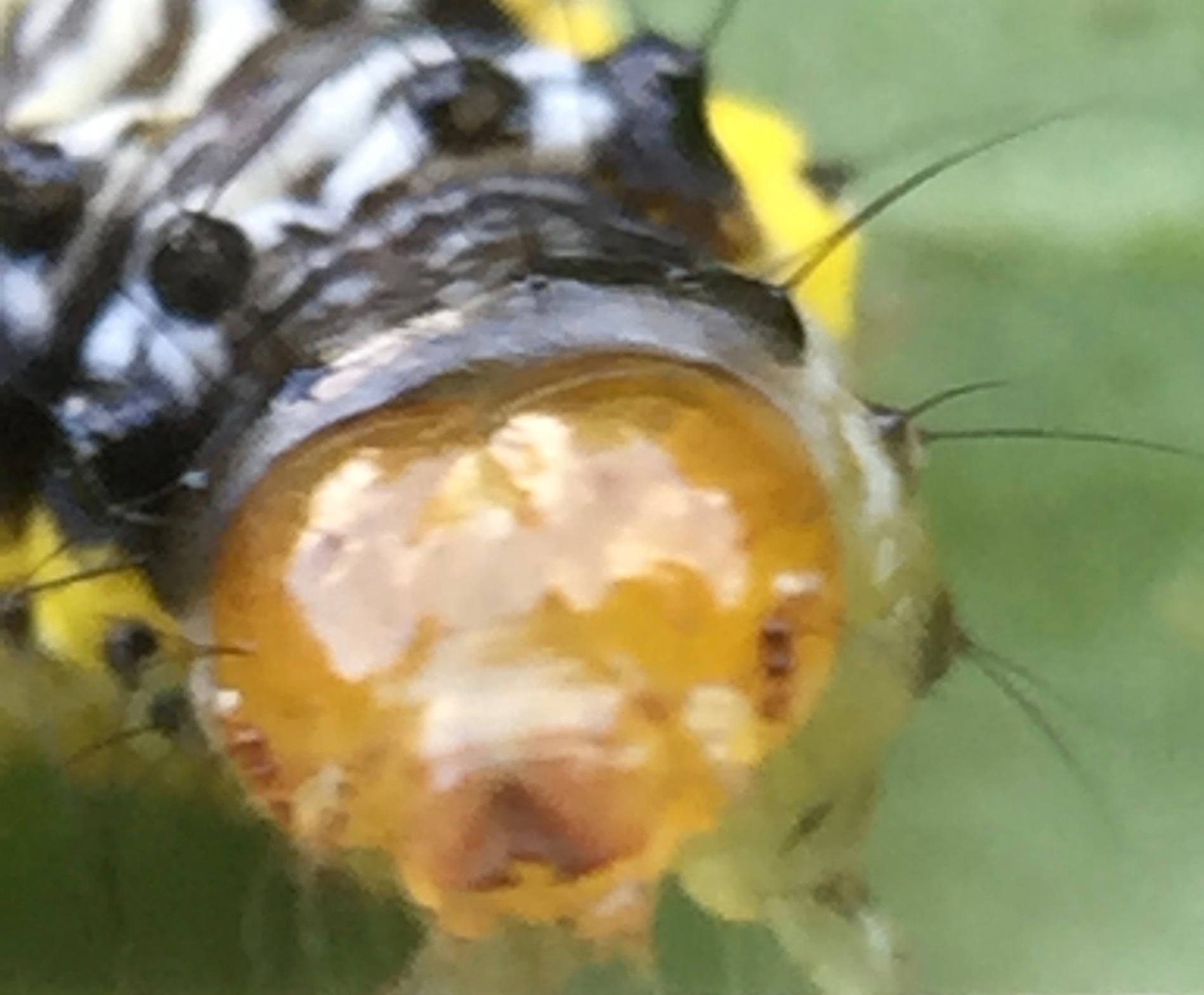
The  fresh new greens on the kale have attracted small caterpillars who eat up to 8 times their body weight in a day. The kale is full of holes. Last night I, as I washed the kale, I had to pluck of as many as 10 on just one leaf. Despite the holes we had a nice ground pork/rice and kale stir fry.

Axel took close up pictures of one of the creatures, even one where it looks straight at him. They are good for a horror movie. IMG_4307.jpgIMG_4308.jpgDespite his efforts to get rid of them, they have now reduced our tall kale plants to stalks with nothing on them. Ughhh, no home grown boerenkool (a Dutch potato/kale stew) this winter.

Some of the leeks and potatoes have been turned into a thyme/potato/leek soup, all from our garden. We have to think of more leek dishes as Axel planted about 40 and we still have many left.

The joy of eating in Japan

Today is my last day of work and our last day in Tokyo . We return tomorrow. There is likely to be more work here later and I am contemplating whether to seriously study Japanese.

While I worked, Axel has been exploring Tokyo, one day with our friend Miho, and the other days by himself. Sofar I have had a day and a half to accompany him on his explorations. It has been mostly raining which has literally dampened the fun a bit.

This has not dampened the food explorations. Every day we have the Japanese breakfast: miso soup, nato (fermented beans), rice with all sorts of interesting add-ons, seaweed, tofu, and more. There is a continental breakfast as well but why bother.

We have had, of course, our sushi, but there is more to Japanese food than sushi and sashimi. Twice we were invited to join with the founder and program manager of the Japanese Women’s Leadership Initiative (JWLI).  On Saturday she took us to a lovely small yakatori (=small brochettes) restaurant named ‘the dirty stinking southerner’ (Nambantei) according to our host. It referred to the smelly Dutch people who entered Japan in the 1600s, the first foreigners to be let in. The walls and menu were decorated with copies of old drawings of these smelly foreigners on their ship (yes, with the Dutch flag I am embarrassed to say) and sitting around a table drinking beer.

Last night (Sunday) we went to a small restaurant where we grilled thin pieces of beef on a small grill in front of us, accompanied by spicy kimshi, salad and a variety of pickled vegetables. The restaurant is located in the neighborhood where our host grew up during and right after WWII. She pointed out where her house had once stood, now replaced by a 4 story building.

Yesterday we got a taste of overpopulation at and around the very busy Shinsuku station, one of four large stations that spew out thousands of people every minute into Tokyo. It has a Times Square feel to it (and there is a Times Square just around the corner). We are glad to be in the quiet Rockefeller house (by invitation only, we are so lucky) with its beautiful gardens, tucked away in the district known for its active and noisy night life.


Next assignment: Japan


August came and went too fast. In the US Labor Day (first Monday in September) signals the official end of summer. The roads fill up again, university cities add tens of thousands of residents as students return. Faro returned to his immersion Chinese school, first grade now, and babbles easily in mandarin according to Sita- none of us understanding him of course.

Sita went and returned from her job at the eventful ASEAN World Economic Forum in Vietnam and barely got to explore Hanoi. She wants to go back there, as we would want to.  It’s an idea for a family vacation.

I completed the lion’s part of my consultancy with an organization in North Carolina, just in time before hurricane Florence moved in. I have started to immerse myself in the preparations for my teaching job in the fall and put the finishing touches on the lectures and workshops in Japan.

We left for Japan on the 12th using up my last Delta global upgrades before they would disappear forever. Even in business class the trip is long. We emerged in a  daze after 19 hours from the moment we got up. After entering and leaving various stations and trains and going up and down stairways and escalators, we found our way to our lovely hotel in the Roppongi area of Tokyo. Our abode here is the Rockefeller-built International House of Japan – a building with a philosophy of cultural and intellectual exchange to get Japan back on its feet after the war. It certainly did!


Abundance and gratitude

Leaves are starting to fall. It’s a time of both nostalgia and great beauty. September is the best month here. There is excitement in the air (new schools, new teachers, new classes), there is the crispness of the air and the abundance in the garden.

Abundance pops up everywhere and it makes me stop to smell the roses.

I am immensely grateful for so much. For one I am grateful for the people I have known who have left this earth. Most recently that was Baba Ted who we met in Kabul and who got Axel involved in Sola where he (and I a bit) worked with Afghan teenagers who were so thirsty for learning, and so full of energy and hope in spite of everything going on there. Through him we met others and formed lifelong bonds.

Gratitude for being able to swim at dawn in Lobster Cove – the water still and clear, the sun coloring the rocks rose and blinding me as I swim towards it.

Gratitude for all the people on Cap Ann who do their bit to counter the forces of evil that are lurking at every corner to destroy the beauty of this place. Last night we sailed on the Roseway Schooner, a fundraiser for Seaside Sustainability, led by the son of a good friend. We learned that the schooner (built in Essex in 1925) had been sinking in the mud, abandoned at a pier somewhere in Maine when (those forces again) people came together to bring her back to her old glory and use her for good. The good includes fundraising events and being a school for young people who are pulled to the sea and sailing. If I could turn the clock back, I think I would have signed on. I watched a young girl move around the deck with great agility, a knife dangling on her side, knotting the ropes on the sail. She had been a schooner crew member for ten years and had been promoted to first mate recently – the latter pronounced with great pride. So young and so accomplished!

Gratitude for my family, the joys of my life – the amazing things they do that make me marvel every day.

Gratitude for work. The laying off in June turned out to be a good thing. It opened so many doors. I am so busy, nearly too busy for summer days. This week I worked 27 hours. I am definitely not retired. The last few weeks I have worked nearly full time.  One week I was in Chapel Hill, this one I was ensconced in the studio across the driveway. We were in the middle of a heat wave and it is the coolest place to be.

I was putting together all that I learned from some 50+ interviews I had done the week before in Chapel Hill where I was on assignment to tease out how my client organization can best move from one state of being to a new desired one.

I am also preparing for our trip to Japan and the three talks I will give there, and a bit of preparation for the leadership and negotiation classes I will teach this fall for a local college.

Wet, wasps and work to get everyone to vote

Everything is wet as it has been raining nearly every day. The once white lampshades on the porch are covered in black spots that only bleach could remove. The table legs, ditto. Our kitchen garden is overrun with weeds. Luckily I love weeding (small plots only) and have started to liberate the asparagus bed from its invaders.

At least 5 colonies of wasps and hornets have built their exquisite papery homes under the eaves around our house. Our neighbor opened his window and got stung. Walking on the outdoor stairs to the studio attic inevitable angered the beasts and Axel got stung. And so we called the exterminators who came in suits and with chemicals that, I was told, would not harm the honey bees that are feeding on our flowering bushes and in the flower beds. We have their word.

I am glad we are now rid of them but it was sad to see their rugbyball sized papery nests hacked to pieces. It must have taken a lot of effort to build those. The hornets and wasps that were not home at the time of the attack and returned later to investigate where their houses had gone, never found out as contact with the old home produced instant death. The surfaces below the nests look like a battlefield, no survivors.

On Thursday we listened to the chief of the Souther Poverty Law Center (SPLC) who is friends with one of our neighbors who is actively promoting voter education and voter registration. SPLC knows a thing or two about how manipulation of the voting process has disenfranchised many, especially those who would not have voted for our current president. Some 90 million people who did not vote probably handed Trump his victory. Now it is all hands on deck to reduce the number of people who don’t bother voting. It was an inspiring presentation that made me want to do more than upping my monthly contribution to SPLC.

Blueberries and oysters

After a week of sunshine we completed our return trip in the rain, which it is still doing some 36 hours later.

Before we left the Brooksville peninsula, we drove around to collect as many blueberries as we could. These are the blueberries we freeze and then eat throughout the winter.

We were late to leave and most ‘help yourself’ blueberries stands had only one or two quarts left. We found our last 2 quarts at a hemp farm on top of a hill. The thick smell of marihuana met us as we made our way up the dirt road.  Those were the best blueberries (less bruised, less leaves, less green ones).

During our entire vacation, while surrounded by water nearly everywhere, we never ate seafood, let alone oysters. We simply could not find stores nearby selling the stuff, a puzzle. Maybe fishermen don’t eat fish? We finally had our oysters (Pemaquid) on our way home, at a stop in Belfast at a local brewery that also served oysters.

We had expected that a five hour trip to our vacation rental would be very long but it wasn’t. It wasn’t because of the stop in Belfast (both coming and going), and also because we listened to Crazy Rich Asians while Axel drove and I completed a very difficult electronic puzzle (1024 pieces, 14 hours to completion).

And now we are back in lush Lobster Cove, which was entirely empty when I woke up on Sunday morning.  There had been more rain here on and off according to our neighbors. All the crops had taken advantage of the wetness, especially the weeds which are huge now.

Far from the maddening crowds

We are far away from almost anything – yet we are also in the center of something called ‘local community,’ the kind of community that looks after is members, celebrates talents and instead of talking incessantly about why we are going to hell in a hand basket, is quietly farming the land.

Last night we went to a community talent show (Brooksville’s got talent) which took place in Buck’s Harbor’s community center which doubles as a basketball court. The show was a fundraiser for the West Brooksville Congregational Church. The newly appointed reverend, his wife and their two grandchildren opened the show, grandma with a fake beard, grandpa and grandson (8 maybe) with top hats and some costume I couldn’t quite place. The grandson was still new to performing and talking into a microphone. As a result I didn’t understand what the story or song (what was it?) was all about but it was cute and the audience was supportive.

After that a range of Brooksville citizens from young to old, some with amazing talent indeed, performed on a variety of instruments and in a variety of styles (modern, folk, Scottish). There was the accomplished guitarist with CDs in his CV, a rock band with what looked like mother and son, but also a line dance by two 7 year old girls who had not quite mastered the steps, a Hawaiian fishing and luau song, including a ukulele and matching outfits for grandma and granddaughter, and a poem for the oldest resident whose birthday wishes we heartily sung after her recital.

Our grandkids didn’t make I through the entire 12 act show. Faro kept eyeing the bake sale table with the kind of high sugar content items he is unlikely to get at home and Saffi because we had passed her bedtime and vacation can be tiresome.

The next day there was another evening of music, this time at an old farm with the musicians using the barn floor as their stage. Sita and Jim had performed in Belfast (ME) some years ago and knew some of the musicians.

As the sky turned various beautiful but menacing colors the adults knew what that meant. The 20 or so kids quickly understood as well that something exciting was going to happen and impatiently started chanting for rain. They were doing their first protest march with sticks and the stomping of their feet, chanting in unison: we want rain, we want rain! They, and all of us, got it but it didn’t matter. 

We moved into the barn and under the canopy of the food tent and simply kept going.  There was a keg of beer, huge jars of ice tea and lemonade, a bucket for donations, big pots of various wholesome foods and a suckling pig on a spit.  Our friends J and P who are renting a little further south joined us. We were the old people there – probably the only one who noticed the similarity with the 60s (the rain, an old farm, music?).  Only the mind altering substances appeared to be missing which was nice. 

Faro, after exploring some of the rusting old farm machinery scattered willy nilly in the field, joined the band of overexcited kids (most his age or a little older) and participated in the chanting. Axel, with is usual flair, introduced himself left and right, making the rounds as if he was a reporter, collecting the life stories of the (mostly) millennial with great gusto. When we left it was as if he was leaving a family reunion.  Everything we learned and experienced was hopeful.

When the chanting for rain started Saffi moved to the sidelines and watched the older kids in perplexed amazement, eyes wide as saucers. I would have loved knowing what was going on in her brain. I suspect that all the existing circuits  were lit and new ones forming on the spot; new circuits that had elements of watermelon, rain, music, and kids marching and chanting for rain; all thoroughly infused with a sense of intergenerational community, joy and safety; even the dogs that usually instill fear in her, made her laugh and approach (other little kids did it, that helped).

Three generations

In the past I would bring all sorts of things to our Maine vacation, out of some fear that I would find myself with nothing to do, maybe? This time I bought only half finished books: Coming Apart by Charles Murray, a book about Madagascar (Lords and Lemurs) and one I bought during our Cape Cod course in June. I am making progress on the Murray book which makes me realize that what is happening now (in the US especially) is a perfect example of the story of the boiled frog that Peter Senge described in his Fifth Discipline: the frog, put in a pan of boiling water would immediately jump out while the one put in cold water that is slowly brought to boil falls a sleep and dies. It’s a cruel story, whether applied to the frog or those who Murray describes as the inhabitants of US Fishtown. 

In the day to day news dramas played out under our president (or any president for that matter), everything is assigned to near and immediate cause and effect rubrics. It is quite a different view from the one painted by Murray from 30.000 feet, spanning the last 50 years. It’s not an objective view, of course – no view is entirely – but it is anchored in reams and reams of data drawn from the census, General Social Survey, Zip code and Census Tract data, National longitudinal Survey, and more. It’s a pessimistic view if you believe that the bedrock of any society is the family. It used to be the extended family: grandparents, aunts and uncles, and cousins. The nuclear family has made the family unit more fragile, more susceptible to the stresses of life as there is no escape.

Our one week of three generations together in Maine makes the benefits abundantly clear – the parents sleep in while Opa and Oma entertain the kids with games, stories and food; auntie Tessa introduces the kids to the care of animals, wholesome food, exercise but also whimsical cup cakes and birthday presents. Uncle Steve the scientist contributes to the kids’ experience of their physical surroundings through discovery. The absence of cousins is the only thing that is missing – they would have taught the kids how to negotiate and resolve conflict, learn to share and play games together.

Digivac

We are off the grid – really off the grid, even the cellphone doesn’t allows us to check in to our digital devices. This is rural Maine. We are in a new vacation place. It is nearly twice the distance from our house as Camelot, the cottage we used to rent on Southport island. Now it took us about 5 hours instead of two and a half.

We had outgrown Camelot where Faro has to sleep in a tent on the porch, Saffi in a closet and Tessa and Steve and the dogs in a tent on the lawn.  Now everyone has their own bedroom and the children have their own bunkbed and a door we can close.  We also have two large dining tables, and a well equipped kitchen.

A steep path runs down to a private pebble beach that is perfect for the kids – for Faro because of the big crabs that live there and for Saffi because the water is shallow and the pebbles are small.

Axel is wearing an orthopedic boot because he sprained a tendon in his foot. He claims it is because of the overextension of his foot as he meditated, kneeling on the small meditation stool he had made for me years ago (and which I cannot use  anymore because of my fused ankle). A walk into town on flip-flops appears to have made things worse and now he is in a boot. As a result he cannot go down the steep path and has to be ferried in Tessa’s canoe from a landing nearby. But all this doesn’t damp the fun of being together for a week on the beautiful Maine coast.

Opanomavacation

Faro’s ‘Opanoma’ vacation has come and gone. Opa and Oma are our grandparents names – to distinguish us from the other two sets of grandparents he has (Grammi and pep in Beverly and Gramps and Amma I Manchester). 

Faro was delivered to us the Saturday before camp and stayed behind when dad and sister left on Sunday afternoon to return home. He was a little sad the next morning.

We did what grandparents do: we spoiled him, somewhat to the dismay of his parents who disapproved mostly in the food department. 

We quickly slide into our roles for the week: Axel was responsible for stories and beach activities, I ran the breakfast and lunch department. We shared the drop off and pick up to and from the Audubon camp in Ipswich. Let year Axel was responsible for nearly everything when I was still employed. I had a new appreciation for how much work was involved in creating a successful into ‘Opanoma’ vacation. 

Breakfast and lunch always included something chocolate (chocolate milk, hagelslag (a Dutch invention), and a dollop of chocolate whipped cream from a can on top of the pancake or waffle. Every morning I prepared (from scratch) at least a pint of chocolate milk. During story time Faro had learned about the concept of ‘counterfeit,’ from a Hardy brothers adventure Axel read to him before bedtime. After inspecting the milk, and after a thumbs up that it was not counterfeit, I poured the chocolate milk into the Roy Rogers thermos that fit neatly into Opa’s, somewhat rusted, Roy Rogers lunchbox.

After camp pick up Faro quickly changed into beach gear and rushed off with his water wings and snorkel to check on the crabs, unless there was another activity, such as the pretend Beatles concert in Masconomo park. I would not be surprised if Faro knew more about the Beatles than any of the teenagers. He knew songs we didn’t even know. An ice-cream (M&M) was unavoidable, what with the ice cream story right there. Two days later we went to another concert on Castle Hill in Ipswich where we met up with friends, another opa and oma and their daughter, son in law and two grandchildren.

On the other nights we watched Shaun the Sheep’s naughty adventures, a claymation movie, which gets Far in stitches, no matter how often he has seen it. After that sleep came quickly.


February 2026
M T W T F S S
 1
2345678
9101112131415
16171819202122
232425262728  

Categories

Blog Stats

  • 139,981 hits

Enter your email address to follow this blog and receive notifications of new posts by email.

Join 76 other subscribers