Archive Page 257

Ups and Downs

I am at Schiphol airport waiting for a connecting flight to Boston. I have decided to not let anyone know I am here so I can finish my reports; the next trip is very soon and I don’t want to work this weekend.

I am out of Africa. It is a traditional call I make to Axel, announcing my new position on the map. I do this early in the morning while he is still up the night before. This time I got Sita on the phone as well. These are some of our small rituals.

I left Tanzania somewhat deflated, without an ounce of energy left. The road trip back to Dar es Salaam took a lot out of me; more than I at first cared to admit. I emerged from the car in pain and stiff as a plank and then my mood began to change; from the high spirits of having accomplished what I set out to do to feeling hopelessly inadequate in the face of overwhelming odds.

Each time I leave Africa I am more confused. The more I learn, the more I know. And the more I know the more I know what I don’t know. And in times like these, when my mood is low, I wonder how I can be of any help. Everything appears to be related to everything else. It feels a bit like untangling miles and miles of hopelessly tangled up yarn. You look for a beginning or an end, to start untangling. And then, not being able to find either one, you take a pair of scissors and create a beginning and an end. From then on it is slow going. Sometimes you feel you are just making things worse; instead of one gigantic tangle, you create a whole bunch of slightly smaller tangles, all as daunting as that first big one. The worst part is that seemingly well-meaning efforts at untangling actually mess things up. I am referring to the hundreds of models, tools and approaches that are being offered by helping hands, some incompatible yet offered to the same people. It is a bit of a lose-lose proposition when I begin to think like this: I am either adding to the tangle – so why continue? Or if I think I am not, I can fool myself by using reasoning that is self-serving, also called arrogance. Of course I have to remind myself that these words and sentences come out of a particular mood. I don’t always think like this; I would not have lasted this long.

Yesterday morning, Isaac and William had asked me to say a few words at the opening of their leadership program, now in its third day, “people would like it.” Participants don’t often see the folks who developed the materials they study. I asked the participants what has changed for them as a result of this program. It was hard to get volunteers so I called on people by giving them the microphone. It is always a struggle, anywhere in the world, to get concrete examples; people tend to use words that are titles of workshop sessions. Up front only one member of a team sits at an otherwise empty table. I asked her what happened to the rest of her team. She explains that one is in the internet café checking up on a letter and the other she doesn’t know about. Getting participants to apply what they learn about being pro-active directly in class is hard; I challenge her to be more active and get her team complete by taking action now. My exhortation clashes with the polite attention that is given to foreigners. Nothing will happen until I leave, if then.

I checked out and paid my bill and then went to the other hotel where the AIDS meeting was held. I arrived in the middle of a morning discussion and I could sense that the meeting had heated up from yesterday. Some agencies had not delivered on promises according to the government representative from one region. Another demands that these discussions are frank and honest, rather than the usual Tanzanian mode of exchanging pleasantries. I so wish I could follow Kiswahili. The session is conducted in the way that Mandela describes how his father held court in the Eastern Cape. The Chief (Chairman) sits in front facing the people who are seated in semi-circular rows facing him. What is billed as ‘plenary discussion’ is actually a very disciplined and choreographed process allowing people to speak, one by one. Their words are addressed to the chief, but everyone listens attentively. There are few non-verbal cues for me to gauge whether they agree or not with the speaker. Sometimes there are a few smiles or hmmms. This is not dialogue but serial monologue. Occasionally I get a translation. I am learning that the reporting process does not accomplish its purpose. Reports are missing; they appear to describe inputs and outputs, or maybe process, but say little about what is different as a result of their work; they also appear hard to read. Imagine nearly a hundred of those. It is no wonder that there is no feedback loop.

I am trying to figure what is at stake for the different groups in this meeting. It appears to have something to do with the modalities by which the national secretariat reaches civil society. The creation of new, temporary structures that consists of NGOs or consortia for the implementation of the project is supposed to help ‘push the money down’ where the government does not have the capacity to do this on their own. The temporary structures have two main purposes: building the government’s capacity at the regional, district and local level and managing the grants given to civil society organizations to produce a string of small victories in the battle against HIV/AIDS. It seems that these two are not always meshed together as they should, but implemented in parallel. Some government people are indicating that the capacity building has not happened and that they don’t know what is going on. Of course in all this the enormous amount of money involved muddles everything. Someone remarks, “If you have a lot of money you don’t need to involve anyone, you can just go it alone.” As an American citizen who contributes her tax dollars to help foot this bill, this is of course not what we intended.

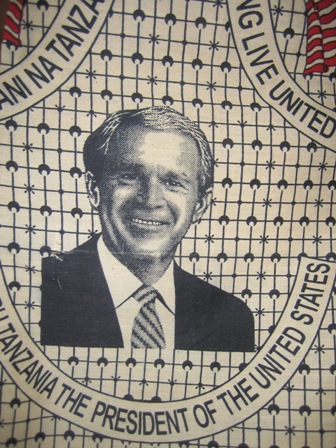
bushclothfull.jpgOne of the women wears a dress made out of US-Tanzania friendship cloth. If there was an archive of bushfacecloth.jpgspecial occasion cloth you could trace the visits of important people across Africa. This includes presidents as well as religious leaders. When we break for tea I take a picture of her, with a separate zoom into Bush’s face. It’s the kind of picture you see in obituaries – depicting a much younger Bush. I wonder about the design and production process of the cloth. Was there an official request, an official picture provided by the embassy? I can just imagine Laura and George sitting with a photo album on their knees, and Laura saying, “George, I think this picture would look fabulous on the belly, bosom and back of a lady in Tanzania!”

At tea break I sit with three women from local government. I ask them how the process of working with the facilitating agencies has been for them. At first they are cautious in their responses but soon they loosen up. They complain about something that I hear around the world. It is a complaint that is wrapped in communication language but that I have come to see as a symptom of something else, maybe a deep-seated fear of inadequacy? It is constantly fueled by the absence of acknowledgments and appreciation for work well done, or by the carelessness with which people communicate (or forget to) with one another; the sense of inadequacy or incompetence is thus reinforced; self protection then leads to resentment of the higher ups, since they are causing this feeling after all. If you belong to a minority group, like the handful of women in this meeting, the resentment is doubled. Instead of spirited engagement we get resentful entitlement. Money has to come to the rescue to ‘motivate’ or ‘facilitate,’ a pervasive belief. This is how I believe we mismanage the most precious of human resources we have: the energy to invest one’s time and creativity in doing a good job. I am re-reading Elliott Jaques about Executive Leadership. He states something that I know to be true from personal experience but also from watching others: “People are spontaneously energetic with respect to the things that interest them.” Could we possibly try this notion on others?

Ripples

The meeting I am attending helps me understand better the context and realities of this country’s response to the AIDS crisis. The meeting has only one other white person in it, a German who just started living here. The meeting’s language is primarily Kiswahili. Although the German looks like he understands Kiswahili, he confides to me that he doesn’t. Once in awhile I recognize an English word such as ‘bureaucracy,’ or ‘sustainability.’ Periodically I ask for translation but I am mostly watching people. Occasionally my neighbor makes a remark that gives me some clues about the issues she is thinking about and that need her attention. Sometimes these are commentaries on what other people say, or on statistics; and sometimes they are topics that only women will understand.

I made a trip to the tiny internet café of the hotel where the meeting is being held to discover that the computer runs on very old software. A message showed up that the system is no longer protected from viruses because the software has not been updated. By then I had already picked up the Trojan Horse and the Rungbu virus on my pen drive. I spent the rest of the morning scanning my computer to make sure no other viruses crossed over.

At lunch I sit with a retired professor of Muhimbili School of Public Health. He is a sociologist and talks to me about the early years of the AIDS epidemic when he was a lone voice crying in the wilderness. There was and still is much stigma attached to being HIV positive and he has lost many colleagues, educated people, who even on their deathbed were not able to acknowledge the disease they were dying of.

From the presentations and side conversations I learn much about the ripples and unintended side effects of the huge amounts of money that stream into the country in the battle against the disease, especially how it affects the lowest layers of organized civil society, the community-based organizations. They are trying to implement activities at the village, ward and household levels. There are expectations that money will solve all problems yet spending the funds has repeatedly been problematic, suggesting that something other than money is needed. [Bunny, the main character in Upton Sinclair’s Oil! remarked on page 490 that “he had learned this much from his father, that money by itself is nothing, to accomplish anything takes money plus management”]. As it happens, this is also one of the main messages of our Leadership & Management Program.

Another side effect is that the care of orphans and those affected by the disease is beginning to discriminate against those who are not HIV-positive. As the wife of the President of a neighboring country commented, “why, you are making people want to be positive!” Apparently in some schools there are more AIDS orphans than non orphans (one indicator programs are being evaluated on). This of course creates much resentment among those who have managed to stay healthy, but poor nevertheless; their schoolfees are not being paid. And finally, it appears that the implementation of care and mitigation activities, two of the three major strategies, are beginning to overshadow the strategy of prevention. As long as prevention is not effective, the other two will require increasing amounts of money to sustain an ever growing pool of people affected by the disease.

One PowerPoint presentation follows another. There are close to twenty. It becomes increasingly difficult to see the forest through the trees. This is too bad because I know there are other ways to structure such meetings that would help create more of a dialogue and keep the forest visible through the countless presentations describing a multitude of trees, some the same and some different from one another. Simple mind-mapping would already have helped; not on the wall though. Hotel management has posted a sign that nothing can be put on the walls. But I could have done it on my computer, quietly in the back, if only I would understand Kiswahili. So I am struggling with how to stay awake, making to-do-lists and writing in my journal; and when that is done I play solitaire. I am sitting in the back row and so I can see that I am not the only one; but, thanks to my Calvinist roots, I appear to be the only one who is self-conscious about it.

I also break the monotony of presentations I cannot follow by taking bathroom breaks. Outside the room are large framed portraits of participants, taken in the morning, developed and printed on large glossy paper and framed in cheap plastic frames. This is a gamble that the photographers take – there is no guarantee that people will buy their pictures; and if many don’t, it will be a significant monetary loss. Apparently they know their market – they are selling well and it must make it worthwhile. They also must have learned over the years not to take pictures of the white folks because they don’t buy. That is correct and I am grateful there is no portrait of me in the gallery.

On Wednesday night, after a work session, I have dinner with William and Isaac. I came back to the hotel too late to meet their participants. This will happen on Thursday morning.

At night I pack while watching a Nigerian movie about a bad church leader. There are many fat men in it with sunglasses and sticks and skinny young women who whimper a lot. I can’t understand what they say but I don’t need to. The story is obvious. The announcement for the next episode promises that things will end badly for the church leader. That is good.

The next morning I watch another Nigerian movie. Once again there is the fat man, also with a stick, but this time also a little fat and obnoxious boy. They are bad and because of that I know they will come to a bad end. There are also several skinny, poorly dressed men who act like children in the fat man’s presence. They too whimper a lot. Witchcraft, in the shape of eggs and wax dolls play a prominent role in both movies. I soon learn why. When the movie is over the credits say ‘Thank you Jesus, you are my inspiration!’ This is Nollywood, with a religious twist.

Wait while we connect you…

Today’s entry can not make it from my pen drive to the website. Some incompatibility of one kind or another.  I probably won’t be able to post again until I am back home on Friday the 7th.

Tanzanian Coffee Scrub

Yesterday I met with the person to whom I will serve as a coach; in the coaching literature this is sometimes called a coachee. I was awed by the complexity of her job and her openness to me, a total stranger from far away. She freely discussed her challenges and dilemmas. I had asked if I could shadow her as this would give me a better picture of the world she inhabits and see what she is up against. She suggested I travel with her to a meeting several hours inland from Dar es Salaam. I will spend two days and two nights there so that, as she suggested, we will have some quiet time to get acquainted and simply talk. I jumped at the opportunity.

My sudden departure from this palatial hotel means I have to put away the menu of Spa treatments that has been tempting me ever since I arrived. I had been considering the Kilimanjaro Retreat (145 minutes) that includes a Floral Footbath, a Tanzanian Coffee Scrub, a Thai Herbal Steam Bath and a Spice Massage; or, more extravagant, the 3-hour Body Symphony that includes a variety of floral baths, foot scrubs, aromatherapy, Thai herbal facial and whatnot. On the lower end was the Executive Awaken, a one hour combination of foot, back and head massage. I simply could not make up my mind over the weekend. And so I blew it because now I am checking out. By the time I come back to Dar es Salaam it will be Thursday and time to present myself at the airport for the trip home.

mshtzoffice.jpgLater in the morning I met my colleagues at the MSH/Tanzania office which is entirely made of glass walls. It is the ultimate transparent office. You cannot pick your nose, play solitaire or cruise the Internet on your computer without anyone noticing. But because many people were traveling I could have done any of that if I had wanted to.

muhassv_small.jpgIn the afternoon I met the team of faculty at the Muhimbili School of Nursing who are participating in our virtual leadership program that Morsi is facilitating at the moment. All but one of the team members were able to meet with me, including the Dean. We had a most wonderful chat sitting around a table and talked about the challenges of teaching nurses about management and leadership as well as the challenge of being a virtual student on top of the usual faculty workload, double now because it is exam time. It was nice to get to know this team in a different way from reading their postings online.

Back at the hotel I started packing while my IT colleagues from Boston tried to fix my email problems long distance, using GoToMeeting (which allows them to take over my screen) and Skype. After about one hour we thought they had successfully diagnosed and fixed my problem. This morning when I woke my computer up, the problem was back.

Lavender honey and PDAs

I woke up full of aches and pains more than once during the night and again in the morning. One of the pains was in my left big toe. I recognize the big toe pain from a gout attack I had many years ago. Now the big toe pain is gone but my body still feels as if it ran the marathon.

Yesterday the city was empty, as cities are on sundays in most of the world, and somber under an overcast sky. This made it the perfect day for finishing loose ends form last week, preparing for next week and cleaning out my email inbox now that I am more securely connected again. All this took the entire day.

One of two highlights of the day was breakfast. It was the most lavish spread I have ever seen; fit for a king (and president I might assume). The big dilemma at the start of the new day was where to begin? Pour myself some ‘young coconut’ juice with a splash of Champagne? And then some freshly baked croissants, almond and plain, with lavender honey or shall it be a banana shake? Take the fresh tropical fruits plain or with any of four kinds of yogurts or go straight to the muesli which is made exactly the way I used to make it in Holland as a child? The amazing array of breads in a basket was out of bounds. A little card said: not for consumption, for decorative purposes only. There were other decorations that were out of bounds, such as a large cylindrical vase, nearly half a meter tall with layers of pastel colored marshmallows and almonds. I am sure that, somewhere on the internet there is a website for ‘buffet decorations’ where people get their inspiration for such displays. I continue to fill ill at ease in a place of such extravagance in a country that has so many poor and malnourished among its people.

As part of my preparation for coaching I read about trust, mutual trust in particular. One aspect of that is sincerity. Do I tell the same version of a story to everyone or do I re-script is depending on the audience? One thing I am learning from public journaling is that I have to recognize what part of my writing is pure observation and what part is interpretation. Public journaling is good practice and a good discipline; actually the same discipline that is required for emails: would I be comfortable if the person I write about, or who observed the same event, reads my piece? If the answer is ‘yes’ I can hit the ‘Publish’ or ‘Send’ button; if the answer is no, I need to return to the facts and revisit my telling of the story. As a writer I can of course do whatever I want, embellish, adding little flourishes here or there or generalize what was very particular. But I’d get into big trouble quickly if I didn’t realize I was doing that.

During my last massage Abi, who is dabbling in astrology, remarked that I may not have enough water in my life. Many years ago a friend did my astrology chart and told me I did not have enough earth in it. I have since taken up gardening and hope that this has taken care of the imbalance. Maybe the plane crash was about too much air. And now it is water, she thinks. I heeded Abi’s advice and packed a small watercolor kit in my luggage and today I painted a Tanzanian still lilfe of fruits, collected from the fruit table at breakfast: two small plums, a banana and a tiny mango. I have lost the touch a bit but it was fun and afterwards I could eat the still life while admiring my rendering of it – fruits that will never spoil.

The second highlight of the day was dinner. I went to see Marc in his much more down to earth hotel and we had a simple dinner sitting outdoors. Marc teaches public health at Harvard and has started his own organization – D-Tree International – that is ‘bringing evidence-based medicine to frontline workers wordlwide.’ He gave me a demo on his PDA and even I could have been able to determine whether someone on retrovirals need to see a doctor or or not. Pretty nifty.

Eurobath

I never got to see Mount Kilimanjaro. It was always in the clouds and on departure from Kilimanjaro airport I sat on the wrong side of the plane. To make up for this, the decorators of the Kilimanjaro Kempinski hotel in Dar es Salaam have hung a huge photo of the top of the mountain above my desk. Now I can look at the mountain to my heart’s content for the next 5 days.

I took the Precision Air shuttle to the Kilimanjaro airport, saving US taxpayers US$60. I recognized some of my fellow passengers as the graduates from the Trade Policy course. We traveled in an odd looking plane, with luggage stored between us and the pilot. The plane was full of French, Dutch and British tourists on their way to Zanzibar, our first stop before landing in Dar es Salam.

The driver who took me to my hotel started talking about Bush as soon as he heard I was from the US. What a good man he was to have come all the way to Tanzania. I asked whether his visit had been very disruptive, traffic wise. One would expect a professional taxi driver to complain about such things; but no, it had been wonderful. He had stood along the road where people had waved little American flags. For the first kilometer, large lightboxes in the divider strip proudly speak of Tanzania-US unity in English and Kiswahili (Umoja). After one kilometer they are empty again waiting for new messages of friendship.

My driver was particularly impressed with Bush’s having danced with the Maasai. He kept mentioning it, complimenting me on having a president who is a good dancer; really, the things you learn while abroad, I had no idea. His handshakes with common people, his visit to a school and to ‘unabled’ children all added up to leave a big impression here. We then turned to the current elections. Everyone I have met so far is following the elections with great interest. An elderly gentleman who teaches at the institute told me, ‘mark my words, McCain will win!” There is also a fear of Obama getting shot. I understand that that is a fear that is particularly prominent in the US black community and it seems to have made its way to Africa. My driver did not know that it was Obama’s father who was a Kenyan (he thought it was his mother) and the idea that a simple villager from Kenya had produced a son who had produced what might become the next US President clearly caught his fancy. He was speechless for a moment and then broke out in a big grin. The Tanzanians don’t particularly like the Kenyans, who are loud, aggressive and too tribal in their eyes (the current crisis is no surprise to them); but vis-à-vis the US, they are brothers.

As it happens, I am staying in the same hotel that Bush stayed in. Of course for him it was emptied of ordinary people. I asked the bell boy what it had been like and he said it was very exciting, especially all these security people and CIA and FBI, things he knows only from Hollywood films, right here in his hotel! He too was impressed with the whole show, and in particular with how hard these Americans worked (day and night).

I, too, am impressed. Bush’s visit added two more stars to the hotel’s five star rating (according to my driver). eurobath.jpgIt is of a luxury that I haven’t seen much in Africa. The bathroom looks like an advertisement in Modern European Plumbing (Italian), with floor to ceiling glass windows looking into the bedroom. They are covered with louvered shades for privacy, which I don’t need. I can watch TV (watching the homecoming of Prince Harry over and over on BBC) while sitting in the tub and look out over Dar es Salaam at the same time.

I had contacted one of my students in a virtual course a few years ago. She is the only one from the team I was able to reach by phone. As it happened she is now working closely with Marc who used to work at MSH during my first 12 years there. And as it happened he is in Dar es Salaam, so the three of us went out together for dinner and caught up with each others’ lives.

Giddy

sl_brochure.jpgWe wrapped up the work and it was crowned with the delivery, hot from the institute press, of an official brochure announcing the workshop to the world. It was not quite perfect but it was more than ‘good enough for now’ – my motto on these trips. It can even be distributed to anyone talking about leadership at the big African Health Workforce conference in Kampala next week.

We talked about the next steps, which is the detailed session planning for the actual workshop next November. My co-facilitator will be a Tanzanian of Indian descent, a real gentle-man with whom I look forward to work. I suggested we use Google Documents, a virtual workspace, to fill in the details of the course as the weeks and months go by, suggest experiential activities, share readings, etc. To show how Google Docs works I downloaded a 3-minute You Tube video on it and showed it to my colleagues. Watching the little movie in the company of my African colleagues made me utterly aware of how American it was, in language, tone and style. They picked up things I had not paid attention to. It reminded me of a film about malaria control that was tested on a group of villagers. Knowing a lot about chickens, they focused their attention entirely on the unknown breed of chickens that happened to be running in the background while the film focused on the drainage of standing water. They missed the part about drainage. We see what we are looking for (or are familiar with). I know I do; I see group dynamics and organizational behavior everywhere!

I hung around for a meeting with the marketing people in the afternoon but they never showed up. I was surprised that no one called them or went to find out what happened to our meeting. There was a sense of fatalism and some anger (we are more senior, we have a foreigner with us, how impolite!) but also a sense of acceptance that this is how things are. I learned a long time ago to take my cues from my counterparts and used the waiting time to explore possible activities for next year, write my report and take advantage of a dependable internet connection. And of course I always love hearing the commentaries each group makes about the other, in private only. This is how I learn much about organizational dynamics and about the (perceived) characteristics of various identity groups: some validated by my own observations, but much comes from (unsolicited) editorials made by others.

A course about trade policy finished yesterday at about the time that we had given up on the marketing people. They celebrated the course’s completion outdoors at the entrance of the institute with many varieties of hard and not so hard liquor, snacks and endless picture-taking with multiple digital cameras. I was invited to pose for the pictures as well, as if I had been in the course with them for 4 weeks. I just imagined the Bangla woman telling her husband, “Here, look at these pictures of the people in the course” and him saying, “Who is she, that white lady?” “Oh she is just some random person who showed up for drinks…” I actually had gotten to know some of these folks from our lunches in the dining hall. The participants were giddy with the excitement of having completed something significant and going home. I know that feeling so well.

My colleague Lucas drove me back to the hotel after I said my goodbyes to the rest of the team sl_team.jpgand then I packed for my departure. I pulled out my books about coaching and executive leadership for my next assignment, an executive coaching one. Although I have done much informal coaching of senior execs, I really haven’t done any such thing formally called by the name of executive coaching. So this will be a somewhat new experience, hence the books.

Wrapping Up

Today we are wrapping things up in Arusha. We will present the product of our week of work to serve as the input for the brochure that will be printed to announce this course for next November. I will be teaching it with one of my team mates. It is too bad I missed seeing him teach yesterday afternoon; no one told me and I didn’t ask. When I arrived for tea in the cafeteria I heard his voice behind the harmonica doors but by then it was too late as I didn’t want to show up in the back unannounced.

Instead I got to watch the Director General teach his course in organizational behaviour (here spelled with a ‘u’) to an evening class of MBA students. I arrived early hoping to find myself an inconspicuous place in the back of the classroom. Of course when you are the only white person it is hard to be inconspicuous, and so I ended up sitting on one of the sides of the U-shaped table, right between two students.

The class was about groups. The professor was a great lecturer and, more importantly so, a man with impeccable management and leadership credentials with an understanding of OB that I rarely encounter. It is therefore not surprising that when he took over the leadership of this institute, he has turned it around from a phlegmatic and inert para-statal, owned by 10 governments – one can just imagine – to a thriving institute that is expanding and attracting good people from all over the region, both as faculty and students.

Over tea one of my counterparts told many stories about what it is like to work here. Every year at Easter, some 75 faculty and staff, spouses and children travel to Dubai for a 5-day holiday. Once there, they split into groups with similar shopping interests. Dubai, after all, is about shopping. Since the institute is an intergovernmental organization, it has tax free status and employees can important cars tax-free. So there is a lot of car buying done there. This explains both the many shiny brand-new SUVs in the parking lot and why, when you get to Dubai airport, there are shops that sell cars and have show models parked right in the transit area. I was imagining the MSH equivalent of such a trip – like going to the Caiman Islands or some destination like that. Or maybe it would be Wall Drug?

The other remarkable story is about the institute’s Cooperative which practices the business skills taught here. It runs on a volunteer basis and invests staff member contributions in running the cafeteria and shop. It also employs the caterer for the dining hall and gives out loans to members, like a mutual savings institute. If there is a surplus at the end of the year, it pays out dividends.

At lunch yesterday we sat with more financial management students, this time from Uganda, Malawi and Zambia. There was much joking about senior leaders once they knew about the senior leadership course we are developing. It is quite striking how badly the top bosses are perceived. I asked them whether they would be like their bosses who they despise once they get to that position. The answer was, ‘Probably!’ as it would be their rightful turn to ‘take’ rather than ‘give.’  Maybe this is why the notion of stewardship is so attractive here to people who are not at the top – an ideal that keeps you going while you are down and which can be discarded once you are up on top.

At the end of lunch break I went to say hello to the Ethiopians, who always sit together, and of whom I had befriended a few. As it turned out, one of them is a colleague of me, from the MSH project in Addis. Another had applied for a job with MSH but had not gotten it; also at the table were two people who I was told I will see on TV when I come to Addis. They are comedians who are active in HIV/AIDS prevention campaigns. They each gave me a shiny colored business card with the promise of a great time in Addis, where I am slated to go at the end of April.

Sun-dried pineapple

Everyday at lunch we eat with the students who are in residence at the institute. Because the dining hall is too small to accommodate everyone at the same time the tables are always full and you have to search for a place to sit. This means that you are likely to sit with people you don’t know, mostly students and occasionally with faculty or staff who are also in residence. This has been an unexpected treat. Yesterday I was sitting with a Zambian and Kenyan accountant who are following a course on financial management; the day before I was having lunch in the company of a insurance company director from Uganda, a trade representative from Malawi and a few Ethiopians following a course offered by the WorldBank about HIV/AIDS (“We are mainstreaming AIDS!” “Really? Why would you want to do that?”). And the day before that we learned about what trade representatives do in Zimbabwe.

For someone who is a great believer in networks this place is paradise. It also gives one a very different picture of Africa than the one that is generally known in the West. Here, Africa is populated by young and eager professionals who want to make a difference; very stimulating!

Before the lunch doors open everyone congregates in a cafeteria-like place; a WorldBank-sponsored HIV/AIDS course is given in back of folding harmonica doors while a large TV is perpetually on (and loud) showing South African soap operas with much drama, tears and shouting. Maybe this is a familiar backdrop for people who are, as they say, ‘in HIV/AIDS.’

I have heard some interesting perspectives here about Bush’s visit last week. He has gained much goodwill among people who rarely speak highly of him. One colleague surprised me most when he said that Bush’s visit was a testimony to America’s (generally admired) long term strategy which has been consistently implemented from as far back as Carter. To my surprise he saw no fundamental differences in the policies and strategies pursued by any of the presidents who followed him; including Bush. The choice of African countries visited was, in his view, very carefully planned (probably, we hope) and related to long term strategic interests around trade, access to primary resources and allies in expected future regional conflicts (just as described by Upton Sinclair in Oil!). It was an utterly novel idea to me and taught me something about how hard it is to leave the mainstream of opinions and explore current reality on its own merits; a topic, incidentally, that I teach.

I spent another full workday after I returned to my hotel in the early afternoon to assemble the results of our work in the morning; we refined the objectives of the course and identified the topics we think need to be taught to achieve each of the objectives, using colored post-it notes, complementing each others’ perspectives. We are very productive and I am hearing great stories; the work can hardly be called work. My colleagues are happy with the process of collaborative design which is new to them. img_1442.jpgHere, courses are developed by a professor about his or her favorite topic and then presented to a curriculum committee, all in a day’s work. Before I arrived they had balked at the idea of working a whole week on course design (why so long?) while we in Boston thought one week was very short to come up with a whole course. The final arrangement of work in the morning and, for me, putting things together in the afternoon is working perfectly.

I made a little outing to the supermarket across the street and bought a package of dried pineapple produced by a cooperative of local women. Although it tastes great, the presentation leaves something to be desired. driedpineapple.jpgThe content of the package look like it was scraped from the surface of a dark and dank place where things similar in appearance grow. This may explain why I have never in my life seen sun-dried pineapple slices; packaging, by the way, is a topic that one of my colleagues is studying at the Maastricht School of Management with financial aid from the Dutch for his Ph.D. The Dutch offer a range of topics to choose from. If you want to pick your own topic, you pay for your studies. The available topics appear to be all trade related; those pragmatic Dutch!

All Ears

Yesterday when I woke up the skies were clear and I could see Mount Meru right from my window. It is huge and rises out of nothing; most of the time it is hidden from view by clouds. I have yet to see Mount Kilimanjaro. I wonder about these sturdy climbers from the plane. Where are they now?


We had a wonderful and productive day yesterday. This is one of these assignments when I marvel how I have come to be so lucky to be paid for something I would do as a hobby. I wonder if journalists feel this way. We spent a good part of the morning telling stories, or rather, me asking questions and my colleagues telling stories, about the people they admire and why. I heard many stories about how their lives have been touched by the larger than life Africans of their/our generation such as Nyerere or Mandela. The African history book (The State of Africa) that I finished reading in fall is coming to life through these stories. Much of the appeal comes from these leaders’ principledness, their integrity, their humility. At some very grassroots level, this is the story of African communities and their leaders; at a national level these stories represent the opposite of what the world has generally seen displayed in this part of the world.


We also talked about what events or conditions trigger personal growth and which ones of these we can re-create in a classroom. I learn much about my colleagues this way and I see, again, how racism and colonialism has touched people. It is very humbling.


Throughout these conversations the course is beginning to shape up. This morning we will agree on the learning objectives and begin to brainstorm about the kinds of activities that may bring about the achievement of these objectives. We are right on schedule.


I spent another 6 hours or so, till about midnight, struggling with my connection to the rest of the world. It is funny how isolated I feel without my mailbox being wide open, at all times, to Boston and home. At least my cellphone is now known by my colleagues and some have called, transmitting all these messages that I usually transmit by email.

As a result of my internet problems I am making good progress in my book. Usually, being connected at all times, means that new work or reminders of old work keep appearing on my screen. That is not happening right now. This is both good and bad. Good for the reading and bad for what will happen once I am connected again.

In the afternoon I visited two gentlemen who I had last seen in Gothenburg exactly 12 years ago. It was interesting to hear how they experienced the course which was for me so full of conflict that it still hurts when I think about it. Apparently I missed the last of four workshops, in Entebbe, in which more conflict erupted. I had tried to use the conflict as the source for productive conversation and learning; I didn’t really manage to do that, only piss off a lot of people. My African friends remembered the conflict and smiled but, diplomatically, made no comments. For me that particular course was a lesson in what happens when you don’t want to deal with conflict but it was also one of the times that I got a glimpse of the extraordinary amount of hurt and anger that colonialism and racism has accumulated into the very cells of some people here. It gives you pause. It is also an antidote for the usual impatience that characterizes much foreign assistance. The paradox is that this very impatience has led to a situation where people, especially from the West and North emphasize that they have been patient long enough and now it is time for action. Maybe this is why these internet problems are thrown at us when we are here….to calm down (which we can’t because we need to get that goddam mail!).


May 2026
M T W T F S S
 123
45678910
11121314151617
18192021222324
25262728293031

Categories

Blog Stats

  • 141,380 hits

Recent Comments

Edith Maxwell's avatarEdith Maxwell on Boosted out
Sallie Craig Huber's avatarSallie Craig Huber on Rays for real
Lucy's avatarLucy on Probabilities
Olya's avatarOlya on Cuts
Olya Duzey's avatarOlya Duzey on The surgeon’s helpers

Enter your email address to follow this blog and receive notifications of new posts by email.

Join 78 other subscribers