Posts Tagged 'Afghanistan'


Washes

I finally did it: I spilled my afternoon tea (black, no sugar) over my laptop keyboard. For awhile my keyboard would work like the T9 feature on my mobile: you type one letter and it adds others, supposedly into commonly used words. For me it always comes out like gibberish and on my laptop it did too. Not only that, caps lock or num lock would go on and off by themselves and commands produced random actions.

I am afraid it is a permanent condition. My small portable laptop now needs an extra large bag full of supports: a multi USB port, a mouse (the touchpad/nipple no longer work) and a separate keyboard. It makes for very cumbersome computering and travel between office, ministry and home.

I was told that new computers are on their way from Boston and that I was on the list to get one; but getting them here and through customs may take awhile so I have resigned myself to this new reality. A small thing that was easy, now no longer is easy. But, I remind myself, there are more serious things happening here, like the Taliban tunneling over 400 commanders into freedom, out of their Kandahar prison cells. How did they do that? It is the stuff of movies and the prospect of more violence.

Back home I gave Axel a traditional Afghan hair wash. The attendant at the Delhi hospital had washed his hair with hand soap. After that it looked flat and brittle. So tonight I applied ‘gil,’ small pieces of hardened clay, dug from some riverbed, known for its special hair conditioning properties. The big chunks dissolve into smaller chunks and eventual into mud when immersed in hot water. It is as messy as doing a henna wash but it doesn’t leave your hair red or orange (good thing said Axel). Whether it is better or worse than olive oil remains to be seen. We can try the oil treatment tomorrow if the ‘gil’ doesn’t produce the desired results.
Missing Easter

Today is an important day for us, as a couple, and yet it was such a non-event. No Easter egg hunt, no peeps, no baskets, no chocolate Easter eggs. The ones Ankie had brought were long gone and, since many of the agencies like MSH were in lock down because of Pastor Jones, we couldn’t invite friends from across town.

It was a work-at-home day for me, a welcome chance to get some serious reading and reviewing done. I also planned tomorrow’s session about our annual performance review process and dug deeper down in my mailbox, giving some people belated replies to questions they had posed weeks ago.

Axel spent the morning boning up on the science of reading, syllables, vowels and consonants and the afternoon at SOLA explaining all this to students.

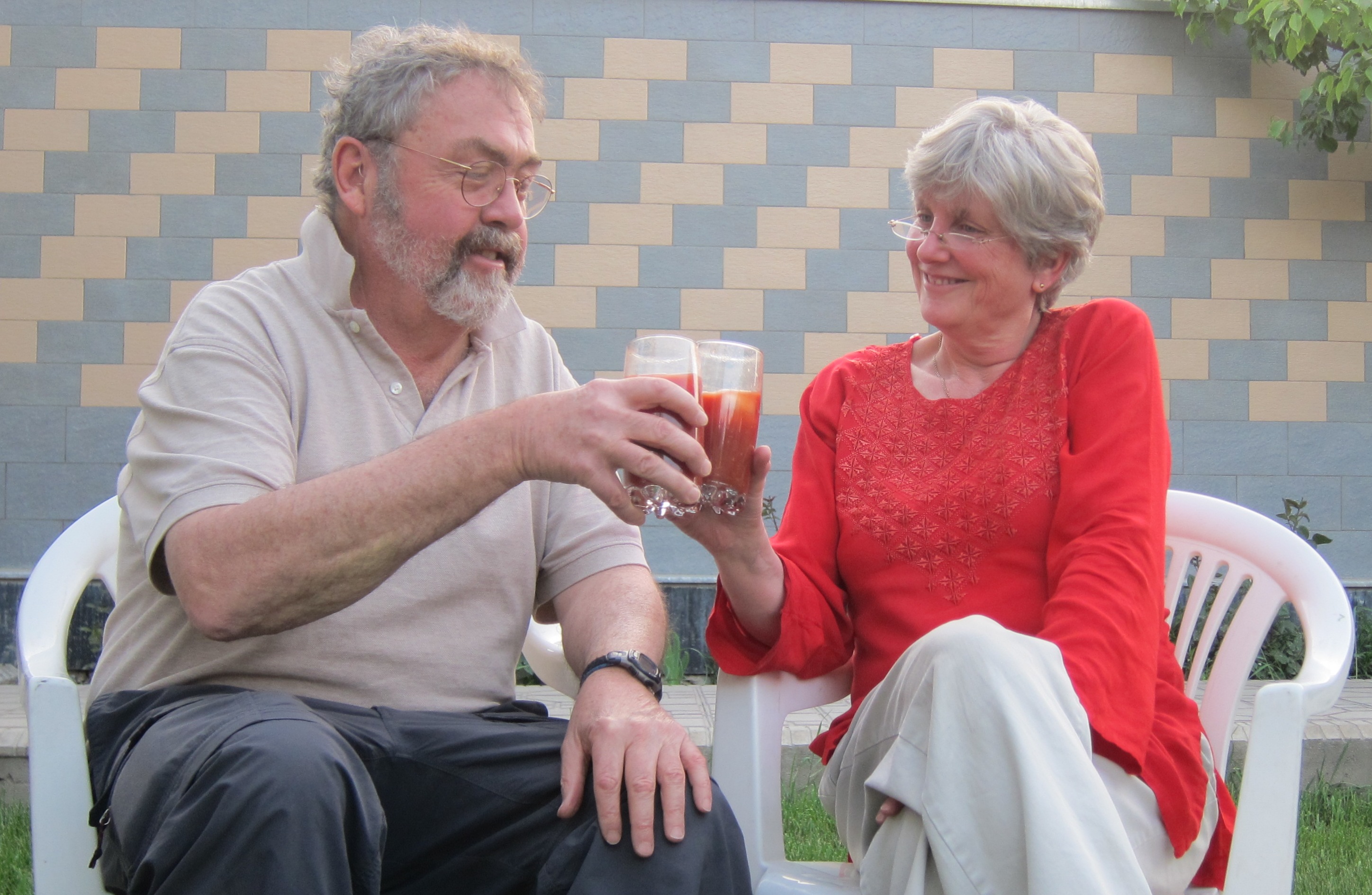
At the end of the afternoon Axel prepared us our traditional Happy Easter Bloody Mary, at about the same time we would have had one in Manchester. We had to improvise a bit because we don’t have all the ingredients for making the Ritz Carlton/Naples/FL Bloody Maries – a staple of our Easter Party. We toasted to all our friends near and far. We missed very much today.

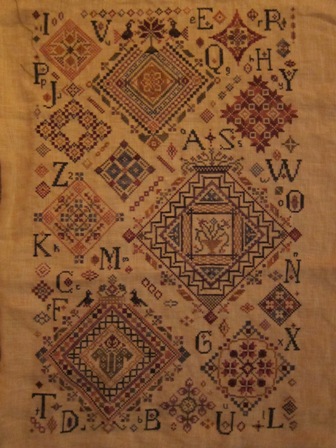
We had some intent to play Scrabble but got hooked into the Doha debates on BBC about whether the Arab countries should lead actions against wayward presidents in their neck of the wood. While watching I did a final quality check of the Quaker (cross-stitch) sampler that I started in Holland in January, added a few stitches here and there and considered it done and ready for washing, drying, and framing.

Axel retired early to bed, coughing and sputtering, with too much fine dust in his lungs. It is visible on all surfaces in our house. It’s even visible on Axel’s chest X-ray.

Glitter and giggles

I worked all day on getting my dress finished for the shab-e-henna, the night before the wedding party, of one off my colleagues’ sons. It was an invitation for women only so Axel stayed home.

The shab-e-henna is basically like a wedding party and I gather at the end the couple is officially married after the traditional and formal negotiations about money have taken place in a separate room someplace in the enormous wedding hall. I assume it is a formality as the decision to wed has already been made.

I had been listening all day to stories from Persia and Arabia and had my head full of images of people dressed in splendid clothes, beautiful walled gardens with songbirds and fountains in the middle of the desert by the time I arrived at the wedding hall. Although there were pictures of walled gardens and songbirds and fountains on the wall, the hall was a far cry from these romantic settings but the clothes people wore could have been from that ancient world.

The bride glittered and sparkled in her heavily embroidered dresses and veils (there were two outfits tonight and tomorrow there will be another set of dresses). And it was not only the bride. One by one, as the women entered they took their chadoors or black cloaks off, and emerged in their finery; more glitter, gold, mirrors, and stunning embroidery than I have ever seen in one place. I felt a little drab in my home-sewn print ensemble which looked liked a moo-moo next to all that fancy needlework.

The place was awash with small kids; half of them were dressed in very cute mini traditional Indian, Pakistani or Afghan outfits, including the embroidered and mirrored hats, the others wore western clothes. They tore through the room as if they had been given uppers; up and down the stairs they flew, the boys little terrors, the girls prancing in their ill fitting party dresses.

One little boy who had his left arm in a cast and sling kept hovering around the stairs as if he wanted to break his other arm. Two others discovered that you could shake a coke can really hard and then pull the tab off and then, best of all, could keep the can upside down above the stairwell. There were more games invented with the soda cans; full cans, shaken and opened a little bit made awesome grenades. What fun!

As more Coca Cola was consumed the frenzy increased while the bride and groom sat quietly and patiently on their thrones, facing us. After the meal the female siblings of the bride and groom danced around the couple in their traditional clothes, carrying decorated clay pots and an arrangement with peacock feathers, candles and other things I could not make out.

The henna ceremony remained a bit hazy for me. It started with the bride holding her hand against her forehead. The hand was supposed to be closed and then to be pried open with money and rings but the bride didn’t even try and willingly opened her hand for her relatives to dab with the red stuff. When all was done the hand was closed and protected with a silver/lacy piece of cloth. And then the party was over. I have never quite stayed till the end (usually the food arrives so late that I can hardly keep my eyes open).

While waiting for the car a young man approached me on behalf of his seven giggly sisters and asked if they could have their picture taken with me. They arranged themselves next and behind me which made for many permutations; each new combination required another picture. No one asked my name. I try to imagine these girls showing their friends this picture of them with the no name gray-haired and foreign lady with her reading glasses and dress entirely devoid of glitter. More giggles no doubt.

One lock down

I read a story to my driver and guard this morning on my way to my weekly massage. I read the story in Dari from a Persian children’s book that contains short animal stories with moral messages. We didn’t get very far because they kept correcting my pronunciation or finishing my sentences. We never got to the moral, told by a wise little bird: the black and raspy old crow is just as important to the world as the sweet colorful little songbird. So there!

The guard and I walked the kilometer or so that it takes when the driver drops me off at the east side of the military complex where large concrete blocks keep us from driving closer. I don’t mind because walking that far is a luxury; besides the weather was wonderful, blue sky and no dust for a change. We chatted in Dari – an advantage of immersion – about developments in the office. Although I have a few holes in my vocabulary about such things we understood each other. Boys, girls and beggars who have learned a few English words from the military personnel that lives behind the barriers tried to strike up a limited conversation (buy, give, baby hungry, hello) but the guard shoos them away.

An hour later, on our way back home, we listened to the local radio to find out if the Dearborne demonstration was on and what the Kabul police had in mind. I was told to be back home around noontime, just in case some overexcited mullahs would be urging their flock to protest against Americans, or westerners in general, when they assume there are not boundaries between us and reckless pastor Jones and his people. But the media were silent on Jones – even the BBC; everyone is too busy with Libya and Syria these days.

Halfway home we were stopped by the police. They were checking our radios to make sure they are legal. Radio licenses are not being renewed by the ministry of telecommunications until a new law takes effect. This make us think that the Afghan government, or at least some part of it, want us foreigners out – first they tackled the private security firms and now this.

After we were waved on the drivers laughed because the police couldn’t read the English papers they were shown. They pretended but the driver didn’t think they could read. No one seems too worried about it, least of all our security chief which I take as a good sign.

One of our drivers tries to speak English with me as I try to speak Dari with others. This leads to some strange exchanges because both of us are lacking vocabulary and sometimes our pronunciation is off. He says something that sounds like ‘Gals with sunglasses not as expensive.’ I quickly look up brideprice in my dictionary. ‘Is that what he means?’ ‘Qimat (expensive),’ he nods but more expensive in the rural areas.’ He switches to English again and cites 20.000 dollars as a price that is not the bride price but some other price. I give up and nod. We have many weird exchanges like that which make for interesting rides across town.

Back home Axel had coffee ready which we drunk on the terrace sitting underneath the grapevine that is just leafing out. It is really too hot to sit in the sun, 26 degrees the BBC told us later. The rest of the day was devoted to a sewing project while I listened to Arabian Nights stories. Axel did teacher homework, printing out colorful posters with which to decorate the SOLA study room and make it look more like an elementary school classroom – vowels, consonants, diphthongs and digraphs; he is learning a whole new vocabulary.

TV dinner and ‘Don’t Eat the Daisies’ was the nightly entertainment during our first day of lock-down.

Duckie Kabul

The Kabul rotary club, in one fell swoop,may have increased its membership by 35% – the orientation evening netted, I think, two foreigners and two Afghans, a father and daughter combo; the percentage of female members would be increasing from 7% to 23%.

For all of us who are bombarded almost daily with stories about greed and carelessness, the stories from current and future members of Rotary Kabul about ‘service over self’ were more than a welcome distraction, truly an inspiration.

We learned a bit about the history of Rotary International and then talked about what we could be doing where, for whom and how. We ended up with some principles: local, continuing relationships and working through existing structures, government and/or traditional.

Through matching grants Rotary Kabul is already contributing to health and education activities of others but we were thinking small; about ways that would combine service with a sense of community of the members, a very small group right now.

Our host, a long time Rotarian in the US and now here, talked about the kinds of fundraising they used to do in her US hometown. One caught my fancy – duck races. I could just see it clearly in my mind: hundreds of numbered rubber duckies floating down the Kabul River, cheered on by people who would not normally hang out together, lined up along the river; lots of laughter in the air.

Some ducks would right away get stuck in the garbage and others on dirty mud flats. It would remind people that their river is not pretty and needs help. After that all things would be possible. Imagine, London has its Henley and Kabul its rubber duck races.

Lumbering along

Kabul by night is very different from Kabul by daytime. The streets are mostly empty except for the police trucks and the countless lumbering trucks going to or coming from points further east. They remind me of elephants.

Many of them are the old ‘bedfords’ – the Dari word for trucks – the ones I remember from 30 years ago. They are round and tall, beautifully decorated. The cabins are lit by red lights and full of dangling things. They are much nicer than the square and flatter Japanese trucks with their more minimalistic decorations. Some do have fantastic metal work but not necessarily colored in the vibrant primary colors of the old bedfords.

We drove back across town from where the road forks off to Jalalabad and Pakistan. We had visited new friends who we met at SOLA as fellow teachers. They work for the European Police Force, training the Afghan police. The police trainers are not surprised about what happened in Mazar a few weeks ago, or now in east Kabul where a factory was invaded by an angry mob because the factory made pulp out of recycled Qu’rans and, allegedly, made toiler paper out of the pulp.

Originally the Germans did the training, on their own – you can tell from the many Mercedez Benz SUVs lining the inner parking place. Our friends are German and treated us to a very German dinner, sausage with senf (mustard), warm rye bread straight out of the bread machine, cheese and herring. As if it was not enough they also ordered us three pizzas.

The compound, hardly visible from the road, under the neon lights of one gigantic wedding hall, looked like a college, an outside space lined by three-story galleried dorm rooms and inside rec rooms. It’s a weird kind of existence – the foreigners (now also Dutch and other Europeans) connected only to Afghanistan via the police trainees – and the nearly impossible task of transforming the police force from nothing into something. They teach leadership so we had that in common. But teaching lofty values and risky behavior (leadership is risky in this country and policing even more so) is not very easy. My job seemed pretty easy in comparison.

Standards

There were demonstrations in town, along our usual road to the ministry; something about land, promises and ownership in Kunar province. It was a peaceful protest. Still, we drove along the edges of town to avoid the gathering. Here you never know if something might turn ugly suddenly.

At the ministry we discussed the new nursing standards for hospital care – a 5 cm thick tome describing the exact procedures and standards for some eighty common nursing tasks. Except for the people who developed the standards none of the rest of us had read the hundreds of pages. But we did ask questions about implementation and the scoring of the assessment forms.

Making nursing care more legitimate (by setting standards and assessing people) is one first step of improving the hospital experience and trying to keep Afghans from going to Pakistan and India.

Later I heard that the wife of one of our guards died in a private hospital here in Kabul because her high blood pressure was treated with drugs that lowered her blood pressure so drastically that all systems shut down. It was one more of thousands of preventable deaths. That’s why people do seek care outside the country.

In the afternoon we met with our donor to discuss our plans for the extension we hope to get. In the middle of the meeting we heard loudspeakers giving tinny messages (in Dari as it turned out). Someone quipped ‘maybe we get to go to the bunkers!’

Everyone was told to stay inside (this is normal – there is not much of an outside) and we resumed our meeting. This scenario repeated itself a few times but we never got to go to the bunkers. Apparently something or someone suspicious had been spotted on the periphery. The barbed wire was pulled across the road. Everyone is a bit on edge after yesterday’s Defense Ministry suicide bomber. It all turned out to be a false alarm and we were able to return to Afghanistan without any problems at the end of our meeting.

For dinner we took Ankie out to the Sufi restaurant and gave her a last chance to gorge herself on great Afghan food. She is leaving tomorrow for Holland – now that the cheese and the Dutch chocolate Easter eggs are gone there is no point in staying any longer. We are sending her home with authentic Darjeeling tea and two cups and saucers.

Sms

Just when I walked over to our cafeteria for lunch I received an SMS from our security that a suicide bomber was on the loose in the ministry of defense. We talked about the message over lunch. No one of us in the ladies lunchroom knew anyone who worked at that ministry. If we had we would have been frantic with worry.

I tried to imagine what it would be like to work in a place full of uniformed men knowing that one of those uniforms was hiding a suicide vest. Minutes later we received another SMS that the vest and its wearer had exploded. Aside from the tragedy it is also a spit into the face of the president and the whole defense apparatus. People were making jokes, ‘how can we count on Afghan defense forces when they can’t even defend themselves?’ But it is no joke at all.

In the evening we watched as BBC program about young boys being recruited by the Taliban in Pakistan to blow themselves up. They are lured away from school with the message that school is useless and that going to heaven is much better.

Sometimes being here feels like Russian roulette although the violence is not random. But who exactly is targeted only becomes known after the fact.

Stuck

Getting medicines to Afghans follows a logical process, at least for us, but other forces are undermining what we are trying to do. In order to comply with Afghan law all pharmaceuticals that enter the country (legally) have to submit to quality testing. So far we have received a waiver because the medicines we bring in are in compliance with very stringent international quality standards. But the waiver has expired and so we have to comply with Afghan law; this means leaving containers in customs and letting government officials take out samples and test these.

I’d like to think this is the right thing to so. The problem is that we also adhere to our own stringent ethical standards which mean we don’t pay bribes to get things out of customs. Others do, we know that. In fact, of all the containers that are stuck, and will soon be stuck, two were released within a day by a company we hire that does things their own way. Slush funds help. These containers are full of contraceptives which follow a different process than all the other medicines we bring in.

Two containers full of boxes with antibiotics and other life saving drugs are now stuck in customs until the contents are tested for quality. These two containers were first stuck in Karachi customs with thousands of others and were finally freed to find themselves stuck in Kabul. We have another container sitting forlornly at the wrong border crossing from Pakistan into Afghanistan. I suspect that by the time we get that one pried loose the contents will be gone or gone bad as a result of the high temperatures.

The truck drivers who transported these containers from India are also stuck because the containers are sitting on their trucks in a part of the airport from which they are banned. And so they cannot sleep in their cabs which is what they are expected to do; they have no money for hotels. We’d like to send them home (they call us every day) but we cannot offload the drugs from the containers. If we did, millions of dollars of pharmaceuticals with a high street value would be lying around loose in boxes in a space that is open 24 hours and to which we have no access. It is practically an invitation to underpaid airport staff to help themselves to some stuff that gets a good price in the bazaar.

Although we can rent containers here we cannot bring them into the quarantine area to transfer the contents because of restricted access. That would be the simple solution.

I don’t know if practices have changed (most people say not) but several years ago quality control officers insisted on taking samples from each batch – not just one but 40 or even 60 samples. Since each container has many batches in it the extracted number of (highly valued and valuable) vials and pills added up to hundreds if not thousands. People tell me that all these products ended up in the bazaar. Somewhere there is a handsome profit.

And so, in trying to follow official procedures and not participate in the national pastime of petty corruption we may end up encouraging another sort of more perverse kind of corruption. I can see how companies resort to payments under the table. In fact, the few hundred dollars that are being paid to extract containers from customs maybe a lot less than the loss of expensive medicine to either damage caused by improper storage or pilfering.

And in the meantime health facilities are reporting stock outs and ordinary Afghans cannot get the drugs that were supposed to be given to them for free, with the compliments of us, American taxpayers. Instead they have to go to the bazaar and buy them. Whether these are pilfered or not we don’t know since for security reasons there is no indication that these drugs were donated by us. It all seems so intractable. How to untangle this mess? Living wages, ethical banks? stewardship of mineral resources?

A different kind of education

We had lunch at SOLA to say goodbye to baba Ted who is off to the US to do his scholarship collection miracles. While waiting for one of the guests we talked about the experience some of the girls had of being mentored by published authors in the US on their essays that they had submitted to Afghan Women’s Writers Project.

The experience of getting positive feedback and encouragement from such mentors or teachers in general is entirely alien to the students. Learning is associated with struggling to keep the teacher happy and lots of punishment, both psychological and corporal.

We told the two girls whose essays we had used in Sikkim about the reaction of the students there about their essays. One was about corporal punishment in schools. This was not mentioned in the essay that contrasted Afghan with American education. The Sikkimese children had talked much about such practices in India. We learned quickly that corporal punishment in Afghan schools is alive and well.

Several of the girls told us stories that made us cringe. Like a pencil threaded under and over the fingers and then slamming all fingers down. It’s a great way to break a kid’s fingers. Hitting a child on the head is apparently another common method by which teachers express discontent. F. told us about her classmate who, after being hit on the head with a heavy book had blood coming out of her nose, coloring her white chador red with blood. Z was eager to tell us her story; she got hit over the head by her teacher because she had misinterpreted her homework assignment. She had a headache for a week.

The most amazing thing is that they all laugh when they tell these stories. I asked whether parents didn’t get upset – in the US the school would have a lawsuit on its hands – but all told us that it was no use to send parents to school to complain because the teacher would simply say that the parents should take their child out of school if they weren’t happy with the methods of discipline.

These cruelties are inflicted by female teachers to female students. But they also have male teachers who cannot touch them and so the punishment is done by reducing grades or other forms of psychological harassment. Of course girls in this society are used to that. F told us that often, after we give her a ride to the corner of our street, saving her a long walk, the policeman standing there harasses her, calling her bad names because she gets out of a car with foreigners, worse, a car with a foreign man in it.


February 2026
M T W T F S S
 1
2345678
9101112131415
16171819202122
232425262728  

Categories

Blog Stats

  • 139,792 hits

Enter your email address to follow this blog and receive notifications of new posts by email.

Join 76 other subscribers