Posts Tagged 'Afghanistan'


Going home

The best thing that happened yesterday was seeing an ecstatic Maria Pia in the hallway of the office. Her big smile meant that the long wait is over and she can fly back to the US with her new Afghan family. Said had received the necessary stamps on his paperwork last week but Wafa remained problematic. For forty-something males (who would have been involved in one form of fighting or another over the last 20 years) getting a visa to the US is nearly impossible. For a moment it looked like little Said could come but Wafa, the closest he has to a parent, would have to stay behind. It was heartbreaking and there was much agonizing and crying.

But then suddenly the forces of the universe conspired and Wafa, Said and Maria Pia will be on their way to their new US home on Monday. We are looking forward to host them in Manchester in the next few weeks. They have never seen the ocean.

The evening has just started back in Manchester but here in Kabul it is early morning and we are all packed and ready to go through the leaving-the-country-by-plane routine. I counted about 10 checkpoints for women 12 for men on my last exit. This time we will be leaving through the new terminal.

The balance between my old and new job has shifted in favor of the new one. In the morning we talked with one of the director generals about where the advisors of the capacity building team will sit when I get back in September. This includes me. Even though sitting in the ministry is less cushy than sitting in the MSH office, it makes so much more sense, since we are supposed to be advising and coaching our counterparts. They want us there, but for many reasons, some I don’t know, the move never materialized.

I have been given my first assignment, writing the new job description for our team leader who sits in the contracting unit of the ministry. The project director wants to ratchet up the management and leadership strengthening work, which is my responsibility. There are some colleagues who still believe that this is a little fluffy. I will have my hands full with them to harmonize and streamlining what we mean by ‘strengthening management and leadership.’

We celebrated our last night at house 26, hosted by Paul who always knows how to get beer and wine. The abundance of such liquids in this otherwise dry place was astonishing. The lively crowd was dominated by Belgians, mostly Flemish and one French speaker. They switched back and forth between the two languages in rapid fire; sometimes so rapid that it took my brain about 30 seconds to recognize which language was being spoken. Axel received a thorough history of how Belgium got to be a bilingual country.

No and yes invitations

The days are long here. We start at 7 AM and just when we are done with the workday here, Boston starts its day and wants answers or data or reports or telephone calls. As a result workdays can easily become 10 to 11 hours long, assuming that you don’t work once you return to the guesthouse (not always true).

At 8 o’clock in the morning we walked by one enormous barricade after another into the gated American community that contains the US embassy, USAID and the ‘hooches’ where the Americans live. I am not sure what a hooch is but I have been told it is a room that is made out of a shipping container.

The Americans cannot get out easily. I was told that they have to request a sortie into Afghanistan (= the city) at least 24 hours in advance and I assume it is probably a hassle. I suddenly realized how incredibly free we are. We can decide spontaneously to eat out in a restaurant pretty much anyplace in town.

The meeting with our funders was to explain our budget for the quick impact work in the south and the east, and present our case for how we think this will work and why it will cost so much. Getting in and out of the actual offices takes nearly as long as a meeting itself, which is why on routine missions temporary duty staff like me are usually not asked to debrief there. But I am no longer considered temporary. The formal submission of my CV by MSH had been received and I think I will soon be confirmed in my new position. It is a key staff position, hence the lengthy and formal process. I was warmly welcomed by the USAID staff so I think all is well.

Once out of the fortified compound Steve and I mingled for a few hundred meters with ordinary Afghans and walked to the nearby ministry of health, also fortified but not quite as much as the Americans. A container with its front and rear end removed leads you from the barricaded entrance into the ministry’s compound which is a lovely garden. It is full of roses and other flowers, small seating areas (always occupied by men, rarely by women), pergolas and pathways that meander through. I am always surprised how full the garden is with people. They sit and talk in twos or small clusters here and there. I wonder what they are talking about. Is it business, the family or gossip?

I had a meeting with another Director General, as per my scope of work, which served as both a follow up of the work done 2 months ago and also a reconnaissance of what they would like to see happening in the near future. Our project’s work planning process for project year 4 starts when I come back here and I need to know what to put in that plan. This time I cannot dodge the responsibility for the plan as I have successfully done back at headquarters. Being senior staff I hope I can influence the process to be more a bit more meaningful and creative.

I am getting plenty of opportunities to practice my new skills of saying no to invitations. First we were invited for lunch at the DG. I said ‘thank you, that is very kind but we have to go back to our office.’ One of my colleagues proudly said to the assembly of men that I am learning the Afghan way and that I am a good student; everyone laughed and we said our goodbyes. A few floors down we stuck our head around the door of the child health department where the chief was having lunch with his staff. We received another invitation and I declined politely. I am getting the hang of this!

Back in the office we met with one of the consultants to discuss his work and next steps. I did not agree with the approach taken and voiced my concern in a way that is not very Afghan. I think my new boss was a little taken aback; this is certainly not his style. I will have to work on polishing my ways of airing disagreements, but I felt too strongly about the matter to remain silent. Others who had expressed concern privately, did not speak out during the meeting. That’s how things work here it seems and it essentially clogs up feedback loops. I am thinking about buying the movie about the Abilene paradox (going someplace where no one wants to go) so that we develop shorthand for such ventures (“are we going to Abilene?”)

I met with one of my new supervisees to review the work of his department and learned much about the joys and frustrations of his work. Again we talked about being straightforward or not and I learned that for Afghans like him who have much experience working with foreigners he prefers them because he can be honest, while he cannot with his fellow countrymen, for all sorts of reasons. He would, for example, never go to my boss to talk about something that I did wrong. From what I gather none of the Afghans would do such a thing.

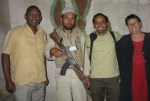
Axel and I decided to go out again. I wanted him to see yet another restaurant, a Texmex place called La Cantina. When I told Patrick, who has been dreaming about beer, that the restaurant serves such a drink, he enthusiastically accepted the invitation to join us. Maria Pia and Nurajan also joined us, each eager to get out of the house. We had two beers each (a tremendous treat) which constituted half of our bill. The other half was for the meal itself: tortillas filled with all sorts of spicy stuff. On our way out we took pictures with the armed guard which they asked to email us. Everyone has email now.

A different view

Things are ratcheting up; for me, and for what America is planning to do here in this country to win hearts and souls. Although not formally in my position yet I am asked to participate in all the senior management team’s meetings. The subject of these meetings is the new (and extra) ‘quick impact’ work in 11 new and insecure provinces. For the first time in my life I am drawn into discussing work that has a mega million price tag. It dazzles me and gives me a headache to look at spreadsheets with three and four digit numbers that have a whole bunch of zeros left out. I woke up with a headache this morning.

I am seeing consultants from the other side now. They fly in and out and do work that we want done and asked them to do. But sometimes they do things they like to do or are good at – I see myself now through this prism and realize how I have sinned: bending scopes of work, writing long and complex reports that would be good teaching documents but overwhelm non-native speakers. I always thought I was good at looking through other people’s eyes but realize now I haven’t seen anything yet. It’s quite a revelation.

I am also getting a taste of living in a world that is full of gossip and rumors. I thought I knew about such things. The air is thick with them, and so far I am only experiencing those that fly around in the office. May be it is nicer to call this story telling, white lies and truth bending. It is impossible to tell what is true and what is not and I have to learn to contain myself and inquire, rather than let indignation and quick emotional impulses take over. Yet I see others do that as well and it is an easy trap to fall into.

I have a deep and basic trust in people, in spite of the occasional disappointment. I assume people speak the truth and have good intentions. People confide in me, back home because I can keep a secret, but here they don’t know that yet. I wonder if here they are telling me stories from below the surface because I am the new kid on the block (and need interpretation) or because people want me to adopt their view about things and people before someone else lures me to their side. This country is full of ‘sides.’

My nature is to check things out with third parties. It is also what I teach: ‘is this an inference or a fact?’ I try to model this because it is a good practice (I learned this from Chris Argyris). But here it requires a straightforwardness and honesty that is entirely counter-cultural. As much as the Afghans have a way of interacting deep in their souls, so do I; neither one of us can shed it like a piece of clothing; it’s deep inside us.

I like people to know me as I see myself: straightforward, and what you see is what you get. When I say no I mean no and when I say yes I mean it too. Other people claim they are like that but I am not sure yet. So far stories I have checked out were denied by other parties, accompanied by new stories and judgments. Just this checking could become a full time job!

And then there is the hospitality which actually isn’t hospitality. This will be a challenge for me as I tend to accept enthusiastically any invitation that is offered to me. Looking back I spot a few such misfirings along my path through this country. Having to offer people tea or a meal even if you don’t mean it has gotten my colleague Ali in trouble when he was in the US and a fellow student enthusiastically (and for Ali unexpectedly) accepted the invitation.

Everyone who has ever been in contact with the outside world has stories to tell about this. Now they are funny but they are actually very sad. Martin Buber was right: say what you mean and mean what you say. Because if you don’t there will be trouble, regret, irritation and anger down the line. Still if this is how you were brought up and everyone around you, then where does change start? I know that it would be hard for me to change in the other direction (but possible, I suppose if I thought it would be a good change – I don’t). This is going to be fun!

Immersion

My immersion into Afghanistan is entering the rapids. Now that people know I am going to live here they all want to be my teachers about the culture and what things on the surface tell about what’s underneath. Opinions and viewpoints are presented as facts that state what and who is good and what and who is bad. Each story is told with the conviction that it is the absolute truth. I have no way of knowing the difference. Axel and I have much reading to do to get even a very basic understanding of what Afghanistan is. What to read is not obvious. What I thought was a good book was dismissed as shallow. The only one book that everyone agrees on is a must-read is Louis Dupree’s ‘Afghanistan,’ a book that I read years ago and will need to read again.

I met with what I have considered my team in the past to go over the program we are collectively responsible for. I am seeing the consequences of parachuting in and out twice a year with little day to day guidance about the process of teaching leadership. Things have gotten a little off track, words and concepts have drifted away from their original meaning. I have some untangling to do. I can’t tackle this until I come back because at the moment I have little formal authority to do so.

One of the things that has gone off the rails a bit is the attempt to strengthen leadership at the central level. It is much more complex than at the provincial level for the simple reason that there are many advisors who each tell the same people how to do better the things they are doing. Predictably, we have run into other capacity development initiatives from the WorldBank, UN and the EU, each with its own traditions. The resulting confusion makes all of us less effective.

After lunch we went to the ministry of health across town in the small office van that shuttles back and forth each half hour. Axel joined us because the film festival venue is along the way. These bus rides are always very animated because there is much joking. Some of these jokes are similar to the jokes that the Belgians and Dutch make about each other, or the Scots and the Brits; here it is between provinces. Axel learned about peculiarities of people from Konar, Logar and Wardak.

At the ministry we found some 100 plus newly graduated doctors in a huge hot auditorium listening to a lecture about community health. About one third of the audience was female and I congratulated the entire group with this accomplishment. I jokingly added that next year I’d hope to see women in the majority which was met with a storm of protest from the men. The women just sat their quietly, mouths closed. It is remarkable to see how threatened men are about women becoming more prominent. Some jokingly said that they wanted to fight with me over this. I offered to stay after class and talk, emphasizing the word ‘talk’ rather than ‘fight.’ The language itself is revealing. The men are used to tackle conflicts through fighting. But in the end everyone stood up and packed their books to go home – it had been a long day; so much for fighting.

I had to use a microphone that produced an echo behind me as if I was an announcer at a large stadium event. It was hard to shake anything loose from the audience, they are trained to sit still and absorb the master’s words. I was introduced as some sort of super guru and Dr. Ali told people about my plane accident (I understood enough Dari to recognize the words for pilot and plane and could figure out what was happening). The men stared at me with mouth open as if I was some creature from outer space. The women kept sitting there with their mouths closed but their eyes were scanning me up and down and sideways. I would have given anything to know their thoughts.

In the evening we picked up a former housemate Janneke from Holland who is now working for and lodged by an American consulting firm on the other side of town. All my current housemates piled along in the car because everyone likes to get out of the house when an opportunity presents itself. We ate in an Iranian restaurant that serves large quantities of meat and rice. This made Patrick from Rwanda very happy because he is not getting enough beef. The only thing missing for him was the beer, but Iranian don’t serve alcohol of course.AF_meatfest

I received a cultural briefing from Steve about saying yes and no. It reminded me of Martin Buber’s saying that all problems we have with our fellow men stem from not saying what we mean and not meaning what we say. This is probably going to be the toughest challenge for me: when people invite you one is not supposed to accept but instead expected to say no, at least three times. Such invitations are not really meant as invitations and they should be declined. I think I have already made some faux pas because when people invite me or give me something I always enthusiastically accept. I come from a place where this is polite and the opposite is not.

Maria Pia has moved to our guesthouse with the fighting partridge that Said left with her. It runs around free in her room and pecks at everything. This includes the key board of her computer. It found the ‘delete’ key and managed to delete an email from one particular person, as if to tell her not to worry about its message. The bird is a genius because she has other things on her mind.

Speaking in tongues

We know that the week starts on Sunday but it felt like Monday, so we are one day ahead of reality. I am on the last leg of this trip and the days are rushing by. There is much to do, to ask and to discover.

Axel went right on discovering new people and places. First came his delayed registration with the ministry of interior, as a foreigner – a process that I have learned to complete on arrival at the airport. It requires a passport picture which he did not have. After several stops at different parts of the ministry he got a special card that needs to be handed in upon departure. I don’t know what would happen if you did not have that card but we don’t want to find out.

While he was away I was taken to another ministry (of health) and met with one of the teams that we have handed the leadership program to – a group of young male and female doctors who are very successful in transferring skills, in their turn, to new graduating doctors. They do this with great enthusiasm, referring to Dr. Ali and me as their parents and grandparents. We know they are doing well because requests for their interventions are pouring in: the blood bank wants to become a leadership center of excellence, and so do a number of the private health facilities. All want their staff to lead and manage better. One of the young female doctors even addressed the annual congress of OB/GYNs with lessons about leadership. I asked her if she had been nervous. “No, not at all,” she answered with a big smile. To me this felt like a cultural revolution.

The young doctors are also among the star performers in a virtual change management program that we run out of Cambridge. They take this very serious and I am cheering them on from the sidelines, wherever I am in the world.

Axel and I arrived back from the various ministries in time to have lunch together in the employee café where we met two new consultants, from the Washington DC area, both very interesting people with a long and deep international career. After lunch Axel went to the film festival and made more new friends whenever he escaped from the hot and airless auditorium of the lycee into the slightly cooler foyer, while I continued my workday at the office.

I was asked to sit in on meetings that are relevant to my future job here. In one meeting a group of consultants from another organization came in for an introduction to our project for which they are designing the follow on. Together with some of our MSH colleagues we formed a microcosm of how much of the world runs: 9 older white males, 5 slightly younger Afghan males and me the only woman. Since I am not yet in my new (very senior position), I chose to observe. It was a role all of us in the minority were put in anyways, whether we liked it or not.

Even though the conversation was about rebuilding their country, the Afghan males were entirely ignored. I was also, except when anyone mentioned gender and then they looked my way. I finally had to say that, being a woman did not make me the gender specialist. They didn’t even think that was funny. I can’t wait to be official. Then I will try to put such meetings on another more inclusive track. The Afghan males are too polite (or maybe intimidated) to say anything about this. But I asked them and they told me. Although they are used to this treatment, they do notice and they suffer, quietly and each in their own way. I will meet with one of the white guys later this week (he does think I have something to contribute after all). I plan to ask whether he noticed something was awry.

In the evening we networked our way further into the society of émigré Afghans. Wahzmah’s uncle is leaving for the US today and invited us to the family house in the middle of Kabul. There we found people speaking in various tongues: a French nurse from the Herat burn center speaking in her language with some older gentlemen, brothers, from the ministry of culture and information, speaking at least 4 languages, an Italian anthropology Ph.D candidate from Boston University in Pashtuni dress, ex military and security man, speaking English, Italian, French and learning Pashto, a young female film maker and director of an animal shelter from Karachi, speaking whatever people speak in Karachi and perfect English and some other people who I never figured out. Our host spoke Turkish, French, Arabic, English, Pashto and Dari, and most people spoke at least two languages. And then of course there was the Dutch me.

Dinner was spectacular, as we have come to expect and seduced me into at least two helpings and Axel into one too many. Over and after dinner we were treated to a host of opinions about what happens here and what happened a long time ago. We are sucking everything up like thirsty travelers.

Movies

We met up with Razia and Wazmah at the Istiglal Lycee in the center of Kabul for the opening ceremonies of the film festival. Being one of the few foreigners walking into the place we were immediately captured on camera. Not just for a while but for a long time, our every movement recorded. There was no need for a special invitation as we were invited with open arms and provided with all sorts of information, most of it in Dari.

There were some glitches and the opening was delayed by nearly one hour during which the temperature rose steadily. A few other foreigners were representing the biggest sponsors: the Goethe Institute, the French Cultural Centre and the British Council. Patrons and artists mixed in the audience, the latter recognizable by their attire, although I could not make up my mind whether the men in shiny suits were sponsors, government officials or film makers.

Axel is very good at introducing himself to anyone at any time. I don’t think he is going to have a hard time networking himself into Afghan society, at the least that part of it that speaks English and likes foreigners. We returned from the festival with several new contacts, one the head of the festival’s organizing team and the other the director of the French cultural center.

We spent an hour and a half listening to speeches, mostly in Dari, by sundry officials, with occasional translation in broken English. The master of ceremonies was the professor of film making, with a penchant for poetry. I was sorry I could not understand him when he recited poetry, sometimes in Dari and sometimes in Pashto. Even without understanding it was beautiful to watch him recite and listen to is melodious voice. If I wasn’t already motivated to learn Dari I would be now.

After about one and a half hour in the musty and hot auditorium we got to see the trailers (too short) of all the Afghan and some of the international films. I wish I could go and see them all but unfortunately the festival is more or less during work hours. Axel is planning to go as much as he can.

After the trailers we were treated to a short documentary about watching movies in Afghanistan. The footage showed pictures of destroyed cinemas (presumably by the Taliban) and old men sitting in living rooms and tea houses watching semi-clad females dancing and singing. Unfortunately the film was entirely in Dari so we missed what all the old men were saying. We knew it was funny because the audience broke out in laughter repeatedly. We gathered that the documentary was about the love-hate relationship of the Afghans (men only) with films: entertaining and titillating on the one hand while rejected as perverse and inappropriate for Afghanistan on the other hand.

Once again the entire thing was primarily a male event. The only female who made it onto the stage was German, from the Goethe Institute. A few Afghan women were present in the audience, and then of course there were the Bollywood actresses, nothing more than objects of lust.

Afghanistan’s eyes

Respiratory disease is a big problem in Afghanistan. Although mine is not acute it feels like my lungs are filled with dust. It reminds we of the period in Senegal when the Harmattan winds blow and everything is covered with a fine layer of dust all the time, no matter how much you clean. I wake up coughing several times a night and am struggling with something like a cold for the first time in many months. I hope the H1N1 flu has run its course because if it hasn’t, we are in trouble here.

The government resumes its work today but we have another day off (unless one works in the government or on something together, as some of my colleagues do). We went to the high school tracks which are not as well maintained as those at the German school. The uneven and over-watered terrain and the lack of shade trees made it less enjoyable. I think I got a mild case of sun stroke and it took me the rest of the day to recover. It was probably 35 degrees Celsius, much too hot for doing anything in the sun.

I showed Axel around on Chicken Street, taking him to my favorite places. We stayed away from buying, except for a birthday present for Tessa. We walked around a furniture place with exquisitely carved tables and chairs that took our breath away; figuratively because of the beauty and craftmanship of the traditional pieces and literally because of the Central Asia dust that is in and on everything. With this kind of furniture available it is hard to understand why people furnish their places with the large and ugly stuffed furniture that is so popular here. Modernity!

We returned home for a late lunch, leaving the others to buy more stuff on Chicken Street. I napped until it was time to go for our Thai massage. I don’t think Axel had ever had such a massage. The diminutive Thai masseuses use the leverage of their bodyweight to massage the various muscle groups. It can be a bit intense at times but it was exactly what the doctor prescribed. I think we are going to be frequent customers in that place.

In the evening we drove to Razia Jan’s place down the street. Razia is from the South Shore in Massachusetts and lives here in Kabul part of the time. She has founded a girl school in a village some 15 km outside Kabul which we hope to visit some time. She is also on staff of an NGO that supports women rug weavers and their families in Bamiyan, paying them fair market price for their rugs and marketing them in Kabul and in the US.

Razia told us her extraordinary life story which took a significant turn after 9/11. That event, in all its tragic consequences, also mobilized an unknown number of people, Afghan and non Afghan alike, into spectacular altruistic action that continues up to this day. In our short time here we have heard several such stories already.

Razia told us about her encounters with the men of the village where the school is located and her efforts to keep them from elbowing out the girls. This is a common problem all over Afghanistan. Men are used to serve themselves first, leaving the scraps for their women. When the men told her that boys needed to go to school rather than girls, they argued that boys are the backbone of the country. Razia answered that girls are the eyesight of the country and without the girls the men are blind. There is ample evidence for that all around us.

Razia had invited another Afghan-American woman, Wazmah, from New York. She is here for her doctoral thesis research on media, culture and communication. Wazmah’s film, Postcards from Tora-Bora, was shown during last year’s Afghan film festival. This annual event, now in its fourth year, happens to start today. Although Axel had spotted the website it contained no information about where; meeting Wazmah was fortuitous. It’s on our program for today, and maybe on Axel’s for the next few days.

Company

Today is Friday which means weekend. There is a routine that I know well but Axel doesn’t. The only difference from the weekend routine I last experienced is that the contract with the German school, hidden behind major fortifications, has run out. A new contract (of the use for one and a half hours of the athletic track and fields) is now with the Habibia high school a little further up the road. It is the place where the Afghan intelligentsia has been trained for generations. For a while it was out of commission, entirely destroyed in crossfire and then fixed up again.

I had my ‘expectations’ conversation with my new boss. I had given him my vision for next year when the project (and thus my contract) ends as well as the actions that I plan to undertake to take me there. We had a wonderful and very frank conversation.

My new boss lives on the edge of many dividing lines: as an Afghan he is head of an American project and thus has to please the American people (or at least those who represent this constituency). The project is designed to help the Afghan government, so he has to please that client too, which includes a steep hierarchy crowned by the most senior officials in the ministry of health, some he knows very well personally but, as a non government official, he has to show deference to all of them. He supervises three expats and also has to keep MSH headquarters in Boston happy. And then there is the staff, some are from the same ethnic background and others are from places that have traditionally been warring with his.

On top of this he is held responsible for the judicious spending of enormous amounts of money, for staff scattered over the country, some in very insecure areas like Kandahar and Khost, and held to performance standards that are high under the best of circumstances. He is a little stressed.

The new ‘surge’ in Afghanistan is piling more complexity on this already stressful state. We submitted a plan to help the US government wean the population away from a hodgepodge of Taliban and Al Qaeda groups by paying attention to things ordinary people badly need, like a place to take their sick wives and children, something the these various fighting groups can’t or won’t provide.

My Dari is improving slowly. We eat lunch, whenever we can, in the staff-run cafeteria where a simple and delicous meal costs 1 dollar. I sit in the men’s section because I am like a third gender, the advantage of being a female foreigner. That is where I practice my Dari and learn a few new words each day. It is easy to learn Dari here (as opposed to learning in the US) because everyone loves to teach me and I am encouraged by all. I am hopelessly in love with this place.

Last night we went to another guesthouse where our colleagues served cocktails and beer. It was a busy place because Maria Pia’s Afghan family had arrived from the north. Wafa’s hair was cut and Said wore a preppy tea shirt. They are ready for this new adventure in their lives, just as Axel and I are, going in the opposite direction. The only thing is that I knew what to expect before heading out here. They have no idea where they are going (or if they have an idea it is probably heavily influenced by the American rambo-type movies that Said loves to watch).

Said had brought his bird, a fighting partridge, which they try to get us to take care of after they are gone. I found the creature a little too nervous for my liking. It did have a nice plastic cage with a carpet on the bottom, we are in Afghanistan after all, but I think we will decline.

They are supposed to leave in less than a week’s time but only if their brandnew Afghan passports are stamped in time at the US embassy here. Everyone is sitting on pins and needles. Maria Pia has been able to secure donated business class seats for all and the experts at Massachusetts General Hospital are on standby to sort out Said’s twisted limbs. I wish I could ride along and watch their faces as they travel away from old and ancient Afghanistan into the New World of America.

We returned to our guesthouse and sat on the porch on our plastic peacock chairs eating yet another delicious meal prepared by our cook. We have a great bunch of people here and are getting to know them better. This is the attraction of living in this guesthouse. If you want to be alone or hang out with interesting people, you can.

We tried to watch our bootlegged copy of the movie The Proposal that I had bought for 2 dollars in Addis. It includes laughing. This is not a track, but real people laughing in a real cinema someplace in the world where the film was video-taped straight from the screen. Our watching experience was a good deterrent (punishment?) to secure anymore of such movies. The copy was OK until halfway through the movie.

Between the recurrent power outages and the defective copy it became too much of a hassle and the audience trickled away until only the two of us were left. Although we have a suspicion of how the movie ends, we don’t know how the storyline will take us there. We did see the scenes filmed in Manchester and Rockport, with mountains inserted in the background. I like that look.

Dynamic

I spent most of the day sitting in a conference room watching about 30 people plan their department’s services. The entire event was in Dari. A female colleague was teaching/facilitating and I got to see how she did this and what happened. It was all very revealing despite the language handicap. I was looking for patterns of behaviors, how people deal with stress and conflict and picking up a few Dari words in the process. This is a good time to observe because soon I will be so used to how people work together that I won’t notice things anymore.

I played no formal role but when I noticed something changed in the dynamics of the group I investigated what was going on. I also delivered some messages about disruptive behaviors when the female workshop leader was uncomfortable doing so. People here get away figuratively (and I suppose literally as well) with murder because there is great fear to confront, especially if the culprit is male of higher social status. Sometimes when I confront people they get prickly, sometimes they open up and spill out why they acted the way they did. You can make ennemies and friends this way, I did the latter (and possible the former).

While observing from the periphery of my vision the workshop dynamics and process I turned 65 pages of reporting data into a deeply layered mind map in order to help me see more clearly the broad and complex landscape of this project. With the new ‘surge’ proposed for the insecure provinces this is going to be even more complex.

I am sticking my toes in the water to better understand why people do things that they claim they don’t want to be doing and the many constraints that, real or imagined, are used to justify non productive or self-defeating behavior. Chris Argyris would have a field day here. I am climbing one ladder of inference down after another. Some people squirm when I do this, others are delightfully frank. Culture is invoked a lot and the effects of stress are painfully visibly, yet few see it or care to admit (most of these people are men).

My new-found friend invited me to dinner. I was accompanied by Axel and Steve. He is a fairly young doctor, delightfully frank and straightforward. It is rare to hear an Afghan tell us foreigners that the workshop we organized was a waste of time, his and others. I have definitely entered a workshop culture: when in doubt, hire a consultant and do a workshop. I can’t remember hearing many of our clients protest this approach so straight into our faces. He was absolutely right and I hope I can reduce the number of workshops a bit.

The Lebanese restaurant, across town, was heavily guarded by young men in combat outfit with a variety of guns. I can recognize the AK-47s now but there were some others that seemed even more dangerous. We were whisked through a covered ‘sluice’ much like in some banks where the entrance and exit doors are not allowed to be opened at the same time. For a brief moment you are in a holding pattern. Then we entered into a brightly lit (except when the power went out) restaurant with people socializing, drinking beer and wine, as if this was downtown Boston.

At the end of the room a bunch of US military guys, buzz cuts and with undulating muscles sticking through their tight drab jerseys, were relaxing drinking whiskey and beer. Since they were drinking I assumed they were off duty. But it was fun to imagine them ‘guarding’ some US powerbroker in a backroom of the restaurant, making deals or twisting someone’s arm.

After being served a complimentary chocolate cake we drove back at breakneck speed across a deserted town, populated by men with guns (presumably good ones) and delivered back at our guesthouse zero. It was a wonderful day and I can’t wait to settle in more permanently. This may surprise some people.

Veranda fringe

We celebrated our 2nd re-birthday as Sallie Craig calls it with a dinner at a lovely Afghan restaurant. Eight people came along to celebrate with us, all of them lodged in MSH guesthouses, most of them colleagues from Boston and DC. We toasted with real beer and wine – a treat – and were served a sequence of small courses with several Afghan delicacies. We were sitting outside in a lovely garden, walled off from the busy town center by high walls. We could have been in the country side. Wood fires in large braziers both lit and warmed us as night fell. In back of me large and well manicured bushes of weed separated the garden from the restaurant’s veranda.AF 001

Earlier in the day we had paid a visit to the Afghan Research and Evaluation Unit, an organization that commissions and publishes research about all aspects of Afghanistan’s society and reconstruction. We were like kids in a candy store and helped ourselves to all sorts of publications to deepen our understanding of what is happening here.

On our way back we stopped at one of the supermarkets that cater to foreigners and paid about 50 dollars for a small shopping basket with essentials such as shampoo, toothpaste, a Japanese tea kettle, some tissues, a kilo of dried mulberries, chai and tissues. For that amount of money we could have bought some exquisite old jewelry, rugs or wall hangings on Chicken Street. Now we know that we should stay away from imported goods if we can (or import them ourselves).

Back in the office, still empty because of all the travelers, we settled in for real work. For Axel that meant sorting out how to survive in an office (and electronic) environment that is dominated by Windows users. Connecting to the internet at our guesthouse requires some special software (or a new computer). As a Macintosh user he is a minority here.

I had my first meeting as a member of the senior management team; unofficially, because I am not yet approved in my new position by the US government powers that be. Those powers are extremely busy sorting out the on-the-ground implications of the revamped US strategy in Afghanistan, led by powerful figures in the Obama administration. Things are definitely going to change here and people are gearing up. We are not sure what to gear up for, except for an enormous influx of people coming to implement this strategy, accompanied by the necessary cash. For some Afghans this will mean employment and survival; for others it will be the opposite.


February 2026
M T W T F S S
 1
2345678
9101112131415
16171819202122
232425262728  

Categories

Blog Stats

  • 139,802 hits

Enter your email address to follow this blog and receive notifications of new posts by email.

Join 76 other subscribers