Posts Tagged 'Afghanistan'


Cowpaths, cola and cleanliness

The weather has turned back towards winter again. It has been raining for the last few days and the warm summer weather has disappeared. I am turning my airco back into a heater. I am told that Afghanistan advertises itself as the country with 300 days of sun. Under other circumstances this might have attracted tourists.  I think at least half of the sun-less days have been used up already over the last month. the only thing that tells us spring is here are the rose buds that are popping and the tiny grape bunches already visible on the vines, growing bigger each day.

The challenge of coaching my Afghan colleagues in using a very well calibrated and researched set of facilitator notes is that I cannot improvise – as much as I like to do that, and often have to do this. This is the contradiction that I experience wherever I go. It’s much like learning to dance. You first have to learn the steps and why the steps go in this order and not that order. Only when you have internalized the steps, so they become automatic and don’t require conscious thought, can you start to improvise and embroider on the material. This is difficult for me because I have to model sticking to the notes yet I know them so well that I tend to do a lot of embroidery in response to the particular needs and realities of the team. So I end up asking people to ‘do as I say’ rather than ‘do as I do.’

We follow a cow path this morning in our session. There is some logic to it since it leads to a desired endpoint but otherwise it winds this way and that. Dr. Ali, bless his heart, keeps bringing in the young women trainers. It is like a kind of inoculation against women power – if you put women up front enough the men get used to it and the sharp edges wear off.

They teach, among other things, Steven Covey’s circle of influence. It’s a popular exercise all over the world and especially here. In our notes we end with a quote that is, allegedly, from Reinhard Niebuhr about knowing the difference between the things you can do something about and those you cannot. In the middle of the exercise someone stands up and invokes (in Dari) the name of God. What follows after that sounds like a recitation from the Holy Koran. I am puzzled and a translator is sent my way. I was right. The verse translates, loosely, like this: when a problem is too big, something you can neither control nor influence, then you can leave it to God. I am trying to reconcile Covey, Niebuhr and God but have a hard time getting my head around these three.

We end the teambuilding retreat with the usual take-out lunch, always with too much bread and too much meat and/or chicken. We are served cans of Kuka Kula. I sit next to the health promotion director and he tells me that the Kuka Kula people take nice Afghan spring water and turn it into unhealthy soft drinks eagerly consumed by people  used to drinking water or tea.

He has a tough job: supporting some good old habits (tea drinking) and unlearning some bad ones (spitting) and teaching the discipline of hand washing and personal hygiene aside from the nutrition, child health and maternal health behavior change communications. We, that is the women in the room, have recruited him, our first male, to be part of a coalition that has just developed its vision for a more healthy ministry of health (clean, smoke free) and a measurable result: 4 clean female toilets in the main MOPH building by December 2009.
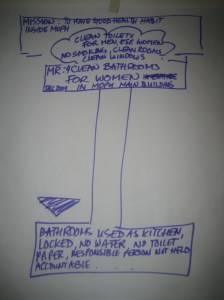
kabul-064I challenge the two young women trainers to take the lead on this initiative. At first they say it cannot be done and I question them about stopping before they have even started. Everyone gets very busy telling me why it is ludicrous to even try. It’s a perfect set up for talking about leadership. People do want to be leaders but they don’t want to change things, or don’t think they can. We use the challenge model tool that we are teaching to everyone here.

Today was the last day of the various retreats in the basement of the ministry of health. One more piece of work that is externally focused happens on Thursday and after that my focus will shift to capacity strengthening in management and leadership within the project.
Men retreat, women advance

We are meeting with the public health institute. After yesterday’s all male policy and planning team we now have at least one woman (a deputy director) at the table, and two younger women as observers. The latter are here to observe and they get to teach bits and pieces. The institute is smaller than the other directorates and convening the direct reports to the DG is easier, despite the fact that one of the directors is responsible for coordinating Afghanistan’s influenza A response – he’s a busy man these days.

There is a good atmosphere in the room and the group is a congenial one. When the two young women stand up front and do their teaching I notice a subtle shift in energy in the room as if the men become more boisterous; the noise level certainly goes up. I seem to be the only one noticing it. I share my observations; people laugh. They don’t think anything has changed. There is much hilarity in the room. Still at some point my co-facilitator, a senior male doctor, has to step in to refocus and bring the energy down to manageable levels.

We conduct the same diagnostic that we did with the policy and planning team. We move faster in some areas and slower in other. This directorate has a beautiful brochure that looks like a glossy magazine, with its mandate, vision, staffing chart and pictures of senior health officials at official occasions in addition to staff sitting at their desks and in action in the field. There are also picturesque Afghan landscape scenes (and some that don’t look very Afghan to me).

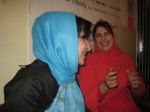
When we ask whether they have a shared vision, some say yes, some say no. I step in to explore whether they have the same understanding of the construct of a vision. Some of the directors have a very sharp and compelling vision for their own teams while others don’t – it’s a little uneven. The women trainers return to the back of the room, and sit next to me. They are giggling and telling me about all the mistakes they made. kabul-052They discover more mistakes in the Dari flipcharts they prepared and giggle some more. I admire their resilience – they are pioneers for their sex. I ask a male colleague who has been observing with me, and occasionally translating, how big a barrier these women are trying to break through. He tells me proudly that having younger women teach older and senior males is OK in his department. It is quite an accomplishment considering that only a decade ago this would have been unthinkable.
I postpone going to the bathroom as long as I can because it is such a hassle. I am told that, in the entire central ministry of health, there are only a few bathrooms for women; one of them is across the hall from our basement training room but it is permanently occupied by women cooking on little stoves and men eating. One floor up are two stalls but these appear to be permanently locked. If you are lucky someone will find the key. It is attached to a rather yucky looking rag that is probably full of interesting bacteria. This time I find a bathroom on the third floor. It’s a very long walk across the building and three floors up. “This is our big problem,” say the young women who serve as my guide. Men don’t seem to need clean bathrooms, but we women do. There is clearly not yet a large enough constituency to demand such a change.

A good day

Our morning starts with a visit to the chief of health services. He greets me enthusiastically and I can now ask him in Dari how his family is and how is travels were. He travels a lot to the provinces and because of that has a good idea of what is happening at the basis of the pyramid. He wants to organize quarterly meetings and rotate them in the provinces and have his staff travel there instead of provincial staff travelling to the capital city.

He talks about good provincial teams and bad provincial teams. Where they are bad, he says, ‘the staff is crying.’ But he cannot do anything about it because some of the provincial bosses are well connected and powerful. This is the impotence of senior leaders that is much more rampant than people at the bottom of the societal pyramid think – the paradox of powerful people feeling powerless. This doesn’t necessarily mean that they acknowledge this and ask for help. But this very senior doctor does.

We talk for awhile so that I can understand his predicaments better and offer ways in which we can assist him. He agrees to bring his senior managers together again, the team building that derailed a bit last week. We will meet on the day that I was supposed to have left and we will give it another try. But this time I extract a promise from him: if he is called away by his superiors, he will say no to them. I realize this is not easy, and may not even be possible. We agree that if he cannot say no, we will cancel the meeting.

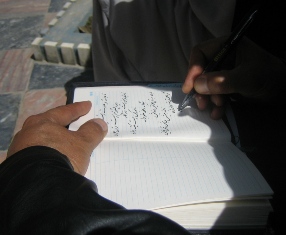
kbl-poetOn our way out of the ministry we run into a man who is the son of a famous Afghan poet, and the brother of another, both named Mushda. We ask him about a poem that we can use in the sessions with the senior leaders that will help raise spirits and speak of unity and collaboration. He immediately starts to pen, in beautiful handwriting, in Ali’s diary, a poem that his father wrote 50 years ago about unity between Sunni and Shiites, between Pasthuns and Hazaras. As we walk out of the heavily barricaded ministry compound onto the street I ponder this extraordinary encounter with poetry right in the middle of the ministry’s flowering courtyard.
In the afternoon we help the policy and planning people create a shared vision and talk about their hopes and dreams – something they have never done before. The turnout of these very busy people is good. We spend a long time talking about what a vision does, rather than what it is. I do an exercise with the kind of elastic that is used in men’s underpants, cut lengthwise into two rounds of about 4 meters. With it I demonstrate the constructs of structural conflict and creative tension, the kind that a vision generates. It gets the message across but, as I find out later, is a little too risqué for my Afghan colleague when I ask him whether he wants to do the exercise tomorrow. Foreigners get away with much countercultural mischief.

After work we drop our colleague off at her apartment that is close to the airport. She invites us in for tea. I say yes right away and then realize I should have refused at least 3 times before accepting. This leads to a discussion about cross cultural disasters when people invite you and you say the wrong thing. I am assured that it was an honest invitation and that my immediate yes was appropriate.

kbl_shahr_aryaZelaikha lives in a high rise complex that is visible for miles – several multistory apartments with a bright red roof on top amidst colorless one story mud brick hovels built by people coming in to the city from the rural areas. Eventually these mud brick dwellings will be demolished and the people pushed further out onto the slopes of surrounding mountains, to make place for more of the high rises.
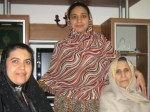
Zelaikha and her family own their flat. She lives there with her mom, sister and brother. Other siblings live higher or lower in the tower. Some of the buildings are 2 years old, others 4 but they all look like they have been there for 20 years: cracks in the wall, run down and people trying to live like they’d would in a village – with part of the contents of their apartment moved into the public hallways and stairwells, laundry draped over gallery banisters; toys and kids everywhere. When the bad weather moves in the wind howls around the canyons created by the high rises and the electricity goes out. Her mom and sister join us but don’t partake in the juice and tea.

The mother has raised seven very successful children: four of the five girls are doctors and the rest are engineers. I ask her if she is proud and my question gets lost in translation because she shakes her head and smiles. I smile back. They lived in Iran and Pakistan during the Taliban years – with all these well educated girls there was no room for them in Afghanistan. Most of them are back and happy to be home again.kbl_portrait

It takes us forever to return to the guesthouse, all the way on the other side of town. We drive under grey skies and through dust storms that reduce visibility to about 2 meters while I listen to the conversation in Dari between the two people in the front seats. I am beginning to recognize a word here and there. My vocabulary is increasing rapidly – there’s nothing like total immersion.

At home I find our new house mate has arrived; Janneke from Holland. There is clearly a Dutch theme to my stay this time. We discover quickly that we have several friends in common and she worked at a place where I applied for a position some 17 years ago. Obviously I did not get it and that turned out to have been a good thing. She may actually have interviewed me all these years ago but we did not recognize each other.

Ring-full and rest-less

Friday is supposed to be a rest day but that’s hard when Boston is still working. When you are in a Moslem country and a full workday ahead, there is really never time off unless you forcefully take it. I did that until about 2 PM (while Boston was still asleep) – we went to the German school and walked our laps around the Frisbee teams, then to Chicken Street.

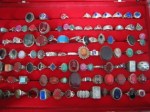
We spent hours amidst dusty rugs, grimy knick-nacks and sparkly jewelry. I sent about 10 pictures of trays with rings to Tessa and she placed her order. This means I have to get back there next Friday.

I was supposed to be on the plane to Boston by then but the amount of work could not be squeezed into two weeks and I am delaying my return by another 5 days. When I look at the fresh asparagus that Axel sent me (as a picture) I regret for a moment the delay. But then I also know I’d like to return home feeling that I got something finished and accomplished – to the extent that that is possible in my work. Five extra days will help.

Said and Wafa went back to the northeast after spending another couple of days with us. Earlier this morning, while waiting for MP and Steve to get up, he served as my teacher and corrected my exercises at the end of my Dari lesson four. I am allowed to move on to lesson five – much less fun without him.

Everyone worked hard this afternoon and we did not come back together for dinner until the middle of the evening. MP and I felt in a celebratory mood and wanted a glass (cup really) of wine. I sent an SOS to Boston to a colleague who was here earlier and also likes wine – to help us finding the cork screw but we concluded there was none and so MP pried the cork out of the bottle with a knife. We did not mind the pieces of cork and other debris in our wine – to have wine at all is quite something.

Tomorrow is a work day again, since I work with the ministry folks and their weekend just ended while the one in Boston begins and my project colleagues are in the middle of the weekend. The misalignment between weekends easily creates a 7-day workweek.

I had a long Skype call with Boston to discuss how best to support the local team and the fact that this is nearly impossible to do in twice yearly 2-week stints. Maybe something longer is needed in the future. This makes sense but also eaves me with mixed feelings and thoughts about next steps. Some things will have to simmer for awhile longer.

I logged on to a webinar with fellow OBTS-er Jim Clawson from the Darden Business school that I had very much looked forward to but discovered that I had calculated the time difference wrong and so I came in just when they were closing at noon EST.  I was very disappointed as it clearly was a good conference.

Comings and goings

We went out for dinner two nights in a row. Steve and I are more inert when it comes to dinner – we’d be fine just putting several leftovers on our dinner plates, nuke them and eat sitting around the large dining room table. But MP wants to get out. Steve and I are the followers. Yesterday that also included Hans. I had proposed we eat at home – after all the cook had made some nice dishes. But I put them in the over too early and too long. By the time everyone was ready to serve the food had shriveled up to about half its size and looked less than appetizing. It was not hard for MP to convince everyone to go out.

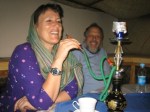
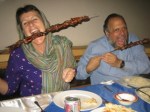
We piled into a car with two robust looking gentlemen in the front seat – our protectors – and drove across town to the area where the MSH office used to be, called Wazir Akbar Khan (WAK) and where many of the restaurants are that cater to foreigners. Yesterday we went for Iranian food: enormous amounts of meat, lamb chops, yohgurt, crusty rice and the hooka with pomegranate shisha as after dinner entertainment.


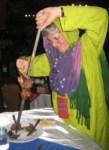
It was Hans’ last night with us. We hope that by now he is in Dubai and not stuck in Kandahar, a stop on the way to Dubai. We all miss him. Back at home we made silly photographs of Hans with his wooden shoes slippers in a blue burka and we dressed Steve up in a burka as well with one of the many headdresses and shields he bought on Chicken street. He looked like Ivan the Terror.

Today Said and his surrogate dad and (real) uncle arrived from the northeast and there was much to celebrate in addition to MP’s birthday. We all piled into the car again, now to an Indian restaurant, again in WAK. MP and I ordered a glass of wine (so we could toast) and Said kept looking at us, waiting for us to get tipsy and act silly – that is what he has either learned or seen – he explained that people who drink wine throw things off the table or fall with their faces in their food. We explained to him that you have to drink many glasses for that – we have each only one – and so we disappoint him. He doesn’t let us clink our wineglasses to his tea cup though, as if the wine affliction he predicts is contagious.

Since this is now the second weekend I am spending time with them I can quote my newly learned Dari proverb: yak roz did dost, dega roz did byadar (first you are friends, then brothers) and I shake hands with my new brothers; big grins all around.

At the restaurant we entertained ourselves by comparing animal sounds in Dari, American and Dutch – it’s always great fun to do this in multilingual company; we also sung happy birthday to MP and had Said guess our ages. MP comes out well, much younger than I. Without any hesitation he declares me old and Steve about the same age. It must be the grey hairs, which also means wise of course.

Back on the rails

A series of accidental things happened yesterday, such as peter Block’s book the answer to how is yes practically falling off the bookshelves while I was looking for a present for MP’s birthday in our lending library; and some emails from Joan about recent blogs about senior leadership.

I think the universe provided me with those resources to get me out of my funk and my moping about yesterday’s meeting getting off the rails. With those I was not only able to consider my own contributions to it but also what to do different today.

I have gotten very sloppy about applying Christopher Alexander’s pattern language – which I reformulated years ago to apply to groups, and usually pay attention to. I did notice that the room we are holed up in each day is messy with very little light coming in through the grimy and barred windows, and piles of paper and debris in the corner. It’s a bit of an energy drain.

It does not have to be a perfect room and some features cannot be changed but any place can be enhanced, spirit wise. Yet I left out my usual colorful quotations and poems on the wall and I disconnected the music after I asked my colleague whether I had the right music. When he said I had not I concluded that music was out. This morning I learned that music is fine. Not everyone has the same opinions about music and just asking one opinion may get you the wrong advice. I had gotten lazy. As a result there was no spirit in the room yesterday and the result should have been predictable to me – may be not to others – but I should have known better.

So today I am in repair mode. I asked Dr. Ali to play music that would be acceptable. I asked my Afghan colleagues who are steeped in local poetry to get me some poems that lift spirits and I am looking for pictures of the Afghan men, women and children that justify the existence of this department in the first place. I am usually better prepared. This kind of last minute grasping at straws is not good for the soul and dos not quite achieve its intended effect – sloppy work is never good but in this case better than none at all. All I managed to get going was the music, and that only for awhile.

Since the official swine flu man is not available the group decided yesterday to educate itself. The family planning director volunteered yesterday and presented what she learned – it’s called self help and it is not all that difficult.

The remainder of the morning session is not mine and I watch it unfold while trying to figure out what plan it follows. I have translators around me and can follow it somewhat so i can steer things a lilttle bit from behind. The rest of the morning consists of a mixture of interventions in Dari and English, with several people taking the lead for this and that and me sitting sometime on the side lines and sometimes standing up front.

We talk about the specific challenges at the top. In private people say different things than in public. In public the problem is not with them but with their bosses; I challenge them on how they can learn from mistakes when they don’t get honest feedback. The women shake their heads up and down, the men sideways – they claim they get honest feedback and learning is easy and straightforward. They are either not seeing the dynamics around them that interfere with learning or they are in denial. I don’t really believe them – just from the way they react to my challenge I can deduce that challenging them from below is pretty courageous, or stupid, or both.

We end on a higher note than yesterday, receive positive and negative feedback from the 8 people who are still with us (most of the women, less of the men). I have no idea what the others are thinking, the ones who left – and whether they left out of frustration or because they were called out.

When lunch arrives all the women leave with their fast food trays. I seek a bathroom but they are all locked. It is weekend at the ministry as of 1 o’clock and the place is deserted. One of the female participants, as a director, has her own toilet stall (one of two on the ground floor). It has its own separate lock. She cannot open the lock and I tell her I’ll use the dirty public stall but she won’t have it. Eventually we get the door open and I step into a stall that is comparatively clean, with toilet paper, running water and a lock, none of which are present in the other stall – mind you, we are talking ministry of health, central headquarters. Of course, what can you expect with mostly men in charge of buildings, designing and building them? I am confident that all this will change when the women are in charge.

Afterwards I am invited to eat with her and another female department chief. The scarf is dropped and intimacies start, even though there are two male secretaries around, but they pay no attention. I hear about the utter frustration of having to prove oneself as a boss, being female, despite superb credentials. It’s a daily struggle for the women in leadership positions who are confiding in me. They are undermined, ignored and bypassed routinely. She receives some technical advice, but it is not about the things she really needs: how to manage recalcitrant or arrogant men who don’t accept her leadership and seem to want to see her fail. I can tell she is hurting deeply. I tell her about pioneers and that she is cutting a path through the jungle – yes, she says, indeed, it feels like a jungle. These women are pioneers, maybe not the very first but closest to the front where the battle lines are still drawn. It will take a few generations, at least I suspect.

Back in the office we are lectured by MP about swine flu – I am starting to become an expert myself. Then I hang around the office for a couple of hours waiting to see if I can meet with key people but they are all busy in other meetings. I sketch out the remaining week of my work and see that every minute is booked in one event or workshop or meeting, most away from the office. This leaves no or very little time for sitting together with my colleagues to debrief, explore, plan, give and get feedback. I am beginning to wonder whether I should postpone my departure.

Centrifuge, humble pie and fruity refreshment

We are in the basement of the ministry, five women and eight men. This is the first of many suprises to follow. Imagine that, more than a third of the team consists of women. I don’t think I have seen this before (in Afghanistan), especially not at this level. Aside from the electricity being on 24/7, this too is a sign of progress, much better actually. I congratulate them. Some men say it is not good enough, and that they need more. Bless them.

The top leadership of the general directorate is not with us – called out to solve a crisis in one of the provinces and then in another. This is the bane of senior leaders’ existence. In hindsight we should have cancelled the event because of this. After all, how can you build a team when the head of the team is not there?

We try to make the best of this situation by focusing people’s attention on the crisis that is around the corner (swine flu). People usually don’t deal with crises that are around the corner because the ones that have already rounded the corner and are in full view demand all their attention. They pull everyone away from the center, each director doing his own thing as best as he (she) can, with always the risk that action in parallel creates new problems that could have been avoided when done in concert. People know they should be doing things differently but there is a sense of frustration and powerlessness to change this dynamic. I had an experience of total immersion in this situation to remind me that things seen from the inside are always more daunting than when seen from the outside.

We wait for about 45 minutes before people trickle in before we start, without anyone’s blessing. That is not how things are done here. I am going along with Harrison Owen’s principles that say ‘whoever is there is the right person’ and ‘it starts when it starts.’ Later in the day I come to doubt the former of these two.

My Afghan colleague is facilitating the event because when I talk in English everything needs to be translated for a few of the participants who cannot follow me. Also, I find that when I talk everyone becomes very quiet. So doing the event in Dari seems better – everyone is very animated and engaged. But since I don’t have anyone who can translate I have no idea what they are talking about. It’s a leap of faith I have to make. It’s a leap that I usually make with some confidence. We went over the design in the car driving across town and my colleague says he is fine with it and with being the solo facilitator. I have seen him do this many times and know he can do it; he is a good facilitator. He is comfortable challenging people in ways that are not commonly practiced, especially at these levels.

I watch him as he talks about vision and influence. Everyone is listening spellbound. For a few this is not new, yet they are attentive as if this is the first time they hear about the topic. For others this is entirely new material.

After that I am not sure where things are going because the temporary translator I had by my side is called to be a note taker. It’s a perfect example of planning one thing and then another need arises that pulls someone off one task and puts him or her on another. In between his writing I catch a few translations, forcing him to multi-task and pay attention to me, the facilitator and to what everyone is saying. This is the challenge and this is the work.

A young female doctor who is a trainer at the public health institute joins us. Her name is Shakile which I am told means shapely. She facilitates some of the conversations and I coach her form the sidelines. I notice when she facilitates that all the men talk right over her. She does not stop them and it becomes a little chaotic. As a young woman she cannot easily confront the group, especially the male directors, and ask for only one conversation at a time. Later I hear that her facilitating was bothering some of the older men. I never quite know whether we should give in to this wish to remove all younger females or let them get used to this because eventually they realize that facilitating is not the same as being a resource person or expert. The young woman has good instincts about facilitation and is thirsty for coaching like a sponge.

The design is slipping away as we start to zigzag, following comments from participants that first take us here, then there. I can tell people are starting to lose sight of the path, that wasn’t very clear to begin with. First it is body language and then they actually speak out.

I am afraid we may have lost some credibility – the design is too loose, too fluid as if we don’t know what we are doing (and maybe this is true). I feel rather helpless on the sidelines, not being able to engage directly with the participants, nor understanding the logic of the emergent design. I call the office and ask for a translator, dedicated to stay by my side for the entire day, with no other task than helping me understand what people are saying.

The executive assistant of our project director shows up within half an hour. By now we are fully off the rails. Here, as with the previous team we worked with, the earlier communication with one part of the ministry contributed to the confusion as they were led to believe that this was a training course. We are experiencing first hand this communication problem everyone talks about and the consequences of having centrifugal senior leaders.

It is good that I expected surprises, but there are more than I expected. Over lunch I find out that the session is supposed to stop at 2:30 and I am beginning to wonder about the utility of another day with this team. Can we put the process back on the rails?

We leave with our heads bowed down. It is a humbling experience to fail like this. People are coming back tomorrow morning. I feel the pressure to have something to show then, in exchange for the time they will have invested in this confusing exercise. Invest in what? We made little progress with the swine flu exercise because the chief expert in the country is meeting with someone from our own project while we wait and wait, and finally disband. This is of course rather embarrassing because it speaks of our own miscommunication and mal coordination – a symptom we are supposed to treat.

I arrive home before anyone else and get myself a softdrink in order to – as per the advertisement – ‘sink myself into fruity refreshment!’ – it’s just what I need now.

Ready or not

More drawn out meals yesterday but more working too; our two days of forced staying at home are over. I produce two designs for the retreat that starts today, or is supposed to start. I am ready for surprises; in fact, I expect them. For one I have had no contact with the team we are supposed to facilitate and have therefore been guessing what people want, both as a process and outcome. And then of course we have no idea whether we will have two days and that the right people will show up.

For lunch we go to the nearby French bakery. It is run by a French couple; the man is a former oil rig engineer turned baker and the woman, whose name is, fittingly, Ariana, a former teacher and administrator. They have been in Afghanistan since 2000 and worked at various NGOs before deciding it was time to start their own (Le Pelican). They combine the art of making French breads, pastries (‘tartes’), croissants and quiches with the education of Hazara children who used to be scrounging around for scraps of food in garbage pails.

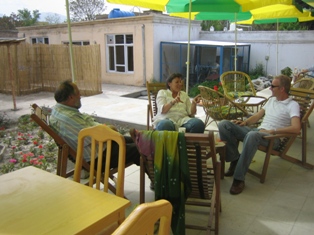
The place is lovely: a garden full of flowering geraniums, and various sitting areas, places for dining as well as comfortable lounge chairs around low tables – the kind that invite staying the whole afternoon with coffee or tea and a good book. The café serves breakfast and lunch, fresh juices and bakery goods that make you think you are in France. kbl_french-bakery

We enjoy a delicious lunch of quiches, a feta pie, an omelet, croissants, and coffee with a giant meringue for dessert. The food is served by teenage boys in a striped peach colored vest over a white starched shirt with a bow tie, speaking impeccable English as he takes our orders, brings our food and clears the dishes.

On the wall inside the café are pictures of the baker-husband with his young apprentices. It’s the perfect combination: eating well and doing good at the same time since the income from the café gets plowed back into the organization that educates over a hundred Hazara boys and girls in morning and afternoon sessions.

After lunch I sit on my balcony and produce a watercolor painting of the otherwise ugly Guesthouse One across the yard while listening to choral music from Brahms. My amateur water color sketch makes the place look better than it is – probably because of the splashes of light green to capture the budding trees and the grape leaves that have just started to come out of the ancient looking grape vine stock. The famous Afghan roses are not yet out but buds are visible. I think they will pop open when I leave.

For dinner we finish the last leftover dishes and I create a salad out of the last veggies that have not rotted yet. Tomorrow the cook will come and we can start afresh. We eat our meals sitting around the TV so we can follow the swine flu story and I am wondering when Afghanistan will show up on the color coded map. We watch another WHO press conference. MP is chomping at the bit -she wants to be out there in Mexico, investigating.

Homebound 1

Yesterday was the first of our two days of being grounded at the guesthouse. It’s kind of nice; no alarm clock, no hurried breakfast. Instead we have a long drawn out meal; MP, and myself in our jammies, Hans and Steve already dressed. It is like Sunday back home. No hurry, nowhere to go. We all do have work to do and we are all procrastinating – we spin out our breakfast as long as we can.

Swine flu is the first topic we tackle. MP’s eyes light up – as an infectious diseases specialist this is what she’s here for in this world: to combat microscopic enemies and keep them away from us fragile humans. She is a fount of knowledge, using words I don’t understand. Steve and she speak a kind of coded language. I interrupt them all the time for explanations. What’s a secondary infection? What do the letters H and N stand for? How bad are things in Mexico? (Bad). What does that mean for the rest of the world? How to handle a swine flu emergency in Afghanistan where the population is prone to pneumococcal infections? What to do about our staff? Hans and I are the non medics and we listen with awe while Steve and MP talk about things we know nothing about.

MP treats us to a blow by blow account (as well as a video later in the day) of the sexual deviance of her two small lovebirds Una and Diego. The female doesn’t want anything to do with male and so he humps a towel on the towel rack instead. The female lays (unfertilized) eggs by the dozen which is also not right in addition to not being good for her health. After observing MP with her two lovebirds for awhile the vet concluded that the female wants MP in her nest, not the more species-appropriate Diego.

After this topic we talk about something lighter, religion, for the remainder of the breakfast. Eventually we start to feel guilty about not working. MP procrastinates a little longer by doing the dishes, as our household help is not coming today, doing everyone a favor. I procrastinate a little longer by surfing, facebooking, twittering and checking mails until I can no longer postpone serious thinking about the design of the next event that starts on Wednesday morning, an intervention with another general directorate team.

Lunch is an equally drawn out affair and we tackle the countless leftover dishes in the two refrigerators. After lunch we all work some more until it is the cocktail hour. We follow the swine flu story and watch the WHO press conference on BBC. More questions, more answers leading to more questions.

It occurs to me that the team building with the senior leadership team might be most useful if it is done around the task of preparing for the swine flu epidemic that is likely to touch every part of the world where there is an airport (rather than swine) and will eventually arrive at Kabul International airport as carry on. The fact that MP was in Mexico only a month ago is a case in point; luckily she’s not feverish or coughing and we are grateful for that.

The teambuilding events with the general directorates provide a rare opportunity to have the top movers and shakers together in one room. They can work as a team to develop strategies, see interdependencies and assign accountabilities for how to deal with the flu when it hits here, and then each department head can push marching orders down the chain of command. Collectively they have authority over significant parts of the health system and can order it to do this or that. Having the time (2 days) to think it through is an unusual luxury. I make the proposal per email to the key decision makers and await a reaction.

I use the rest of the afternoon for writing assignments and my annual performance self assessment. The latter I do reluctantly, and with a cranky edge as my supervisor Alison describes it. She returns it with some comments and suggests that I sit on it for awhile until I am in a more positive mood about my headquarters. Good idea!

After a dinner where MP and I finish the wine and the four of us try to finish a few more of the leftover dishes, we watch an Oscar Wilde movie, a chick flick (A Good Woman) that we women understand better than the men. After that everyone wants something with more action and select Raiders of the Lost Ark, the movie with the snake pit that I don’t ever need to see again; I retire across the grassy courtyard to my lonely quarters in guesthouse zero, postponing my bedtime until I can’t keep my eyes open any longer.

Good grief

I dreamt that I was up against organizational rules and being choked by an unsympathetic bureaucracy in a deeply disempowering way, leaving me feeling utterly demotivated and ready to quit. The rules were silly, cooked up by someone who had no idea what they were talking about, yet enforced as if the future of the company depended on their rigid implementation. My noncompliance became a disciplinary issue and eventually a fight. But I did find some kindred spirits, ready to fight back.

I know exactly what the dream was all about. It was a continuation of a talk that Maria Pia and I had last night about travel – a topic that is, for us frequent travelers, a source of endless stories; nice stories, horror stories and causes of great grief. I Iearned that other travelers have come here on tickets that can be upgraded or changed in ways my deeply discounted ticket cannot. The tickets were more expensive, sometimes more than three times as expensive – and sometimes they are issued directly in business class. How that is possible appears to depend more on people and their attitudes than on company policy.

The conversation turned my disappointment about not being able to route myself back through Beirut, to be there with Sita (since I am practically flying over her head), into anger. I think if someone had offered me a job right then and there I would have taken it. It is the inequities that bother me – if everyone is told to fly on the cheapest ticket, I would be at peace with it. But I learn that this is not the case.

Enough of this self pity. Yesterday was an exhausting but satisfying day. We did manage to have a significant number of people from the policy and planning general directorate in the room. Of course we women were outnumbered by a factor of four – but this is to be expected; especially in a directorate that has a lot of powerful departments that each handle enormous amounts of money (grants, construction, finance, etc.)

Despite the usual assurances that the event could be facilitated in English (people at this level are expected to speak English with ease), we quickly fell into Dari when I noticed that the conversations were more spirited in Dari than in English. This meant that my colleague was facilitating and I watched over our emergent and fluid design from the sidelines, sometimes whispering suggestions in his ear about what to do next. I prefer to ‘dance’ with the participants directly instead of being a choreographer, but until I master the language, that is the role I have to play.

The design was derived from a medical model: diagnostics to see how the circulatory and other organizational systems were functioning. Although we had hoped to get to at least a shared vision, the diagnostic took the entire morning. It was the first time ever they were sitting together like that and talking about their work, their accountabilities, their collaboration and their mandates.

My colleague did his job as facilitator as well as an insider (= Afghan) can do (this means he cannot question and push back in ways I can do, as a naive outsider). He asked the two young female doctor/trainers to contribute bits and pieces here and there that warmed my heart. When the third female, a recently hired female doctor who will advise the chief, and who is used to run an entire organization, was asked to take flipcharts home to type them up I intervened and pushed the task back to the chief, for his assistant to do. I don’t think he was happy. We have had one other female advisor placed with a government department and she was quickly turned into a secretary. If she doesn’t watch out, the same fate awaits her.

Despite assurances that the team was willing to work through lunch, once lunch was served the work was done. We tried to resuscitate the lethargic body after lunch but soon realized it was in vain, the energy gone and life intruding again. To our great delight the group had found the exercise useful enough that they wanted another session before I leave. That was better feedback than any verbal comments on the session.

This is a group of people (men) that is pulled in all directions and super busy. That we found a slot of 3 hours that (most) everyone can attend is a miracle. The only regret was that several of the department heads were absent, having sent their deputies or other underlings instead. I hope we created enough of a buzz that they’ll show up next time.

Suddenly I was pulled out by my colleague who practically dragged me to a large hall, rushing over so we could be present at a graduation ceremony. What I learned along the way is that a group of 250 public health students had gathered in the large auditorium of the ministry to receive their diplomas. What I had not realized (and no one told me) is that they had wanted us to be there at the ceremony and speak and that they had dragged out the ceremony, waiting for us for a long time – while I was eating my lunch, oblivious that around the corner these 250+ people were waiting. As we entered the auditorium I asked Ali whether I was expected to do anything (like a speech) – hoping I was not. But when I was whisked to the front stage and given a microphone, I knew.

I wondered what it was like to be a celebrity and always having to give such impromptu speeches and concluded that the worst part was speaking to people I had no relationship with; a few would be OK but 250?

Since they had learned about leadership and management I was presented as the guru from the US and had to improvise a speech befitting a guru. Once again, I wished I could have thrown in some Dari, but I am not there yet. Besides, I am discovering over and over that when I pronounce the words, thinking I say them exactly like an Afghan, they don’t understand and look at me blankly until I show them the words – then they say, ‘oh, you mean…?’ (saying what I think is exactly what I said); so better not getting into such an awkward situation.

And now a full two days of staying home.


February 2026
M T W T F S S
 1
2345678
9101112131415
16171819202122
232425262728  

Categories

Blog Stats

  • 139,805 hits

Enter your email address to follow this blog and receive notifications of new posts by email.

Join 76 other subscribers