Posts Tagged 'Afghanistan'


Easing in

My first day of work is a half day. Saturday is a work day for the government but not for my colleagues. Since their counterparts are in the government they often do end up working 6 days a week.

My colleague picks me at my guesthouse and we drive across town to pick up his boss before heading to the Ministry of Health. Security is enhanced and people can no longer walk into the place unhampered. Sandwiched in between my male Afghan colleagues I walk right past the guards who stop us to check my bag. They let me pass through when one of my colleagues said that I was not with Al Quaida. I must have looked like a low risk between the countless turbaned Afghans who would all have been frisked had this been an American public building.

We meet with our counterparts of the Institute of Public Health who had signed up for several virtual courses which I am asked to explain. I do not know the particular course they signed up for and that starts next week but tell them about our virtual courses in general, with the message to over-communicate rather than under-communicate with the facilitators, having been a facilitator with a few too many under-communicating teams in the past.

Next stop is the institute for health sciences where paramedical, nurses and midwives learn their trade. I did not expect to see so few women in an institute that trains students for what I consider female professions. But I could have known. We see a few young female students at the end of our visit. I am told that now it is 100% better than at the Taliban time when of course there were no women at all in the building. There are jokes made about that time but I cannot understand them and no one translates.

We meet with senior faculty to talk about introducing or strengthening management and leadership as topics in the curriculum. It is entirely neglected in the midwifery curriculum because of the haste to churn out large numbers of midwives and to cut the program from 3 to 2 years. Whatever little there was of management preparation (and they do have to manage once on the job) was considered a luxury that could be discarded. Yet when I query them about their own clinical experience they all have stories about costly mistakes that were made because they weren’t prepared for the management and leadership tasks on the job.

The meeting is entirely in Dari and reminds me of the need to learn that language, even though it is kind of a long shot, given how infrequently and briefly I am here. Yet, every new word I learn contributes to my understanding which is now entirely dependent on translations from my colleagues. Their short translations don’t match the discussions in length and I have no idea whether I am given a summary or a commentary.

Ali buys me a small notebook to put down the words I am learning from listening and asking him when I hear a word repeatedly (shagerd = student, nars = nurse; qabela = midwife). It is a little plastic covered booklet with a large feather on top and part of a poem by Thomas Gent (1828): “The beauteous yesterday is fading away light a blushed twilight. Though nothing can bring back the hours of sweet treasured past. I will grieve not but rather find splendor in the memories.” I wonder who decided to print that poem on this booklet in this place. There are no spelling errors in the text and so I conclude it cannot possibly come from China. A local product from a designer with literary aspirations perhaps?

On our way home I am invited to lunch at the boss’ house but when he checks with his womenfolk no one is prepared for such a spontaneous visit by a foreigner. He tells the driver to turn around and takse us to a fast food restaurant, despite my protestations. He orders me a fried chicken leg with fries, to take home for lunch. The rest of the afternoon I catch up on mail, chat with my housemates and start to think through possible designs for tomorrow when one of the director generals with his direct reports (we think) awaits us to deliver on expectations that are far from clear (on all sides).

Towards dinner time Maria Pia opens a bottle of wine; an alcohol-containing present for Steve that goes the way all his other alcoholic presents went (this is the problem when you share a home with transients like us). It is an untold luxury in a place I associate with sobriety. While we sip our wine she treats Hans and me to many stories about the time she was working at Logan airport as Massachusetts first defense against viruses that come in on planes in dead or feverish people, and/or in live or dead animals. She talks about her colleagues from immigration, agriculture and customs and border patrol. They are from very different professional tribes, thrown together in an uneasy alliance with the creation of Homeland Security. I see a book on the horizon.
Booms and bubbles

I had a good night sleep, needing to be woken up by my alarm, not like yesterday at 5 AM by a loud ‘kaboom.’ It was what is called a ‘satchel’ bomb thrown from a vehicle into the police station near the Russian embassy, about one kilometer from the office; far enough to leave us alone but close enough to rattle the glass, loose in its window panes.

Locals seemed not too disturbed about the bomb. A few policemen died since it was too early for the general public to be out (and Friday). I was thinking of those policemen and their families last night – no bedtime for them. I guess if you live in a place where bombs are not that unusual the only thing that counts is that you are safe and no one you knew got hurt.

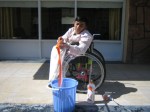
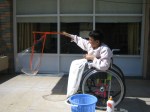
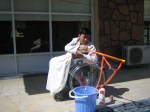
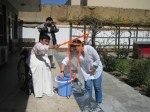
We tried out the bubblething I brought form the US and experimented with the local dish soap, the quantities of starch and baking powder, as per instructions in the accompanying bubblething book. At first we were not very successful – soapy foam everywhere but bubbles that popped prematurely. But everyone got the idea and Said worked at his skill.

We went to the German school, a Friday morning tradition to let foreigners out of their confined spaces, to walk around the tracks and get some exercise. You do have to duck once in awhile to avoid the Frisbees that whizz by at high speed from the competing Frisbee teams. We parked Said in the shade and he and Wafa watched the foreigners enjoying themselves in physical activity. This included the unusual sight of women in shorts and T-shirts.

After our walk we split up, Maria Pia and her friends went back home and the rest of us went for an outing on Chicken Street where I got the rugs Sita had requested. This required sitting on the ground in a small shop and looking at hundreds of rugs being unfolded. I think my lungs are now full of dust mites from all over Central Asia. How to bring the rugs back is not clear yet – they are slightly heavier and larger than I had realized.

We were joined by a group of women who are here to study ways in which the DOD, USAID and other US government agencies can work better together to improve the health of the population. One of them was our USAID counterpart in the early 90s – the best we ever had. I had not seen her in 15 years. It was a wonderful reunion.

I found another brand of local dishwashing detergent in a small supermarket and hope I found the best brand for Afghan bubbles. For lunch Steve took us to a local restaurant in downtown Kabul. We had manto, a local ravioli, yogurt and pumpkin dish, spinach, pilaf and goat knuckles – accompanied by the Afghan equivalent of lassie and yogurt served in small plastic Mountain Dew cups with plastic Chinese soup spoons.

The rest of the beautiful spring afternoon we experimented with our bubblething and Said actually got some really good ones that lasted for a few second. The new soap is better and the Afghans in our household can now say the word for dishwashing detergent in English (‘dish soup’) while I can say it in Dari (moyazarfshui). But is is not quite as good as Joy (the recommended brand for the US) would have been and we could not replicate the bubbles on the photos in the book. The bubblewand left this morning to go back north with Said so he can practice. We’ll see him again next weekend and I hope to see the results of all that.

Guests 3,4 and 5

The flight to Kabul is half full. I study my Dari lessons. I am at page 40 of about three hundred and fifty pages. I only recognize a word or two when the flight attendant tells us we are nearing Kabul. This is going to take a long time with these shorts bouts of immersion twice a year.

The descent into Kabul is always a little tense for me as it brings up my frightening departure, now a year ago. We circle and zigzag through openings into the mountain range; snow clad mountains on one side and down slopes and valleys with a thin veneer of spring green on the other.

I am met by staff from MSH and welcomed like a sister or auntie. It feels a bit like coming home. I am lodged at guesthouse zero again and try out another room, this one with a shower that is both warm and has some power. No one is home yet as the work day is not quite over. I learn that Kabul city now has electricity 24 hours a day; it explains why it feels different here now – without the sound and soot of generators humming from 5 AM until 10 PM.

Steve is still in Guesthouse 1 and has signed on for another year. He has bought more stuff since I last saw him, slowly moving the contents of the Chicken Street shops to his temporary lodgings. His rugs now also decorate the guesthouse across the yard, where I stay. The two guesthouses remain ugly but the wall hangings and carpets are attractive cover-ups.

Later Maria Pia returns from work with Hans, a compatriot who lives in Namibia. Hans is an architect and knows a lot about creating natural ventilation that is so important in TB wards. It is usually done mechanically using air conditioning that is both expensive to install and to maintain. A series of unexpected opportunities and chance encounters have changed his career as an architect in ways he could not have imagined. He started in a regular commercial firm in Germany and then Luxemburg, well off and successful at the young age of 28 when he tired of that life and applied for a job with a firm in Namibia.

Not even a graduate from a school of architecture (he finished a midlevel vocational study) he has now become one of the world’s authorities on low cost building adaptations for facilities that take in TB patients. It is new territory for both architects and TB doctors and he is as excited as a kid in a candy store. He was asked by a Harvard medical school professor to give a lecture about his specialty to some 40 people from all over the world. He is still pinching himself about this; something he couldn’t have dreamed up in is former life. We talk for hours in a combination of Dutch and English.

In the meantime Maria Pia’s guests have arrived; Said, who is somewhere between 11 and 13 years, who first lost his mom to TB and shortly afterwards got paralyzed because he was in the wrong place when an RPG hit the roof of his dad’s house, about 6 years ago. Since then he has spent half of his life in hospitals (first in Afghanistan, then in neighboring countries for over a year). It is hard to imagine a 6 year old going through this series of traumatic events on his own. He would be a perfect subject for a study on resilience. You could not guess any of this when you see him sitting perfectly content in his small wheel chair, babbling away in the English that was taught to him wile in the hospital. he sounds just like my former colleague and friend Miho from Japan which makes me wonder whether his teacher was from Japan.

Presumably there is a father someplace, a commander, but the boy claims he doesn’t have one. He does have a friend, Wafa, who was initially hired by his dad to look for a few days after Said while at the hospital. After sleeping in the hospital’s basement for a over a year, dad never showed up again, then was hired by the hospital to make himself useful as a cleaner as there was nowhere for the boy to go. Wafa became something like a surrogate dad. Said was finally ousted from the hospital (this is not an orphanage) and thanks to his own wits secured a room in a small clinic at the edge of the hsopital grounds where he has lived with Wafa fro the last year. But they will have to move from there sometime soon.

Said and Wafa travelled down from the northeast to stay with us for a few days. Maria Pia opened a suitcase full of gifts: a Rosetta Stone level one English course, an external hard drive, Charlie and the chocolate factory and other films to lure him away from the violent movies he tends to watch. For Wafa she brought shoes and a Steripen, a new LL Bean product that sterilizes contaminated water by stirring it with a UV wand. We try the pen out on bottled water that doesn’t need it. It’s high tech in any surrounding and will be even more so when it is taken back to its destination in Afghanistan’s northeastern country side.

Said goes to school and is doing well, at the top of his class. His ability to speak English while not in an English speaking country puts my feeble attempts at studying Dari to shame. From time to time he translates for Wafa whose doe snot speak English and cannot write or read – the two complement each other nicely and have bonded strongly over the years.  He has offered to give me some Dari lessons tomorrow and started with teaching me to say goodnight when I retired. Tomorrow I plan to demonstrate the giant bubblething that I brought for the guys in the office. I think I found a better destination than my doctor colleagues from the capacity building team.

Checking out

I left Kabul on Safi Airways, a local airline company that has gotten highs scores from some of my colleagues. This exit was very unlike the previous one that got us in a stall as we climbed out of Kabul airspace. With good visibility and blue skies I was able to understand what happened on that cloudy and drizzly April 10 when our UN flight pilot did a straight out departure from runway 29. Straight out is always faster and therefore cheaper in fuel use than circling the airport in an upward spiral until enough altitude is gained to get over the mountains surrounding Kabul. I don’t know whether these considerations played a role in the decision making process, but as a result we just barely scraped over the top of the mountains.

I boarded the plane with some trepidation and was glad that the skies were blue. Except for a thick layer of dust that disappeared at about 500 feet, all looked clear and I figured I would at least see whether we were heading straight into a mountain. When the pilot did a right turn immediately after takeoff I let out a deep sigh of relief and knew I was in good hands. We spiraled up and then zigzagged between the lower ranges until we reached sufficient altitude to turn to our heading. A straight out departure, even on this calm and clear day seemed nearly impossible given the height of the mountain range.

The greeting by the captain was done in two languages but the messages were different. The English was the usual standard welcome on board message but the other was something else. I presume it was a reading from the Koran because I recognized more Arabic than I usually do when Dari is spoken and God was invoked more than once. That is the difference between travelling in this part of the world and elsewhere. Invocatus atque non deus aderit, was engraved at the entrance to Jung’s house in Swisterland, imeaning ‘Invoked or not, God is always there.’ Here they invoke, just to be on the safe side.

Getting onto the plane was no small feat. I counted 13 check points between our guesthouse and my seat on the plane. The first few were handled through the car window while I was still accompanied by an escort from the office, the rest I had to do on my own with various young boys carrying my suitcase for a few meters for which they expected to be paid one or more dollars.

All of the checking is done in a cursory way or not at all. The various officials are mostly just going through the motions. In the US it is called the TSA Theater – it’s no different here. Only dumb terrorist would be caught. My female checkers didn’t even take my scotch tape away as was done in 2002 – supposedly because I could wrap scotch tape around the pilot’s mouth and eyes and then do my evil deed.

The checkpoints do of course cause many long queues and for once it is advantageous to be a woman in this country because men cannot frisk women. You have to go through a separate entrance, hidden behind a ragged and dirty curtain where one or more female officials were shivering in the cold. I must not have looked the profile of a terrorist and was ushered through quickly each time; only once did I have to open my suitcase.

On the way to the airport we passed unimaginable amounts of rebar-reinforced concrete and razor wire – a good business to be in. Tucked in between all this was the World Philosophical and Mathematical Society. I wondered what they were calculating and contemplating in there and who its members and sponsors were – or maybe it was just a front for something that had to be disguised. A Google search came up empty.

The heat of Dubai was a welcome change from the cold in Kabul. It was my luck to have once again a driver who did not know where to go. I summoned all my Arabic but he turned out to be a Pakistani with a dead cell phone. Eventually we found the place. I checked in and took a taxi to the Dubai Museum. I had contemplated going to the ski slope or camel races, and the bell captain suggested racing around dunes in a SUV followed by belly dancing but that was not very appealing. The museum was crowded with loud Europeans and I got out of it quickly and found a nice restaurant on the Creek.

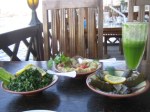
I had a yummy Lebanese mezze with a lemon-mint concoction that looked dangerous but was delicious while watching the frantic activity in and around the Creek with loud noises from any kind of motor one could imagine, cars, trucks, boats and planes.

I took a water taxi back to the other side where my hotel was and ended up walking all the way back because the taxi market is a seller’s one – they are in short supply and the few that stopped where not interested in my destination; either too close by or too much traffic. And now on to Holland.

Out and about

We spent three and a half hours in a strategy and teambuilding meeting with the entire team minus one. He had to deal with passport and visa issues, something I have great sympathy for as I am still not sure how to get my Bangladesh visa in time for takeoff, just over a week from now over Thanksgiving week.

We reviewed the last two weeks and all the events that happened. They appeared disparate and unconnected from one another but not to those of us who were involved in all four; we moved from central level NGOs, to provincial level mixed teams, to the DG team and finally the entire collection in one room. It was a perfect assignment for me – two weeks of nothing but designing and watching the design come to life.

We ended the team meeting with an exercise around learning styles that resonated much with everyone as they guessed, mostly right, who had what kind of learning style; there were many aha’s and much laughing but also, I think, some recognition that all styles produce important contributions to the team’s task. I am not sure that the idea that they have a team task has taken root yet – last time I was fooled they had but now I am more realistic. It’s a novel concept and there are few role models.

I was sent out of the room at the end because they were collecting contributions for a present which was bought by the secretary and Ali and offered with much photo taking, after work hours in an empty office. One of the gifts was a porcelain ring box with Egyptian motif made in China, bought in Afghanistan which will be transported to Holland and then the US. The world is indeed flat.kabulnov2008_gifts

Pia, who used to work at MSH and set up our office some 5 or 6 years ago, came to say hello to old friends. She has her own company now and spends much time in Jalalabad and other places that are much less secure than Kabul. Like me (and Axel and Joan) she is an unlikely survivor of a horrendous (car)crash and bears a long scar on her head, horizontal, as opposed to Axel’s vertical one. We went to the guesthouse and had a real social event in our salon, which looks like an antechamber to a carpet store with all those rugs from Steve. For food and drink we did not have much to offer other than toot and tea (or water, diet coke or fanta). This did not matter because the company was entertaining enough, with Steve, Maria, then Brad and Maureen joining us later.

Pia and I took off for my first night out (which she found unbelievable so it was a rescue mission of sorts). I finally had my long awaited coronas and two tacos thrown in for good measure but not until after a wild ride all over Kabul searching first for Pia’s hotel and then the restaurant. It was a little unnerving because the driver kept saying he knew where these two places were when he did not but could not say so and of course our Dari and his English were no good for serious talk about such matters. At night the streets are fairly empty except for a few trucks and cars and of course the ubiquitous large SUVs scurrying foreigners around who have to escape their confining quarters. Being lost was particularly nerve wrecking when the driver stopped in front of a heavily guarded building with floodlights and suspicious guards coming out of the dark with large guns. After that the coronas were especially wonderful.

We met John and SueAnn from another NGO who are used to go out at night and manage to get their daily rations of alcohol, so unlike us in hotel zero. John worked for Hillary’s campaign but is nevertheless happy with our new president. John is a temporary visitor like me (TDYers we are called); his colleague works in Kabul. For Pia Kabul was a haven of peace even though she was busy on her cell phone arranging for armored cars for their staff doing reconstruction in the East and South. The freedom and normalcy of Kabul made her giddy. Everything is a matter of perspective. I was reminded of Beirut again. John had lived in Beirut and studied at AUB. I rarely meet anyone who has lived in Beirut. Of course neither one of us knew the Beirut the other described, given there was about 30 years in between.

At 10 PM the driver arrived and this time, unlike 7 months ago, I immediately recognized the car and got in without a hitch because I knew the license plate, color and make. Last time I had no idea which car to pick from the line up of large SUVs with turbaned and bearded drivers and security guards. How was I to tell the difference between those with good and bad intentions?

kabulnov2008_last_nightAnd then it was time to pack. I took the decorations down – the pictures from the Khulm bazar that I bought on my second day in Kabul which seems ages ago. I rolled up the new Maliki rug and put it in the canvas bag that brought the rolls of paper and posters on my way in, a perfect fit.

My sleep was restless and full of dreams about plane and orthopedic disasters, two things that are on my plate now and that fill me with considerable anxiety: getting out of Kabul by air and having appointments to figure out what to do with my ankle next week.

Interference

kabulnov2008facsFor our session yesterday Ali had mobilized eleven facilitators, most were his own colleagues from our project, a few from the ministry and some from another donor. Their job was to help the small group conversations stay focused on the end result: clarity on issues that they could resolve themselves and those that had to be tackled by higher level authorities in the ministry or even beyond.

After a set of predictable but unpredicted delays our session got started rather late. As planned it did get the system connected to itself with provincial, central and NGO participants talking with each other about things that held them back. It unfolded more or less as we had hoped until the previously mentioned international organization ran interference again. A two person delegation showed up to present something that was not on the program but deemed important (everything here is deemed important). Everyone argued their case (of why or why not this presentation should be inserted in the middle of our group process that was in full swing). We were like lawyers of opposing parties walk up to the bench and whisper something to the judge while the audience waits for the process to continue. In the end we prevailed and our carefully designed and agreed upon process continued; the invading delegation left with a vague promise that they would be on the program later. I know they came back in the afternoon but I don’t think their presentation ever happened.

kabulnov2008smgrpThe small groups went through a filtering process that produced a summary of the major bottlenecks (or issues, or recommendations – the language was a little unclear and I suspect stuff was lost in translation). It’s not my favorite approach, to start with problems rather than a vision, but that had been a given. Post-It notes with issues that did not fit in the current health and nutrition strategy, that did not need to be tackled right now or that could not be tackled by the people in the room were put in envelopes labeled ‘not strategic,’ ‘not now,’ and ‘further up.’ The latter was handed over to two of the 6 DGs for putting on the agenda of minister and his deputies. At least that was the plan. That too did not quite happen in the way we had designed it.

Just when we were ready for the lunch break and the system looked engaged and connected to its self, the said international organization showed up once more, this time its top leadership and a delegation from their regional and world headquarters. They took place at the high table and were invited to address the participants. Then came a goodbye ceremony of one of their staff members, presents, certificates, more speeches. It felt as if we had tumbled into a parallel universe. The impromptu event overpowered what was left of the design of the day and from then on everything defaulted back to familiar patterns of large public events. The energy that had filled the large ballroom only hours earlier had all but dissipated and everyone went back to telling (top) and asking (bottom).

There were some feeble attempts made to refocus the event but it was out of our hands. At 5 PM Steve and I quietly walked out and headed into another dust-filled traffic jam across town. We did not get home till 6 PM. One of our colleagues called at 9 PM that he was just home. The event he had put so much effort in to organize had droned on hours past its formal ending time. May be it was a big success, or good enough but I don’t think it did much for encouraging leadership in the provinces, despite the exhortations to lead.

Vaccination dress

I dreamed of a simple dress that contained vaccine. Somehow, it was able to slowly pass from the fabric into your body and deliver sufficient protection to save you from one or another vaccine-preventable illness. I heard enough the last few days about unnecessary deaths that could be prevented through vaccinations that my mind set to work during the night and came up with this idea. If I had an iota of entrepreneurial gutsiness in me I would further explore this farfetched idea. But I don’t. I am in a different business which is the one of thinking and talking together in productive ways. That will be our challenge this morning. It was originally on yesterday’s program but various forces conspired against it.

Yesterday had some activities inserted that were not on the program. A high powered UN team from outside the country arrived just in time for lunch – funny how so many people show up just before lunch. The delegation shamelessly hijacked the morning program under the guise of ‘a nice opportunity to exchange views with you.’ I could see the organizers biting their tongue. But the interference is sanctioned by the highest levels, so what can you do?

Although I agree that it was an opportunity, the ‘exchange’ part did not work. The exchanges were nothing more than a series of requests for help from the audience, reducing participants to the role of victims, or worse, beggars for this or that, rather than agents of change. It is a role many are familiar with when in the presence of higher authority and, like a well worn coat, they wear that role with ease. While some of us try to strengthen leadership and management, much of the design of public discourse produces behavior and attitudes that are antithetical to leadership and instead reinforce helplessness and dependency.

I have entirely transferred responsibility for our interactive session to my counterpart, and he has successfully delegated subtasks to his peers. He organized a just-in-time orientation of facilitators from our project’s team, the EU team and some from the ministry of health. Organizing this was a challenge and a half. I admired how he pulled it off over lunch. This required not only rounding everyone up but also chasing higher level officials away from our reserved table, something no one felt comfortable to do. I offered myself as the naive foreigner and politely explained why we needed the space. I hope my outsider status made this act forgivable. All in all it was a nerve wrecking enterprise and I tightly crossed my fingers behind my back.

The hijack of the morning created such a ripple that the entire program was hours behind schedule. By the time our session was supposed to start it was too late. We scrambled to re-budget the time for the next morning, knowing that there was a hard stop at the very end of that last day and that this change, in turn, would create further ripples. Everything was off balance.

More annoying than the hijack itself was the fact that the high level delegation left after lunch and therefore never found out about the consequences of its act. I am trying to figure out how to get that feedback to them since I know it is unlikely that any Afghan would even consider doing something like that. It is safer to whisper and complain about it in private conversations (and I heard a lot of those).

It was past 5 when the day was officially closed, and it took another half hour before we had a car. The sun was setting by the time we got on the road. And although rush hour should have been over, the traffic was so thick that it looked like a slow drive home. The driver decided that was not a good idea and took us over Television Mountain to the part of Kabul where we live. I am not sure it was actually cutting anything short but there was at least a sense of movement, albeit it very bumpy, over unpaved mountain roads. It wasn’t only better than standing still in traffic; it was also exotic and different. For awhile we were high up seeing the lights of Kabul below us while around us we appeared to be in a remote mountain village – mud brick houses and hardly any lights.

Steve was delivered at the office to catch up on work and messages from Boston but I had had enough and was dropped off at ‘hotel sifr.’ I realized that I had not yet gotten the irritations of the day out of my system and unloaded on Maureen and then wrote an impulsive angry email which I later regretted, before it got far into cyberspace ( I hope). An early evening phone call with our team in Cambridge was the final work activity of the day. Altogether it was enough and made for a very long day.

Living beautifully together with herbs

In Dari the place I am staying at is called hotel sifr (zero) or hotel yak (one), That is what the drivers call on their radio when they approach the house because the guards have to open the gate so there is no idling in front of the house; a security measure. I am still not sure which of the two houses in our compound is Guesthouse Zero and which is Guesthouse One. If I stayed in hotel zero last time I must now be staying in hotel one; or it is the other way around.

My evening and morning routines in the guesthouse are now well established – it took a while to do so as I was learning how to make best use of all that was available to me. After dinner I fill the rubber bladder that I brought from home with hot water and put it inside my bed. That way it has a few hours to warm the bottom of my bed where my toes will be.

I bring a thermos from the kitchen and some bags of green tea. The Thermos bottle is made in Japan; unlike the large and often garishly decorated and colored Chinese thermos flacons that are ubiquitous in developing countries, this one is reserved and subdued in its colors and decoration. According to the label at the bottom of the thermos, the color is ‘cacao herb,’ an undefined tan color. Three messages, written in very small print and thus easily overlooked bring the user some good advice. Nobody in the house had noticed them. Two of the messages, marked by a large letter G and F say that we should enjoy working in the garden and put fresh flowers in our house. The third has a stylized picture of a flower and sums up the other two: Live beautifully together with herbs. The two kinds of thermos flacons entirely capture the national character of these two different nations, as least as I have experienced them. The adjectives I have heard the Chinese use to describe the Japanese and vice versa could also describe these insulated bottles that keep our water warm.

I drink many cups of jasmine green tea at night. According to the package, this tea ‘reduces stress, depression and headaches and stimulates metabolism and the calorie burning process.’ I am also assured that the tea has no side effects. All this is good since I am eating here more and differently from what I am I used to. I leave enough hot water in the cacao herb bottle for the morning to warm my hands while blogging and checking mail. It helps with the increasingly unpleasant task of getting up in the morning. The cold invades my room during the night when there is nothing to hold it at bay other than my 25 pounds of Chinese blankets.

After writing and checking my mail I wrap myself in a warm blanket, put my slippers on and cross the yard to take a shower in the downstairs bathroom of the other house where the water is hotter, the pressure stronger and the tank bigger.

For breakfast, unless it is his day off, our housekeeper puts everything on the table that could possible be consumed during breakfast. Every day he puts things out that nobody touches. It is all about routines. We have a choice of jams and jellies that come from Greece, Turkey and Pakistan, peanut butter from America, honey from Australia and various Kellogg’s products, Familia Muesli, leftovers from last night’s desert, cookies, yoghurt, a bowl of fruit, a bowl of hard boiled eggs, brown European bread and naan (local bread), milk and a variety of juices from Europe. The Special K box reminds us that ‘Every woman wants to be admired in that special way’ and then gives us advice on how to get the shape that would have us admired. Of course this includes eating lots of Special K. Steve has been eating the stuff for months but it doesn’t work for him. You have to be a woman.

Warrekshp

The national health coordination warrekshp (this is how the word is spelled and pronounced in Dari) is held at the glitzy Safi Landmark Hotel in downtown Kabul that stands in sharp contrast to its surroundings. It is considered a pretty safe place even though important people congregate there. It has the kinds of glass elevators that ride up and down the sides of a 7 story atrium, just like the big chain hotels in the capitals of the world. It also has a mosque on the 7th floor so prayer breaks can be short. At the bottom of the atrium is a real coffee bar and sparkly stores with expensive toys for grownups. Some of our colleagues who work on another project stay there. I am glad I am not. I much prefer our homey guesthouse and its interesting inhabitants.

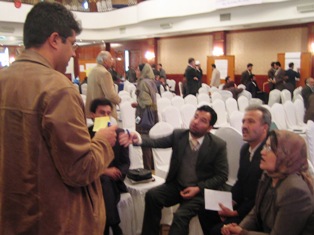
I was glad I was not responsible for the conference that started yesterday. It had all the usual glitches that happen when you invite high level government officials who do not show up at the appointed time because something else pulls them away. I was sitting next to someone who was responsible, a half Greek, half Italian, French speaking and Afghan looking woman who represented one of the three major donors who had paid for this gathering. We had a good time together, me providing perspective while she sailed with clasped hands and a good sense of humor through the ups and downs of the conference’s beginning. In the end everything worked out, as things often do that we obsess about.

kabulnov2008_wreathThe high official eventually arrived and exhorted everyone to do their best. He also paid homage to fallen comrades, some 45 doctors, both female and male, who had been slain in the line of their medical duty over the last year, mostly in the areas to the South and the East of Kabul. Four had their portraits displayed. They all looked sad, as if they knew what was in store for them when the pictures were taken.

One of the director generals showed a video of a trip in winter in Heart province (it should really say Herat Province but the built-in spell checker always changes it to Heart). It is amazing how snow covers all that is not pretty. The video footage of SUVs driving (and being stuck) in snow could have been taken in Massachusetts, except for the part where doctors treat patients right from the back of the truck or the passenger seat with crowds of mothers standing in the snow and holding their babies up for examination. There is much writing of prescriptions going on which is, I am now learning, the essence of medical practice here. I am learning so much each night around the dinner table that I think we should be sending anyone working in public health to one of the guesthouses for a thorough induction into the profession and learn about the difference between theory and the real world.

Steve and I did not stay the whole day for the conference. It is expected and good form, as foreigners, to show up at openings even if a conference is in the local language. When the opening takes place in the middle you end up attending most of the day. By the time the conference was officially opened it was nearly lunchtime and so we stayed to partake in the very classy meal that was offered to us by the World Bank, the EU and the American People. It was a few notches up from our guesthouse food; given the cost, it should have been indeed.

The first part of our session is today. The session had no name other than ‘organize for group work.’ I think that is because people know that is what I will do. I proposed a more appealing name (Towards aligned and concerted action for better health). It is placed at the low energy hour of the event, after the mid afternoon tea break. Whether it will actually start then assumes that everything else will go more or less according to plan. Dr. Ali is mobilizing all his colleagues to help facilitate the break out groups while he will lead the session. I will hover on the side, may be occasionally mouthing the words ‘focus.’ The session is so designed that it should hold the conversations and create the container in which ‘us versus them’ can become a ‘we.’

Nouns

“Learn the nouns,” said a colleague in my dream. It was about learning Japanese, but of course my mind was preoccupied with Dari. I would be an awkward speaker, just nouns, but it would help. I would add the Dari word for ‘to do’ plus a noun to make the verbs. A vocabulary of a 1000 words would be a good start. Which 1000 words is not clear yet, that is where I would need guidance. Now, with only 4 days to go, it feels too late for such an exercise. Of course as soon as I am in another linguistic environment the urgency will disappear. But yesterday the urgency was real as it was another total immersion into this language; even at the very top, the nature and dynamic of the conversation changes completely depending on whether it is in English or Dari. It is obvious to me that I either have to remove myself (as an English speaker) or stay in with enough Dari to understand the general gist and get myself understood. The speaking about work-related stuff would be harder than the understanding.

Aside from immersion in Dari (which will continue the next 3 days), yesterday was also an intense day of immersion into the inner workings of the top tier of the ministry; or maybe it was not the inner workings but the outer, visible manifestations of the inner works by its senior staff. I was reminded why I like to work with senior management as much – there is a sense of powerlessness that I feel can be remedied if only people learn to better talk and think together.

I prepared a PowerPoint lecture – yes I can do that if I have to – that was primarily drawn from Bill Isaacs work about dialogue and the dynamics of senior leadership teams. Much of the conversation was about system dynamics – Afghanistan is like a laboratory with lots of balancing and reinforcing loops. The fundamentalists throwing acid into the faces of young girls walking to school is one such a balancing loop. My intent of the team retreat was to help people see the invisible so that it can be incorporated into the decision making. The other intent was to show why teams are needed in a complex environment like this, especially at the top. We did not get the intact team in the room so the relationship building had to wait; but I think we made a start by at least revealing what results each one is held accountable for and what contributions each department wants from the other.

Every so often I saw signs of collusion with patterns of behavior that may have been set a long time ago and that have gone unquestioned or even unchallenged. Of course as an outsider it is easier to question and challenge exactly because I am an outsider. Whether my questioning makes any difference remains to be seen. I see myself as a gardener, putting seeds in the ground. I have no idea which ones will sprout, or which were not viable in the first place.

If anything took root I might see something in the next few days. Today a big and costly conference starts that brings together a significant portion of health movers and shakers (and non movers and non shakers). The event will be in Dari, except the part I am supposed to facilitate but I have decided that it is better if my counterpart does it. Each time I conduct a session in English I find everyone, even very smart and wise people, reduced to passive recipients of my supposedly wise words; it’s partially about politeness and partially about an ingrained behavior pattern in the presence of experts; the latter is a major handicap. If I can get away with it I will coach from the sidelines.

After a late meeting at the ministry with the DGs about their role in the conference, Ali and I waited in the dark and the cold within the perimeter of the ministry compound, for our ride back home. Ali went for prayers and left me close to a cluster of His Excellency’s guards. He felt I was in good hands with these high level protectors. I would not be able to tell a protector from a bad man, especially in the dark, but felt safe nevertheless. There was much coming and going of expensive SUVs and one minibus ambulance with a red blinking light; a donation from the Islamic Republic of Pakistan it said in big letters painted on both sides of the vehicle. I don’t think there was a patient in it, since the ministry is not a hospital. It disgorged some people and then rushed out again; it is clever way of cutting quickly through the heavy rush hour traffic I suppose.

Back home I found Guesthouse Zero transformed. Maureen, with the help of cook and cleaner and with the permission of Steve, had raided his stash of carpets, helmets, shields, and other knick-knacks that were stored in bags and closets inside and outside his room. They decorated the entire house which now looks like a fancy version of a Chicken Street store. It will provide new arrivals with a quick overview of things that can be purchased here. Steve told us it was only a very small part of his collection, and that most is still in bags and drawers.

Over dinner I reported out about my day. We concluded that we, development types, have created many of the problems that we are now trying to resolve. We invoked time and hope and tried not to be too cynical. That was reserved for the three pieces by Kipling Steve recited to us. One was a poem, over a hundred years old, entitled The White Man’s Burden. It was written at the time of the US occupation of the Philippines; the other were two are ballads about the gruesome mercy and jest of Abdhur Rahman, an early ruler of Afghanistan. Compared to that, living in Afghanistan now seems a little better in spite of everything.


February 2026
M T W T F S S
 1
2345678
9101112131415
16171819202122
232425262728  

Categories

Blog Stats

  • 139,805 hits

Enter your email address to follow this blog and receive notifications of new posts by email.

Join 76 other subscribers