Posts Tagged 'Bangladesh'


Forced stop

The BNP, opposition party, last Friday, threatened a non-stop shutdown, here known as a ‘hartal’ if the government failed to produce its kidnapped leader Elias Ali alive. The hartal started already and forced us to start the workshop a day later. This will only work if the strike is called off tomorrow at the end of the day. If not, we have to scramble, along with lots of other people in Bangladesh who made plans.

I had forgotten about these hartals that are so common and yet catch everyone by surprise. Here too, like in all the countries I have worked in, politicians are the great spoilers and there is great disdain and dislike for them. Yet they can’t all be bad. Bangladesh has made some great strides in raising literacy rates, increasing family planning and reducing the growth rate of its population.  But with so many people it will take awhile before that reduces actual numbers. A hug bulge of too many babies born over the last 40 years has to work itself through the life cycle.

And so tomorrow we are told to lie low. Not the kind of low as in Afghanistan, in fact I was told that being a foreigner does not put me at risk. But I am not sure what it means for me, this extra day of waiting.

Today I met the rest of the facilitation team, one batch in the morning and another in the afternoon. In the morning I met my MSH colleagues at the local office and in the afternoon only those local to the area could show up. Crossing town after 5 PM was not advised because demonstrators can get nasty to cars driving around. People are warned to get home before 5 and then stay put. And so we won’t have everyone in the same room until the workshop starts – assuming it will – the day after tomorrow.

The list of invitees is long, over 90 people, but no one expects all these people to show up. Only 22 replied positively. What started as a workshop for 20 to 30 people is now anyone’s guess.

In the meantime I learned that my trip to Kenya, replacing the cancelled trip to Afghanistan, is now also cancelled which means my travels will stop a little earlier than expected. As with so many other things, whether this is a good thing or a bad things is hard to tell at the moment. The focus of the work was right up my alley so I am a bit disappointed, but then again if the grandbaby comes early it would be a good thing.
From there to here

The trip to Bangladesh has three segments, each one a little shorter than the previous one if you travel East, the opposite if you travel West, with each segment a little longer than the previous one and also longer because of flying into the trade winds.

Segment one and two were orderly, as one would expect. But segment three was very disorderly although the Emirates people did their best and kept their cool.  There are lots of young Bangla men working in the Emirates and there is a constant shuttling back and forth as these young men go home or try their luck. I suppose those are the lucky ones, the ones who are not bonded slaves.

After reading (Gregory David Roberts’) Shantaram I was looking for the gold that was/used to be smuggled out of the Emirates as jewelry around arms and necks but I saw little of that. In fact the Bangla customs form allows very little jewelry to go untaxed. The authorities may have wizened up after reading the book, after learning about the inner workings of the Bombay mafia and its grip on the black markets of the subcontinent.

For the final push into Bangladesh it was my luck to sit at an exit row where I could stretch my legs with an empty middle seat; it was my bad luck that that seat was across the aisle from a tired young couple with an infant that didn’t want to sleep in the bassinette and cried when not wiggled on his dad’s knee. Still, I managed to sleep most of the way – exhaustion and earplugs helped.

I woke up when we were getting ready to land only to learn that a VIP had sequestered the airport for the next hour. When you have been on the road that long such an extra hour kills. And so we circled over Dhaka until the airport opened again. Then followed another long hour standing in chaotic and ever-shifting lines of exhausted, numb, irritable but also happy travelers to get ourselves stamped into the country. I was waiting in line with a Bangla grocer from Lynn, MA, who had come by way of Newark to Dubai and was just as exhausted but in a fine mood. He was going to visit the few remaining relatives who weren’t already living in Lynn, and the proud owner of the much coveted American passport.

It was Friday so traffic was light, which is a relative concept. Still, it shortened the 45 minute ride to the hotel to 20 minutes. That was a good thing.

I made contact with Courtney, formerly from Safi airlines who is now flying out his remaining days till retirement ferrying planes from Dhaka to the US or China for repairs or lease returns. He happened to be in the country and so we had a date, fully encouraged by our two home-based spouses. He took me to the Westin and treated me to a multi-cultural buffet dinner that would have been wasted on either one of us alone. We caught up on life and adventures that we had since we said goodbye at the Barbecue Tonight restaurant in Kabul, now 9 months ago.

On our way back, we threw ourselves into the throngs of beggar moms and street urchins that are attracted to the moneyed customers of the Westin. After having been chauffeured around in Afghanistan for two years, or driven myself around in South Africa, the experience of haggling for a taxi or the motorized rickshaws was new again. The smoke-spewing baby taxis of yesterday are now called CNGs (compressed natural gas), encased in a metal cage (to keep the riffraff out I presume) and running on clean energy. I am sure it makes a difference in the quality of the ride if not of Dhaka’s air. I remember driving in these things with my scarf wrapped around my mouth as a rudimentary airfilter.

Solo

In sharp contrast to the day before, yesterday was more of a solo day. It started with breakfast in a restaurant that was deserted except for two chipper waiters, one of them Rosario with the Portuguese roots. I chose the local breakfast, a chili omelet. Nowhere else have I had this cooked just right with exactly the right amount of hot chilies.

While waiting for my order I had time to study the English language newspaper. It was full of encouraging news about the new prime minister and her cabinet which has several women in important roles. One of them will be Hillary’s counterpart. Most of the people I have worked with are happy about Bangladesh’s new leadership, and so this country joins the happy brigade that already has America and Ghana marching behind their inspiring new drummers.

One disconcerting piece of news was an action by a local Moslem council to close the road, on which its mosque is located, to women. There is a photo with the story that shows an elderly gentleman with a stick. He stands at the entrance to the street and beats every woman who dares to enter. It is a little piece of the middle ages that is preserved in this capital city of a country that has at least 5 women in its top leadership and another 20 or so elected in Parliament. That there isn’t more outrage about this kind of behavior is unimaginable.

In another piece of B-news, a school of girls is exhorting its graduating class to go out into the world and emulate great men. I understand the idea but the wording bothers me. There are so many great women to emulate it is in this part of the world (later in the evening I met a whole roomful).

Yesterday’s program consisted of writing the retreat report and then going over the draft with the key players before finalizing it. I like these zippy assignments: fly in, hold retreat, write report and fly out, all in 3 days.

I had taken public notes on the whiteboard (with permanent marker) and made digital pictures at the end of each session, not having time to type the notes up as I was doing double duty as a facilitator/note taker. From some 40 jpg files I was able to reconstruct the data and surrounded them with a narrative to capture the deliberations. By the end of the day I removed the word Draft from the title page and emailed the report away from my to-do list.

I said goodbye to my new friends at the School and made a last courtesy visit to the Centre and went home to prepare for my evening out with Sayeed and Shika. They brought me along as a mystery guest to the house of their relatives the Khans, old friends of several of us at MSH. I was immediately taken into this noisy and boisterous family gathering that was in honor of Sayeed’s son and his brand-new wife. I had not seen the son since he was a teenager and so did not recognize him. I learned much about the social context of weddings and wondered what it would be like for the young couple to have to appear weeks on end at lunches and dinners until they leave to go back to New York later this month.

Many of the nieces and nephews live part or all of the time in the US. Most of the men appear to be IT professionals while the young women are financial analysts and economists. It is the generation of their mothers that paved the way for this. Those feisty women were the activitist who pushed and pulled, created organizations, convinced donors to give them money and are still busy, now on the world’s stage, to help their sisters along. We talked about what had changed for women in Bangladesh during their lifetime (they are huge) and noted there is still much more to be done (e.g. men with sticks and blocked streets).

I thought about the book The Namesake and it turned out that most had seen the film. It’s the story that some of them have lived as well. It is about loneliness and being an outsider and having kids that become outsiders back in your homeland. Seen against the backdrop of this noisy and happy family gathering I imagined the new bride in her Queens apartment, later this month, solo, while hubby is away all day at work. I heard she has sisters in the US and can only hope that their presence will be enough to stave off the loneliness.

A quality union

I am wearing my Nepali shalwar kameez. It is a little out of fashion here. I am not sure whether this is because it is from another country or whether the shalwar kameez fashion has simply changed everywhere since I bought it four years ago. The hemlines are way up and I feel like an old maid in a calf-length skirt amidst miniskirts. I learned years ago that here, just as in the west, the hemline defines how fashionable you are. At that time I was out of fashion in the opposite direction (I wore a hip-length top when everyone else’s top was down to the calves). I figure one day I will get it just right.

I started the day blowing a fuse in my room and thus had to shower in the dark. But my computer was on another circuit and Axel greeted me enthusiastically via Skype; it was 6:30 AM for me and 7:30 PM on the previous night for him. It was a nice start of the day.

It took us 2 hours to get from my hotel to the retreat place which is not all that far outside Dhaka. Savar used to be a rural area but now textile factories are being built closer and closer and with that populations move. It is semi-urban now and will soon be urban judging from the construction.

When I walked into the room reserved for us it was set up in U-shape with a power point as the central feature. For a moment my heart sunk – it is hard to dismiss the person who was planning to present the first powerpoint. After a brief formal opening I asked permission and forgiveness to dispense with the powerpoints (this is always a gamble) and was met with enthusiastic cheers. And so we dropped all the presentations and followed the day as I had designed it. From then on it was easy to facilitate the group.

For the first time in 5 years these two parties were sitting together around a table, one a famous cholera research center, the other the school of public heallth. We spent the day around 2 challenges; the morning we studied the quality of the MPH program using data in people’s heads as well as formal evaluations; in the afternoon we studied the upcoming ‘marriage’ as one centre moves in with the other by the end of the year by looking at identities and then, in small groups, explore hopes and worries about the union. The union/marriage metaphor was fun to play with (dowries, in-laws) and also because I got to quote Obama often about a more perfect union. The nice thing is that everyone understands this language which is now suffused with hope.

We canceled the dinner in exchange for a lunch at some later point in time because everyone wanted to get on the road. The trip back out also takes hours again. I had a private tour of the trainging and resource center and then we joined the rush hour which we interrupted at ‘Coffee World’ in a crowded Dhaka street for an Americano and more talk about BRAC, facilitation and succession planning (BRAC has now completed that process successfully). By the time our coffee was finished the traffic had eased and we made it to the hotel quickly.

I ordered another Thala in my room which was delivered by Alexander Rosario. I asked the waiter about his rather unBangladeshi name. As it turned out he is from the Portuguese diaspora (way back he indicated by pointing far behind his shoulder). I wonder if this was a group of Inquisition refugees who moved East rather than North to Amsterdam centuries ago. I’d love to know that family’s story.

Runup

Despite taking a double dose of the Ayurvedic sleep medicine it did not deliver on its name (‘I Sleep Soundly) during the final stretch to Dhaka. Aside from the medicine there were the wide seats that practically extended horizontal and several soft pillows, but none of that helped. I think I was beyond tired by then.

As luck had it, the gentleman across the aisle was heading exactly the same way as I was, to BRAC, and a co-conspirator in the sense that he too wants BRAC’s school of public health to be the best that it can be. He is a fellow OD (public admin) person, who flew in from Kenya. He introduced himself by saying, “I think we have a friend in common.” That was Jon.

This coincidence added a new dimension to my preparations for the retreat and I flooded him with questions. He could describe the BRAC side (as opposed to the university side) and clear up some things I did not understand about the financial part of the picture. The best things I retained from our conversation is that things at BRAC evolve rather organically – like stem cells dividing and coming together in clusters that then form a system that performs a particular set of tasks. This appeals greatly to me.

And then everyone around me went to sleep (and I tried). It was another half empty cabin (only the business class) and things were quiet while we overflew the enormous subcontinent. One of the flight attendants was studying safety procedures. I peeked over her shoulder at the questions. The answers were sobering, like: ‘How long do you have before impact after the captain says ‘Brace!”?’ (Answer: half a minute.) I hoped she’d never have to put that knowledge to the test. Knowing is one thing, but acting wisely and according to the lesson plan in an emergency another thing entirely.

Getting through immigration and out of the airport was a cinch with my shiny new virgin passport and its only stamp, good for multiple entries into Bangladesh. There was no waiting for luggage and I hitched a ride that was waiting for my companion to the BRAC Inn where I installed myself for the duration of my short stay in Dhaka.

Around lunchtime I walked over to the school and had a very productive meeting with some of the key actors to whittle the agenda down to two main challenges. Lunch consisted of a glass of coca cola, a white (Western) sandwich and two very spicy fried veggie-curry balls, everything washed away with an authentic Nescafe which always brings back early coffee memories from home (I was blissfully ignorant that Nescafe was actually not really coffee until I was 18).

Back at the hotel I cross checked with my travelling companion whether the new design made sense and then took a badly needed nap. After that more cross checking with Jon (in South Africa) and preparing soome flipcharts.

I was too groggy to eat out and ordered a vegetable Thala (like the Indian Thalis) that was brought to my room. And with that I have come to the end of the runup for tomorrow’s event. The only thing left to do is a warm bath, pack my bag and have a normal night of sleep.

Catch up

My last day in Dhaka was low key. It started with a last breakfast with my Nepali friends who left for Kathmandu in the morning. Ellen, who is from Holland and who I found again on Facebook after having lost her for awhile after she exchanged Tanzania for Park Slope now lives in Dhaka where her husband is the UNFPA rep. We had coffee and caught up with each other and talked about how to raise Dutch girls who have never lived in Holland. She has two little ones. I brought her drop and a chocolate letter (E of course) to remind her of home.

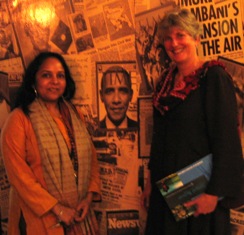
Next stop was the School of Public Health, housed in BRAC University where Bangladesh is preparing some of its future social scientists, computer engineers, businessmen and English teachers. I finally was introduced to the faculty I had heard so much about a few weeks ago in Kabul when Jon was telling me all about this place. I met a few Americans, one an intern from GWU who said her goodbyes after 4 months of fieldwork and another American MPH student about to graduate in a couple of weeks. Everyone was very enthusiastic about their experiences in this place of learning. After a very British fish-and-chips lunch at the Newsroom cafe with Sabina and Lauren sab_svI returned home to sort through my stack of business cards and start preparing for my return home.
Sayeed picked me up for dinner and took me to a Korean restaurant which instantly flooded me with memories of my many trips here with Ann over 10 years ago. I remembered Sayeed taking us out to a Korean restaurant then as well. We agreed that Ann was hovering around us even though she is far away in Newton. We had much catching up to do since we had not seen much of each other except some fleeting moments in Cambridge and Kabul; and, as he always does, Sayeed gave me his own familiar and contrary views on BRAC, development, and NGOs, before showing me pictures on his iPhone of his new daughter-in-law and his grown up daughters who are living in the US and UK. The wedding is in three weeks and I was invited to witness this multi-day traditional event. It would have been fun but it is time to go home.

Firsts and seconds

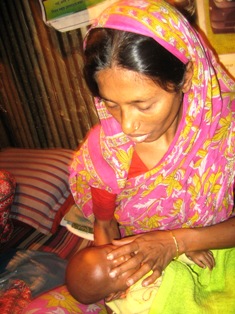
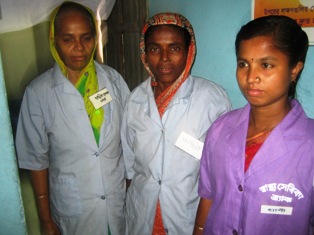
After an early breakfast and many goodbyes, yesterday morning, we distributed ourselves over several small buses that took us to the various field visit sites, some rural, some urban. I joined the Dhaka urban maternal and neonatal child health group. We visited the Corail slum area to see BRAC’s birthing huts, a program that provides very basic facility-based delivery care to some 700 women through traditional midwives supported by a community health volunteer and an upward chain of increasingly trained healthcare workers. It’s still a pilot project but the results are promising.

bracutbsWe met some of the traditional urban midwives, community health workers; saw a bunch at the conclusion of their training, and some of the BRAC program staff responsible for services to the 10.000 households that live in this one of several Dhaka slums. BRAC program coordinators took us through small passage ways, over scary looking open gutters into compounds and even houses (smaller than my king size bed in the BRAC Inn) where we met with brand new moms, or very pregnant ones and thanked our lucky stars that we were born on the right side of the tracks.brac_gutternewmom
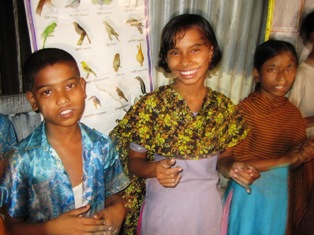
Everyone, kids, women and men alike asked to have their picture taken and grinned with delight upon seeing their picture on the camera screen. This is probably why so many annual reports and pamphlets from international health organizations have pictures from this part of the world on their covers. We also met with a member of a microfinance group and visited a BRAC school, where the students welcomed us in beautiful English, danced and sang and asked for nonstop picture taking. All the kids told us their name, then each mentioned a country of the world and then what they wanted to become. One girl wanted to become a pilot and so, naturally, we posed for a picture together. bracschoolpilotShe promised to write me when she entered pilot school – which will be some ten years from now. In between the acts we practiced writing our names, they writing mine in English script, me writing mine in Bangla, no small feat for either any one of us.

All the urban Dhaka groups met for lunch at the BRAC Inn before swarming out over Dhaka in various directions to go shopping, which is part of any conference experience in the world; the people from far away go to the handicraft places while the people from the region go to the discount designer wear market places. In Dhaka this means to the factory outlets where seconds from the countless factories that produce for the US and European clothing markets are sold. A bunch of us went to Aarong, BRAC’s upscale clothing, linens and handicraft chain of stores to buy our Christmas gifts and for me to get some new Shalwar Kamees dresses, handy for future trips to Afghanistan, Pakistan, India and Bangladesh.

For dinner I met up with my Nepali friends, one old, one new, and Pedro a computer engineer from Cuba who is awaiting his return to Nepal, pining for a beer and some proper nightlife and his girl friend. When he returns next month they plan to start a Salsa dance academy in parallel to a computer engineering business. “You see,” he explained to me, “in Cuba engineers also do salsa, we develop both of these sides of ourselves.” But a drink surely helps. He ordered coffee and the rest of us drank water and toasted each other and pretended all were cold beers; just a few more days for me and an entire month for Pedro (for visa reasons he has to wait until 2009 before he can enter Nepal again).
I stayed up very late delighted with my private and fast internet connection, cleaning out my mailbox while watching a rerun of Jaws, without the music of course, but still putting my fingers in my ears when I knew what the music was doing (doodoodoodoodoodoodoodoo).

And now on to the last part of my assignment and check out how the faculty at BRAC’s School of Public Health teaches new professionals how to manage and lead the way to significant impact, like their mother institution has done for more than 30 years.

On the shape of hidden fish

I tried to find the fish
Below the surface
Of the dark waters of the pond
Sometimes I saw their lips
Coming up for air
And I thought of the things
Everyone talks about

I watch their lips and search
For what’s below the waterline
Glimpses, vague outlines
And then suddenly
I am showered with
bubbles everywhere,
Like effervescent tablets
in a glass of water

as I listen to Laksmi’s passion
breathing life into her people,
her acts of generosity
Breathing life into is
What it means to inspire

Breathless I listen to Afsana,
Rajani, Tina, Neela, Lynne
Carmen, Anna, Carole, Susan
I have a weakness for strong women
I find so many here
No nothing wrong with the men
But scaling up with heart and care
Needs strong women

Awed by our hosts
Who are flawless in my mind,
A royal welcome at the airport
Whisked safely past potholes and
Frightening oncoming traffic
In the dark, delivered
Safely in this paradise
BRAC taking us in as family

I came with hand luggage only
But now the suitcase doesn’t close
So full of new connections
The weight of countless business cards
Heavy and light ideas
Jumbled together
To sort out during days of travel back

And knowing much better now
The shape of the hidden fish

Rajendrapur, December 5, 2008

Truthtelling

By the time of our closing session yesterday, our ranks were reduced by about 50%. Everyday people are peeling off and flying out to places far and near. We listened to an excellent synthesis done by someone whose ancestors came from Lebanon. He did a great job acknowledging individual contributions to his distillation of key lessons; one of those was the absence of presentations about failures. It’s a nice idea, and everyone nodded hard, but I can’t imagine anyone being willing to present their failures in public like that.

I did my presentation in the early morning and asked the audience to tell me whether they always wash their hands after going to the bathroom (the entire 26 seconds recommended), whether they smoke, wear a seatbelt, plan their family, practice safe sex and delegate. I also asked them to be truthful in their responses. Some were and some were not. I knew that some were lying because research in the US (done in bathrooms at selected airports) has revealed that only a small percentage of men wash their hands – in the conference room the percentage was outside that range but the key point was made: there is a huge gap between knowledge and action. The lonely smoker acknowledged that he knew smoking was not good for his health…and yet.

The presentation was well received, but then all presentations were well received. Conferences are not great places for truth telling. Truth telling doesn’t start until people feel safe and connected, which is just about starting to happen, but we are done now. That is always the case with three day conferences, except maybe with OBTC, where some of us have known each other for decades now.
The dinner was organized outside next to the pond from where our fish came from. I wrote a poem about those fish (“The hidden shapes of fish”) which I read later on our talent show evening. Dinner was another fabulous example of Bangla cuisine. This time I ate with my hands, even the soupy dhal. A few brave souls stepped up to the podium, for our talent show and broke out in more or less spontaneous song and dance (the latter not entirely voluntary). We were treated to modern Bangla love songs, English love songs, a WWII Christmas song, and even a long jiddish joke directly from New York. I read my poem which emerged only minutes before dinner started. In between our acts were professional dancers showing a variety of traditional dances, instruments and songs.

And then there were the goodbyes from the people who will not accompany us on the fieldtrip today because they live here or they have done this before. Most of the Indians are going back to Delhi or wherever they live. I had not followed the news about India and was told that the terrorists had done/were planning air raids on Delhi’s airport – it sounded very frightening. But when I went on the internet to read the India Times I could not find anything about this. I suppose this is how rumors are created. But I was happy to be traveling back through Dubai and not Delhi, even though I would have liked to visit with Nathalie for a day. That will now have to wait.

Effervescence

In the mornings some of us meet in the computer room in the hope that we can catch a small window of low use and fast(er) connections. I managed to get my blog posted just in time and then the window closed. Under these circumstances ‘internetting’ is actually a social or meditative activity with so much waiting for pages to load that one can either strike up a conversation with one’s neighbor or stare at the flickering screen and meditate on the meaning of life (or the joy of this or that).

There is much mention of poor management and lack of leadership as determinants of scaling up success or failure and I wished I could make another presentation, about how we teach management and leadership, as opposed to the change presentation that I do on behalf of a consortium I feel little ownership of.

Although I sat through another 12 or so powerpoints yesterday, I am increasingly humbled and impressed by the depth of knowledge, the passion and the long experience of the people in the room. We are slowly beginning to become a community, find out who is who and does what just when the end of the conference comes into view. There are so many people I want to talk with, get to know but there is not much of a common area, no places to just sit and talk besides classrooms and dining hall. In addition, the schedule is quite full and follows a classic conference model; after dinner all the locals go home. As a result the networking opportunities are limited to breaks and mealtimes. There can only be four people at each dining room table; if you come late it’s the luck of the draw who will be your table mates. I end up sitting a lot with the few Africans – mostly from Tanzania; I do feel more of an affinity with them than I do with the many Asians and the couple of Latin Americans. With a few exceptions from the US, Canada, UK, the handful of participants from Latin America and Africa, none from the Arab world, this is mostly a subcontinent affair – a part of the world I don’t know all that well. There is an effervescence of this group that I usually don’t encounter in Africa, effervescence being the only word I can think of to describe the enthusiasm, openness, creativity, drive and bubblyness of the participants from India, Pakistan and Bangladesh I have encountered here.

It is impossible to sit down and talk with the people I want to talk with about the second objective of my visit here which is about how to insert/improve the teaching management and leadership in public health educaction; the faculty of BRAC’s school of public health have been key organizers of the conference and are, rightly so, entirely absorbed by the event and the opportunities it presents them for making new connections, strengthening others and survey the state of the art in scaling up health programs.

There is much to learn for our project which has a ‘scaling up’ mandate. I wished I had some of my colleagues here – taking so much in by oneself is a bit daunting and I am not entirely confident I can absorb all the things I hear, let alone transmit key points. And each time I hear someone present either about BRAC or from BRAC my admiration for this organization increases. It feels a bit odd to come all the way from the US to explore the teaching of management and leadership in a place that is a prime example of superb management and leadership. To what degree we are dealing here with leadership of the ‘born leader’ variety is not clear. Where we may be of some assistance is the challenge of ‘growing leaders’ when natural talent is either in short supply or undetected.


December 2025
M T W T F S S
1234567
891011121314
15161718192021
22232425262728
293031  

Categories

Blog Stats

  • 136,984 hits

Enter your email address to follow this blog and receive notifications of new posts by email.

Join 76 other subscribers