Posts Tagged 'Cote d’Ivoire'


Sights

2013-03-27 20.27.03

2013-03-27 20.29.08

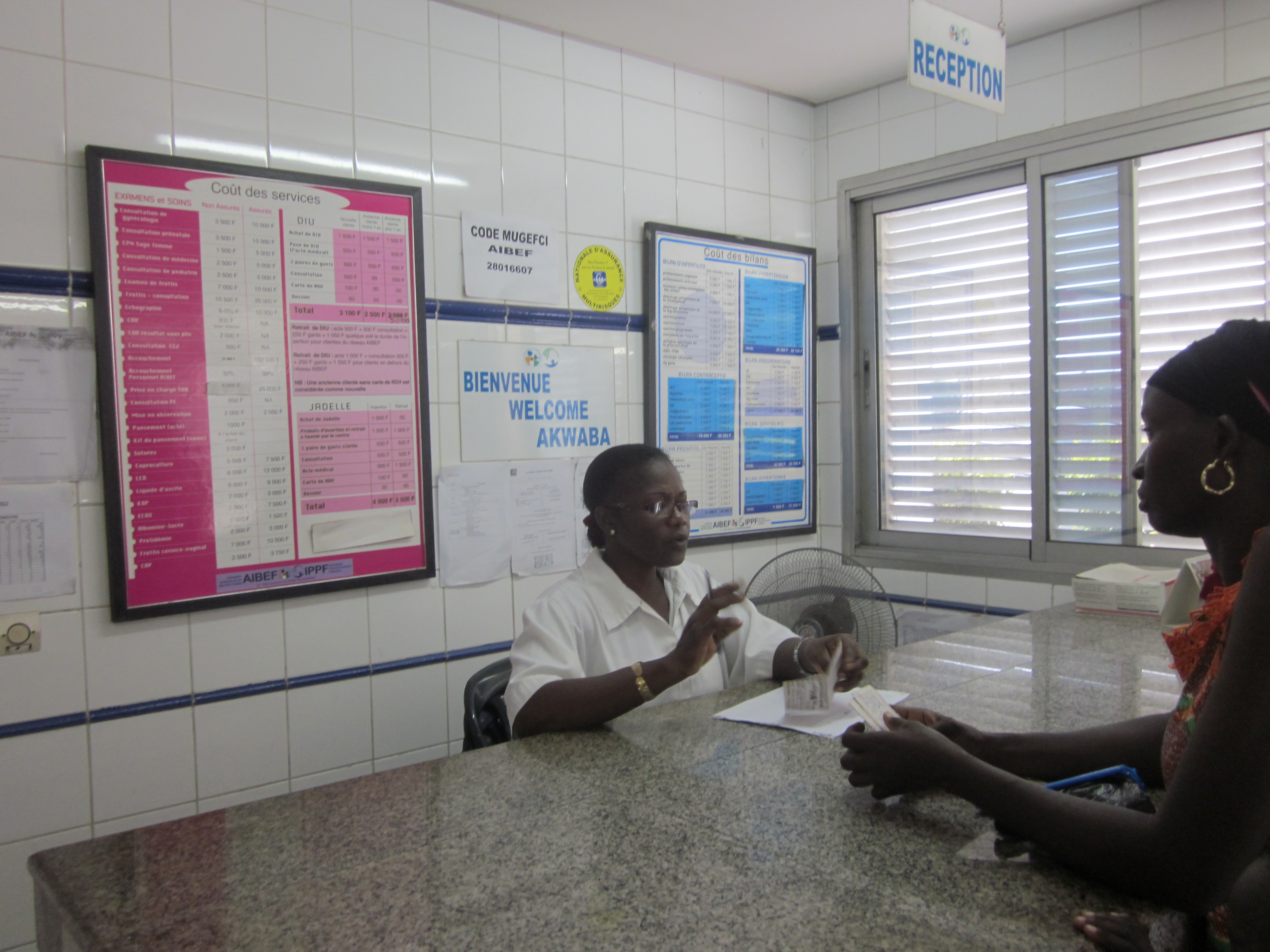
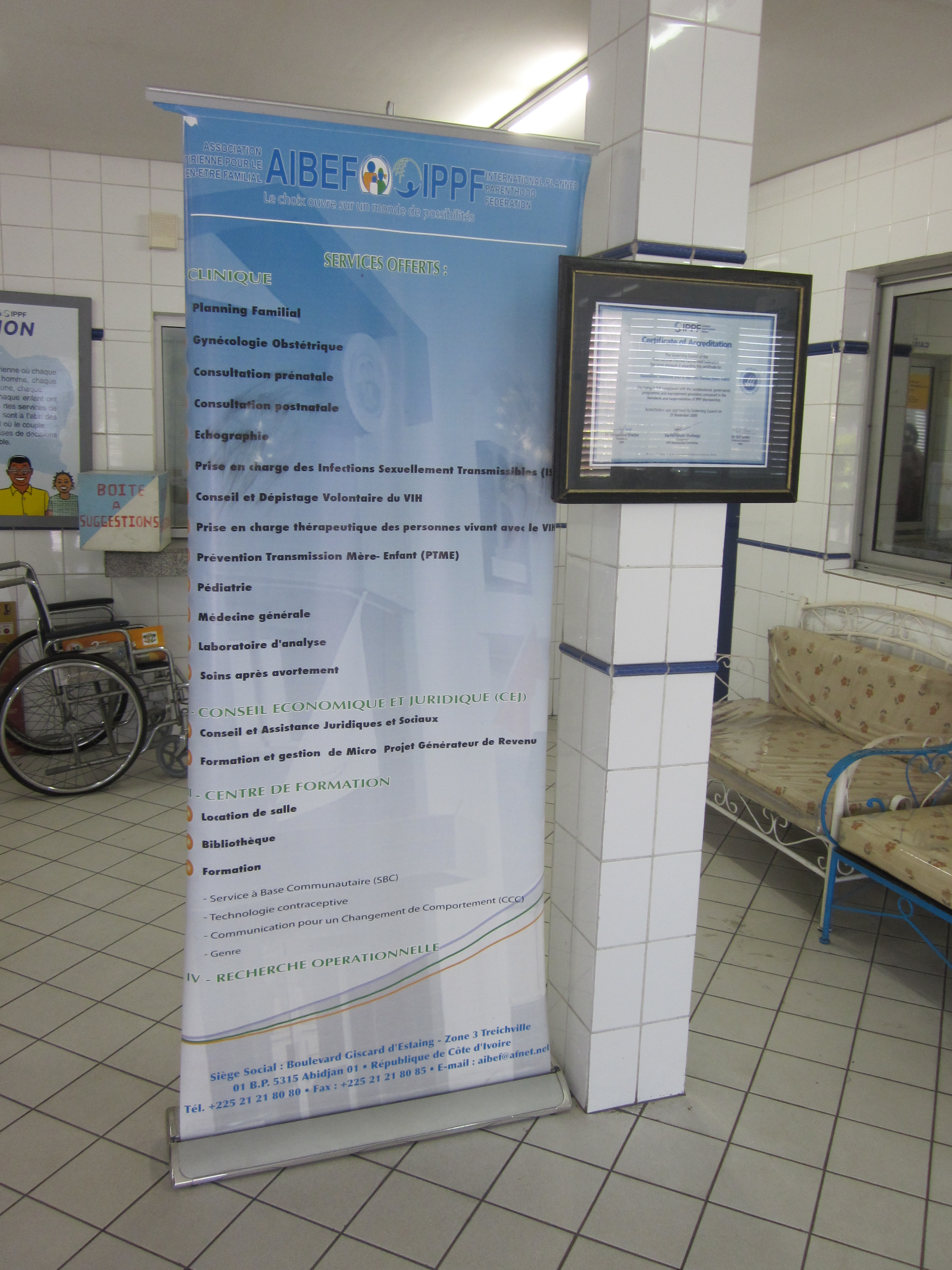
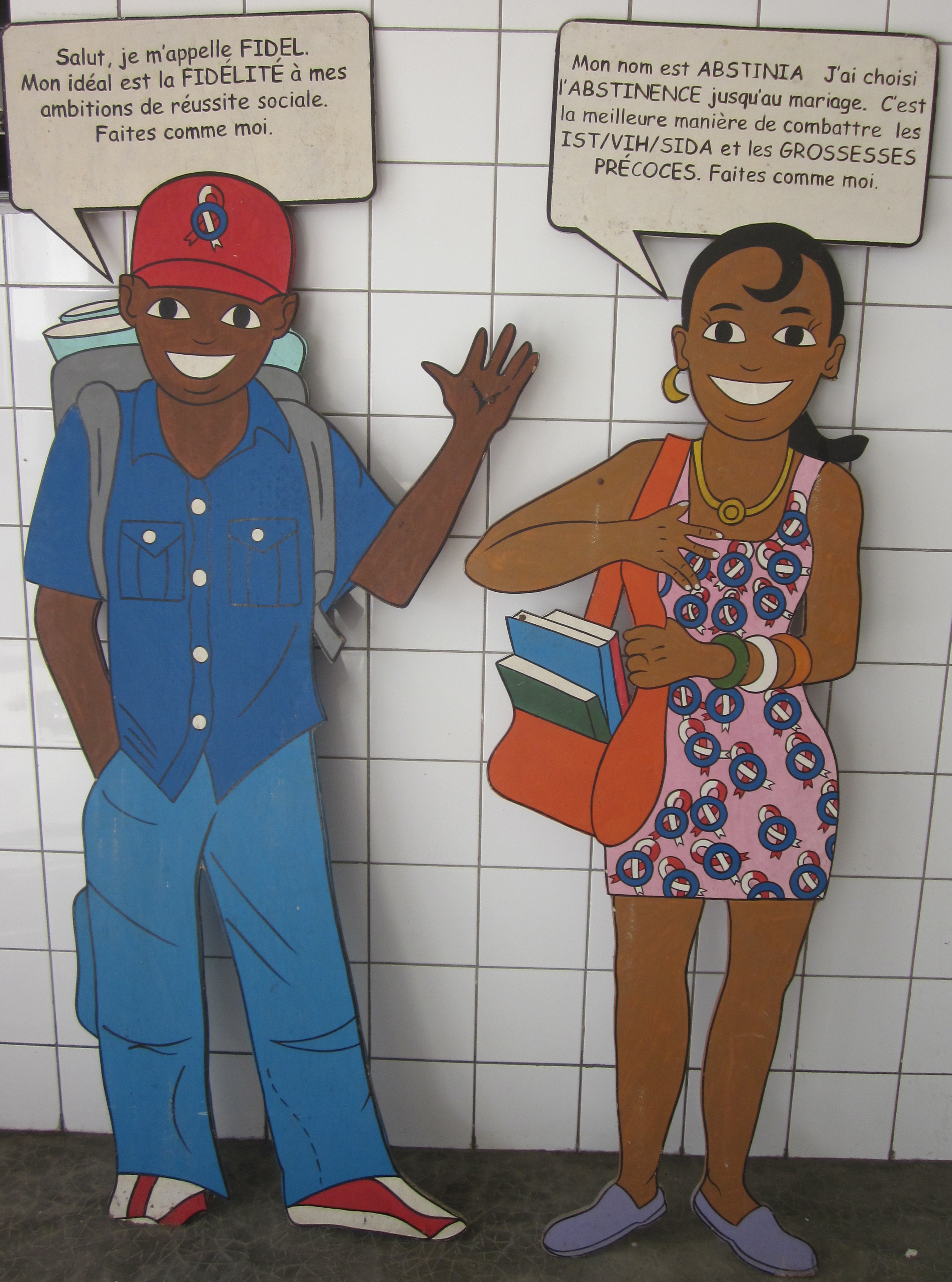
???????????????????????????????Our second visit for the day was the local International Planned Parenthood Federation affiliate, AIBEF. I visited AIBEF exactly 20 years ago when it was not in a good place because of poor governance. The current AIBEF is blossoming, having realized a vision that was expressed all these years ago: aside from the usual family planning services, there are HIV/AIDS services (diagnosis and treatment plus outreach to young and old), there are pediatric services, ultrasound, and even a maternity plus training rooms and lodging. There is of course a new vision that includes an operating theatre.

We were warmly received and given a tour and loaded with brochures and T-shirts at the end. From the logistics managers we received the same orange/white T-shirt he wore. It had a message on the back that no one should be dying of an abortion gone wrong. Abortion is still illegal here except under a few tightly worded exceptions, but even then it requires multiple doctors to agree. It is still the doctor who decides, although the doctors are no longer male.

When asked whether there had been progress, everyone agreed they had come a long way. That long way was hardly interrupted by ‘la crise,’ as the time of warring presidents is commonly referred to. AIBEF came out OK, partially because of heroic behavior of its leadership and may be also because of its location and local support. I learned that the MSH office here was less fortunate and was reduced to its walls with everything stolen or broken. That, I believe, has nothing to do with politics but everything with unbridled rage, let loose by power plays of well-dressed gentlemen who claim to not be in control (or is it not like that?).

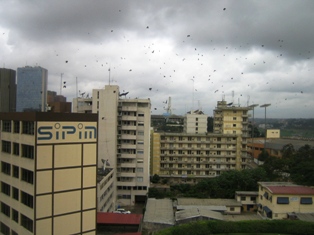
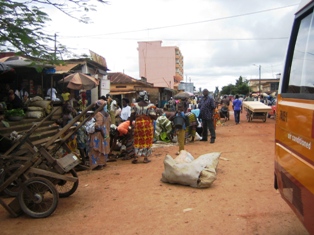
In the evening our host took us to a small maquis (inexpensive local no-frill restaurant) at the edge of the Laguna that separated us from the skyscrapers of Abidjan. To get to the maquis we first traversed the empty section of town where the embassies and big people had returned from a busy day at work for a quiet evening. Then we entered a vibrant quarter which consisted of bars, maquis and hair salons, with music everywhere. Here everyone was wide awake and ready for a busy night. We parked on an unpaved and potholed road, put a man in charge of the surveillance of our car and walked over to a place that we would never had suspected was a waterfront restaurant.

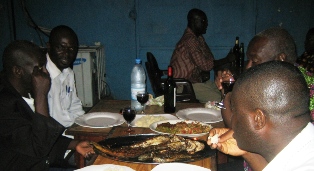
Although the Laguna is polluted, the smell I had expected, if it was there at all, wafted away on an outgoing wind which kept us cool and the mosquitoes away. We had carpe braisee, a local specialty with vinegary onions and pepper and some wicked hot sauces, french fries and aloko (fried plantain, a specialty in this part of Africa), while sipping a Flag beer. Across the Laguna we could see the traffic jam of cars trying to get home, as late at 8:30 PM it was one solid line of yellow car lights. Traffic here, as in nearly all capitals of developing countries, is intense as the middle classes are growing and buying cars; a sign of prosperity, that is creating new problems screaming for solutions.
Humdidee

It is very hot and humid and tonight at 6 PM humidity became 100% and the skies emptied over Abidjan. And then it went and soon the humidity was back where it was before. K, a colleague from Johns Hopkins and I had dinner served on the little front porch that belongs to her room (my front porch is the swimming pool). We chose not to eat in the dining room. A combination of bug repellent, mildew, perfumed room freshener and cigaret smoke would certainly have interfered with what was otherwise a nice meal.

We accomplished what we came here to do. We are laying the rails in front of the moving train and so far we appear to be on track, with enthusiastic counterparts, Johns Hopkins colleagues who are running an impressive program. Their office is festooned with HIV/AIDS awareness posters, pamphlets of every size and color for every possible target group. They employ some very good artists. A storyteller from South Africa came up to Ivory Coast to help them write stories for comic books. I started reading about Marcelline and Jojo and couldn’t put it away, wanting to know what happens next, and next. It’s a good story with great illustrations – so much more effective than direct exhortations. We each received two comic books cadeau – if I didn’t know about HIV and AIDS, these books would wake me up.

The office is small and so much of the work is done through local organizations, some small, some big. We will visit two organizations tomorrow, just to get a sense of the range of partners the project is working with.

We had the morning off while our counterparts were taking care of their affairs. I took advantage of the free time to visit with a former chief of an important coordinating body who had been part of a leadership program we ran here in 2006. Later in the day I also contacted a young colleague who I mentored as she gained confidence in facilitating leadership development. In the years since we were together she has actually consulted on leadership outside the country and taught her older male colleagues about leadership. This is so neat and proves again (I know this already) that people will rise to a challenge that is thrown in their lap. I have more stories like this and they make me intensely happy.

I am beginning to suspect that the ankle operation made no difference. Part of me keeps hoping, but so far the reality is that the talus bone still catches on the tibia bone or vice versa, despite the scraping that the doctor did on March 5. Someone asked me what next? And I realized I didn’t want to think about it too much as all three options are unpleasant prospects: fusion, ankle replacement or not being able to walk without pain.

The other side

West Africa smells different than East Africa. You can tell as soon as you emerge from the plane. They say that smells are powerful triggers for memories, and indeed, memories of Senegal presented themselves immediately upon entering Ivory Coast. The last time I was here was 7 years ago, and the first time was exactly 20 years ago. It is a different place now, with its combative ex-president awaiting trial in The Hague, and the winning president trying to figure out how to deal with high unemployment and restless followers of the former president. The Ivoirians have suffered much since my last visit but now the country is busy trying to regain its former status as the bedrock of economic and political stability in West Africa.

Although it was Saturday noon time when I arrived, there was a lot of traffic and it took forever to reach the little inn where I am put up. I killed the time by bombarding my driver Aristide with thousands of questions.

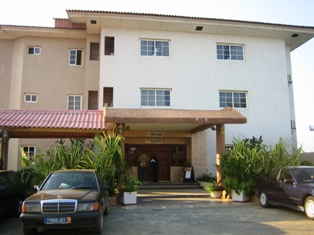
My new lodging for the week is a small inn tucked behind a main drag in the part of Abidjan that is called II Plateau. It has an eclectic collection of rooms, each with a different theme. I am trying to sort out the theme of my moss green and pink pastel room – it looks like a guestroom where all the picture discards went: frilly oval pictures of flowers, sad little children and some gold painted wooden flourishes nailed willy-nilly to the wall. The floor consists of white and black tiles, straight from a Vermeer picture, partially obscured by an olive drab (gray?) rag carpet reminiscent of the 70s, and a fleur de lis area rug leading into the bright blue bathroom.

I look out on a small pool with an eclectic assortment of sitting places, tiled, painted, metal, wood and plastic. I went for a swim before my siesta. As I was swimming in the little pool, dodging downy feathers from the birds hanging out above me, I realized that I could have arrived a day later and done my swimming in the Indian Ocean. What was I thinking, rushing off the island so fast?

On the other hand, the place does tend to invite to relax, and the prospect of having an entire Sunday to myself is appealing. It won’t be all relaxation though as work in Cambridge goes on and my corporate responsibilities don’t stop when I travel. I have a shopping list of tasks by my side that already counts 7 things that need my attention tomorrow, some of them rather large tasks.

My solitary dining experience was enhanced by memorizing the scene for my blog: enormous blue and red velvet-covered banquettes made for giants, set uncomfortably far from the table as if only fat-bellied people ate there. Red and gold frilly chairs and doilied low tables were set up in a space that was already full enough. Enormous cognac glasses on stilts with tea lights provided a soothing contrast to the bright and cold spiral everlast lights or the collection of colored lights hiding in every nook and cranny. For awhile I was mesmerized by a spotlight directed to a large print of the girl with the pearl earring, the colors changing along the rainbow, from yellow, to purple to blue, then red and green, casting a large oval colored ring on the picture.

Dinner was pricey, my ballon de vin rouge rounding it off to something with many zeros. I am not sure this is going to be my prefered place for dinner although the crabe farcie and the French french fries were great, so was the juicy papaya at the end. Unfortunately I am too early for mangoes.

Screeches and screams

Alphonse the driver came to pick me up at 7 PM at the hotel last night. I had to leave my room at 6 PM, already quite generous of the hotel, and so I spent the last hour in the lobby, dozing off now and then which made the hour go by fast. I gave Alphonse my leftover Chinese toys and cheap gadgets for his kids and the bar of chocolate I never got around to eat. I also gave him my cell phone chip which will expire in January. I don’t expect to be back before then, so it is better if someone else uses it in the meantime. I never got attached to my number. I have already forgotten it.

In the morning Oumar sent me his contributions to our final report shich took me the rest of the day to complete. While I was working I followed on CNN the path that hurricane Ike was slashing through Texas. It is odd that we sent people into these storms to report on them when they cannot really see anything because of the wind, rain; on top of that the electricity is out. They really did not have much to say and what they said was repeated every 15 minutes as were the pictures.

In between the wet and windy reports on the American disaster I watched a program on Democracy in Africa which included some gruesome scenes from the Congo and some interesting ideas about democracy African style (as in ‘winner does not take all’). Will it happen during my lifetime, I wondered? As we know from Ivory Coast and Kenya, the progress can easily be reversed.

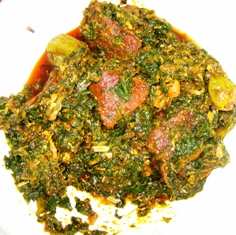
Oumar and I had our last lunch together in a practically deserted restaurant. The only other creatures around us where the ubiquitous bats, screeching and pooping as if there was no tomorrow. I had my last ‘sauce feuilles’ with rice, so did Oumar. Not his last, I am sure, although the crabs will be missing in his hometown of Kankan, deep inland, near Bamako. He didn’t eat the crab pieces anyways, much like I did not eat the bush meat that comes from an animal resembling a large rat.

We reviewed the 10 days we had just completed and then we said goodbye. He called me hours later that he was still at the airport, his plane delayed; nothing unusual in this part of the world, but by the time I arrived at the airport there was no sign of him, so I assumed he was on his way to Conakry or already there.

On the way to the airport I wondered what it was like to have lived here during the shooting and looting that took place not that long ago. It is not like with us in Holland where only old people now remember the war. Here, everyone would remember. Where were they, what did they do and what/who did they lose?

There are many billboards around town and a lot along the road to the airport. They promise riches, beauty, happiness, wisdom and whatnot if only you buy a certain brand of tomato sauce, cell phone, refrigerator or toothpaste. Against the backdrop of the chaos, dirt, the messiness of ordinary life, I can see the attraction. They are part of the attempt to create a consuming middle class. It may actually work.

I had the good luck of sitting in the plane on the same row as a young father with his little girl. She screamed nonstop for the first half hour, bringing in various African moms sitting in our section of the plan with advice, food, toys, even chips; all to no avail. The father who already looked much harried as he entered the plane, was getting increasingly agitated. I wondered about the story. Where was the mother? Was he taking the child to her mother or away from her? With her permission or without? Later, the AF lady who brought the bassinet that clips onto the wall chided the father for not knowing the child’s weight (mothers know such things), standing tall above him, even taller because of her high heels; after that the father looked even more diminished. With a wink to my neighbor and me, she made us witness to her warnings about all the risks associated with placing one’s baby in the bassinet.

Once we had taken off I offered to place the, by then sleeping child, in the bassinet, a delicate undertaking, and discovered what might have been the cause of the screams, a very stinky diaper. I pretended not to notice as I imagined that this would only further agitate the dad. I hoped the smell would be contained in the bassinet (it did).

And now I am sitting in the exclusive AF lounge which offers me a shower and a rich buffet of foods and drinks. TVs are everywhere, though none of the programs shown (all French) mention hurricance Ike or Texas; as if that’s already old news and not worth mentioning. Or is it because other news is considered more important (plane crash in Russia, bombs in Delhi and the Pope in Lourdes)?

Potato girl

It took me a few days to figure out that the bats are out, even during the day, because of the clouds. It’s not the light they cannot stand, it is the sun. The skies have been mostly grey since we returned to Abidjan, having a decidedly Dutch appearance. It is the right kind of weather for staying inside, watch TV and do homework. The sun does not always shine in Africa.

While I was busy behind my computer Oumar talked on the phone with several people who had participated in our workshop. They called him or he called them. At night, over dinner, he gave me a summary of what he learned. It made me realize that when I travel alone and don’t have such insider’s intelligence, I miss out on a lot. It tends to be given more freely to people seen as (more) similar to oneself. I had never thought much of that because people do share much with me; and so it is easy to get caught by the illusion of being taken in confidence and considered ‘one of them.’ I may get close but I don’t think I ever will receive the kind of phone calls Oumar gets. I imagine that much of what I hear is carefully calibrated by politeness, people trying to figure out what it is that I like to hear. This is one of the reasons why I try to work with local counterparts (the other reason is that there has to be some form of transfer before I leave).

Earlier in the day Eustache joined us for lunch at the Old Combatants restaurant. It was a rather late lunch and since on Fridays the commercial center around us empties out early there were few patrons in the gigantic restaurant and the menu very limited. But one thing that can always be had, just about any place and any time, is a grilled fish (carp , sole or machoiron) covered by an onion/tomato mixture and some mystery spices that makes it hard to reproduce, plus of course the usual staple of atieke, rice or plantain (smooshed into a paste or fried, called aloko).

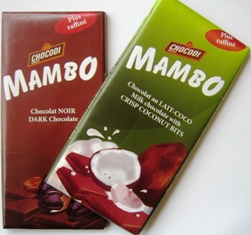
After lunch I went in search of a super market because of a craving for something sweet that needed urgent attention. Unlike in neighboring Ghana earlier this year, where we were served pineapple at any occasion, here I have not seen any, only bottled juice. This is odd because Cote d’Ivoire is, I believe, a major producer of pineapple; on our way to Aboisso we drove through endless pineapple fields. The country also produces cocoa and so that is what I bought, in its processed form, chocolate, plus some dates, but I would have much preferred fresh pineapple.

For dinner we revisited a restaurant in the Mermoz section of town, also quite empty and reviewed everything that happened since we started on September 4 and what needs to happen next. I ordered the same local dish that I had for my first dinner, kedjenou. I could not finish the enormous quantity of food put before me, still full from lunch. I have eaten more rice these 10 days that I eat in an entire year at home (I am a potato girl, really).

And with that I am signing out of Ivory Coast (incha’allah), expecting, if all goes well, to write my next entry from Charles de Gaulle, terminal E or F, tomorrow morning.

Sidewalk johari

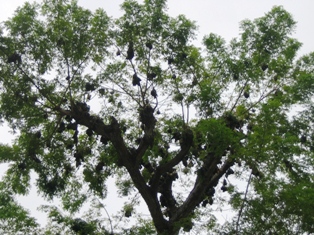
The bats and I were both late this morning. It was nearly 8 AM when I woke up and the sky was still full of them. Suddenly, and in just a few minutes, they vanished into the trees, as if humans and bats cannot be up at the same time. At dinner last night I learned that the bats are only on the section of town called Plateau. At one point the authorities decided to get rid of the bats (messy, noisy) and bombed then out of their trees and then cut the trees; an enlightened environmental action that did change things only for a while. All of the bats are back. It is, after all, their territory.

I was very aware of the date yesterday. The local news, radio and TV, all carried shots of our two presidential candidates, stiffly walking side by side at ground zero.

We made our round of visits to various stakeholders in the Global Fund to discuss what happened and sketch out next steps. We sorted out paperwork and contracts and began to lay the foundations for the next workshop that I will not attend, in November. I passed the baton, in the shape of a flipchart marker, to Oumar during our last facilitator meeting Tuesday night and he has been the team leader every since.

He leaves no opportunity unused to teach about management and leadership. He does this without even knowing it; teaching adults about changing their behavior is in his cells, he can’t help himself. We passed enough tidbits about management and leadership in our debriefing with the principal recipients of the funds that we left them hungry for more.

Last night at dinner, at a sidewalk restaurant, sitting on wobbly chairs around a wobbly table en plein air deep in Treichville, around a plate of grilled fish and atieke, he taught the president, the permanent secretary and our chief consultant about the Johari Window with great passion. My colleague Jana who taught Oumar about adult education would be proud. To hear such words as ‘moi chaché, moi aveugle, moi publique’ and ‘moi potential’ in such circumstances is quite amazing. Oumar, master trainer/story teller, kept them spellbound. It was wonderful watching him at work like that. I know the program is in good hands, he will do very well. His most important task is to transfer his skills to the local team so that he can look on, the way I do now, as his local colleagues take over. He has six more months to get to this result.

On our way to the restaurant the president took us on a tour of his childhood neighborhood. As he drove through it he kept pointing at this and that and added commentaries, the way I do when I show my colleagues in Holland where I grew up. Of course there was no comparison with that neighborhood (a small village really) and what it is now, as we are talking 1949: no paved road, few solid structures, no phones (c’était de la magie), few cars.

I could actually picture all this because my dad made a tour of Africa on behalf of the Dutch breweries in 1953 and left me a stack of postcards of many of the major African cities, including Dakar, Abidjan, Cairo, Nairobi, Johannesburg, Lusaka, Lagos, Antananarivo, etc. They are postcards made for foreigners like him, with a few cars showing (mostly old Peugeots) and many bare-breasted African women. The colonial buildings in the downtown shots are freshly painted. The shots of villages neat and orderly; not all that different from villages today except for the absence of the ubiquitous remains of the blue, pink, white or striped plastic bags. He also left me a diary that I have found hard to read at times because of the way he talks about Africans. He talks (writes) like a ‘colon.’ Even though not French or British, he was after all a man of his times. We have come a long way since then in terms of attitudes, but the environment has gotten the short end of the stick, bats, plastic bags, buildings and all.

Today is our last workday here and the report and the design for the next workshop are on the table. It turns out that not being able to change my ticket was a good thing; yesterday would have been too rushed. It was nice to sleep in and wake up with the bats.

Credible

I am back in Abidjan, goods delivered. All the angry faces have vanished and their owners become enthusiastic. We are credible now (something that has to be established, over and over again, which gets to be trying at times, hence the grey hairs). We are happy that we were able to show that (a) we know our stuff (‘animateurs maitrisent bien le sujet’), and (b) there was something to learn. Whether one day this becomes ‘there is always something to learn, no matter what’ remains to be seen. Patterns of thinking are hard to change.

The words spoken at the closing of the workshop came from the heart, as opposed to those spoken at the beginning when everything was still new and stiff. We were warmly invited to pay a visit to one of the people who had appeared rather cool and aloof at first; something shifted. It was also a reminder that first impressions can be entirely off the mark.

I handed out my usual leadership kits to remind them during their next meetings of what leadership and management means: a magnifying glass to scan and focus, a large button that says five time ‘Pourquoi,’ to remind them that fixing symptoms is a waste of resources; an eraser to erase all the mistakes of the past, and a mechanical pencil to ‘keep their points sharp.’

With that we packed our bags and headed back to Abidjan, a short ride, where we did our compte rendu with the acting chief of the MSH office. Now we are back at the hotel where we started, only one week ago. It is amazing how the psychological landscape around us has changed.

I tried to connect with the Boston office but something else has shifted also: we were not able to connect, after trying multiple ways: Skype, landline, cell phone. Nothing worked. This morning, I am also cut off from the internet. I had gotten used to a perfect and dependable connection to the outside world but am reminded again that I am in a place where such luxuries are not to be taken for granted.

I was put at the 9th floor of the hotel but requested a lower floor. It is not the height that bothers me but what to do in case of fire. May be it is a leftover fear from my childhood fire experience or having seen the movie Inferno. At any case, I have no illusion that one can survive a fire at the 9th floor. Now I am on the 4th and right above the swimming pool. I calculated that I could jump if needed.

I am on the other side of the building now, looking out over the inland part of Abidjan and the waters around it. At about 5 PM the sky started to turn dark with the frantic movement of a million fruit bats. I remembered this from Niger, sitting at the terrace of the Grand Hotel and watching the bats fly out over the Niger River. It is a breath taking nightly ritual that has gone on, probably undisturbed, for millennia. It does make one wonder why the city is not buried under tons of bat guano or whether this has already made its way into the lungs of people.

This morning at 6 AM th sky was still filled with bats but one by one they returned to their trees where they hang upside down, waiting to take to the sky again tonight. At 7 a few stragglers, adolescents probably, are still fluttering outside my window, and then, 30 minutes later there are none to be seen.

Change of view

People are beginning to realize that this leadership program is different. On Monday morning some of the participants had indicated – nonverbally and possibly unconsciously – that they really did not need to be here; that they did not need a leadership training, that they had already attended courses on leadership and, because of their position, were already leaders. Others were testy. Two walked around in a cloud of negative energy, their faces in an angry grimace. I wondered what was going on in their life that made their faces so tight and full of anger. One woman had said earlier to one of the organizers that she did not think she ought to participate because it would be ‘trop scientifique.’ Etc. To balance things out there were also people who were surrounded by a positive spirit that was infectious; they wanted to know more, be better, improve themselves and make a positive difference. They were impatient to start, showed up at the designated hours and wanted more, more, more. The combined cast of characters is, in this sense no different from other programs, except that in this group, nearly everyone is at the very top of their profession, organization or association. It is a condition for being in the group.

Since the field visits and yesterday’s introduction to all sorts of ideas that were new to them things are beginning to change. I was particularly happy to hear one person say ‘most of our failures (in terms of a society delivering quality health services) are because we are concentrating too much on the technical aspects of our work…’ I felt like giving him a high-five, but he is an earnest priest in a long grey collared robe so I contained my enthusiasm. I did ask him to write his words down so I could use them as a quote but what he delivered to me a few minutes later was an intellectualized version of these words, no longer direct from the heart but filtered through the intellect. Too bad, he spoke so eloquently. It is very hard to get them to bring the intensity of their intellectual activity down a few notches as it translates everything into abstractions. There were other small shifts: the trade unionist so much liked the challenge model we teach as part of our leadership program that he plans to introduce it in his training sessions. Yeah!

I am beginning to learn people’s names, workshop behaviors and quirks. Not enough to say something about everyone as I like to do at the end of a workshop, but enough for a few remarks that I am supposed to make as a psychologist. I will not disappoint them. The introverts, this includes the big boss, are harder to read for me and I won’t be able to say anything more than a few banalities as we bring this first workshop to a close.

We worked beautifully as a facilitation team yesterday, dancing I call it. But there was one glitch that created some heartache. We discontinued the contract with one of our team who simply had the wrong profile to be effective; rather than helping to do the work she was using up our precious energies as we tried to teach her the ropes. The distance to bridge was just too big. It was hard and painful but the only right thing to do, a quick cut now rather than a long drawn out struggle that would only generate frustration and exhaustion. She took the bad news in stride. There were many bases to cover to get to this result, requiring multiple conversations and emails to line up all the stars, including the fallen one.

A new configuration of the team is emerging. It includes Flore, our MSH admin assistant as an apprentice. We are swimming against the cultural currents that define who counts and who is worth listening to. A young woman is not considered an appropriate choice to teach about leadership and management, even when everything she does and has accomplished oozes these capacities.

Over lunch we talked about stress. When I mentioned the notion of setting boundaries and turning one’s cell phone off for starters, once home or during the weekend (most people walk around with at least two, some three) I was reminded of John Galbraith’s quote: faced with the choice of proving one’s opinion or changing it, everyone gets busy on the proof. My three lunch companions all got very busy explaining to me why this could not be done. I pushed back a little bit and was then told that ‘here things aren’t like that. You don’t understand.’ I used to get annoyed with those comments but now I let them pass and change the subject. It is no use to talk about choice when people feel so completely at the mercy of forces bigger than themselves (culture being the biggest one), even those who are at the very top. It is both sad and scary and, I believe, explains much about Africa’s predicament.

Luck

The field visit to Aboisso, a town close to the Ghanaian border, took us one hour further East of Bassam. It is a busy two lane road that is part of the larger corridor that connects Lagos to Abidjan. By chance I drove back from the field visit in the rented bus rather than the MSH car as I had done on the way out. When the MSH car finally arrived back at the hotel we learned that they had avoided, by a hair’s breadth, a horrendous accident that could have ended very (very) badly) if it wasn’t for the alertness and skill of driver Alphonse. He was visible shaken even though he said he was not. His quick action had avoided the unspeakable (failli de mourir). The phrase has of course particular significance for Oumar and myself. We were both very grateful having been spared this experience this time. We are also thankful to Alphonse. An experienced and alert driver is no guarantee for accident free driving but it helps in these parts of the world.

To my great surprise we left exactly at the appointed time in the morning, not just around 8:30, which would have been good, but exactly at 8:30. Imagine that!. This turned out to be a very good thing because, with an hour drive ahead, followed by the required protocol visits, a morning is very short; too short really.

Once in Aboisso our larger group split into smaller groups. Flore and I accompanied two CCM members to the NGO Lumiere Action, an organization that receives funds from the Global Fund through CARE to help people diagnosed with HIV/AIDS manage their disease and their families. Its office is right next to lab of the general hospital. This is a good place to be because once diagnosed as sero-positive, the patient can be seen immediately by the agency’s staff. It is a wonderful example of private-public sectors working together. We were told that when the group was not on the premises, most newly diagnosed with HIV left the hospital grounds and in doing so, fell through the cracks as they returned to their communities, may be infecting others.

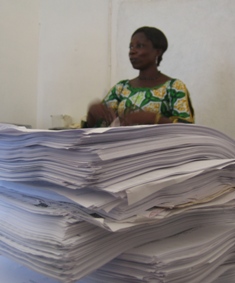
The staff of the agency includes a few supervisors, counselors and volunteers. The very junior and enthusiastic ‘senior’ staff is crammed into an office that is barely 2×3 meters, most of it filled with dossiers, a small table and plastic chairs. The dossiers are a mystery to me; boxes full of papers with information about patients. One wonders what will happen when the caseload really increases, as it has been of late. It is only going to go up.

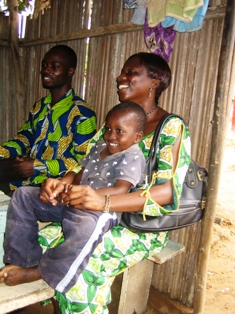
The agency works with the extreme poor, people who go into debt and borrow money to pay for transport to go to a patient meeting in town. We went on a short drive to that part of town that is defined by the word ‘transit. Aboisso is the last big town before the border with Ghana. Not surprisingly the prevalence of HIV/AIDS there is high. Our hostess took us to the house of a sero-positive woman with 7 children of various fathers; the youngest child, Belem, was diagnosed as positive. She doesn’t know about the others. Some of the other children were ushered out of the simple bar structure that provides a little income to the sick and single mother; they don’t know and mom did not think they need to know. It was very humbling to be so close to the bottom of the societal pyramid. We were all touched by the devotion and caring of the agency’s chief who had clearly gotten the confidence of many people who might not have made it without her. But it is also overwhelming when you think of the number of people who need the same kind of tender loving care. It is hard to even consider the word luck, but it seemed that the woman we met was lucky in a perverse sort of way. Even in bad luck there can be good luck.

Décollage

A night full of dreams that were dense and a bit somber. I think they were that way because I am a little bit anxious about today. It is all one big experiment yet I am supposed to know what I am doing. I do in some ways and I don’t in others. I have no idea how well our hosts today are prepared for this unusual kind of visit, a learning visit rather than an inspection visit. There is no model for this. People understand it intellectually but will they get it in the heat of the moment? I will be going to a small NGO called Lumière Action with only two other people. We have asked to accompany some of their field workers. More about that tomorrow.

I stayed up late last night in the hotel’s lounge because that’s where I can get the wireless, not in my room. It is already more than I had expected so I am grateful for this service that would have been inconceivable when I was last in Cote d’Ivoire, 15 years ago; especially in a three star hotel outside the capital city.

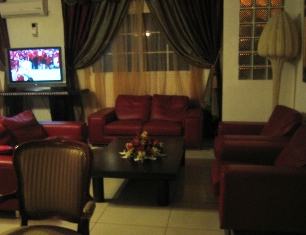
I was alone in the lobby lounge that is made to look like a living room with a large plasma TV that is permanently on, showing one American movie after another, with mouths that speak English while the words come out French. The films are of the action type genre that I can only tolerate when doing something else or on a plane with the sound turned off. When it gets really late the X-Files come on; also dubbed in French. The only other person watching was the receptionist. I suppose it is one way to pass the lonely evening in the empty lobby.

A small gadget mounted on the wall puffs out, at set intervals, a tiny cloud of some chemical compound meant to make the room smell ‘fresh.’ The smell is strong and overpowering, especially since the thing puffs rather frequently. I believe these gadgets are meant for bathrooms, but here someone had a bright idea. This morning I discover the same gadget is mounted on the wall of our conference room. It makes a soft squeaky sound each time it releases a puff; it continues to catch me by surprise, and then I remember.

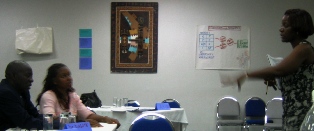
We started the workshop in a rather tentative way. Only one third of the invited members and their alternates were in the room at the appointed time after lunch. Right there we had the entire ‘problematique’ of a voluntary body before our eyes; if you want to test it, start on a Sunday afternoon, during school vacation, in a place 40 km away on a congested road that makes the distance appear twice as long. It is actually amazing that we had about half the people in the room by the time we ended the day, and all but 5 at night time.

Launching a workshop is like taking a plane up into the air. You have to get to a certain speed and get the weight and balances organized right. You can calculate much of this in advance (and you should); you have to trim the plane just right, all the while watching the various instruments that provide information you need to take into account. And then there are those things you cannot change such as wind and temperature but you better be prepared to adjust your wings.

That is exactly what we did. Oumar and I were well prepared and we adjusted our program when it became clear it needed adjustments, given who had shown up, or rather how many had not. Oumar, in his masterful way, used the example of this adjustment to teach our local counterparts a few lessons about leadership on the fly.

One of the members of the CCM was also a student in the last of MSH’s publicly offered leadership course that I taught in Dakar in 2001 with Bula-Bula from the DRC, one of Francophone Africa’s all time master trainers. We co-facilitated many workshops in the 1990s. But Bula did not take good care of himself (leadership lesson #1: Stay alive!) and died of a heart attack quite suddenly and much too early. I sometimes think that Oumar channels Bula.

For dinner we went to the same place as yesterday but this time with an order placed ahead of time; it was waiting for us on the table. Back at the hotel, close to 10 PM, we found our local counterparts fully engaged in practicing their session of tomorrow, as we had suggested. I realized that I had overestimated the skill level of at least one so the practice was important. We spent the next hour coaching, practicing, more coaching and slipping in a few tidbits about adult education that were missing. I am encouraged by their engagement and enthusiasm. This includes Flore the local MSH admin assistant who is giddy with excitement about her good luck to be allowed to attend the workshop. I think I see a budding facilitator and coach. While Oumar and I were having dinner she replaced us, without being asked, as audience for our practicing colleagues. She gave them feedback and support that was much appreciated and very perceptive. Sometimes talent hides in surprising places.


January 2026
M T W T F S S
 1234
567891011
12131415161718
19202122232425
262728293031  

Categories

Blog Stats

  • 137,094 hits

Enter your email address to follow this blog and receive notifications of new posts by email.

Join 76 other subscribers