Posts Tagged 'Ethiopia'


Habit

I am starting to get the lunch routine: large quantities of finely cut meat and chicken deposited on the rag-like injeera bread, eaten very quickly as if one’s life depended on it and then a visit to the espresso machine for a much more leisurely after lunch macchiato. Eating is more of a functional activity than a social activity. Some of the people who have visited the US commented on how long Americans spent in restaurants. Not here.

The restaurant where we ate Wednesday night’s meal is called the Friendship restaurant. It serves a house injeera dish, friendship firfir, chicken pieces, egg mixed in with pieces of injeera on top of injeera. Last night’s new dish was Ethio-Italian fusion: spaghetti with injeera, eating with one’s fingers. Kids would love it here!

I am beginning to learn the names of the various local dishes. At first they all looked alike. I can now detect the raw meat dishes that are served amidst the cooked meat at lunch during the workshop. Since we are holding the workshop in the dirty hotel, I am not touching those. This seems the prudent thing to do, even though I did like the ones I tried last week in Addis.

The Friendship restaurant is an example of Ethiopian entrepreneurship. The owner is a lecturer about entrepreneurship at Bahir Dar University and clearly knows his subject matter. He started with a small eating house which has now become one of the more popular dining establishments in town. When we got there it was full and when we left it was still full of people eating injeera or pizza or spaghetti. Even last night, with electricity missing, it was full with people eating entirely in the dark. We went elsewhere, preferring a meal we could actually see.

At lunchtime I joined a zonal governor and a regional health economist. They talk about leadership – what else – and then about Obama. They had both read his two books and cheered him on long before most Americans decided he was the right person. They brushed aside his African descent as of minor importance; instead they admired his stance towards change, his sincerity, his courage and moral character. You’d think he is their president, so proud are they. It is nice to hear that people here feel America has brought them good things, for a change, like Obama and Michael Jackson.

The group is beginning to thaw a bit. I notice a little more energy on our second day. The shy people (the two women and some of the men lower in the hierarchy) are starting to participate more. The facilitators are realizing that the quiet nature of people is not entirely an immutable fact of life and depends to some degree on their own behavior as facilitators. It’s a powerful lesson about change and taking things for granted – we are going straight against the grain of a long process of acculturation. I am pointing out things they can’t see because they are so used to them being the way they are. We are trying to instill a habit of questioning the status quo – it’s a little revolutionary. Some of the people get that and see the potential.

The facilitators have a tendency to drift back into what I call ‘priest behavior’ – passionate lectures with raised finger to emphasize their message, make a point. Everyone falls right into position of passive listener. It feels familiar and comfortable and we argue a bit about whether it is good or not. There is a tendency to patronize people: punish late comers (the facilitator is the one who punishes) and reward those who arrive on time with a prize. I remind them that this is a parent-child relationship with people who are otherwise adults and ask them if that is what they want. No, they don’t but had not realized that that is what they were doing. These are very deep-seated habits, created way back in grade school and never questioned since. The pervasive religiosity in this country, with its paternalistic language, supports this way of thinking and being – flocks, sheep and shepherd, father and son, obedience, good and evil.

After dinner we went to a tiny night club, its 25×25 feet floor space occupied by at least 50 people sitting (very) closely together on tiny stools drinking beer or Coca Cola and watching traditional music, song and dance. The artists performed in a space no larger than 3 feet by 2, with waiters and incoming and outgoing patrons squeezing by. Sometimes the audience had to duck to avoid the dance props (umbrella, sword and stick). The songs, I was told, used to be about politics but now they are about sex. All the foreigners were singled out for sung comments, producing much laughter. Pierre-Marie and I smiled as if we got the joke and pressed the expected 10 Bir bills in the singer’s hand.

Back at our dark hotel Hana and I tried to negotiate a late check-out but the desk clerk was unmovable about the 11:30 AM check out time (“I will have to charge you another night after that time”). After all the lousy service I managed to get myself worked up about his rigidity and unhelpfulness and angrily climbed the 3 flights of stairs in the pitch dark, fueling my anger even further. I vowed to write a scathing review on the virtual tourist and trip advisor sites, joining many other negative reviews. The concept of customer service is not in use here. I don’t think they realize they should try to avoid getting customers like me so upset.
Slow and dry

Despite the presence of electricity I was off to a slow start on Wednesday morning, the start of our first leadership workshop. Slow as in ex-cru-ci-a-ting-ly slow internet connection, not able to post my daily blog (Axel did from faraway Manchester) and participants trickling in to the workshop at the pace of snails. I am slow myself in adapting to the slowness of everything but I am getting there. I am adjusting to the non-responsiveness of the surly hotel staff and the absence of the most rudimentary standards for a hotel. I am resigning to the reality of a life without internet access. Maybe this is simply a downshifting of gears for my new life in Kabul.

A third member of the Centre for African Leadership Development (CALD) joined us last night. The only one we are missing is Abigael but she has a three-month old baby and cannot be away overnight. We expect her to play her part in the Oromia Region leadership program that was postponed and will hopefully happen later this month.

Ethiopia has now entered July, the beginning of the new fiscal year. People are available again. Pierre-Marie found government officials celebrating this transition in his hotel with a party. They were expending the last monies of the year before theses were returned to the treasury.

I have installed myself in the back of the large conference room, not planning to play much of a role other then counsel and feedback. I am finding myself less involved than I was in previous launches of our program. Partially because I am moving out of this business and partially because I have learned to trust that things will work out in the end, even if not entirely going to my (high) standards. The facilitators are learning a new dance – I gave them the steps and now they have to find their own rhythm.

The early exercises are very quiet; people appear subdued, even zombie-like. According to my new colleagues, who are all half Amhara, this is part of the ethnic character. The expectations exercise is usually full of platitudes, like I want to learn about leadership, but this one is different. In their very quiet way, the participants are telling us they expect to see results of their acquired leadership skills in the reduction of waiting times, the better use of resources, more people referred for counseling and tested so they can be treated. I have never heard this before and am pleasantly surprised.

At the copious break we are served dry cookies, cold (dry) French fries, (dry) cake, (dry) buns, (dry-looking) kebabs, (dry) donuts, and more (dry stuff). I go for the wet things and ask for tea. I sit with one gentleman from the regional level and one from the woreda (district) level. Both are very excited about their participation in this program, even though nothing in their faces shows it. Exactly after 15 minutes everyone gets up and walks back to the conference room. I guess this is how they show their excitement.

Over lunch everyone watches the Michael Jackson memorial show, the same we had to watch over dinner last night. Although he never came to Ethiopia Michael Jackson was a big star here as well; a real star in the sense of a celestial body, ungraspable, mysterious, bright and shiny, from an alien and faraway world. I am told Ethiopians feel indebted to Michael because he alerted the world to Ethiopia’s plight during a massive famine sometime in the 80s or 90s. And so they are mourning his passing with the rest of the world.

I am posting this during a brief internet window that opened hours before everything will be turned off again. This is an advance for tomorrow.

Power falls

Before I went to bed last night I plugged in all my electronic equipment so they could start charging as soon as the electricity came on. At 4:30 AM everything sprung to light, literally. The cellphone, computer, ipod and Kindle began to fill up their empty battery bellies with juice – like little piglets sucking from their mother’s teats.

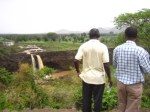
Yesterday morning we worked for about an hour dividing the sessions between the local facilitators and then decided it was time to play before 3 hard days of work. There are not that many tourist attractions here but the Blue Nile Falls is one we were told not to miss. Since the rains usually start in the afternoon we decided to go in the morning.

We squeezed the 6 of us in the rented SUV, just barely doable for the 45 minutes ride each way over an unpaved washboard-like road. I was thoroughly shaken by the time we came back to town. I was also exhausted from the hike up and down valleys, over the 400 year old Portuguese bridge and along a mountain path that led us to the plateau from where the water tumbled.

Electricity, when it is there, comes from a hydro-electric dam that catches the power of the Blue Nile. The engineers have created an alternative route through which they lead the water to and through the hydro dam. This reduces the enormous natural falls to a narrow trickle, still impressive but clearly no comparison to the real thing.

Apparently, the flow is routed back to its natural course every 24 hours or so which makes the falls quite spectacular. Our double bad luck was that the water was routed through the hydro station so we did not get to see the river falling down naturally while also not benefitting from the generated electricity that day.

My colleagues told me that the Ethiopian government blames the WorldBank for its power problems and the WorldBank blames the government for unacceptable equipment and designs and thus withholds funds. I am not sure this is the real story but whatever is happening, no one seems to take responsibility for the fact that half the time businesses like hotels, restaurants, copy shops and internet cafes have no power. Since it is not anyone’s fault, everyone has learned to live with this state of affairs. It makes you want to take certain people by their shoulders and shake them. What are they thinking? (or, what am I thinking?)

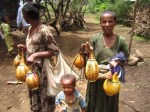
Along our hike we met a dozen small kids, all speaking perfect tourist English, selling their wares (decorated gourds and woven shawls) with the perseverance of encyclopedia salesmen. On the way up to the falls we promised ‘later.’ When we came back they reminded us of our promise and eventually accused us of being untrustworthy. We were indeed, shame on us, but what do I do with a decorated gourd and yet another shawl?

Because of the power outage there was no water in my room when I returned to the hotel. My request for a bucket of water was met with incredulity. Why? I finally convinced one eager young man to get me the bucket if only to please me. The absence of water and electricity every other day is considered entirely normal in this hotel. I am still counting the days: three more, of which two with electricity and water and one without.

Today we start our workshop in the conference room of the dirty hotel (but with generator). Life is full of surprises.

Patience

At the same time that the large blue neon sign was turned off our electricity came on yesterday morning. A little too late since the day had begun and I did not need it anymore. The shower was of course cold because the water heater had been off for 24 hours. I tried to remember that many people around the world, if they have showers at all, have never known the luxury of a hot shower. I held my breath as I washed my hair. Without a shower curtain the small bathroom was wet in no time; cold and wet I dressed and had breakfast downstairs where the lights had been on all night. It’s easy to feel sorry for oneself under such circumstances. Sometimes being in Africa sounds more exotic than it actually is.

For three dollars and sixty cents I had a large glass of fresh mango juice, several enormous slices of toast, a chili omelet and a macchiato, not as good as the macchiato at the Yoli hotel but better than Nescafe.
I knew things were taking a turn for the better when I was, against all expectations, able to post on my blog site, just in between two early morning power outages and before our work started. It made my day after the inauspicious beginning yesterday and I felt outright lucky. Thank God for small victories.

Of the 35 people we had invited for the senior alignment meeting about 22 showed up, including, in the end, the big boss which was the signal that we could start. Having had similar events in other countries with only a small fraction of the number invited I was quite pleased, especially since we had several people from the office of finance and economic development. Such cross-sectoral involvement is rare in health programs even though money is a significant driver of their success. The problem here is not a lack of money but too much of it that is not being spent in time.

We discovered that the Ethiopians are still in the month of June, something I should have known but had forgotten. It is the end of their fiscal year and they are trying to spend all the leftover monies before the kitty locks up. This explains why the Oromia program launch was postponed. We thought it was already July – it is for us but not for them. Today is June 29 on the Ethiopian calendar that counts 12 months of 30 days and one of 5 or six days.

Pierre-Marie is moving to another hotel. He has had it with the lousy service of the hotel that claims to be a four star establishment. We had our MSH operations manager talk with the hotel manager about client satisfaction and dissatisfaction. I am hopeful that this will trigger some changes in staff responsiveness to our needs and will give the hotel another chance. Pierre-Marie will not. He found another hotel at the edge of the lake with guaranteed water and electricity.

I learned from our colleagues who stayed in the hotel next door, where our meetings take place, that they did have water and electricity but that the rooms were so dirty they slept on their towels on the bed. Weighing dirt against the absence of power and water I opted for clean and power/waterless. I can compensate for the absence of utilities with candles and bottled water in case the manager’s promises fall short. I can’t think about anything I can do about dirt.

We ended the day a little early and had time for a quick debrief. Everyone agreed that it had been a good day. What I had taken for less than active participation was considered very active by our Ethiopian colleagues. Apparently the Amhara people are reserved and not very expressive. Since the entire day was done in Amharic I could only judge what I saw, not what was said. And so Pierre-Marie and I were re-assured that the participation had been excellent and of good quality and had created a hunger for more learning about leadership and management.

This (Tuesday) morning we are once again without electricity – for the next 24hours. Posting this took a trip to the other side of town and long waits. The internet café next to my hotel stays closed until the electricity comes on again. There is also no milk, no juice and no syrup for the French toast that has little to do with the original product I ordered. How a town can exist like this is a mystery. No one but me and a handful of foreigners are perturbed by this state of affairs. For everyone else this is normal and deserves no more than a shrug of the shoulders. Patience, I counsel myself.

Powerless

We flew in an old Fokker 50 up north. It’s an old workhorse but it got us there safely. We descended straight in over Lake Tana. The lake looks muddy from above; brown-red from the runoff off the red earth around it(we are in the big rain season). The lake is dotted with bright white pelicans. Bahir Dar is a provincial town. It reminded me of Kisumu in Western Kenya, also situated on a lake, on the other extreme of the same volcanic rift.

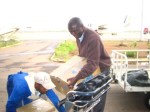
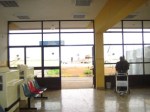
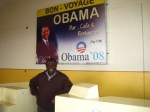
The small airport is a throwback to the days when there was no such thing as airport security. People wander in and out of the building; no uniforms or metal detectors. A large billboard with a smiling Obama advertises for the Obama Café and restaurant in town. I would have liked to have lunch there but unfortunately it had closed.

We were greeted at the airport by a colleague who is in charge of regional operations. He had hired a driver and car for us which we can use as we please. After settling into our hotel, we asked driver Abraham to show us the town. It is small and consists of a rectangle of paved roads with dirt roads in between and hundreds of little shops. In the middle of town is the large church with hundreds of people dressed in white sitting and standing everywhere to follow the services which continued throughout the day.

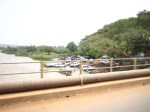
The town is bisected by the Blue Nile; on one side of the bridge was a small café built on stilts over the river while on the other side of the bridge the Nile served as carwash. The bridge is guarded on both sides by two lone military men.

Everywhere in town we saw graduates with mortarboards and gowns with colorful sashes, accompanied by proud parents and siblings. They had their pictures taken at the church, at the lake and at the monument that memorialized those who had risen up against the Mengistu regime. The other happy crowd in town consisted of newly married couples in their noisy and gaily decorated motorcades that came by every few minutes into the evening. A happy but power-less place this town of Bahir Dar.

Over lunch of grilled fish from the lake and the traditional mounts of meat on injeera I grilled Pierre-Marie about his unusual life style: as my MSH colleague he is a program manager and public health physician but he is also a traditional chief in a small town in Cameroon. Technology makes it possible to be those two things at the same time: his advisors who rule on his behalf during his absences check with him on decisions via email and the town has a website so he can peek in via the internet.

Access to the internet here in Bahir Dar is a problem. After lunch we surveyed the local internet scene. Because the electricity in town is out today this means there is no internet access at any of the internet cafes, except one with its own generator. We check it out. We patiently wait for the pages to load and give up after about 15 minutes. We pay 70 cents for our combined half hour of access. I managed to get one message out to Axel that access will be problematic this week.

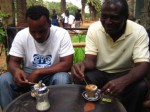
No electricity also means that the espresso machines don’t work, and thus no macchiato. But Abraham knows about a generator-powered machine and so we do have our one macchiato of the day, for 30 cents each.

When night falls the only two things lit are the huge bright blue sign of the Amhara Development Association Head Office that shines straight into my room and the hotel’s restaurant which is powered by a generator. I have two small stumps of candles in my room which won’t last long. Asking for more candles downstairs requires a drawing – English is definitely a weak second language here.

I have a feeling that this is going to be a long week.

Up and dark

This was probably my most boring 4th of July. I missed being in Manchester, watching the parade and having the wonderful 4th of July plein air lunch at the Makowskis. Instead I spent the day in my hotel room, watching TV whenever the electricity was on, and when it was not, the clouds, the rain and the few people outside through my window. I played solitaire and read Dawkins’ irritated tirade about the God Delusion.

I emptied my mailbox down to the last 3 emails and since everyone is busy celebrating the 4th, no new emails came in. I packed my two suitcases and a small travel bag to take to Bahir Dar – the suitcases stay behind in the hotel – while I watched the Matrix, a movie I would never think of renting or watching in the US. Here I can simply mute it when it gets too exciting. I needed Axel or Tessa by my side to explain what was happening.

Dinner with Pierre-Marie in Don Vito’s was probably the most exciting event of the day. We know the menu by heart. It has not changed in years. We ordered the same thing: mushroom ravioli, salad, a glass of wine and a macchiato served by the same girls with orange blouses. They must be working at least 14 hour days since they also serve us for breakfast in the morning.

And now it is some ungodly hour on the 5th of July which is still the 4th in the US. It is pitchblack outside except for the nightclub decoration and cars coming and going. The musci is thumping along insanely loud downstairs, probably at its peak (it is 4 AM). We are off to the airport with all the other people heading to the graduation ceremonies in Bahir Dar. I hope we are early enough to secure our reserved seats.

Cultural

The fourth of July started with loud-thumping music seven stories down from one of Addis’ premier nightclubs, conveniently located in our hotel’s basement. The action went on until the day started, around 5:30 AM. It’s America’s birthday but few people would know here.

Liz left on the Lufthansa flight to Frankfurt last night. Pierre-Marie and I have the day off before heading out very early tomorrow to Bahir Dar. We have no connections at the US embassy and so we will pretend it is an ordinary Saturday.

Yesterday morning we reviewed the notes of the workshop that starts next Wednesday, demonstrated a few more sessions and hope for the best. The local team is ready to take on the work of developing (health) managers who lead in Ethiopia. We will watch them run workshop #1 and provide them with support and feedback. After that they are in charge. It is a just-in-time orientation that has worked well in Nepal, Swaziland, Ghana and Cambodia. We have active teams busy in all these places, all on their own with only occasional support, by email, from me.

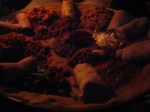
In the evening we were taken out to a cultural restaurant, a uniquely Ethiopian phenomenon, omnipresent throughout the city. It was my third such experience and that is enough for now. You sit on low chairs around a small table, eat the sour-tasting injeera bread dotted with heaps of meat prepared in various ways. ET_dinnerThis included raw meat which Liz politely declined. Eating vegetables is not part of the experience. I am told that vegetables are for poor people who cannot afford (much) meat. I haven’t eaten this much meat in a long time and am craving fresh fruit and veggies.

Singers enliven the eating experience. The first singers were either male or female, clad in tiny pieces of leopard print and other cloth that would be entirely out of bounds in my future home of Afghanistan. Halfway through the evening the singing and dancing became ‘cultural’ which means tied to specific regions of the country. The government is encouraging the resurgence of tribal pride in ways that makes the younger generation, raised as Ethiopians, and often of mixed heritage, very uncomfortable. They have seen the consequences of tribal pride in neighboring countries and it scares them.

The female dancers are stunningly beautiful in their traditional outfits. The men appeared to be made of rubber. During one of the tribal dances my neighbor points out to me that these men would procure male genitalia as wedding presents to their brides. These were cut from hapless travelers who crossed their territory. I am glad that we have evolved a bit as a human species. There are still a lot of things wrong in the world, but I don’t think this type of cultural legacy is OK.

The cultural restaurant experienced is a bit tainted for me because of the expectations that visitors, especially foreigners get to embarrass themselves publicly by dancing opposite one of these rubber people. I dread the moment when the dancers start to scan the audience and begin to pull people to the stage to dance with them. I tried to make myself small and never look the dancers in the eyes. I went to the bathroom at a strategic moment and in doing so avoided this embarrassment. Liz and Pierre-Marie did not but I missed seeing them dance.

Back at the hotel the red carpet to the nightclub was out and the music had started. We said goodbye to Liz and withdrew into our rooms, trying to shield ourselves as best as we could from the loud thumping of the deep base tones coming from down below.

Buffed and polished

Because of all the schedule changes and Liz’ departure tonight we treated yesterday like a Saturday, a half day of work and the rest playtime. Early in the morning, before the office car arrived, we took a rickety taxi to the other side of town where the leather factory is and bought the leather good we had fancied and put aside last week. Even though I felt a little guilty about the amount of money we dropped there, Liz convinced me that we had actually supported the local economy. I can only hope it was not a Chinese owned factory, a real possibility. The Ethiopians here say that the Chinese are taking over by consuming their women and their chickens.

Even if it was a locally-owned factory, I was still wondering about the social impact of my purchase. I watched the Story of Stuff the other night on YouTube and am trying to be a little more conscious about buying stuff. For one, I was wondering where the runoff went of the chemical processes used for converting the hides into soft colorful leathers. I can only hope that it is somewhat regulated (am I kidding myself?). The factory is located in a neighborhood with other factories surrounded by small houses behind walls and narrow unpaved roads. Would anyone know the cancer rates in this part of town?

The rest of the morning Liz oriented all of us about the various management tools that MSH headquarters makes available to our field projects. I listened with my new hat on, as a director for management and leadership and thus a potential user of such tools. I imagined getting Liz to come to Kabul and do the same there. She’s very good at it and knows the management tools better than I do.

We had lunch at one of our favorite café/restaurants that is conveniently located above the Boston Spa. We had changed our Saturday appointments and spent the entire afternoon being scrubbed, buffed, polished and massaged. Now Liz is ready (and pretty) for the long plane ride home and I got some of my stiffness massaged out of my tangled and knotted tendons and muscles. My feet were sanded down to soft baby skin and my toenails painted a deep dark red.

In the middle of our beauty treatment the electricity went out, a fairly common occurrence here, rain or shine. It is hard to imagine a spa in the US functioning without electricity but here no one seemed very perturbed by it. I am glad I had selected the color of my nail polish before the lights went out because doing that by candlelight in a windowless room might have produced some surprises. So we ended up having our nails painted in the dark. The nail technicians had done this before; our nails came out perfect.

Pierre-Marie had no part in this very feminine entertainment and only joined us at night for dinner. He was actually working, interviewing candidates in Kinshasa for his other project launch in the DRC.

Surprise!

It’s July 2nd in Addis, Tessa’s birthday. Back home she still has to sleep through the night before the festivities start. It was 24 years ago that Tessa arrived amidst the smoke of the burned croissants in the locked oven of the Beverly Birth Center! Congratulations dearest Tessa, you are nearly a quarter century old.

July began with rain, just as in Massachusetts. All those low clouds were beginning to get to me but the clouds lifted and we saw sun and blue sky for the first time in days.

Just when we were ready to celebrate the completion of the training of trainers and move into the implementation phase with the first important meeting on Friday, we received word that the whole program in Oromia region was off. ‘Sorry, not a good time,’ said some underling on orders from up high.

We sent a heavy delegation to the health office to inquire and find out what was behind this order. But the underling didn’t know much and the bosses were in meetings. We don’t known whether the program is postponed or cancelled altogether.

This surprise came after countless inquiries months ago to make sure the timing was right. One of the things we (the foreigners) learned is that this period is the end of fiscal year and therefore planning (and spending budget leftovers) time. You’d think that that could have been known some time ago. There are also other events organized by other agencies. This is where we trip over each other.

The disappointment also provided an opportunity to experience the first workshop together, in Amhara, rather than in two parallel teams. It is a nice idea in theory but not everyone can be there on time because the planes and hotels are fully booked as it’s graduation week at the University in Bahir Dar. Nothing is going to be easy.

Liz has decided to go home – she was supposed to coach the team in Oromia and we don’t need three coaches in Amhara. This works out well for her because she’s needed back home. I will miss her, not just for sharing the spa experience on Saturday (male colleagues are not so much into spas), but also because I would like to hand over some of my work to her as I clean my desk for Afghanistan.

Sans pizza

Nightlife is active around the hotel throughout the night. It is a good thing I usually sleep well but occasionally I wake up and wonder who is out there being entertained by those who earn their living that way. When I get up early in the morning there are always a few stragglers down below, night creatures who appear to dissolve in daylight, then re-appear when it gets dark.

Yesterday we spent the entire day practicing how to monitor and evaluate the leadership work. We use real life examples of leadership-driven change projects that we have gathered over the years. I think it was an eye opener for our new facilitators who are more used to focus on individual transformational work – good work that is notoriously weak in showing anything tangible as a result.

Today they get to practice sessions that they will do for real on Friday when we are really launching our program with what we call a senior alignment meeting, an attempt to get the bosses on board – at least the ones that show up (something we have no control over).

It has been raining ever since we arrived and were told to have brought luck (i.e. rain) with us. The rains are like monsoons and drench the city, leaving huge puddles wherever the roads are not paved and overwhelm the drainage on paved roads. As a result the electricity goes on and off, a problem that everyone seems to take in stride and which shows up in poor internet connections and the inability of restaurants to produce pizzas.

My longtime friend Youssouf from Burkina also showed up in Addis, even staying in our hotel. Liz now is the only non French speaker. Occasionally we slip into French and Liz gets to experience a little bit of the total immersion that she will throw herself in when she comes back to the US and heads to Dartmouth for a 10-day French intensive course. Youssouf and Pierre Marie know each other of course. In their company I experience that special ‘je ne sais quoi’ that makes working in Francophone Africa (something I have not done for a long time) so wonderfully appealing.


December 2025
M T W T F S S
1234567
891011121314
15161718192021
22232425262728
293031  

Categories

Blog Stats

  • 136,982 hits

Enter your email address to follow this blog and receive notifications of new posts by email.

Join 76 other subscribers