Posts Tagged 'Ghana'

Fits and starts

The return flight had a few glitches. Not the kind that can easily be fixed by one person because they are ‘system’ glitches. But what is ‘the system’ when you try to fly home?

The Ghanaian Delta staff valiantly tried to load the plane to New York without the help of computers because ‘the system was down.’ I found throngs of people in front of the Delta check-in counters, a full two hours before departure. It was a good thing I had checked in online and printed my boarding passes on hotel stationary. As a result I breezed through check-in and formalities and bypassed the crowds. Still, the people at the gate did not believe that my ordinary piece of paper, the seat assignment section ripped off along the non-existing perforated line, was actually a real boarding pass. This self-service check-in is clearly not a common practice yet on that side of the Atlantic.

Check-in without the help of computers can be done but the manual system is rather slow and flawed. As a result the boarding process was hopelessly chaotic because most people had not received a seat assignment. The plane left an hour and a half later than planned. It was a lucky day for at least 35 people who were pushed forward into the large but empty business class. Among them was Gloria, one of the senior managers with whom I had just spent 3 days at our retreat. It was her lucky break at the start of her vacation.

There was a different kind of chaos awaiting us on the other side of the Atlantic – a traffic jam at JFK which kept us searching for a spot to park and then waiting for a people mover, the funneled buses on retractable stilts. One people mover parked at the rear of the plane which disappointed all the people in business class, especially those who had found a seat near the front door in the hope of being the first out of the plane. Just when we had all moved to the back of the plane, waiting for another bus, one showed up in the front. The mass of people heading for the back door turned around and rushed back to the front door as if the tide had turned and eb turned into flow.

All in all it took over an hour from touch down on the runway to stepping inside the Delta terminal. There was much stressing around me, and we had not even gotten to the city itself! Many people had missed their connections. Not me, I had four hours of waiting ahead of me and so it did not matter where the waiting took place.

Arriving at the Delta terminal at JFK does not show America at its best to first time visitors. The place is grungy and not very welcoming. The TSA lady, asked to do a body search on me because of my sling, inquired what the thing was. I answered that it was a sling, as politely as I could. She then asked me to stick my arms out. I told her my arm was in a sling for a reason and that I could not raise my arm. This was a new concept. After making sure there were no traces of explosives on the contraption I was admitted to the inner departure sanctuary for my next flight.

More glitches as we waited to unhook ourselves from the jet way. Our 10 PM flight was ready for take-off at 11 PM precise. Axel was waiting for me in Boston; it was now close to midnight. There was one more glitch: something big (an accident or a mega construction project) on 128 South had closed the highway and we were ramped off to find our way through exurbia back to 128  a few exits further south. We arrived home after midnight and I tumbled into bed, beyond tired, around 1 AM. It was a fitful sleep but a happy one after this very long day. I am home again with my honey.

Last day

Saturday is for rest, in principle; as is Sunday. But this Sunday is for travelling back to Manchester by the Sea and yesterday was for finishing the work of this trip and the last day of work of nearly 23 years of work at MSH headquarters. It hasn’t quite hit me, but it is momentous.

I completed our report as far as I could get and in the late afternoon we met to complete the missing pieces. In between we played with friends. Jacqui was one of them. I met her in Rajindrapur last Decemer at the BRAC conference and we clicked, as they say. She is from the UK and her husband is from Denmark. His job here has earned them a CD license plate. I am not sure it helps them much in traffic jams but maybe it helps in other ways.

Jacqui was the chief of party of one of the USAID projects that has just ended and did not win the follow on project, against all expectations. This means that Jacqui is free now and available on the labor market. This is good for MSH.

Jacqui was one of the lucky people who got to chat with the Obamas during their visit here in Ghana. Laterwe met with Barbara who also shook hands with our president and his wife. Everyone agreed that the Obamas visit was spectacular and special in addition to being a lot of work and, traffic wise, a pain in the neck. Barbara told us there was a baby (Theresa) sitting on the lap of her parents near the family planning station, who was picked up by the president (presidents do this sort of thing) and that this baby is now referred to as the Obama baby. Maybe the parents should consider a name change (Obamia? Or simply Michelle?)

After a lukewarm Nescafe capucchino-wanna-be, Jacqui took us to a shop to get one of the many designs of cloth with Obama’s photo in large ovals. She also took us to a small shack-like store of a long-term resident Swedish seamstress whose unusual designs told us something about her unusual mind. We had not expected to go shopping and so the prices exceeded what was in our purse.

At the end of the morning Jacqui left us to return to her family and we pursued our (re)discovery of Accra. I found the Lebanese silversmith I had first visited with a colleague some 8 years ago. We spent a lot of time in the store that is like a living room with thousands of lovely and not so lovely pieces of silver jewelry, hiding in a regular house off the main shopping street. I practiced my rusty Lebanese and bought a few pieces to be gifted away. Lunch was across the street, Lebanese of course.

And now it is time to zip up the suitcase, pay my bill and say goodbye to Diane and Ghana, for a while.

Habit

Ghana_SLR 161At 6 AM the car park outside my window is teeming with people carrying small and big bundles. Taxis and small buses stand ready to take people wherever they want to go. It is Saturday morning and time to travel. I am told that much of this travel is to relatives far and wide to attend funerals and weddings, events for which people are spending more than they can afford and go deeply into debt.  William has told me about this disastrous social trend that drags middle class people below the poverty line. Apparently it is the Christians more than the Muslims who engage in this Ghanaian version of keeping up with the Joneses.

Like any gathering of people, it is also a good place to sell stuff or to preach; both are happening in a cacophony of voices, colors and sounds: it’s pure eye candy. I try to capture it on my small low performing camera. Where are my daughters with their equipment and skills when I need them?

William drove us back to Accra after the completion of the retreat, more or less on schedule. The HR director and the DG joined us at mid morning, something we had hoped but did not want to believe until we actually saw them. They arrived just when the participants, in self selected teams, had made commitments to take a small bite out of a series of huge challenges, observed during the visits we made earlier, in cross functional teams: one group took a bite out of the human resource challenge, another out of the resource management challenge, another sat down to tackle infrastructure challenges, a fourth team took on quality assurance and the fifth team decided to get their own house in order to improve the functioning of the national health insurance scheme. All challenges are enormous and represent nearly intractable tangles of interests, agendas, stakeholders, schemes, models, languages, and a history of piecemeal and failed attempts.

We call these leadership projects that give senior leaders a chance to rehabilitate themselves in the eyes of those working at the operational level and improve their management and leadership skills. It is opportunity to show that they can make a difference for the levels below that keep pointing fingers at them. There is a tendency to want to take on everything at once and cover the entire country, in the process making the task so difficult that everyone gets paralyzed or feels so impotent that any action feels risky. This, I believe, is the cause of much of the inertia that we see and that people complain about.

I also believe that the inertia comes from not seeing it; everyone else does the same. I provoked the participants a few times on their passivity when their team members did not show up at agreed upon times. No one took action; no one called his or her team mates, even after dropping a few hints. People want to be congratulated on being on time themselves; when I told them it doesn’t count until their teams are complete there was this vacant look on their faces. It made me want to wave a large flag in front of them, shouting, ‘anybody home?’

They all say they want to change this habit they consider dysfunctional. But it is lodged deep in their cells.  It will take an enormous and sustained effort to dislodge it. As Mark Twain observes: “Habit is habit, and not to be flung out of the window by any man, but coaxed downstairs, a step at the time.” We did a lot of coaxing these last few days.

Many of my observations about senior leaders were confirmed by my friend Seth who is now high up in the ministry of education. He happened to be in the neighborhood of our hotel yesterday and we met in the hotel bar and talked about his new role and his past history with the regime that is in power again. Seth and I met at a conference in Zanzibar some 3 years ago and have stayed in touch. He will be one of my sounding boards for my theories about senior leaders, since he is one himself.

I am disobeying doctor’s orders and slept the entire night without my sling. I can’t stand it any longer. The physician’s assistant had told me some weeks ago that he usually lets patients take the sling off at night after four weeks. In two days it will be four weeks. I let my body guide me: the discomfort is less without the sling than with it.  I can move my shoulders in several directions without any pain.  I assume this means it is not frozen, something I was worried about.

Make-do/can-do

The chaos of getting 22 people off in 7 cars to 7 different destinations as close to 8 AM as possible did not materialize. Our Ghanaian colleague Philip had been fretting over getting this right, not an easy task, and then everything was right. At lunch time everyone returned and the field visits had been completed without a hitch, with spirits high. There had also been some bonding across organizational divides; there is nothing like sitting together in a car going over bumpy roads. It reminded me of a field visit I made with a bunch of family planning professionals from all over Francophone Africa in Benin. We travelled over bad roads for 700 km, from early morning to deep into the night. We sang songs for hours, told jokes, changed tires and pushed the car out of mud; we became friends for life!

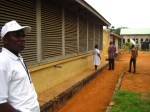
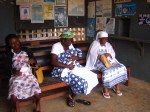
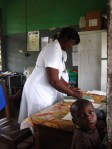
I accompanied two gentlemen from the ministry of health and we were  expertly chauffeured by driver Valentine over roads that had lost their hard top here and there. Although our destination was not far, it took us exactly an hour to get to our destination. We were warmly welcomed by the midwife in charge, just outside the Labour Ward where some hard work was being done by two women who had reached their term. No husbands were present – labor, even with an extra ‘u’ is women’s work.

Over the next couple of hours we chatted with various employees and explored the buildings and rooms that were part of the health center. The senior leaders were told to present themselves as students, counter cultural for sure. There had been much concern before the visit about whether this was possible and shouldn’t we surprise people. But none of these fears came to pass, as I knew from experiences elsewhere.

The health center consisted of the main block with wards and consultation rooms, a block of dilapidated staff quarters, an incinerator, two containers that houses the generator and the ambulance, a block of rooms for specialized services and something that was referred to as the ‘new’ building, a large unfinished structure in a corner of the compound. Work had started some 8 years ago but they had run out of benefactors or the benefactors had run out of money.  Inside it did not look like a new building anymore.

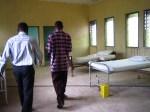
A matron who had been taken out of retirement had settled into one corner of the building overseeing a makeshift recovery ward. The ward has two beds, one covered with two crib mattresses instead of an adult mattress, a bench and a crib. ‘It’s not enough,’ she said. Sometimes she has to ask the least sick person to move over to the hard bench. We were all inspired by her commitment, passion for her work, concern for the community and can-do attitude. She surely was able to make something out of nothing. Asked about her retirement, she answered that she was too good and too strong for that and that she plans to continue working under contract as long as she can.

Throughout our tour the accountant accompanied us, pointing out the places where resources would make a difference and places where they themselves had made a difference in the absence of a response from their own employer, the government of Ghana.

At the family planning clinic we found the nurse talking with one of the outreach workers, a young man who does vaccinations as well as HIV/AIDS outreach. We asked the nurse to teach our driver how to put on a condom. He was a good sport and demonstrated at the end of the lecture that he had understood everything well, from hand washing to opening the package and rolling the condom down on a wooden model; all this done with great care and clarity and a good dose of humor.

On our way back to the hotel we stopped at a tiny community health center staffed by community nurses. We learned much about the reluctance of the (very poor) local people to be referred to the next level health center and how this has led to true telemedicine: the nurse in charge calls the physician assistant, who is the person in charge of the referral health center  (the one we had just visited ) who coaches her trough his cell phone on how to give care that he would have given. It is not ideal but she learns from this and the patients benefits; another form of can-do/make-do.

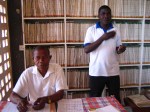
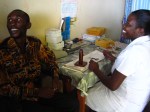
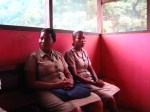
I interviewed three young community nurses who are entering their second year after 3 weeks of practical work. They had just returned from their community outreach rounds, checking up on the vaccinations of babies and mothers. Their eyes sparkled and their uniforms were spotless but brown; the coveted white uniforms are not for them until they pass next year’s exams.

After lunch we compared notes among the seven teams, using appreciative inquiry as our approach: what had they seen that was inspiring, touching, surprising (in the positive sense) and life-giving (literally and figuratively). What we heard stood in sharp contrast to the supposed incompetence, low morale, mediocre care, inertia, drug supply problems and poor management that we are usually being told about by the top people in the ministry, people like the ones  we had in the room.

We were encouraged by the interest and enthusiasm from our participants; there is no more coming and going and, aside from things like punctuality, everyone is fully participating and deeply involved in the program.  I provoked them around the punctuality issue. There is much denial about their own behavior and they are rarely confronted, except by their bosses, who probably don’t manage themselves very well either. There is also much inertia and little sense of collective responsibility. A few individuals are proud, and want recognition for being on time and ‘sticking to the norms.’ Yet there is no action to make sure their whole team is present, even after several hints. Although Americans are culturally considered individualists, and Africans collectivists, when you look closely you see that the educated elite has drifted far afield from the collective sense of duty and responsibility, may be not in their words, but surely in their actions.

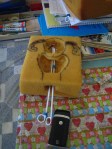
We ended the day with two exercises, one called the Helium Rod, which we fabricated out of flipchart paper, and the other about shared vision, using a gadget that we also constructed out of material found locally. Experiential exercises are still a novelty here. It is one place where we can put a mirror in front of the participants and show them what they actually do, as opposed to what they say they should be doing. In a place where senior people don’t ever get direct and honest feedback about what they should be doing differently, this is the only way to confront people so they can see what they need to work on. Intellectually they buy this, but there is a sense of impotence when it comes to action.

Today the rubber will hit the road. In a reflection about the effect of the appreciative inquiry many expressed concern about it being a bit artificial and not contributing to the solution of problems. The problem-focused approach to work and life is so deeply entrenched, and so pervasive that it has become embedded in their very cells and doing anything else feels wrong. We told them we will get to these problems later but first wanted to establish a solid foundation of knowing what is going well so that this can be supported, enhanced and extended.

Today we will focus on their challenges. We will put them to work, in teams, on analyzing how they can remove obstacles they observed in the field. I have a premonition that they will find ways to push the responsibility for solving these problems further up the chain, thus reinforcing the practices that firmly keep in place the roadblocks that everyone can list in their sleep and that have been identified in countless reports for as long as I remember but that no one feels empowered to tackle.

Frogs to start with

An ADRA driver picked us up and took us up to Dodowa, in principle a ride of one hour that took us closer to 2 hours. We kept turning right, and then right again, and again, and again. I expected to find ourselves back at where we started. I find the layout of Accra and its outer roads very confusing and disorienting. There are some cities, like New York City or Washington, where I can quickly orient myself, even without a map. Accra is the opposite, together with Conakry, two places I never figured out despite multiple visits.

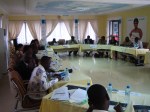
The start of the retreat was as tentative as the 9 months of stop and go preparation. Of the 30+ invitees only 4 were present at the appointed (lunch) time, 11 people showed up an hour later, still working on their lunch when we were supposed to have started. More people straggled in over the next few hours. Nevertheless, by dinner time we had caught up with our planned program and everyone was deeply involved reflecting about leadership, their own and others’.

After dinner we lost people as fast as we had gained them. Some went home even though we already paid for their hotel room. We are apparently still too close to Accra. Still, many are intrigued with the methodology and the approach we are taking and fourteen people showed up for the after dinner session on work climate. Our lead facilitator was stuck in the rush hour traffic leaving Accra for hours and Diane, bless her heart, jumped in with only seconds notice and ran a good session in his stead.

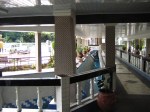
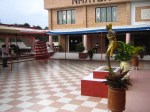
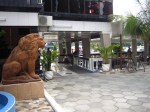
We are staying in a hotel that was designed, I think, by a builder who doesn’t believe in architects and who cheaped out on materials. It is a veritable accident waiting to happen with shiny tiled stairs that could kill you in the rain and levels up and down everywhere, gratuitous steps without a purpose other than to trip you. Tripping would be a disaster for me as I cannot catch myself with two arms. Thus I walk slowly and very mindfully through the long death trap hallways, up and down levels that are hardly noticeable because the tiles fool you into believing all is level.

When I went to check out the hotel on Monday, straight off the plane, a gathering of traditional rulers was in session. Each ruler was decked out in magnificent cloth, loosely draped over one shoulder, with spectacular staffs, thick gold necklaces and head bands with fur from powerful wild animals. It was a photographer’s dream but I was too timid to snatch the opportunity until invited to pose with two of them. I was promptly addressed as ‘wife’ by one – apparently spouses can be acquired easily by a traditional ruler. I smiled and then we parted ways – divorce being just as easy.

At the end of the day I retreated to my enormous, gaudy pink and gold room. Outside the hotel, thousands of noisy bullfrogs, who live in the blue-tiled moat that traverses the grounds, make any conversation impossible. They make such a racket that neither the airco nor music could drown them out. It is a deafening cacophony of ribbits and croaks that went on all through the night. According to my faithful medicine cards, the frog stands for cleansing, new beginnings, or maybe simply a good start.

Touched

I woke up to the news that Ted Kennedy died. Someone reminded us how many people’s lives he affected and I thought of Said, now settled in Cambridge with MP and Wafa; that’s three people, right close to me whose lives he touched.

One of my first experiences of America’s internal politics was watching Axel’s parents mutter and sputter as they sat in the smoke filled TV room, each in their own naugahyde chair, hers white and his red, watching Teddy Kennedy speak. The political divide between Axel and his parents was always huge; they were staunch republicans and Reagan could not do no wrong.

Back in Ghana we met with our co-facilitators at the ADRA office which has become like a home away from home. The ADRA staff treats us as family members, looking after our comfort, picking us up, dropping us off. They do all this without us signing logbooks or collecting receipts for reimbursements from someplace else – an old fashioned kind of courtesy that is rare in my line of work. It’s all driven by a deep concern for our well being and old fashioned hospitality.

We completed our preparations for the senior leadership retreat and made a visit to the US embassy compound. I asked the guard who checked us in whether President Obama also had to hand over his cell phone, show his passport and walk through the metal detector [big laugh].  Everyone had been there to see the president; it had been a time of great excitement and tons of extra work, gladly done for the reward of seeing his majesty himself.

In the meantime Diane and I had a chance to get to know each other better.  Diane lived in Ghana some 12 years ago as Plan International’s country director. Her account of that time was so very positive that I did not understand why she had left the position, until I learned of the rather dramatic circumstances that spurred her family’s departure: she lost her mother-in-law, only days after she had returned to her native Bolivia from a visit to Ghana, to a particular malignant form of malaria; she nearly lost her then 2 year old daughter. Diane herself left the country seriously ill with the same disease and struggled to recover in Britain. While all this was happening their house got cleaned out by burglars. All circumstances combined to signal them that it was time to leave. The return back to Ghana is clearly an emotional experience.

Diane is rediscovering her old staff. They all seemed to have done well; most impressive is the one who is currently vice-president of the country. We schemed how she could get a message to him.   Conveniently we had dinner with Brian, a friend and member of the original leadership development facilitator team, who was part of the current president’s campaign and transition team. He will pass Diane’s personal message to the vice-president. How cool is that?

Educating testosterone

The New York Times published a series of articles with a focus on women. The articles were sent to me also by email by various friends and colleagues and posted on facebook.

The conclusion was so obvious and earth shattering (no, wrong metaphor) – namely that when poor women are given the chance to lift themselves up, they tend to lift everyone else up around them, including their abusive husbands. When people say that ‘a tide lifts all boats’ I now realize that this is not about economic progress but about the influence of the moon (feminine) and its tides (feminine).

 I was particularly struck by research findings about crops produced by men and women, not sure where it was, India may be. When the men’s crops did well (and these crops were things not necessarily good for humanity, like tobacco) the earned money was used for sex, drugs and alcohol; when the women did well (crops to feed themselves and others) the money went to education, food and clothes. Even if it is an oversimplification and generalization, everything I have seen in my career confirms this. Education of men and women changes the dynamics significantly.

All the articles were right in line with Bryan Sykes’ findings as described in ‘Adam’s curse,’ as well as the description that Sarah Chayes gives about the behavior of men the last 20 or so years in Afghanistan, especially in and around Kandahar, and especially the non-educated men.  Can we take this curse another 100 or 200 thousand years, as Sykes predicts the lifespan of the Y chromosome? Women do keep up half the sky; they also counteract unbridled and uneducated testosterone.

In the meantime, things continue to move along in Ghana. Diane arrived, as intended, on the KLM flight, in good spirits and rested. We ran into our colleagues Issakha and Aboubakry, both from Senegal, who are here setting up a new regional project that MSH won. Issakha will be the project director based in Accra and Aboubakry, who I last worked with 7 years ago, will be the technical lead based in Dakar. We had dinner together and had a good time.

At 10 PM I tumbled into bed and fell into a bottomless sleep, making up for a missed night.

Moving right along

Even my comfortable business class seat was hardly wide enough to hold me and my sling contraption. It took me several hours over the Atlantic to get comfortable enough to fall asleep. Luckily I had no neighbor; he or she would have been whacked a few times with my slinged arm on a shelf.

It was a good thing I had some sleep. As soon as I had checked in to the hotel, before my luggage even made it upstairs, I was on my way in a taxi to a health facility on the outskirts of Accra to meet up with part of the team that is running the coming retreat.  Despite Axel’s admonition at our goodbye (‘now, take it easy’) and my answer (‘sure! you know me!’) I did not want to miss the chance to visit the health facilities that would be hosting the most senior leaders from the ministry for their scanning visit and I also was curious to see what my team mates were actually saying about the retreat and the field visits.

What struck me right away was the absence of context setting. I guess people are used to headquarter folks coming in and handing them a letter telling them to be here or there (usually in just a few days) or hosting this or that group. The conversation was short and straightforward but if I had been on the receiving end I would have wondered, ‘what’s this all about?’  Maybe the health facility staff did wonder but are used to never question people higher in the hierarchy.  I started to add some context to the retreat and soon my colleagues added this to their introductions and I could sit back again and watch (and trying not to yawn).

I visited more places, offices, hospitals and health centers than I can remember. I was in a bit of a fog from the 11 hour flight and the 4 hour wait at JFK. Besides, the weather was hot and humid, just what I had escaped in Massachusetts and New York; travelling under such conditions is hard at any time.

The roads were either bumpy, requiring us to zigzag, tripling the distance, or newly paved which the driver took as a sign to accelerate to twice the speed limit. What really did me in was the constant getting in  and out of the large ministry of health  SUV, the kind that you have to pull yourself up in; it’s tricky with only one arm. Halfway through the afternoon I was getting very sleepy and  wondered why I was putting myself through this. Now, back in the cool hotel, after a bath and a change of clothes I am pleased again that I went. It was very illuminating.

So now I am back again in the land that tells sexual deviants, right at the immigration desk, to go someplace else (for their own and others’ good). I am trying to imagine someone walking up to the officer and saying that he’s a deviant and that it would be better if he goes someplace else. On which plane would they put him? The Virgin Nigeria that was parked in a far corner?

I am also in the land where nearly everything you need can be bought from your car window; like Ethiopia, this is a country full of entrepreneurs – money can be made in a thousand different ways but most seems to be made in tiny increments from selling telephone cards, cheap stuff from China, snacks or cold drinks.

The city is still full of pictures of candidates who lost the elections. It will help with name recognition, I suppose, in the next elections, some years into the future. Accra is also full of signs that our president was here: there are tiny Obama chop shops (local food shacks). Enormous billboards feature the partnership for change with John Atta Mills and Obama shaking hands – they both ran on a similar change and hope platform.  

Most striking is how clean the city looks. A man in blue coveralls with  a yellow safety vest is weeding the sidewalk of one of the main drags with gloved hands. Maybe no one told him he could stop now and that Obama has left; or might it be possible that the municipality of Accra plans to keep this up? That would be something to write about.

A toe in the water

More calls, more negotiations, explorations of options, but all separate conversations, one-on-one phone calls, small meetings with key actors missing, not sitting around a table together. This is hardly possible as centrifugal forces pull everyone into parallel or intersecting orbits, never the same. If you’d try to map these orbits it might look like a drawing from an angry child; Separates that do not make a complete wardrobe; stuff not adding up. How anyone can concentrate on doing anything well seems like a miracle. Still, stuff does get done.

I have made a new proposal, just one event, to dip the toes into the water and try this new thing that’s not called a training program. I use the word conversation. It would be actually a series of structured conversations over three days or so with all the key actors of one program together. It would have to be the family planning program because of the funding source but it really doesn’t matter – it could have been any program. And all of the conversations would concentrate on where the rubber hits the road – where the services are delivered in whatever way they are or should be.

I remember from watching a video of Parker Palmer talking about medical education where he insists that the whole patient sits in the middle of the conversation – all the time; something like that. The way to get the – in this case provider-client interaction – in the middle of the conversation I would ask them to spend an entire day either shadowing a community or outreach worker on visits or working side by side with service providers in a health facility (health post, clinic or hospital). It will not be easy to actually organize this, but that is also a matter of finding the right people (it always is), who understand the concept and are excited by the idea.

I wrote a long email to the chief of the Health Services and his HR Director and ended it with a quote from Scharmer’s Theory U book: “On the one hand it is the experience of shaping something: that’s a source of empowerment. On the other hand, it is to see the context in which you and your colleagues work. That changes your view of the larger system. You learn to see the meaning of your work in the context of the whole (region, program). Seeing that larger whole and how you relate to it is empowering. Through your better knowledge about how the system works, how the region (or program works), and by getting to know [all these] people you end up having a different access to making things work – things tend to flow more effortlessly.” (Since I read him on a Kindle I don’t have the page number, one Kindle flaw for people like me who are always looking for quotes.)

Although I am not entirely sure how this will come together I know for certain that this idea will produce the desired outcome: a small group of people who see the potential of such conversations and want more of them, with more people. I dare to stake my reputation on that – if only given the chance. I have done something like this before, nearly 10 years ago in South Africa’s Eastern Cape with the entire top team, led by its energetic chief. Not much came of it I believe because soon after the outing the chief died at the young age of 51. In the midst of paying attention to everything and everyone else he was not paying attention to himself. He died of a heart attack. Since then, when asked “what is the most important thing for leading at the top?’ I always say, “stay alive.’ After all, no matter how good you are as a leader, as a dead leader you are no good at all.

And now, onwards home after a brief catching of breath and buying of cheese in Amsterdam.

Squirreling

Although I didn’t feel so positive as I headed into town to speak with the HR director, road signs tried to cheer me up that good things were afoot. “French begins with you & it is possible” exclaimed a small hand painted sign tacked to a gnarled tree near the city-central cemetery.

A huge bill board from one of the main cell phone companies promised that the world would be one in 2010 and that it (the company) couldn’t wait. The small soccer ball in the corner indicated that this was only true for soccer lovers. The company operates in many countries so the odds are that ‘it’ will win. And then there was the giant national monument promising Freedom and Justice, the national motto, presumably for all; a lofty ideal that still has a way to go.

All over town there are two sets of political signs, one with the candidate who won, and his running mate, sometimes depicted as very dark skinned and on other signs as very light skinned. I wonder whether that is a printing error or intentional to appeal to all shades of Ghanaians; the party that lost also still has its giant signs up saying that their man is the best. May be he was but he did not win.

We had a long and frank conversation about this senior leadership program that I am trying to get started. There appears to be a reluctance to say no to the donors and their particular agendas. I am not hearing the ‘no thank you’ although I have suggested it as an option. Maybe I will hear it today.

Of course there is also the option of looking at the funding, with all its strings attached, as an opportunity to also get something else done or to re-negotiate the strings (possible, I am told by the donor). Once again, it appears to be a conversation that is not happening – instead I witness meetings in which people don’t really say what they mean, or, to paraphrase Martin Buber, don’t mean what they say. No wonder we are all in trouble.

So I have shifted my framing of what we can offer: a series of conversations rather than a training program, in which we can slowly rebuild the feedback loops that have been severed or missing, and hear the stories from the heart rather than the intellect. I think I can do that and today I will find out whether I’ll get that chance. Or I’ll finally hear the no, and I’ll have peace with that too as it means the timing was not right.

It was clear that my unconscious was not done with the events and insights of the day after I went to sleep. One dream put me in a winter landscape, on slippery ground where my guide plunged a long way down into a stream. He could have been killed but he survived. A wild fox that looked suspiciously like Alison’s corky Abby jumped from tree branch to tree branch overhead like a flying squirrel, it colors brilliant against the white winter landscape. I know that in Native American medicine the squirrel tells something about squirreling away nuts for later; busy now with collecting, safe later during the bleak days of winter. I certainly have been busy collecting impressions this week and have stored them (on this blog and in my mind) for later.

I wrote a message in the guestbook for my friend Susan from Alaska who has just been diagnosed with pancreatic cancer. It is odd to be on the guestbook side of Caringbridge, a site so familiar to me as an author during our first 5 months of recovery. I am glad to know how important these messages are and that we are all given the chance this way to follow her in her journey and cheer her and her family on. This journey will take her to Boston repeatedly I suspect and I hope to see her in person at some point. It does put things in perspective.


December 2025
M T W T F S S
1234567
891011121314
15161718192021
22232425262728
293031  

Categories

Blog Stats

  • 136,984 hits

Enter your email address to follow this blog and receive notifications of new posts by email.

Join 76 other subscribers