Posts Tagged 'Ghana'


Disconnections

With my system recovered from the flushing activity of Tuesday, I was ready for a full day of work. It turned out not all that full as we had only been able to secure one appointment in the morning. A dinner meeting was added later in the day, unplanned but welcomed, with a team of consultants assessing the health system’s health.

I found myself less certain of the good outcome of this trip after meeting with one of the regional directors who challenged me, indirectly, and politely, on bringing in yet another training program. She listed training programs done by other organizations – some of which I know – that all came with promises that weren’t realized.

Organizations and projects often put training workshops in their plans because it is something that you can do no matter what and then tick off as accomplishments. Of course they are not accomplishments unless the participants go back and change their ways but that requires intensive support and coaching over a long period of time. That rarely happens. How can I explain that what we bring is different?

I like that we were being challenged because it actually shows that someone is not happy with this state of affairs. No one should be, but people have a love-hate relationship with the donors: they like the treats and the trips but they don’t like to be bossed around.

In the afternoon I got a surprise call from a (Dutch) compatriot who is in country with a multi-donor team that is here to validate self assessments from various parts of the health system in preparation for the Health Summit that happens next month. It’s a lofty idea but only works if people actually do their self assessments which they had not. So the team went fact finding on its own.

What they are finding is not a surprise and could be found in any country that receives mega donor funds. Every part that plays a role in the larger health system is disconnected from every other part, from the community down at the bottom of the societal pyramid all the way up to the donor community with their earmarked funds. Everyone knows this, but it is mostly an abstraction as long as the fingers of blame point away to others.

One of the team’s conclusions is weak leadership at the top. That too is not new – but then what? Sending people to Harvard or Oxford, or bringing in a big consulting firm to teach these leaders about management and leadership has been tried before and not produced any of the hoped for systemic changes, even though individuals changed.

Here, like in most other places I visit, the work is embedded in a culture that does not let criticism rise to the top. As a result higher ups are not benefitting from any meaningful and actionable feedback about their own contributions to bottlenecks and miscommunications. Thus it is not surprising that people are looking for causes and solutions that do not include them. What’s bad and hurtful about this state of affairs is that the criticism is voiced to others, outsiders or peers, and so it does enter into the organizational bloodstream after all. And yet it cannot be acted upon in a direct way because of the way it is voiced, softly and behind people’s backs. No one will ever be successful this way.

All this makes my mission very timely and at the same time difficult because everyone wants other people to be trained in leadership, yet there is no open communication about any of this. I am making these visits and notice that the dots are not connected, and no one wants to be fixed unless the training is seen as a nice vacation from work and some extra income.

How all this is playing out in my psyche was obvious from a frightening dream I had during my afternoon nap in which my brain was disconnecting from my limbs and senses, or more correctly, the place that the sensory nerves went to was disconnected from the command center that told the motor nerves what to do. I wanted one thing but my body did something else, my eyes weren’t registering what was in front of me and I had no control over where I was going. It was a perfect representation of the team’s findings that were communicated to me many hours after I had the dream. On a cellular level I knew.
Architecting a better place

After our first day of work in Ghana I can say that we made progress on one front and were set back on another. The senior leadership program is beginning to take shape. We got something I have wanted to get for months: a determination of which teams shall participate. We also have a rough idea on when this program might start and who will facilitate. I am testing the model that we constructed only a week ago in Cambridge on what sets senior leaders apart from the district teams we have been working with here in Ghana – that got a good response too.

The next hurdle will be to get attention from the very (very) busy senior leaders and their subordinates so that we can explore what they are up against, collectively and individually. We are calling and trying to get appointments but so far no luck. I have used up one of my 4.5 days here, so this will be an exciting race against the clock.

The setback is that the submission of our research proposal to the authorities, which we had thought had been duly submitted as required three weeks ago turned out to have been lost in between offices. This led to a frantic scramble to get official letters from collaborating institutions here and in the US, and a new document, written according to guidelines that have only now been revealed to us, a literature review, consent letters, etc. People and organizations like ADRA and GIMPA are coming to our rescue.

The document has to be delivered, in 13 bound copies, at the Ministry’s Research Unit early this morning – with no guarantee that the review board will get to it, or consider our handiwork of last night sufficient. The next meeting is in 2 months, too late for us to piggy back the low budget research project to the leadership development program that starts in one month. This delay would effectively nix the research project.

La Rue, bless her soul, is doing the re-writing as she knows about research and the requirements of Institutional Review Boards. I would have been totally flummoxed. My contribution was to deliver the connections and a cell phone with enough minutes to produce at least some of the letters and endorsements, including a phone call from the highest authority. Whether this will help remains to be seen and we are keeping our fingers crossed behind our backs. One step forwards, one (or two) backwards.

In the meantime a surge of energy is coming in through the internet from Sita who has set out, with her Value Web colleagues and graphic facilitator buddies to connect the dots around the world. The dots are all the people who are working for social justice and eradicating all sorts of bad stuff from the globe – not for profit but out of a deep sense of obligation, or simply the excitement of trying out something new. She is bringing idealist fervor to the table that is in sync with what our new president is trying to hold on to in the midst of public outcries and self-righteous and simplistic demands.

Sita wants me to connect her to other people who are experimenting at the edges, innovators, creative geniuses, social experimenters. It makes me search my mind for people in my network who love this sort of ambiguity, open-endedness, and would embrace the idealism of such an outrageous idea (what? work together, hook up with people around the globe, across disciplines to make the world a better place?).

It has been tried before and it can be tried again, each time a little different. The codeword I am learning, as I follow her quest, is re.co.de which stands for repetition (as in iteration), collaboration and design. I made a subfolder in my inbox to hold all this energy tightly together. I named the folder ‘Sita CTW’ – the last letters stand for Change The World.

But when I go through my network I find very few of the kind she is looking for and more of the kind who, I think, would ask me: what’s this all about ?(answer: an idea as in idealism); what’s the result ? (answer: we don’t know); what’s the outcome? (answer: something good); how would we measure that? (answer: beats me); who would benefit? (answer: everyone except the really bad people); who’s funding this? (answer: no one in particular moneywise, and everyone who joins, energy wise).

At a closer look of her last email last night I noticed that her signature stamp said, Sita Magnuson – Vice President, US – The Value Web. Imagine that, we have a VP in the family. I am so proud of her, not so much of the VP title, although that is certainly cool, but because of the energy she is applying to this connecting people to one another around the world for a greater good. It’s a long way from the moody adolescent who said she wanted to be a garbage collector in New York City because someone had convinced her they made so much money, and that’s what she wanted.

Just say no

When you arrive in Ghana a big sign with the words ‘Akwaba’ welcomes you. Right below it is another sign “Peadophiles and other sexual deviants are not welcome here.” There was a gentleman sitting behind me on the plane who was reading a help-yourself-type book with the title, “The Hardness Factor.” I did not have to read the subtitle to know what that was about. I don’t’ think he fits the category the Ghanaians are afraid of, at least not yet. The lady sitting next to me on the way back was reading a much tamer book that contained 105 prayers. Of course I don’t know what the prayers were for.

When you leave the country you are reminded every 10 meters that drug traffickers eventually get behind bars. Someone designed this campaign, hired an ad agency and now it is considered implemented. Will any of these campaigns make a difference, I wonder?

On my last night in Accra I saw another campaign at work as I was watching a local TV network: a compelling ad shows people trying to slip money into the hands of officials for work they are not supposed to be paid for. In the first part of the ad you see various officials happily pocketing the bills and providing the payer (briber) with whatever it is he wants. Interestingly, none of the bribers are women. Then, the movie is rewound and the same scenes played over again but this time each of the officials portrayed (women among them) shouts ‘NO’ with the sound missing but you can read their lips. They bravely and selflessly put the common good before self interest. It looks so simple. It is a strategy out of the behavior change school that believes that exhortations to “just say no!” actually work.

That it is not as simple I witnessed at Accra’s airport yesterday morning. In order to get checked in and cleared to leave Ghana, with all your stuff intact, you have to follow a very convoluted and circuitous process with many stops where officials go through the same documents, open and close (or not) your suitcase and rifle through your carry-on baggage. A gentleman in front of me, flying business class to some UN meeting in New York pressed a 5 Ghana Cedi bill (about 5 dollars, a considerable amount of money for ordinary people and low level officials) into the hands of the lady who was checking his hand luggage. This is the weak chain in the security link. I watched her lips and she did not say ‘No.’ Instead she quickly zipped up the bags and the UN delegate was cleared. They saw me watching. I saw no signs of shame, secrecy or anything that indicated they considered what they just did wrong. I wondered whether they had seen the ad and if they did, whether they considered it had anything to do with their own behavior.

It may be a common practice and hard to stamp out, but in my line of work, the places I travel to, I have never needed money to get through a barrier. This includes a checkpoint with drunken teenagers carrying Kalashnikovs in northern Rwanda a few years before the genocide, a Kenyan security agent who found cash on me and told me I was not supposed to export any Kenyan Shilling (nice try) and a Guinean customs agent who wanted money but instead got a pack of condoms which I had been given after touring a PSI project in Kankan. May be the latter does count as a bribe but it has a nice side effect from a public health point of view.

I was thinking about the ad that urged me to contact an official whenever I witnessed bribing. I tried to imagine actually doing that right there in the airport and realized that the exhortation to ordinary citizens to act on (rather than only denounce) corruption is a nice idea but quite naive. I looked at officials in the area and wondered who I would go to. Who would be the righteous one who would take my complaint serious? Who would thank me because I had helped him (or her) stamp out the practice? More likely, I suspected, would be a polite nod from the official who would then turn around and make the rest of my departure miserable or encourage other to do so.

Corruption is so tightly woven into the fabric of life that I don’t think you can tackle it through exhortations on TV. And so I justified not sticking my nose into the UN delegate’s business. My Quaker consciousness rebelled a bit against this decision but my Dutch sense of realism and practicality won out in the end.

I am still not sure I did the right thing but I did get upgraded again to business class. Reward for what?

Westwards

Yesterday I was up early, did my exercises and took my regular seat in the internet café behind one of the big clunky machines. I finally got the hang of posting my blog from a pen drive. It takes some organization and it takes time. But at about 3 dollars an hour one can be patient.

My first morning here breakfast consisted of cold pre-fried eggs on equally cold and very thick toasted white bread, sliced to the thickness of about one inch thick. Toast is therefore merely an idea as it is hard to penetrate to the center of the slice without burning the outside. Yesterday’s breakfast consisted of hard boiled eggs with the same toast and a tiny dish with miniscule amounts of butter and jam. At least nothing would be wasted.

There is a choice of a Lipton teabag, ingenuously constructed with two strings looped inside the teabag so that when you pull the label the strings magically lengthen, or Nescafe, now packed nearly everywhere in the slender stick package that was, when it first appeared, so very European. Hot water is kept hot for hours in a Chinese made thermos, ubiquitous in Africa. ‘The Perfect Choice’ it says on the label of this particular thermos that comes from the ‘Envy ™ serie.’

I was the only guest in the breakfast room as the participants had all gone home. I sat on a small balcony looking out over the ocean and the wavy palms. The words ‘Oh what a beautiful morning’ popped into my head and I had to contain myself not to break out into song. It was that kind of morning.

The rest of the morning I met for the last time with the facilitation team and we retraced our steps from the just-in-time start in January to the results presentation this week. The experience had been overwhelmingly good except for the continuing sticky issue of money requested for things that were not in our budget or we are not allowed to pay for as per US government regulations. These things tend to create a very negative field that can completely obscure whatever good feelings there were before.

When we were done there was a long wait before lunch. We killed time by talking about yesterday’s late start and how this was yet another example of espoused theories about leadership that bump into ingrained reflexes to leadership anchored in the institution of the traditional chieftaincy. Talk is cheap; acting on those words is dangerous and can cost you your job, as some have personally experienced. Most people cannot afford the luxury of speaking their mind. This is when I discovered that Brian (Brain) is not afraid. He has put his eggs in the basket of one of the presidential candidates who appears to have a good shot at the throne. If he wins Brian hopes to get a position in the presidential entourage. Then I will have a friend in a high place. Later in my hotel room in Accra I watched a video portrait of his candidate. I think I have to talk with Brian about that portrayal. His man came across as someone who hires young men out of work to dance and sing around him and look excited. I was not impressed and was struck by the general absence of women in the video montage.

The hotel in Accra hosted a fashion show to which all guests were invited. The most intriguing outfit was from an up and coming young designer who had attached a gold-sprayed calabash to the model’s derriere. It bumped around as she did her catwalk. It did not look like she could ever sit down with the thing dangling behind her. The ingenuous headdress, very African, very Ghanaian, also required at least one hand to keep it from flopping over. It was a nice outfit to look at but so totally impractical.
All models had faces like masks. I suspect that is how they were instructed. They posed where I stood (the photographers corner) and so I had a good up close look at their faces. Theirs was a kind of vacuous gaze. I had fun staring back; my gaze was met with a stare that only babies could trump.

And now back to JFK, about 10 hours away, westwards.

Smooth operation

You can’t say no to royalty. Today’s royalty in Africa are the chiefs of administrative ‘tribes,’ of government ministries and departments. When they arrive late you feed them breakfast, even if 30 people have been waiting in a conference room for over an hour. Maybe they did not even ask for breakfast but you treat them like royalty, nevertheless. That’s the tradition.

So all of us were way off with our bets on how long after the official starting time of 9 AM we would actually begin the formal show and tell. It turned out to be one hour and a half. It never ceases to amaze me that this keeps on happening despite all the rhetoric (and much complaining) about punctuality. I watched people’s reaction intently and was glad that I was not in charge. Some people openly rolled their eyes presumably because they saw the contradictions; others are so used to it they don’t even notice; and finally there are the facilitators who appear to be, as a universal subspecies, in perpetual denial about when people will actually arrive. I stopped proposing to include the expected delays in the day’s programming by padding all the activities with extra time. We never caught up in the morning. Everything got simply moved up. People are used to this. I did not see anyone look at their watch but the participants did decline the afternoon break until the program was officially closed, and the bright yellow ADRA polo shirts and per diem handed out, late in the afternoon.

While the important people ate breakfast the teams used the extra time to get their final presentations in even more final shape. I could not help myself and dragged inserted photos back in shape here and there. People liked it when I helped them look thin again instead of the squashed creatures they had become. Pen drives were exchanged accompanied by queries of ‘how clean is your’s?” or “Are you free of viruses?” With all of us working in public health we have fun with these allusions to safe sex and infections. We, or rather our viruscan software, did ‘catch’ some nasty viruses in the process; Brian, who was first introduced to us as Brain – a name that stuck – lost some files. They were suddenly gone. If ever there was a good reason to back up, this is the place. I travelled with my two laptops, 2 pen drives and 2 multi-gigabyte hard drives. Between the two computers I juggle two versions of MS Office, one readable on one computer but not on the other. It gets rather complicated and it is a challenge and a half to backup the right new versions over the right old versions in such a way that the files (doc or docx) are on the right computer, hard disk or stick and can be opened properly.

During the morning I managed to sit through all 7 PowerPoint presentations without yawning. Listening to the presentations was actually quite enjoyable because they were sharp, tight and short. The facilitators had sprinkled the really good ones in between the less impressive ones but in the end they all came out quite compelling. Yeah for PowerPoint!

And once we started it was one smooth operation from start to finish. The presenting teams were confident and completely owned their challenges, showing results people had not expected possible in only 6 short months. And they promised more results and more impact by the end of the year.

I watched the facilitators guide the show with equal confidence. I was happy. Maybe this is what grandmotherhood feels like, watching the grandchild walk with confidence and seeing the parents enjoy the miracle; that’s how we were all together yesterday morning.

After the presentation a flurry of excited conversations took us through lunch. We discussed a senior leadership program for teams from the central level. The top is usually left out from the sort of practical training district officials often receive. They are occasionally sent to overseas courses but most are theoretical and very cerebral. The senior leaders are very thirsty for having the experiences that their subordinates have, and so the doors are wide open and we started to explore how and what to do. I am thinking about using juggling as a metaphor for learning. I did this many years ago in Turkey and produced some twenty fine jugglers in the process, all wearing suits; they were also to have become better trainers but of that I don’t have first hand experience.

In the evening Naomi and I accompanied the facilitators for a walk on the beach followed by a meal that was slow in coming, and pricy for Ghanaian standards; the worst was my five slice pineapple desert that cost the equivalent of 5 dollars; this in a country where pineapples practically grow by the side of the road as a weed. Everyone agreed I paid ten times too much, so I left the precious pineapple fibers stuck between my teeth for awhile prolonging the delightful taste of Ghanaian pineapple.

On the balcony

Yesterday I arrived in Cape Coast quite rested. Somehow I managed to take a few catnaps on the way down there even those the car rattled and vibrated like a truck. I already knew that, if there is no choice, our bodies are quite adaptable and the mind can simply shut off.

I arrived at the Sanaa Lodge hotel about noon time, expecting to see the entire group at lunch. I was wrong. I was welcomed with applause as I entered the conference room in the middle of the 4th of 7 dress rehearsal presentations. It is then that I realized, once again, that the visa/passport hiccup that had postponed my trip by a day had, after all, been a good thing. I have a hard time sitting through many slide presentations and seven in one morning would have been a bit much; three and a half was just right.

 Some teams had done well, others less so. I noticed that the tendency to call absences (lack of this or that) ‘obstacles’ was still alive and well.  It was good to sit in the back and listen and see where our notes or instructions have not quite had the desired effect. But it was also nice to sit in the back and be an observer for a change. The facilitation team, brand new to each other and the material in January, had nicely come together and was entirely and confidently in charge.

Naomi is here from our partner organization ADRA. She flew in from the Southern Sudan via Kenya and is here to be proud of her organization, especially the team leader William who is the exemplar of a leader and exactly the right person to lead this program.

We walked around the reception area with our laptops trying to ‘catch’ the wireless  signal which the hotel claims to have and we failed to find. The hotel’s IT guy is looking into this but since we are leaving tomorrow we are not holding our breath. The five clothes hangers I asked for have not arrived either and will probably never do.

Susan and her colleague from USAID/Ghana arrived in the afternoon and we sat side by side in the hotel’s internet café having plenty of time to catch up during the innumerable pauses created by slow machines and slow connections.

For dinner we drove into town and had shrimp curry and jollof rice in a little shack on the beach. When we came back I had planned to head straight for bed but was told that a gentleman was waiting in the conference room for me. That was of course William, abandoned by his crew and acting very much like I would have as lead facilitator: taking care of details for tomorrow, getting all the handouts right and working late into the night. I ended up working with him, ‘drawing’ the vision that was created in January on a giant flipchart and reviewing all of the improved PowerPoint slides until it was past midnight.

Today we have been told that a ‘high-powered’ team is arriving from Ghana’s health headquarters to listen to the results of 6 months of intense leadership development work. This we have been promised by the top chief who cannot be with us, unfortunately. I was able to catch him on the phone in between meetings but that is all the contact we’ll have on this trip.

It is a risky thing to invite people for morning attendance at a site that is several hours and many traffic jams away from their usual place of work. We guessed how late some would arrive and when we could actually start. As usual, I am the more pessimistic one on that; all but one of my Ghanaian colleagues think that this time, here, now, things will be different. I have heard that said before and am doubtful but won’t make it my problem. I am, after all, an observer, or, as one of the facilitators said, “you are standing up on the fourth balcony above the dance floor, watching.” Ron Heifetz would be thrilled to know his metaphor is used so fluently in Ghana.

Rush-rush-wait

Given how many things could have gone wrong, it is a miracle that in the end nothing did. But my departure was one long suspense-filled affair. It consisted of a concatenation of just-in-times, starting sometime last week. First there was the late travel approval from Washington, then the last minute visa and passport return, the nearly too late departure from home for the airport, the long lines I was able to circumvent because I am a (very) frequent traveler. Soon this became a pattern of rush-rush-wait like a two-step dance. Once in the New-York bound plane we were put on hold in a far off corner of the airfield waiting for the thunderstorms to pass. Then there was a problem at Gate 1 at the Delta terminal at JFK which kept us sitting within view but out of reach of the jetway for another 45 minutes. And then it was back to rush-rush again, having only 15 minutes left to make my connection to Accra. Then another wait of one-and-half hour before take-off. As if the universe conspired to test and then reward me I was given an unexpected upgrade to the fourth row in business class fort the 11-hour plane ride to Accra.

There is a saying that ‘In the end, everything works out. If it hasn’t worked out yet, that’s because you haven’t gotten to the end. It comes from Brazil; must have been someone who had an experience like me today.

Fitting with the general theme of just-in-time I drove Axel to an appointment in Gloucester that was inserted in the half hour before the scheduled noontime departure from Manchester to leave for the airport. I kept myself busy for the half hour he was occupied, fueling myself with iced coffee and the car with gasoline. I ordered a flower arrangement for Magid’s daughter who returned from the hospital yesterday without her bothersome appendix. The saleslady shook her head when she heard I was on my way to the airport. “You rush to wait,” she added with a tone that indicated she had given up on flying some time ago. Rush-rush-wait, rush-rush-wait indeed.

After all this I arrived in Accra close to the expected arrival time (9 AM) and so did my suitcase, miraculously. I found, as planned,, a driver waiting for me; the same Charles who had chauffeured Cabul and me around 6 months ago. We immediately set out for Cape Coast, several traffic jams and a few hours away. I arrived just in time to hear the last 3 of the 7 team presentations, which was about the right number before lunch.

Today is Tessa’ 23rd birthday. I have been celebrating it all along from a distance, capped tonight with a cold beer, the best drink in this very hot and humid climate. I am glad I made it here but I was sorry to have missed the celebration. My spirit was in Lobster Cove, from the early morning birthday girl chair decoration all the way to the perfectly grilled chicken for dinner. These are rituals that go with the day. Happy birthday Tess!

Black Stars and Yellow Boubous

I am writing from Schiphol very early morning. At this time, somewhere above the Atlantic approaching Europe, Sita is flying to the World Economic Forum in Davos. “She’s all kitted out with long undies, a silk ski mask, the over sized boots, 220 volt travel iron and everything she has to wear that fits in the category of dressing for success in Switzerland with galactic elites – all in durable basic black,” writes Axel who put her on the plane last night.

I had a good night sleep, falling into an exhausted sleep immediately after take off and waking up half an hour before landing. I am now waiting until it is a decent time to call Sietske so I can finally show her my scars.

Yesterday was supposed to have been a day of rest and relaxation but instead it turned into a full work day. We started off with a debriefing at USAID where we had the full attention of the Mission Director, his deputy, the HPN officer and a few others. We showed the video of the leadership program in Aswan which remains a moving story no matter I often I see it. We had a lively conversation about what is different about our program. With so many of these programs under our belt, I can be quite confident that important shifts will occur as a result. We brought the ADRA staff along to introduce them as the new leaders of the facilitator team.

From there we went to ADRA where we assembled the staff who had contributed to our successful launch. The night before we had printed certificates of appreciation for everyone, from the drivers to the country director. In a brief ceremony we thanked them for taking us in as if we were family and looking after us in ways that touched our souls. We exchanged presents and left with some great Ghanaian music.

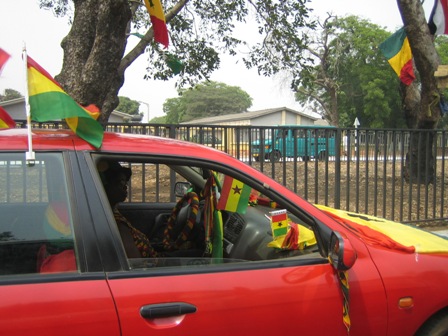
blackstar_feverr_sm.jpgFrom there we threw ourselves into traffic that had doubled in size since the previous week. The frenzy for the Africa Cup Football tournament is heating up. It was very apparent that the ships from China had arrived with all possible kinds of stuff that would add to the patriotism and nationalism that sport events of this magnitude tend to bring out. I imagined the factories in China running non stop for the last month to produce the thousands of flags, hats, badges, balls, umbrellas and whatnot that were now being hawked on the streets by colorfully bedecked young men and women. blackstar_fever2_sm.jpgThe pace was clearly picking up. We saw little of that last week and I suppose this was because the ships had not arrived yet.

It took us an hour to get to GIMPA, the Ghanaian Institute of Public Administration, a Harvard B-School wannabe for West Africa. Brian, on faculty at the School of Governance and Leadership, was one our facilitators and wildly enthusiastic about the program. The intent of visit was to meet the GIMPA leadership and talk about ways to work together on our collective mission to improve management and leadership in the public sector in Ghana. We met the Rector who gave us an autographed book about leadership and nation building and offered us lunch. After that Brian gave us a tour of the campus and the newly built executive conference center where we might have stayed if we had not found a hotel room. We were glad we had not stayed there even though it was beautiful; the trip back to Accra (only 16 km) took about one and a half hours. We were able to use that time productively, I by typing in the workshop evaluations and Cabul by catching up on some sleep.

Back at the hotel we sat down for our last big beer and talked about the two weeks, what went well, what did not and gave each other feedback. Susan Wright swung by to say goodbye and then Cabul and I had our final dinner together, a curry that he had raved about (and he knows about curries as one would expect from a Mehta).

At the airport I found a madhouse. Large buses were standing by to take all the top African football (soccer) teams that were flying in to their hotels; hawkers were everywhere and anybody who wanted to be away from the place before all hell breaks loose (Sunday) scrambled to get out. In the lounge I found some 24 men dressed in dazzling white and bright yellow boubous watching a game on TV and relaxing. I was trying to imagine who they were and why they were all dressed the same. I asked the attendant who told me it was the Mali national soccer team. They were magnificent. They were on their way to Kumasi, further north, where their pool was playing. As they filed out of the lounge I wished them ‘bonne chance.’img_1398.jpg I was too shy to take a picture of them but took a stealth picture of the lounge earlier. If you look carefully you can see the vibrant yellow. If they play as well as they look they will surely win, although the Ghanaian team (the Black Stars) is of course the favorite.

Best Among Equals

We are back at the Alisa hotel which has as its motto “The Best Among Equals.” This is a bit of a mind twister. I suspect what sets them apart from the other equals is that they have two Cerulean (blue) leather couches in the lobby that flank a Herculean air-conditioning apparatus. I am sitting on one of the couches to pick up the wireless that does not reach into my room this time. I am surrounded by myself because of all the mirrors.

In the 25 years that I have traveled to and in Africa, the continent has made great strides: wireless internet, cell phones, ATMs,  just to mention a few of the things that have made our lives easier while on the road in Africa. You know that you are getting old when all this was unimaginable when I made my first trip across Africa in the late 70s. On the other hand, traffic jams were rare at the time, as is the more tangible pollution that goes with it.

Yesterday we started our day at the beach, having another breakkfast with a view. It seems that the beach resort is much frequented by the Dutch since the little library in the restaurant consisted mostly of Dutch books. This was perfect as I was in need of a new book. We read for a few hours, and swam in the best waves and water temperature one could wish for. Around noon we piled into the car with club sandwiches and limp but tasty French fries to return to Accra. It took several hours, especially the last few kilometers.

Susan had invited us for dinner at her house. She has spent much of her career in Francophone Africa, mostly West and we reminisced about places and people as old folks do (we did apologize to Cabul but he seems to enjoy it). We discovered that we all know Jerry Martin, among others.

Cabul and I completed the burning of CDs and we printed a set of certificates of appreciation for the staff of ADRA, from drivers to Country Director. Some twelve people have put their shoulders behind the launch of this program and in their various capacities contributed to the success of this first phase.

Today we are going for our debriefing at USAID this morning, then to ADRA, then to the Management Institute (GIMPA) which is at Legon University for lunch and then back to write reports and finish all that cannot wait. And then I am leaving for the airport, leaving Cabul behind who is still trying to get tickets to the Ghana-Guinea match or something else.

The best part of travel is going home.

NicaBoca Glory

On Wednesday night Cabul and I were eating our NicaBoca Glory desert (pink ice-cream with crushed peanuts and chocolate sauce) while sitting in a Caribbean looking restaurant, looking out at a starless night with a giant flaming oil rig in the far distance off the coast. (Could this be a real burning platform?) The NicaBoca Glory was a special indulgence to celebrate our achievement. Less than a month ago Cabul had asked whether we could pull off what we just pulled off. I had said yes but only if he came along. And so we did.

The workshop ended exactly at the appointed time and in the envisioned high spirits. All through the morning the facilitators had been facilitating and I had been busy thinking of loose ends that required my attention as well as preparing the materials and photos to be burned on a CD for each of the teams and a few high level officials. Outside the conference room Cabul and Jennifer were preparing for the ritual of handing out the envelopes. This is a euphemism for money. Participants get it on the last day so they don’t cash in and leave on the first day. Frankly, I would have preferred that as it would have separated the corn from the chaff, or at least the really light chaff would have been blown away. When people have no interest in coming other than the handout they receive I’d rather not have them in the room. On the other hand, now that they stayed, we may have planted some seeds.

The preparation of the envelopes required that Cabul make several trips to the local bank which was a severe test of his patience. In this part of the world banks are not there to serve you but to serve themselves. If you expect anything else you are bound to get frustrated. I am very glad that it was Cabul and not me who had to deal with this.

Once the closing speech was made the feeding frenzy started, both figuratively (the envelopes) and literally. Countless drivers came out of the woodwork to claim their envelope and a free lunch. The plan was for the facilitators to lunch together and reflect on the entire workshop and look ahead to the next. This part did not go according to plan. Some of the facilitators returned to the training room to announce that all the food was gone. How 40 people can eat that much food so quickly is a mystery but they did. This did not help their mood; several of them were anxious to get on the road. The discontent came on top of other grudges that were wrapped in verbiage about mismatched expectations. Some of it was our fault and some of it was about the meaning of ‘expenses.’ Unfortunately it was our new team leader’s organization that was seen by all as the miser. I felt bad because such things can create ripples that affect their work here. I am not sufficiently familiar with this country to know whether grudges like that hang around for a long time or are quickly forgotten.

It was a tricky situation that showed how quickly a sense of collective inspiration can be completely eroded by mismatched expectations, or, more seriously, by more basic needs. It also shows that the collaborative spirit was still a very thin veneer. It does make one think about Maslow’s hierarchy of needs. The situation asked for leadership and that is what I then saw in action. The team’s new leader stepped up to the plate, got the anger and frustration out in the open and facilitated a conversation until agreements were reached in which we all, not just me and Cabul, had a role to play. We ended up not doing any of the thorough debriefing I had hoped to do because the last conversation used up all our remaining energies.

I committed a final faux pas by hugging instead of shaking hands. I could tell from the bodies stiffening under the hug that I had crossed a boundary. It was time to part company and go our way. Cabul and I quickly packed up our own stuff and left the hotel even though the restaurant had started to prepare more food and announced, by way of our driver, at 4 PM that lunch was ready. But by then we had just completed our debriefing with the Regional Health Director and preferred to continue down the road rather than turn back for what would be a heavy starchy lunch that I could do without.

After one more attempt to extract money out of an uncooperative bank and a finicky ATM (we did succeed eventually) we were off to our evening and morning of relaxation at the Anomabo Beach Resort – I kept calling it the Anaconda Beach Resort – where Cabul had made us a reservation. It is a hitchhikers and campers place on the ocean, simple and lovely. img_1385.jpgWe took the most expensive rooms (45 dollars) for our night of luxury and had one big bottle of beer each, plus that NicaBoca Glory ice-cream desert.


December 2025
M T W T F S S
1234567
891011121314
15161718192021
22232425262728
293031  

Categories

Blog Stats

  • 136,984 hits

Enter your email address to follow this blog and receive notifications of new posts by email.

Join 76 other subscribers