Posts Tagged 'Holland'


Dejavu

Familiar themes play like old tapes in my head. Jane Kenyon’s poem Otherwise popped up, I got out of bed/on two strong legs/It might have been /otherwise. Images keep coming back, like in July, and my stomach contracts involuntarily when I relive the swaying of the plane, the loud roar. I have been there before and my body remembers.

I had to talk with people badly but I was alone so I fired off random emails to just be in touch; once more an intuitive response to activate my support network. A few responded right away, these virtual hugs did the job. Somehow, being shaken up like that is easier to handle when others shake with you.

I could not sleep as I had planned and hoped; instead I kept re-reading my description of those few minutes of terror. I am not sure if the intent or effect was to take the emotional edge off it or to remind me that it really happened and I survived again. It felt a bit obsessive but I could not help myself. I used the fancy espresso machine in my room, over and over again; first coffee, then tea, and finally I had the eight dollar Foster beer. I took a very long hot bath and then watched a Dutch TV station util it was time to go.

Dubai airport is the opposite of Kabul airport. At Kabul airport there is a little shop that sells bags of nuts and dried fruits, rolls of biscuits, Arabic sweets and coffee and tea from thin paper cups. In Dubai you can buy anything your heart desires, from formula one cars to barbie clothes, as long as you have the money. It is a shopping frenzy that must be an eyesore to those inhabitants from the region who think the west is wicked. The shoppers are the passengers on some twenty long haul carriers that take off within hours of each other to all parts of the world. There were thousands of people, mountains of baggage and long lines everywhere. My Platinum Elite frequent flyer card is a godsend. It offers some respite from the lines and the hustle and bustle.

The flight was full and I could not get the upgrade I so badly wanted. I slept fitfully and watched a sweet Chinese movie that made me forget about bad things. In Amsterdam I called Axel to hear his voice and let him know I am nearly home.

As I am bracing for the last part of the trip my body is sending out signals that it needs some TLC. Axel has set up and appointment for me for massage later today and then I think I will return to Ruth next week for some remedial EMDR work, to bring everything back on an even keel.

I flew back with two MSH colleagues, Miho, who used to live in Kabul, and Yen, coming in from Addis and Nairobi also on their way home.

Memories

Yesterday, after the graduation and lunch were over, Theta and I drove to Amsterdam and I got to experience rush our on the Dutch highways. Luckily we had lots of catching up to do and so we didn’t notice that we inched a long for half an hour. We still arrived one hour early for a reunion of a student committee (de lustrum commissie) that organized a gigantic 5 day celebration that takes places every five years at the student association Minerva of the University of Leiden. It is one of those ritualistic events with a long history, an illustrious cast of characters who call themselves the Winnie de Poeh Society (intentional Dutch spelling) and no gender balance until 1974. Ours was the first event organized by and for both sexes and Theta and I have the honor of being the first female commissioners in this exalted committee. We had not seen each other for many years and then started making contact again when our hair turned grey and the act of retelling old stories became increasingly rewarding. Only our treasurer was missing. It was a wonderful occasion to test our memory of the joys and nightmares of that intense time of organizing and managing together; it was also a test of spontaneous recall of names and people who populated our various subcommittees and the dramatic events that now seem exceedingly funny.

My memory was probably the worst and I can blame it on the crash or on the fact that at the time I had fallen in love with someone from outside the student society who had little patience with our vision of grandeur and accompanying follies. Since I saw everything through his eyes (love is blind as far as one’s own eyes go) I erased many of the memories, good and bad; but over cocktails and a wonderful dinner last night things began to come back into focus. My stops in Holland are a great excuse to meet up again, and continue the telling of stories, interrupted for so many years.

Being in Holland is a complex emotional experience for me. Although on some level I am home, I am not in the country I left some 30 years ago. At that time Holland was mostly a white, Calvinistic country. Now, people who used to be foreigners hold Dutch passports and speak Dutch quite fluently. There is of course resentment about that. A recent book by Ian Buruma, Murder in Amsterdam, describes the context of Theo van Gogh’s murder and the changed make-up of Dutch society. This morning I witnessed a scene that warmed my heart. A cleaner, probably from Turkey, rolled his cleaning cart into a waiting area where one black man was sitting. He approached the gentleman and spoke to him in perfect English, “Sir, are you from Africa?” followed immediately by the words, “You are very welcome in Holland.” The two two engaged then in conversation while I walked out of earshot. It made my day.

I got my upgrade for the flight to Dubai after only two, very short, lines. It still required some back and forth and I cannot get anything arranged for the return trip, but I am happy with what I got now. And now on to Dubai.

Winter time

I am back in winter time in more than one way. Holland hasn’t gone over to daylight savings time yet and it is damp and cold. The daffodils have been beaten down by a freak snowstorm on Easter Sunday. It is a sad sight to see these flattened flowers just at the height of their bloom. Only the large fields still look spectacular from the train.

The flight from Boston to Amsteram was harder than I had expected. It seemed that the space between chairs had gotten even smaller since I last sat in the back. An obese gentleman across the aisle could not lower his tray table because of the size of his belly and had to content himself with a slanted table, eating with one hand and holding on to his food items and drinks to keep them from sliding off the tray on the ground. I admired his good spirits. I once read that patience is the ability to wait without complaining. He was a patient man.

I ran into my ex colleague and good friend Barbara who was on her way to Malawi. We had some catching up to do; the last time we saw Barbara and Steve was when we were still patients and they came to cheer us up, sometime last fall or summer.

I slept fitfully during the short night and woke up with a swollen right foot and back pain, the kind I suspect Axel has all the time. It made me wonder whether he can actually make the trip across the Atlantic next month to celebrate a few important family events. Upon arrival I decided to investigate whether I could get an upgrade for any of the remaining stretches of flight. I spent the next hour standing in various lines. It was a frustrating experience because each time I made it to the front of a line I was given information that turned out to be incomplete when I arrived at the front of the next line. And each time there was another line. I gave up and tried to do things by cellphone but the experience repeated itself; all to no avail. I was told to try my luck on Friday when luck returned and I secured the much coveted upgrade for the flight to Dubai.

After my arrival I took a taxi to Aalsmeer. My driver was from Afghanistan and was very angry at first. There had been a police trap at the airport to catch drivers who had not paid their various taxes. The trap had gotten him stuck for several hours at the airport and he needed a very long ride to make up for lost time. My ride was much too short and hardly worth his while. But once he found out I was on my way to his country and actually spoke a whopping three words of Dari he thawed and we parted on good terms and he with a nice tip. He never wanted to live in Holland but was ordered there. He wants to go back to Afghanistan ‘when it is quiet.’ We both knew this may never happen.

In Aalsmeer Sietske had made my bed before she left for France. Piet received me with a few cups of coffee and a breakast of good dutch bread and then we each went our way. I took the train to Leiden University Medical Center to attend the graduation of my nephew Reinout. We were nearly complete, with me and my sister being the aunties who came from afar (Ankie came from Brussels). Only one of his (paternal) uncles was missing. With that we had surpassed the allotted 9 seats reserved for the graduates’ families but no one noticed. It was a very formal event with doctors in black velvet robes and caps and each graduate pledging the Hippocratic Oath (alternative: Promise if you did not want God Almighty to help you). My nephew choose not to ask God for assistance. After that the presiding authority presented a 5 minute biographical sketch for each of the brand new doctors. In a room with bad acoustics and 15 candidates all deserving equal air time, this was an exercise in patience, especially since it was over lunch time. We all made it through, solemnly listening to the top doc’s acknowledgments of each graduate’s unique and impressive student career. For some of us it would have been more bearable if we had actually understood what he said.

Something funny happened after the ceremony was over – the graduates and their families were offered a drink and some snacks in a room too small to hold us all. Quickly the families spread out across town for celebratory lunches. Ankie, her husband, my friend Theta and I found ourselves excluded from our nephew’s lunch arrangement for reasons we did not quite get. It stung a little bit but we got over that and ended up having a very nice and quiet lunch with just the four of us. As a result I never got to say goodbye to anyone, as we had expected to be part of the celebration over lunch. Families can be funny.

Ups and Downs

I am at Schiphol airport waiting for a connecting flight to Boston. I have decided to not let anyone know I am here so I can finish my reports; the next trip is very soon and I don’t want to work this weekend.

I am out of Africa. It is a traditional call I make to Axel, announcing my new position on the map. I do this early in the morning while he is still up the night before. This time I got Sita on the phone as well. These are some of our small rituals.

I left Tanzania somewhat deflated, without an ounce of energy left. The road trip back to Dar es Salaam took a lot out of me; more than I at first cared to admit. I emerged from the car in pain and stiff as a plank and then my mood began to change; from the high spirits of having accomplished what I set out to do to feeling hopelessly inadequate in the face of overwhelming odds.

Each time I leave Africa I am more confused. The more I learn, the more I know. And the more I know the more I know what I don’t know. And in times like these, when my mood is low, I wonder how I can be of any help. Everything appears to be related to everything else. It feels a bit like untangling miles and miles of hopelessly tangled up yarn. You look for a beginning or an end, to start untangling. And then, not being able to find either one, you take a pair of scissors and create a beginning and an end. From then on it is slow going. Sometimes you feel you are just making things worse; instead of one gigantic tangle, you create a whole bunch of slightly smaller tangles, all as daunting as that first big one. The worst part is that seemingly well-meaning efforts at untangling actually mess things up. I am referring to the hundreds of models, tools and approaches that are being offered by helping hands, some incompatible yet offered to the same people. It is a bit of a lose-lose proposition when I begin to think like this: I am either adding to the tangle – so why continue? Or if I think I am not, I can fool myself by using reasoning that is self-serving, also called arrogance. Of course I have to remind myself that these words and sentences come out of a particular mood. I don’t always think like this; I would not have lasted this long.

Yesterday morning, Isaac and William had asked me to say a few words at the opening of their leadership program, now in its third day, “people would like it.” Participants don’t often see the folks who developed the materials they study. I asked the participants what has changed for them as a result of this program. It was hard to get volunteers so I called on people by giving them the microphone. It is always a struggle, anywhere in the world, to get concrete examples; people tend to use words that are titles of workshop sessions. Up front only one member of a team sits at an otherwise empty table. I asked her what happened to the rest of her team. She explains that one is in the internet café checking up on a letter and the other she doesn’t know about. Getting participants to apply what they learn about being pro-active directly in class is hard; I challenge her to be more active and get her team complete by taking action now. My exhortation clashes with the polite attention that is given to foreigners. Nothing will happen until I leave, if then.

I checked out and paid my bill and then went to the other hotel where the AIDS meeting was held. I arrived in the middle of a morning discussion and I could sense that the meeting had heated up from yesterday. Some agencies had not delivered on promises according to the government representative from one region. Another demands that these discussions are frank and honest, rather than the usual Tanzanian mode of exchanging pleasantries. I so wish I could follow Kiswahili. The session is conducted in the way that Mandela describes how his father held court in the Eastern Cape. The Chief (Chairman) sits in front facing the people who are seated in semi-circular rows facing him. What is billed as ‘plenary discussion’ is actually a very disciplined and choreographed process allowing people to speak, one by one. Their words are addressed to the chief, but everyone listens attentively. There are few non-verbal cues for me to gauge whether they agree or not with the speaker. Sometimes there are a few smiles or hmmms. This is not dialogue but serial monologue. Occasionally I get a translation. I am learning that the reporting process does not accomplish its purpose. Reports are missing; they appear to describe inputs and outputs, or maybe process, but say little about what is different as a result of their work; they also appear hard to read. Imagine nearly a hundred of those. It is no wonder that there is no feedback loop.

I am trying to figure what is at stake for the different groups in this meeting. It appears to have something to do with the modalities by which the national secretariat reaches civil society. The creation of new, temporary structures that consists of NGOs or consortia for the implementation of the project is supposed to help ‘push the money down’ where the government does not have the capacity to do this on their own. The temporary structures have two main purposes: building the government’s capacity at the regional, district and local level and managing the grants given to civil society organizations to produce a string of small victories in the battle against HIV/AIDS. It seems that these two are not always meshed together as they should, but implemented in parallel. Some government people are indicating that the capacity building has not happened and that they don’t know what is going on. Of course in all this the enormous amount of money involved muddles everything. Someone remarks, “If you have a lot of money you don’t need to involve anyone, you can just go it alone.” As an American citizen who contributes her tax dollars to help foot this bill, this is of course not what we intended.

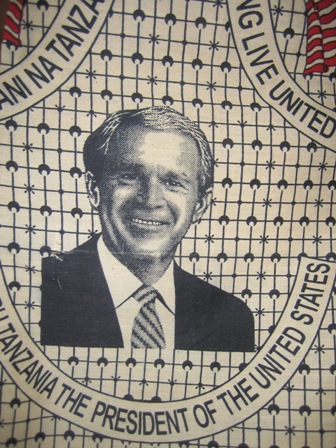
bushclothfull.jpgOne of the women wears a dress made out of US-Tanzania friendship cloth. If there was an archive of bushfacecloth.jpgspecial occasion cloth you could trace the visits of important people across Africa. This includes presidents as well as religious leaders. When we break for tea I take a picture of her, with a separate zoom into Bush’s face. It’s the kind of picture you see in obituaries – depicting a much younger Bush. I wonder about the design and production process of the cloth. Was there an official request, an official picture provided by the embassy? I can just imagine Laura and George sitting with a photo album on their knees, and Laura saying, “George, I think this picture would look fabulous on the belly, bosom and back of a lady in Tanzania!”
At tea break I sit with three women from local government. I ask them how the process of working with the facilitating agencies has been for them. At first they are cautious in their responses but soon they loosen up. They complain about something that I hear around the world. It is a complaint that is wrapped in communication language but that I have come to see as a symptom of something else, maybe a deep-seated fear of inadequacy? It is constantly fueled by the absence of acknowledgments and appreciation for work well done, or by the carelessness with which people communicate (or forget to) with one another; the sense of inadequacy or incompetence is thus reinforced; self protection then leads to resentment of the higher ups, since they are causing this feeling after all. If you belong to a minority group, like the handful of women in this meeting, the resentment is doubled. Instead of spirited engagement we get resentful entitlement. Money has to come to the rescue to ‘motivate’ or ‘facilitate,’ a pervasive belief. This is how I believe we mismanage the most precious of human resources we have: the energy to invest one’s time and creativity in doing a good job. I am re-reading Elliott Jaques about Executive Leadership. He states something that I know to be true from personal experience but also from watching others: “People are spontaneously energetic with respect to the things that interest them.” Could we possibly try this notion on others?

Black Stars and Yellow Boubous

I am writing from Schiphol very early morning. At this time, somewhere above the Atlantic approaching Europe, Sita is flying to the World Economic Forum in Davos. “She’s all kitted out with long undies, a silk ski mask, the over sized boots, 220 volt travel iron and everything she has to wear that fits in the category of dressing for success in Switzerland with galactic elites – all in durable basic black,” writes Axel who put her on the plane last night.

I had a good night sleep, falling into an exhausted sleep immediately after take off and waking up half an hour before landing. I am now waiting until it is a decent time to call Sietske so I can finally show her my scars.

Yesterday was supposed to have been a day of rest and relaxation but instead it turned into a full work day. We started off with a debriefing at USAID where we had the full attention of the Mission Director, his deputy, the HPN officer and a few others. We showed the video of the leadership program in Aswan which remains a moving story no matter I often I see it. We had a lively conversation about what is different about our program. With so many of these programs under our belt, I can be quite confident that important shifts will occur as a result. We brought the ADRA staff along to introduce them as the new leaders of the facilitator team.

From there we went to ADRA where we assembled the staff who had contributed to our successful launch. The night before we had printed certificates of appreciation for everyone, from the drivers to the country director. In a brief ceremony we thanked them for taking us in as if we were family and looking after us in ways that touched our souls. We exchanged presents and left with some great Ghanaian music.

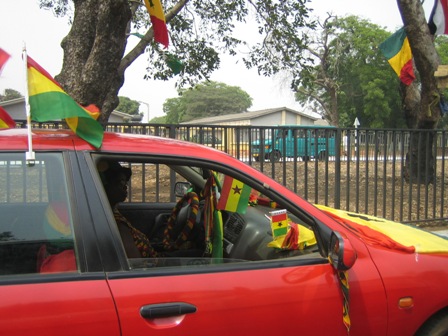
blackstar_feverr_sm.jpgFrom there we threw ourselves into traffic that had doubled in size since the previous week. The frenzy for the Africa Cup Football tournament is heating up. It was very apparent that the ships from China had arrived with all possible kinds of stuff that would add to the patriotism and nationalism that sport events of this magnitude tend to bring out. I imagined the factories in China running non stop for the last month to produce the thousands of flags, hats, badges, balls, umbrellas and whatnot that were now being hawked on the streets by colorfully bedecked young men and women. blackstar_fever2_sm.jpgThe pace was clearly picking up. We saw little of that last week and I suppose this was because the ships had not arrived yet.

It took us an hour to get to GIMPA, the Ghanaian Institute of Public Administration, a Harvard B-School wannabe for West Africa. Brian, on faculty at the School of Governance and Leadership, was one our facilitators and wildly enthusiastic about the program. The intent of visit was to meet the GIMPA leadership and talk about ways to work together on our collective mission to improve management and leadership in the public sector in Ghana. We met the Rector who gave us an autographed book about leadership and nation building and offered us lunch. After that Brian gave us a tour of the campus and the newly built executive conference center where we might have stayed if we had not found a hotel room. We were glad we had not stayed there even though it was beautiful; the trip back to Accra (only 16 km) took about one and a half hours. We were able to use that time productively, I by typing in the workshop evaluations and Cabul by catching up on some sleep.

Back at the hotel we sat down for our last big beer and talked about the two weeks, what went well, what did not and gave each other feedback. Susan Wright swung by to say goodbye and then Cabul and I had our final dinner together, a curry that he had raved about (and he knows about curries as one would expect from a Mehta).

At the airport I found a madhouse. Large buses were standing by to take all the top African football (soccer) teams that were flying in to their hotels; hawkers were everywhere and anybody who wanted to be away from the place before all hell breaks loose (Sunday) scrambled to get out. In the lounge I found some 24 men dressed in dazzling white and bright yellow boubous watching a game on TV and relaxing. I was trying to imagine who they were and why they were all dressed the same. I asked the attendant who told me it was the Mali national soccer team. They were magnificent. They were on their way to Kumasi, further north, where their pool was playing. As they filed out of the lounge I wished them ‘bonne chance.’img_1398.jpg I was too shy to take a picture of them but took a stealth picture of the lounge earlier. If you look carefully you can see the vibrant yellow. If they play as well as they look they will surely win, although the Ghanaian team (the Black Stars) is of course the favorite.

Sunday, November 18, 2007

Last night I went to a reunion/alumni event at the Societeit Minerva in
Leiden. This is a socio-cultural phenomenon that is nearly impossible to explain to anyone who does not know about traditional student life in
Holland. It was a gathering of hundreds of gentlemen, generally well off, mostly in grey suits and with grey hair, and smattering of women (the male society merged with the women’s society in 1972) in a cavernous hall that is completely brawl- and beerproof. It smells and looks that way. There is not a square inch of loveliness to be found in that place. Even architecturally it is a monster but it is most functional. The event, I suspect, generates nostalgic reminiscences, family updates and inquiries into retirement. I watched and participated in it both as an alumna myself and as a foreigner. There is nothing quite like it. It is, from an American perspective, totally not politically correct (no diversity in the room, no handicapped access). I tried to forget about my foot because sitting down was imposisble until dinner started, quite late in the evening.

I had arrived very early in the morning at Schiphol airport after a mostly smooth flight. KLM cabin personnel had once again been very sollicitous and put an aluminum container in front of my seat so I could keep my leg up during the flight. I did not sleep much; nights remain somewhat difficult in anything that is not a flat bed.

My taxidriver to Den Haag was a young man from Jalalabad who had fled with his family from Pakistan to
Holland some 10 years ago. We spoke in Dutch the entire trip.
Holland is his new country. He dropped me off at my brother’s place. My sister-in-law Greet who is a Re-Balancing therapist, gave me a treatment in the morning which was happily received by my worn body. I emerged relaxed and slowed down to a crawl to find my other brothers Reinout and Willem with their mates who came to see the new, repaired and, hopefully, improved me. We had a noisy reunion where everyone talks at the same time. This is genetic. It can be rather intimidating to more introverted types. We, born into it, are masters of the craft.

The only one missing was my sister Ankie. She returned to her
Brussels home from a hospital stay and was not quite ready to drive down to Den Haag. Instead we had a very long phone call comparing hospital experiences, abdominal scars and the recovery process. After a wonderful lunch we visited the Mauritshuis, a lovely small museum at the government center in the center of Den Haag to see an extraordinary exhibit of seventeen-and eightteen-century Dutch portraits from the most famous painters
Holland has ever known. One couple painted 300 years ago that had been languishing on their separate panels in musea in different countries, were reunited again. You can imagine what a happy event that was.

On December 5th we Dutch celebrate Saint Nicholas day (Sinterklaas). The Saint arrives usually a few weeks before. What luck! While in the museum, Sint Nicolaas arrived on his white horse at the square next the the museum. From our second floor window we could see the action in a side alley where Sint’s horse trailer was waiting to take the horse back to wherever it came from. Americans, I suspect will find it a very bizarre thing: an old bearded man, dressed like a bishop (one piece of clothing that has not changed over the centuries) sitting on a white horse with tens of white people whose faces have been painted black so they look like royal slaves, dressed in the garments that were in fashion in the 1560s. They all have the same name (Zwarte Piet, Black Peter) and throw small spice cookies and candy that they carry around in pillow cases into the mass of kids and their parents who have gathered to watch the event. I can see it through the eyes of an American because I am an American. My Afghan taxi driver admitted that at first he thought it was a weird celebration. But now, after ten years in
Holland, he and his family enthusiastically participate in the event and think little about what it really portrays. It is much like Christmas in other parts of the world, a feast where, originally, the rich give gifts to the poor.

I was dropped (off) in
Leiden and met five women friends from my yearclub in a small restaurant to catch up in an environment more conducive than the cavernous hall for conversation. We had seen each other in June for some other nostalgic event and so we continued form there. Of course everyone wants to hear my story. There was actually not that much to tell since they have all followed Caringbridge and know most of what there is to know. Each had brought a poem that they had written or a favorite from a Dutch poet and a gift to celebrate my second life. I was touched deeply and will be reading through all this quietly again on my flight back to
Boston.

I came home at 1 AM from the
Leiden event. It was probably a bit much for someone in recovery like me but I would not have missed it for the world. And now, back home.


December 2025
M T W T F S S
1234567
891011121314
15161718192021
22232425262728
293031  

Categories

Blog Stats

  • 136,984 hits

Enter your email address to follow this blog and receive notifications of new posts by email.

Join 76 other subscribers