Posts Tagged 'India'


Catching up in Delhi

The next couple of posts are a little behind the times. Incessant rains in Gangtok had disabled internet access. We are back in Delhi now where it doesn’t rain and the internet connection is very fast.

[April 1]Every morning we look out of the window of our greenhouse hotel room and see clouds (behind the very happy orchids) and every morning we hope for the best. During the day the clouds lift a bit, come down a bit, parts of the cloud cover lights up as if to suggest that the sun is right behind. But it is no more than a tease because in the afternoon the clouds move in with a vengeance, as if the clouds of all of Sikkim congregate in Gangtok, and the rains come, monsoon type rains.

Unperturbed by the cold, in his crimson robe with his arms bared, a monk sat all day at the entrance of the school ringing his prayer bell and reading his prayer books. Attendants at the front and back sides of the school kept two very smoky pine fires going to bless the laying of the second story cement floor of the new wing in back of the school. This was done by hand by 65 workers, male and female, carting heavy bags of cement up and down planks, first in their regular clothes and then, after the rains started, in blue tarps fashioned around them as if they were company-issued raincoats.

When the monk left everyone in the school was coughing from the thick pine smoke that had encircled the school. Axel’s poor lungs, still recovering from Kabul, where particularly affected. We had hoped to send along some prayers for blue sky and, maybe, even a glimpse of the snow covered peaks, to no avail.

We had been invited to open the daily assembly and did so with a slide show about Afghanistan. We tried to show the parts of Afghanistan that don’t make it into the news. But here in this far corner of India such news hardly had reached people. The students knew more more about Alexander the Great, Timurlane and Gengis Khan than about 9/11 and its aftermath. In fact, only two students in the 7th and 8th grades we taught later that afternoon knew what 9/11 referred to.

We showed pictures of traditional music (and played it), handicraft, landscapes, flowers, architecture, woodstoves and city scenes. We had checked out the books about Afghanistan in the well endowed school library and showed the students who wanted to learn more. And then we gave our presents to the headmaster (the woolen wrap I had borrowed yesterday) and a piece of traditional embroidery to put on their wall.

Before our afternoon class we sat in some more classes (math, report writing), we met with teachers to learn how they assess reading levels and had lunch with the math teacher. And then we prepared for our class. We had been given two class periods with the 7th and 8th graders, a mixture of restless and sullen kids (“are you really up to this?” asked the headmaster with a hint of concern in his voice).

We sat in a circle on the carpet and discussed our slideshow, then one essay by one of Axel’s students about the differences between American and Afghan schools which we then turned into a discussion about Taktse International and government schools in Sikkim. One significant difference between the former and the latter was the absence of corporal punishment –still common practice – about which we heard some grim tales later from the adults.

In the second period we studied another essay written by another SOLA student about her mother’s mistreatment by the Taliban and her parents’ underground school. It led to a wonderful conversation about standing up to power, non violent action and the power of education, and then of course to Ghandi.

After our class we were shown around the grounds by one of the visionary trustees who infected us with his inspiring philosophy and plans for the school’s future which at some point merges with Sikkim’s future. His Buddhist outlook on the future was both practical and energizing and made the small muddy steps from here to the next minute, the next day, the next year and the next generation utterly sensible and doable.

He showed us the cows and the cowboys who use half of the cowshed as their primitive living quarter. One was making tea on a traditional mud fireplace that is not that different from those I have seen in other parts of the world. He offered us each a cup of sweet milky tea while we watched the two other cowhands turn straw and cut greens into a mush for the cows. A one week old calf was sitting in the middle of the path through the cowshed and looking at us with bewildered eyes. Slightly older calves were lying down at the other end, wiser and more at ease with their small world. The cows now provide all the milk for the schools. Leftovers go to the poor.

One valley in back of the school was filled in through natural landslides and is now a near full size soccer field. In this hilly country such things are rare. The basketball court has just been completed and a volleyball court is in the works. Further away from the school are terraces where organic vegetables are grown, a new addition, also with the hope and prospect of a self sufficient school kitchen garden. A farming/cooking club for the older children was just introduced (alongside a knitting club, a sport club, a computer club and a cinema club).

After school we went into downtown Gangtok to the shopping area, modern and full of cheap Chinese goods. By then the downpour truly started. We walked the steep streets up the hill in the pouring rain with Axel wheezing behind me. We arrived, totally drenched, at the old house of one of Sikkim’s notables families, now converted into a guesthouse, for a final farewell dinner with family and friends of the American/Sikkimese family that founded and runs the school along with one of their trustees who helped Axel dry his clothes with the help of a hairdryer. It was the first time we observed an actual stove (wood fueled) in Sikkim, a rarity obviously.

We tried the local brew, ‘chang,’ which is served in a wooden beaker with a bamboo straw. It is filled with fermented millet grains over which hot water is poured over and over again. It is a bottomless sake-like treat that, we were told, can either make you very drunk or very sick or both. We loved it and stayed both healthy and sober. We were served yet another wonderful meal that had little to do with the Indian cooking were are familiar with, including the very American chewy browny at the end of the meal.

We are starting our last full day in Sikkim, once again, in the clouds.

Zigzags

I would not recommend Sikkim to people who have a fear of heights or who get easily car sick when there are too many turns. We traveled a mere 75 km in 5 hours, winding our way down from 7000 ft to 1000 ft, then back up to 7000 ft, then repeating the sequence once again, hence the five hours.

We said goodbye to our hosts this morning and were once again festooned with the now familiar cream-colored ‘safe travels’ scarves. Our hosts also gave us a beautiful turned wooden container out of which the traditional beer is sipped through a straw.
They did recommend that we not try this beer as it is not only very strong but also known to make people who are unaccustomed to the brew, very sick.

It was hard to say goodbye. We have every intention to come back. It is the perfect place to hang out for awhile and write a book or sew a quilt or some other big project like that. I can’t think of a more peaceful place in the world; the perfect antidote to Afghanistan.

We drove off in the rain and the clouds which made us happy to travel along paved roads (mostly paved as it turned out). We stopped at the first pass to have a Nescafe cappuccino, then at another to have momos (dumplings) and spicy potatoes before arriving at our destination, Gangtok, Sikkim’s capital city.

Compared to rural West Sikkim East Sikkim is bustling and noisy. There were even noises up in the sky; a helicopter brings people in from Darjeeling; folks who don’t like or have no time for the zigzagging roads that lead to Gangtok.

We drove through a few towns that had large Indian flag banners tied to posts and houses in anticipation of a victory over Pakistan in the World Cricket Cup. It is a bit like the USA hockey team playing the USSR team in the olden days. But things are not looking good. Axel watched a few minutes and found the Indians behind. A message flashed across the screen ‘this is a game, not a war,’ to remind people that losing from Pakistan in cricket is not the same as ceding Kashmir.

We are staying in a hotel that is built in layers against the mountainside (hillside people would say here). In between the rooms are thousands of flowers, orchids, azaleas, primroses, snapdragons. Even the inside spaces are filled with flowers. It is not clear what this place is first, hotel or nursery.

This slideshow requires JavaScript.

At school

After breakfast we walked down the hill to the small village where our host teaches in the rural Grade 1-4 government school. We walked for about 45 minutes downhill, a drop of about 2000 ft. It was a sensation our bodies could not remember, rather painful after walking just a short distance. Once down we realized we would never be able to get back up. Most of the road was asphalted but the last few hundred feet down were not. If the rain started early even our car would not have been able to take us up. Luckily our hostess had noticed this and summoned our driver down to pick us up a few hours later.

Our hostess walks the 2000 feet up and down every day, half an hour each way, six days a week. She does this on slip-on sandals and takes the very steep shortcuts between the hairpins. We concluded that with the home grown organic food and the daily walks she and others like her must live very long and healthy lives. From our high perch in Sikkim most of the rest of the world suddenly looks very rotten.

We found the 64 school kids standing in four neat rows in front of the school building, each row headed by their class captain facing them. We were received, once again, with the now familiar cream-colored scarves and a bright ‘good morning’ coming from 64 high voices. The assembly routine was repeated for our benefit as we had just missed it when we struggled in on our last legs.

There was the national anthem, followed by the pledge of allegiance (to the Indian motherland and righteous living), something in a language we did not understand and then everyone was dismissed to their respective classroom.

The headmaster, a native from a village elsewhere in Western District, who came from a family of teachers, received us in a simple office that was decorated with pictures of Ghandi, Nehru and other fathers of the nation that has so little in common with Sikkim.

After that we were given the run of the school spending quality time with each of the classes. This was a little awkward because the level of English rudimentary but the students stood up politely each time we asked a question and then stared at the ground or giggled at each other.

As soon as we pointed at something on the wall, the English alphabet, the Nepali alphabet, the numbers or a chart with letters and words, the children broke out in spontaneous, collective and rhythmic recitation of whatever we pointed at. They knew how to do that very well.

With grade 2 we sang ‘I am a little teapot,’ ‘Twinkle, Twinkle,’ and other old English favorites. Then they sang a song their teacher had surely learned in her missionary school about God who had created ‘birds, trees, fished and me and you.’ Each time they sang the work God they pointed up at the sky. They then repeated the song in Nepali still pointing at the One Up There.

In class four they spoke English a little better but they were still too shy to say much of anything that would have helped to have a conversation. And so I showed them pictures from two schools in Afghanistan. We wondered later what these kids would be telling their parents later today. Some, the teacher told us, had never even been to the town of Peling perched above their village on top of the hill from which we had descended.

When I asked the fourth graders what they wanted to become they replied with the only two professions, other than farmer, they know of: doctor or teacher. I asked if anyone wanted to be a pilot but they stared at me blankly. They didn’t know what a pilot was. There are no planes flying overhead here, where would they go? The closest airport is in another state and about 6 hours drive from here, or, a more familiar way of counting distance, at least a two-day walk. Then I realized one feature about this place – there are very few sounds of the modern world that have penetrated this far – only the car and the motorcycle and the occasional TV.

At peace

A soft knock on the door signaled our morning tea, at about 6 AM. I received special dietary treatment Sikkim style: lemon tea for breakfast, rice porridge with curd and a banana. Axel had breakfast downstairs, a three course breakfast with porridge, followed by a fresh egg and then two potato pancakes from the potatoes dug up yesterday that don’t taste like any other potato he’s ever had.

Our hosts are speaking perfect English with us. The wife, who is a teacher of English and Environmental Studies in addition to the usual grade school curriculum, learned her English in a missionary school. The missionaries were quite active here. On our drive from Darjeeling we had noticed several catholic schools, some churches and a few Jesus-loves-you bumper stickers.

With our guide our hosts speak Nepali. This appears to be the lingua franca (not Hindi), even across the border in Darjeeling and upper West Bengal. Our hosts are also speaking Bhutia, and Lepcha and then there are another 9 languages, Tibetan and others I have never heard of.

The weather is cloudy again but in the morning we glimpsed a few of the white capped tops of the real high mountains through openings in the cloud cover. The sun was out while we walked down and for the first time since we arrived I was warm. Brightly colored finch-like birds darted left and right, chasing each other, cows lowed, donkeys brayed, and somewhere in the valley someone was nailing planks together. It was utterly peaceful in a way that only a forgotten corner of the world can be.

We’re not in India anymore

We did manage to cross the border into Sikkim after a two hour drive straight down from 7500 ft to 1000 ft. I calculated that we dropped about 50ft every 1 minute during our descent to the border, not the main one but a smaller, out-of-the-way crossing at the end of a shortcut from Darjeeling. When we arrived, just minutes before the strike was called, the sleepy border patrol officer asked, “Why are you so early?” He did not know about the strike.

Instantly the feel of the place changed. This is no longer India. The fact that it officially is is a historical accident, something that should not have happened. Everything is different here. I like it more than any other place I have been. I can’t tell exactly why.

Sikkim felt more organized, the government more present than we had observed in the northern part of West Bengal where the government seat is thousands of miles away. Within two hours of our arrival in Sikkim we saw two mobile clinics, road improvement projects everywhere, large billboards reminding people to keep the environment clean, be good citizens so the government can be good government. We saw school children everywhere on their way to school through the dripping mountain clouds and forests. The Afghan government could learn something from this obvious commitment of the state government to make life better for ordinary people.

We arrived at the small B&B that is owned and run by a young man who, in the early eighties, studied for three years at the Waring school in Beverly where our kids went to school about a decade later. The Waring connection has now come into full view: we will drive to Eastern Sikkim the day after tomorrow to the Taktse International School which is run by Sita’s classmate at Waring, a sort of Waring East. His father, a Sikkim native, had been the cultural tutor of the American woman who became Sikkim’s queen, in the sixties. One thing led to another which landed the father at Brown University where he met his American wife. It is a story about education and passion that cannot be done justice in one blog paragraph but it will have to do.

And so here we find ourselves talking about education as if that is the mainstay of our life in Afghanistan. Sometimes I think it may actually turn out to be. Sikkim is changing its education philosophy and it is noticeable in this remote spot in the world – teachers are being retrained to evaluate the whole student, scholastically, socially, civically, physically, continuously rather than to give a final exam that leads to a pass or a fail.

Once again we are in the clouds. We have been told at several occasions that the third highest peak in the world is within view if only the clouds would go away. We have been given a spacious and simple room with cedar planks on the ground and windows on three sides, plus a balcony that should one day reveal the snow white peaks. We still have some hope to catch a glimpse but this requires a lot of luck.

Our host and hostess served us breakfast and then we retired for a nap. In the middle of the day a knock on the door provided a superb meal, again, nothing Indian about it, accompanied by ginger tea.

Something I ate yesterday disagreed with me. I was given a local remedy, a piece of the stem of a garden plant cut away, peeled, washed and cut in pieces. “Chew it,” our guide and host commanded, “then swallow.” It tasted very much like the West African cola nut, bitter and astringent. We’ll see if it does the trick.

Axel went for a walk around the neighborhood of the village where we are lodged. Out of the blue our host asked Axel how old he was and if anything hard happened three years ago. Apparently it is expected that every first of the next string of twelve years ‘something hard’ happens. A plane accident counts.

We are still in the clouds but high black mountains are visible. We were corrected, these are not mountains but hills. I told our hosts that the tallest spot in Holland is called the Vaalserberg (Mountain of Vaals) which is 323 meters above sea level. Here a 9000 footer doesn’t qualify for the word mountain.

We visited a monastery with indescribable art and artifacts that would many many a western museum envious. We realize how little we known about Buddhism, Tibetan Buddhism and Hinduism.

We noticed the appearance of snakes, something we had not seen much so far in Hindu holy places. From native American mythology and cosmology, people whose DNA may actually somewhat match the local DNA, the snake stands for transmutation, moving from one plane to a higher one. The gigantic wooden statue, carved out of one enormous piece of wood, that we saw in the monastery is about the same thing as it depicts the ascent of man from our lowly earthly existence to ever better reincarnations. We are indeed in a different part of the world.

In the clouds

We spent all day in the clouds. This should not be so surprising given that we are at 7000 feet or thereabouts. While still in Kabul we would every night see the BBC weather map of the subcontinent and noted that this part of it was usually in the clouds. And so it was today. We learned, in the Ghum railway museum, from no less a person than Mark Twain, who was here some time ago, that weeks can go by like this.

We got up at 4 AM to make the trek up Tiger Hill to see, as promised by our travel agent and most guide books, the most spectacular sunrise on earth. With a lot of luck we would see all the highest peaks of the Himalayas in cotton candy colors.

The trek was by motorcar. Before we left I had this image of us standing on a tall outcrop all by ourselves. As it turned out we made our way up Tiger Hill with about 200 other cars (each with at least 5 people), all jostling to get to the top first and take up the choice spots on the lookout place. That place was also not quite as I had expected, with several large and ugly cell phone antenna structures and an ugly three story building where one could, for 300 rupees, buy entrance to a heated third floor for more comfortable viewing. So instead of the rosy peaks we watched Indians being tourists in their own country while the clouds passed right through our midst leaving us cold and clammy.

When it was clear that the sun wouldn’t be able to pierce the thick cloud cover the predictable mayhem ensued. All 200 cars tried to leave at the same time, some facing uphill, others down, on what was basically a one lane partially paved track (‘jeepable’ it is called here) up the mountain.

Rather than wait inside the car until the traffic jam dissolved (I couldn’t imagine how it ever could without divine intervention, but it did rather quickly), we decided to walk down and let our driver fend for himself – walking freely like that is such a treat for us and the moist cloud cover felt wonderful on our dried out skin.

On our way back to the hotel, for breakfast, we visited a spectacular monastery and got some basic education about Buddhism from our Buddhist guide, turned several prayer wheels sending wishes for peace in Afghanistan into the clouds.

After a hearty English breakfast we took the famous ‘Toy train’ of the Darjeeling-Himalayan Railway up to the town of Ghum, chugging along at 9 km/hour, if that. Halfway up the mountain we had to fill up on water to continue to generate steam. A large black cloud of coal smoke accompanied our ride and drifted into open windows along the line and enveloped newly washed clothes dangling on clotheslines; people turned their heads and smiled at us while hiding their mouths and noses behind scarves, sarees and facemasks.

Then it was lunch time. We have an hotel arrangement that includes all meals so we seem to be sitting down to eat a lot. In between our guide takes us places. After lunch it was the Himalayan Mountaineering Institute which is tucked away in a corner of the Darjeeling zoo. In the west we learned that Sir Hillary was the first to make it to the top of Mt. Everest but here it is the Sherpa, Tenzsing Norgay, whose name comes always first. We visited his memorial tomb and his glass encases gloves, boots, socks, crampons, coats, glasses and whatnot.

On the way back through the zoo we passed an enormous Bengal tiger, safely tucked away behind a moat and thick metal wire while someone’s radio played Evita’s melancholy song.

Back at the hotel a real English tea, complete with watercress sandwiches and scones with jam and cream, awaited us in one of the sitting rooms that was heated by a cozy coal fire. A young woman in an authentic English maid costume, as if we had stepped right onto an Agatha Christie movie set, served us tea. Cross-stitching my sampler felt exactly the right thing to do.

Promptly at 6 the tea service was discontinued and the bar opened for GTs, accompanied by snacks until it was time for dinner, beef Wellington with bread pudding and custard for dessert.

Once again we have to get up early, even earlier than yesterday because there are problems at the West Bengal-Sikkim border. Our guide told us that if we don’t get there by 6 AM we will not be able to pass until after 6 PM; so much for sleeping in and not having to love by a rigid schedule. Unhappiness with the statusquo is following us all the way from Afghanistan. Still we feel miles away from the stress of our adopted home, happy even in the clouds.

Time warp

We spent another full day, 11 hours, to get from our New Delhi hotel to the Windamere hotel in Darjeeling. We first flew to the capital of Assam, then to Bagdogra. Once more we had something draped around our neck, this time the cream colored scarves that the Nepalese give to travellers, for good luck.

From Bagdogra we wound our way to Darjeeling over poorly maintained roads from 500 feet to 7000 ft along hair raising hairpins at a snail’s pace. Halfway through the trip we stopped at a tea house to have a cup of Darjeeling and some cheese pakoras.

During the final ascent we followed the narrow gauge tracks of the Darjeeling railway, passing the third highest railways station in the world. We shared the narrow and potholed road with the tracks that ran right in front of houses and shops. A W/L sign wherever the track crossed a village or town meant ‘Whistle and Listen’ and at each crossing there was a handpainted sign with the a child’s drawing of a locomotive and the words ‘stop, look and go.’

We were told that the 3 hour road trip, by train, would take about 9 hours. Unfortunately the main road (as well as the train tracks) have been blocked for over a year since a landslide and the West Bengal government has other urgent roadwork elsewhere in the state. That’s one of the reasons the Aswanese and Sikkimese want to secede.

We are now in Gorkhaland (or Gurkhaland) and the main language is essentially Nepalese even though we are in India. Our guide and driver are ghurkas. In Afghanistan we know the ghurkas as the folks who guard the American embassy and who I greet with a palm-pressing ‘namaste’ each time we enter the place. We flew back with many of them to Delhi, on home leave to Nepal.

Here at the Windamere hotel we found ourselves in a time warp. We had cocktails in what could have been a Victorian living room, with pictures of dead local and British folks, including the former (and last) king of Sikkim and his American bride, a marriage, we were told didn’t last long, with offspring, two kids, who have disappeared from sight, according to our guide.

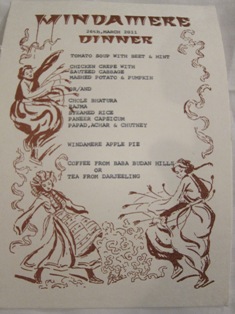
After our cocktails we had a pre-fixe dinner in the very Victorian dining room with music to match. We could have pretended we were in another era. White gloved turbaned waiters with wide cumberbands (in modern Afghanistan the Dari word for seatbelt is ‘kamrband.’) noiselessly served us our three-course dinner (non-veg) which we enhanced with a glass of wine.

And now we are in our lovely room with flowery curtains, a fire in the fireplace, old wooden furniture and a tiny clawfooted bathtub in the old fashioned bathroom.
Outside our room are camellia bushes, potted English daisies, bright red geraniums, flowering lantennas and other signs of an English garden tradition. Because it is dark we haven’t seen the view but given how the chairs on the veranda are lined up we expect it to be spectacular. Our guide will come and pick us up at 4:30 AM to see the sunrise over the Himalayas.

Jailbreak

The flight from Kabul to Delhi is only one and a half hour but it took us 8 hours from door to door. At the entrance of the airport we met our friend Sabina, a reporter I met a year and a half ago in Herat when I spotted a western woman sitting alone at breakfast in the Nazary Hotel. Since then we have become friends, she visiting us more in Kabul than we her in Delhi. I had just written her an email that we were going to be in Delhi. She had not read it yet.

She returned from Kandahar where she met and interviewed all sorts of powerful people who hold the destinies of thousands of people in their hands, life, death and wealth; the latter through the contracts that the military are bringing into the country. I asked her whether she had not been afraid. Life goes on in Kandahar, she reminded us, much like it does in Kabul; in spite of the many acts of violence that are committed there. Places are always scarier from a distance.

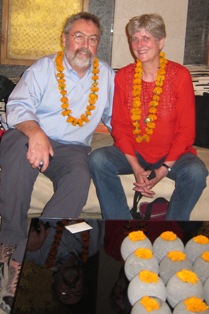
We were greeted at Delhi airport by the same young man who had first welcomed us to India in January. Now we are like old friends. He put marigold leis around our necks by way of welcome – we must have risen in status because last time we didn’t get those. Back in Manchester we plant marigolds around our vegetable garden to keep undesired animals out. They smell strongly and not particularly pleasant but they look very festive.

And now our fantasy vacation has really started. We ordered all sorts of Indian delicacies up to our room for a late supper before turning in. My sore throat and Axel’s respiratory problems have disappeared as by magic. Breaking out of Kabul is a good thing.

Triangulated

An early rise allowed us to squeeze as much of Jaipur into our day that also included the ride back to Delhi (6.5 hours). Although also a prime tourist destination Jaipur did not quite feel the tourist trap that Agra is. Despite the chaos we felt right at home. Our hotel was in one of the restored houses of the well to do, a heritage hotel (15% of remodeling to become a hotel compliments of the federal government). The design and decoration reminded me of a computer program that allows you to drag any kind of architectural style onto a layout of a house, and a whole family got involved, each dragging that which he or she liked best, producing a hodgepodge house.

We did the usual tourist stuff: a picture of the Wind Palace where the court ladies could peek at normal town life from behind marble lattice work, a ride on an elephant into the Amber Fort. While waiting in line we met John of Dutch descent who now lives on Baffin Island in the far north of Canada. His ancestors came from Zwolle where Axel and I just passed by only a week ago.

He and his wife were a little on the heavy side and so, in order to distribute the weight evenly they had to lay nearly flat on the elephant seat. They flopped back and forth at each step of the elephant. It did not look like fun.

The whole world was at Amber Fort which made it rather crowded, even though it can hold a lot of people. After the fort we stopped for the obligatory picture of the Water Palace which also happened to be the focus of the kite festival that was celebrated that very day. There were dances and kite design exhibits, a 50 kite superkite that was hovering above us, a marching band and someone who looked like the last maharaja (an obese gentleman dressed in traditional clothes and with diamonds on his cheeks). Axel got to fly a kite and managed to get it cut down in 5 seconds.

Last stop was the Jantar Mantar which, our guide told us, produced the word jantra mantra which is the Indian version of abracadabra. I can’t quite remember the connection between a magician and the scientist who figured out the complex astronomical calculations, including the tilt of the earth and the distance to the equator.

We got the idea of the sundials but not the astrological equipment that determined the sign for each day and the signs of the zodiac in back of it. The only thing we did notice is that the Leo and the Sagitarius were right next to each other, just like the two of us.

After another excellent lunch we realized we were not going to get back to Delhi before nightfall. This worried me more than it worried Axel. Our guide claimed the road was excellent which it decidedly was not. It was probably the most uncomfortable and haried part of our trip and undid some of the vacation (and massage)-induced sense of relaxedness.

Thanks to our good driver and a lot of luck we made it safely back to Delhi. I did notice that Indian drivers have difficulty committing to lanes and so the weaving in and out of lanes was for them not weaving but simply hedging their bets. Our driver participated enthusiastically in this mad rush.

We had our driver drop us off at Connaught Place for a last Indian meal. After that, to complete the India experience, we rode back to the hotel in an auto-rickshaw (or baby taxi as I learned to call them in Bangladesh). And now it’s time to go home.

Dead India – Live India

Live, the Taj Mahal is even more breathtaking than in the pictures. I had no idea of all the architectural treasures that surround it. We both liked the guesthouse, the mehman khana, with its red sandstone interior. I did try to imagine what it would be like to be a guest in such high vaulted and stone places, without windows, and very draughty and cold in the winter. I was told there were curtains and the place was carved up in smaller interior spaces – still it would be the equivalent of a high vaulted church in Europe.

Mumtaz’s story, albeit it a love story, is also a story about family planning, or rather the sad failure of family planning. She died at 29 during her 14th delivery, with 8 children already dead. The emperor’s tears may have been real and sincere, but she had more reason to shed them. Not only did she lose 8 of her children, her rival’s son imprisoned her king until he died.

Later we saw his ‘prison’ which was not such a bad place; he had a nice view of Mumtaz’ tomb, the river, the town, his own mosque and some pretty nice baths.

We had two enormous beers on a rooftop terrace until it got too chilly and then found a restaurant that Lonely Planet recommended. The food was good but the atmosphere left something to be desired – eating alone in a restaurant is always a little unsettling. But then again, Indians eat late and we were early.

We stayed at Colonel Lamda’s guesthouse. It took forever to find it in the suburbs of Agra. The colonel is an elderly and presumably retired military who is running a small guesthouse. When we arrived he was giving a cooking class to a party from Oxford. The room was frigid and there was no way to heat it as the entire guesthouse was running on solar battery power. We crawled under our 15 pound Chinese blankets, 2 of them, and remembered that this is how most of the people in this part of the world go to bed at night.

Being essentially without electricity meant we could not charge our electronics; besides there was no internet, hence the missed posting.

On Thursday we toured Agra’s red fort (more bad news for women as I learned that pregnant concubines were thrown off the ramparts into a big holding tank. It was not clear whether the cheetahs cleaned up the mess or some untouchables; either way, not a pleasant practice or sight). I assume that the ladies in the harem must have figured out how to not get pregnant or abort, or both, as not knowing was potentially lethal.

We visited the abandoned Mughal capital of Farahpur Sikri on our way to Jaipur. We discovered that dealing with dead India (the Mughal architectural treasures) is much easier than dealing with live India, the hawkers, touts, pseudo guides and shoe wallas who all want to extract as much money out of you as possible for next to no effort. It made me not want to come back to Agra.

Five hours later, in Jaipur, all knotted up from the long ride in our ‘luxury sedan’ we noticed the Ayurvedic massage place near our hotel and managed to get the last 70 minute slot of the day. Side by side, with a curtain separating us, we were sprinkled with hot oils until our skin couldn’t absorb anymore. We emerged relaxed and oily like sardines, greasy hair like Elvis.

We asked out driver to take us to a nice local restaurant, which he did. Inside celebrations were taking place, for a birthday, and the lengthening of the days, with drums, fire, a puppet show and traditional dancing. The best part of it all was that we were the only foreigners and no one was trying to get us to buy stuff we didn’t want. In fact, we bought exactly what we want, which included some adult beverages, and then were invited to join in the festivities with the all-Indian patrons.

We declined and later wondered why? Because we had to get up early to see more of dead India. This touring business on a tight schedule to see dead India has some flaws, we realize now. Next time, we keep saying, next time…


February 2026
M T W T F S S
 1
2345678
9101112131415
16171819202122
232425262728  

Categories

Blog Stats

  • 137,629 hits

Enter your email address to follow this blog and receive notifications of new posts by email.

Join 76 other subscribers