Posts Tagged 'Kenya'


Goods delivered

We completed the vision for the Kenya Institute for Health Systems Management. It is as practical and complete as it could be given who was in the room. The final activity consisted of public commitments from key stakeholder groups on how they can and will support the fledgling new institute as it takes its first steps.

Several of the participants, in a series of self-revelatory statements, mentioned that Kenyans are very good about making big plans, conceptualizing stuff and then dropping the ball when it comes to implementation. I assured them this was not a unique Kenya quality and that it had something to do with either not owning the vision or plans, being too ambitious in scope, or finding the complexity of implementation, while none of their other work had disappeared, simply too much.

We’ll see in a few months. The group certainly had reached some momentum by the time we finished. The original ending time was 4:30 PM but we were done before lunch. The closing act took another 45 minutes and included a special African clap that is rather involved, a lengthy vote of thanks leaving no one out, an exhortation about change management that appeared to inspire everyone much like a minister inspires his or her flock on Sunday, and more claps.

Everyone left with a button, immediately pinned on. It should have been a lapel pin, stating that the wearer was a founding member of this new institute. The pin idea got sunk because there were too many logos that needed to be included. Since the elections some years ago that left Kenya in flames and with two dueling presidents there have been two ministries of health. Add to that MSH as the midwife of this institute and USAID as the financier, it was simply too much to squeeze on a lapel pin. No one seemed to think any less of a button.
It gave the wearers a special status. These buttons are of a limited edition, only for those who helped to build the vision from scratch. Maybe one day they will be collectors’ items on E-bay.

And then we drove back through the dense traffic that streams relentlessly in and out of Nairobi, all day long and into the evening. I was deposited at the hotel I left two days ago for my last night in Nairobi.

For dinner I took a taxi out to the house of a colleague. It still feels a bit funny that I can walk out of the hotel – I had to suppress a reflex to pull my scarf over my head – and take a taxi from the taxi stand, walking unaccompanied.

At the house I found dear old friends I had not seen in years, all of them having become moms (of boys) over the last four years. It was an evening of countless stories about everything, including about much reviled facebook which, nevertheless got us talking for at least an hour, engaging those who loathe facebook, those who love it, and those who claim they don’t ‘do’ facebook.

And now I have checked in for tomorrow’s flight and am preparing for the final deliverables.

Electronic portholes

The Africa I first visited, some 32 years ago, is different now in ways no one could have imagined. Of the 40 people or so in the room today, all are computer savvy, several have iPads or Samsung tablets, notebooks; many have two cellphones of which one a smart phone.

Wireless availability in the conference room requires my utmost effort to compete with the distractions of the entire world that can enter at any time through electronic portholes.

Many things didn’t quite go as indicated on the agenda which we used to our advantage. We skipped ahead to sessions planned for tomorrow. One speaker didn’t show up and another was shorter and more engaging than we had expected.

Although we haven’t quite gotten the partners that we wanted in the room, the ones who did show up are 200% engaged and fully supportive of what the Kenyan government is trying to do – the creation of an institute to ensure that, in the future, anyone graduating from medical school, or seeking a refresher course, will know how to manage a health facility or service – thus avoiding at least some of the costly mistakes and most of the painfully acquired lessons about good management.

Less than 10 years ago we did much of that preaching but now we are preaching to the choir. There is much energy for the task at hand, even right after lunch and deep into the afternoon. We got all the work done before it was time to leave, and more.

With a medical engineer, principal of one of the technical schools, I retraced the 5 km jogging trail around the golf course. With company the track seemed shorter but we walked one hour nevertheless. The monkeys had moved to another place. We spotted them grooming each other on the far end of the gold course, small moving black dots on pristine greens. The ants had completed their crossing and I didn’t see them again.

For dinner I avoided the formal and empty dining room downstairs. Instead I had a pizza, beer and lemon grass ice cream by the pool. I sat at the bar, the only place with enough light to read from my portable library on my Kindle-equipped smart phone. I am halfway through The Thousand Autumns of Jacob de Zoet, a historical page turner novel about my (our) next destination, Nagasaki.

Tuning

We spent the morning finetuning the design of the workshop and meeting with counterparts. I ask about expectations, about challenges, traps and pitfalls I can expect. This is not just for me but an occasion to help people be realistic, let go of wishful thinking. “We don’t want to have politics interfere,” says one. But politics are always there.

I now have a co-facilitator and a flexible plan. I use the time to get my co-facilitator on board as an educational intervention. I explain my thinking and assumptions and test them. Heads are nodding when I describe situations we want to avoid: dominant people inserting agendas, hijackings, people not daring to speak out. More nodding, they have all be there and look relieved when I tell them there are ways that make all this more difficult for the hijackers or the monologuers or the grandstanders.

The first day of a workshop is always full of unknowns. I have padded activity times with extra half hours here and there in case we start late (likely) and speeches are longer than predicted.Padding the time allocations has the benefit that things can go faster. Sending people home early is never a problem.

In the four years since I was last here the case for better management and leadership training of health professionals has been made abundantly. I don’t have to advocate for it as I used to. I am surrounded by advocates –that baton has been successfully handed over and progress is visible.

I am moving out of my nice hotel to the place further out where the workshop will take place. I am taking advantage of my last few hours here by doing work that requires the internet, not knowing what awaits me.I traveled light so packing and unpacking twice on this trip is no problem.

It is warm and lush here. I had forgotten that it is not winter as I understand winter to be. it is hot and dry. It suits me fine.

I keep thinking I have to put a scarf on, that walking out of the hotel’s gate is not allowed, and marvel at the thinly clad women with their exposed legs and arms – Kabul routines are still deeply embedded in my head – I have to tell myself, I am in Kenya, not Afghanistan.

People say there are threats and attacks, from the Somalis. They consider security tight but to me it is not tight at all and probably rightly so – how can one preserve safety in a large city, teeming with people and cars? Life is risky, here too.

Later: I was driven to the Windsor Golf and Country Club – a fancy resort with, depending on one’s room, has a view over green with the city of Nairobi in the background or Mount Kenya and the Aberdare ranges on the other side. I have seen neither so far.

The magnificent 18 hole golf course has a 5 km path that meanders around it, through woods and open lands with an abundance of tropical trees and bougainvilleas in bright colors, their faded blossoms like a carpet on the ground. There are signs of wildlife. I spotted some Sykes monkeys overhead, paying no attention to me, and a column of ants, one inch wide, without beginning and end, that cut right across the path. I watched them for awhile and film them with my smart phone.

Thirtytwoyearsago

Two and a half years have passed since my last visit to Africa, a continent that I visited so often and for so long before I moved to Kabul.

I am starting my re-entry with Kenya, a more or less normal place after Afghanistan. I wrote to my old friends, colleagues, students in Kenya who I haven’t been in contact with for years. Not surprisingly many of the emails bounced, but some wrote back right away. I told them that my schedule was tight and my visit short but hoped we could at least talk on the phone, re-acquaint.

Some of the people I hope to see or will see weren’t parents, or not even married when I last saw them. Now they are parents to more than one child. There is much to catch up. Others were AIDS activists. I am not sure they are still alive. Some of those emails bounced.

I am going to do what I like to do: facilitating the conversations between key stakeholders that need to happen to establish buy in, create a shared vision, for an institution that is supposed to teach Kenyan health professionals how to be good managers and leaders in moving the health agenda forward.

I am only part of this during this one step. There have been many steps before and there will be more in the future. Accompanying such a process over time was the attraction of going to Kabul (an attraction few people understood). A structure with a similar mission (improve management and leadership skills of health professionals) now exists within the ministry of public health in Kabul; it is staffed and has a space, two enormous accomplishments that happened after I left. I helped with the planting and the watering, but am not sure I will ever get to see the harvest with my own eyes – of my four planned trips to Kabul not even one has been scheduled.

Arriving in Kenya was full of old and new; the smell of Africa, stepping out of the airplane, the airport (no change), the road into the city (just more businesses, more buildings) and the hotel (upgraded). I remembered my very first trip to Nairobi in 1979. When Axel and I left to return to Dakar, Sita, the size of a pinhead, traveled back with us. Much has changed, in the world, in airline travel, in Kenya and in our family, since then.

East and west

I imagine there must have been many negotiations when the wedding was being planned over how traditional or how modern this event would be. The parents of the bride were, I believe, very happy with the traditional part. The Jain vegetarian food and absence of alcohol were, no doubt, non-negotiables. The western ceremony, and especially the Bollywood disco party were probably non-negotiable on the young couple’s side. That’s the part that took place on day two, part two of the wedding.

After a very challenging yoga session from 7 to 8 in what must have been around eighty percent humidity and a swim to cool off, we were offered yet another lavish breakfast. Although mostly a breakfast for Indians, for those craving for their home food there was even bread and cheese.

The rest of the morning was free until noontime when the next event would start. Some people went on boat rides in the backwaters – the one thing we had already done on our way out here – others went to the spa, all slots of treatments were booked, and the friends of bride and groom went to the adjacent presidential suites respectively to hang out – apart but within hearing distance.

Each of these bungalows had a fair sized swimming pool and waiters at beck and call to bring in goodies. The groom and his friends hung out in the pool while the bride, on the other side was, I presume, chitchatting with her friends while being made up and dressed in another saree fit for a princess for the next program. The groom simply slipped into another stately Indian outfit just minutes before the next event; no turban this time.

The afternoon program consisted of traditional dances and dances by the groom’s family and friends. The groom’s sister and her friend, plus their teenage (male) cousins had studied a dance routine and the bride and groom had taken some lessons back in Mumbai. Everyone was forewarned – showing off your dancing prowess is apparently part of the deal. In an Indian-to-Indian wedding, I was told, the two families show off before the wedding in a rather competitive spirit.

The traditional dances gave us a taste of the variety of exquisite feminine dances like those from further east as well as demonstrations of martial dexterity with a variety of very scary looking weapons. Although these martial dances were done by men, a large poster from the Incredible India campaign showed women with shields and swords jumping high up while going after each other.

Then a late lunch buffet before the next to last part of the wedding. All the men, Dutch and Indian, including the groom came dressed up in two or three piece grey suits (although the Indian ladies continued to wear their bejeweled sarees). I knew that some of these suits had been tailor made from Italian fabrics according to the latest Italian designs but frankly, to me each grey suite looks like the next one.

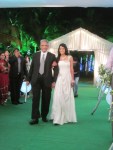
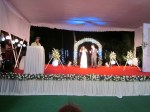
The groom and his dad waited at the front of the completely transformed outdoor wedding hall – new flowers, new decorations, new theme, new lights, new colors – when the bride, now dressed in white, with still spectacular but now less abundant jewelry entered on the arm of her (suited) dad. The audience stood up and only the traditional wedding march was missing – now we were marrying the two in (somewhat) western style. There even was a churchman who sermoned about two becoming one and the responsibilities and duties of each towards the other.

There were vows, lighthearted and funny revealing things about habits that have clashed in the past and may well continue to clash in the future, then the rings, a wedding cake and other parts of the western wedding ceremony, slightly altered or influenced by the Hindu context.

Following western tradition a MC asked for people who wanted to say a few words and that is when the tears came when family members and friends of the bride offered tearful farewells (I wondered why as the couple is, apart from the honeymoon, not going anywhere).

The father of the bride had made a slideshow of the groom’s early years with the theme of ‘finding India.’ I wondered what the Indians thought of it all – scenes of snow and travels around the world. I noticed how we have all aged – four among the people in the audience were featured in the film (the parents, oma and friend Joe – over the last quarter of a century.

The grand finale was in two parts: first what is called the sangheet – a series of dance acts on Bollywood themes performed by family and friends of the bride with the greatest joy in the greatest heat that none of them seemed to mind. The young generation was taking over while the older one sat stoically in their seats – I wonder whether they were suffering all this or simply sad that the very traditional wedding they would surely have wanted was now a thing of the past.

Part two of the grand finale was definitely a western affair in a pavilion off on the side, decorated Bollywood style with lifesize cutouts of Bollywood stars, a smoke machine and laser light and a real DJ who played very loud western music. We danced a bit while there was still room on the dance floor – in spite of the immense heat – until the young people moved in, the girls in tight short dresses and the men in comfy clothes – most holding glasses with, I assumed, adult beverages.

Drenched from sweat I returned to my houseboat to find the electricity off. I dozed off thinking how most people in Indian sleep like this every night – mosquitoes, intense heat and no electricity for fans let alone AC. I was woken up at 2:30 when a generator was turned on and bringing the fan to life making the rest of the night a breeze.

Thursday, November 15, 2007

Late September when I signed on for this assignment the 16th of November looked like a long way off. It would be the day that I would know whether going to Kenya was foolish (as some around me said) or whether I could handle an assignment like that again. So the day has arrived and I am still in one piece. The piece is a little sore, especially its lower extremity because it was a very very long workday yesterday; actually it was a very long and intense week. But here I am, November the 16th and I am flying home tonight.

Yesterday started at 6 AM with my usual morning routines that include exercises under the shower and then outside the shower. By then I am usually limber enough to walk fairly normally to the breakfast restaurant which is one flight down and then a short walk past the swimming pool. After that I am being picked. Here in Kenya I am not picked up but picked, just like I am dropped, not dropped off, at the end of the day. The driver takes me to KIA, a ride of about 15 minutes if we are early enough. Then comes the set up for the day, turning on the music so that people can come waltzing in and ready to focus on the tasks ahead.

Yesterday morning was a little different because I taught a short catch up session for people who had missed it on Monday morning on adult learning. I have a lot of fun with this session. I bombard them with a fast lecture about adult learning and violate all the principles that are written on my powerpoint slides. In my reflection afterwards we uncover the feelings people had while I lectured them. After they are sure that they can be honest with me and they get past the customary politeness to professors, especially a foreigner with grey hair, I ask them if I did a good job teaching them, what they think they’ll remember from it and how they’d grade me. I am pleased when I get the lowest grade possible; I should. The rest of the program we will honor the principles of adult learning and they see how, understand why. Now they know.

In the evening there was much to do because on the eve of the last day nothing can be postponed anymore. My foot protested and I slept with it propped up on several pillows. This morning it refused to bear weight by itself, something I know it can do. I am glad I scheduled one more physical therapy session this afternoon. Ida and I will see Josephine and her little girl in the hospital (she has tonsilitis we now know) before I head out to the airport in the evening. KLM is scheduled to depart at 11:10 PM for Amsterdam.

Wednesday, November 14, 2007

Yesterday was the 14th. I am still counting in months. It now has been 4 months. I don’t think all that much about the crash anymore, except when people ask why I am limping, which I do especially on my way to or from the dining hall. It is a bit of a hike and I can’t quite hide the limp. Those are the only times and I am factual and brief in my reply. But last evening, while Eunice gave me my last massage, the image of me losing control of the plane suddenly re-appeared out of nowhere and I found my whole body going rigid, right in the middle of the massage. And then it passed. I guess there is still a part inside me someplace that has not quite come to terms with what happened. My EMDR therapy has been interrupted for three weeks and it is obvious that I am not quite done with it, no matter how good I may look and how much I appear to have resumed my old life.

And so I switch my focus from the big global picture of poverty and maternal and infant mortality to my recovering body. I can’t quite control it as it happens without my intent or consent: a body part complains and wants attention. I respond with a massage and a warm bath. When all had calmed down again I went to bed.

We have passed the halfway point of the workshop and my departure is in sight, tomorrow, in fact. The work is not quite done but we are on track and everyone is learning, as intended. This includes me. I continue to learn about working across cultural and other boundaries. From time to time there are surprises; about how seemingly innocuous words or acts that were meant to serve a common goal are received quite differently on the other end. Our collective challenge, on all sides of the many divides (culture, age, gender, profession, you name it), is to keep talking, distinguish intents from interpretations, consider impact and then move on, everyone a bit wiser. Such experiences reinforce my resolve to get better at what I believe I am supposed to do on this earth (and maybe why I was given a second chance) which is to help us learn to have productive, rather than destructive conversations about things that matter. There will be more of this today, no doubt.

Tuesday, November 13, 2007

Josephine’s little girl is sick. We sent her home to be with her. She is admitted to the hospital. The health of our children is precious and we don’t realize it until they fall ill. We worry when the doctor cannot tell us what is wrong and the medicines don’t work. But Josephine is among the lucky ones: she has access to doctors, medicine and a hospital. Our work here is for people for whom this is out of reach, a luxury they cannot afford or access. As a consequence their babies die of preventable or treatable illnesses. It is a frightening thought to imagine such a tragedy. Josephine’s worry grounds me as it reminds me of why I am here. I once had a large button made for participants in a workshop here in Kenya, many years ago. Against a background of the colors of the Kenyan flag it says in big white letters “Why Am I Here?” Sita had put that same button on the lamp next to my bed when I first came back from the hospital on July 21. William wore that button on the opening day of this workshop. It is not a bad thing to ask oneself that question periodically

We completed day two of the workshop and tried to get the participants as much grounded in the philosophy, methodology, concepts and tools of the leadership program as is possible in a short time. With life interfering, as it did with Josephine, or other commitments that pull people in and out, our facilitation team is never complete. I am blessed with a team of colleagues that is so flexible that they can handle this reality without batting an eye. I made a point of sitting down more often and putting my legs up while William and Ida ran sessions.

After the workshop was over we drank our tea hastily and went downtown. That sounds easier than it is. We inched our way to the Hilton Hotel which took a good 45 minutes. I caught the nurses in their last hour of work. They were from all over Eastern and Southern Africa as well as the Commonwealth Secretariat from London which sponsored the event. We had a wonderful conversation about what makes midwives and nurses in general effective or ineffective in their work. They had already put subjects in their curriculum that I believe are critical but usually missing such as self awareness, group and power dynamics. The examples I knew about why they need these topics resonated with everyone.

Afterwards Ida picked me up and we had an Indian dinner. Back home a few more exercises, my footbath and email checking routine and then to bed. And now, while I am writing I am multi-tasking again, Skyping with Axel and Tessa at the same time as they are winding down their day and I am ramping up mine. I am already in their tomorrow.

Monday, November 12, 2007

Yesterday things started to speed up. If I had not gotten that idea myself my dreams last night would have informed me. They were of the multi-tasking and sensory overload type such as trying to answer a phone when a noisy speaker truck drives by (the type they use here n Nairobi to broadcast election messages). But there were also babies being born, old movie reruns with extras I knew and a doctor’s check-up. For now I will let these swirl around in my mind while I figure out which marching orders my subconscious has hidden in these dream for me for today. I suspect there is something in them about letting go and letting something be born while taking care of myself. The latter will be a challenge as today I will do double duty: after the workshop I will jump in a taxi and head down-town for a work session with East African nurses who are re-writing the nursing curriculum in the Hilton Hotel. That’s how these things work here. They asked me to talk with them about adding something better in it about management and leadership than what they currently have: theories from dead white men from the US.

Yesterday I had set my alarm very early so I could do my exercises, write in my journal, have breakfast and be on time for Josephine and John to pick me up around 7 AM. When we got to the venue at the Kenya Institute of Administration (KIA) Ida and William were already there, preparing. There was still much to be done, and there were the usual ‘start-of-workshop’ glitches. But we pulled together nicely as a team and the day unfolded much as we had expected, except for the fact that we were missing some the KIA faculty (even though we are at their place) and we were all very cold. In Kenya there are also climate surprises; global warming has made the usual weather pattern unusual.

It was a long day and even longer as there was homework for all of us and for me more exercises, footbaths and all that. Being up and on my feet most of the day took its toll: my foot was swollen and stiff, my neck and shoulders sore. The icepack was waiting in my mini fridge and did the job while I soaked my foot and answered my email; I can do all these things at the same time.

Sunday, November 11, 2007

I woke up from a dream in which I was presented with two choices: do something entrepreneurial and creative, or unload a car and add more stuff to a place that was already very full. Axel was encouraging me to go with the creative choice but I got busy loading more stuff into the room which required organizing what was already in there. I am not sure what this is all about other than getting mentally ready for the workshop that begins in a couple of hours.

Sunday was very quiet as I had intended it to be. I did go to Quaker meeting. This meeting is different than ours in that there are books on the table, several Bibles, Faith and Practice and other holy books and one can do contemplative reading during the meeting for worship. One of the members read a passage from Mark. It is the story of Jesus driving out the evil spirit from a, presumably, epilectic boy. The father of the boy had asked Jesus “if you can do anything, take pity on us and help us.” To which Jesus replied, “If you can? Everything is possible for him who believes.” The story is about the transformational power of believing in something. This is very much the core of our leadership program, here and elsewhere. The transformation occurs when someone believes in something enough to propel him or herself into action; when others see that, some will follow and become believers as well, attracting others. If you have enough of those who believe, things begin to change. This is how social change happens.

The theme reminded me of an interview I once read by Edmond Desmond in 1989 with Mother Teresa in which she said “I am like a little pencil in his [God’s] hand. That is all. He does the thinking. He does the writing. The pencil has nothing to do with it. The pencil has only to be allowed to be used.” And then I thought about the three of us in the plane wreck, three broken pencils, unable to write. And now, nearly four months later, here I am in Nairobi, with a newly sharpened point. I may not be quite like a brandnew pencil, but I am very ready to write again. And the work, not surprising, is about transformation.


December 2025
M T W T F S S
1234567
891011121314
15161718192021
22232425262728
293031  

Categories

Blog Stats

  • 136,758 hits

Enter your email address to follow this blog and receive notifications of new posts by email.

Join 76 other subscribers