Posts Tagged 'Niamey'


Leaky

This morning I went to see the hippos. The young man who sells knickknacks and souvenirs in the hotel lobby had proposed an outing last weekend but I had too much to do. I also thought the initial cost of the two hour ride (160 dollars) was a little steep. Since he has not been able to sell me any of his wares (I tried to explain that I had many of the things he sells and was actually divesting them), I said I would be willing to go see the hippos if he dropped his price. This he did instantly, by 50%.  We negotiated a little more and for a price I still though rather steep, I agreed.

We walked some ways to get to the waterfront, through a narrow slippery path, to a half-submerged pirogue, that took me through a field of water hyacinths to the larger pirogue I paid for. I suggested that next time he makes sure that the little boat was at least bailed out. I figured with the money I paid I could insist on better service, at least for people following after me.

I arrived at the edge of the river where at least 10 men were washing clothes, their arms and upper bodies covered in suds. They would not let me take a picture unless I paid. I didn’t. I indicated surprise that men were washing clothes. As it turned out they are commercial washermen from Mali.  They collect the clothes, wash them in the murky waters of the Niger, then put them out to dry on the dusty and dirty sidewalks near the hotel. In the afternoon they collect them, bring them home, iron and deliver to their customers. Like any other profession, once it becomes lucrative, men take over. As far as I know the women I see washing clothes along the river do it for free.

The large motorized pirogue, all 30 feet of it, was all for me – with my guide sitting in the front, to explain to me what I was seeing, and two boatmen in the back, handling the outboard. The middle section of the boat was covered with an awning, and with mattresses on the bottom, but I could see those were already soaked. The boat was rather leaky, held together with wire and struts, tape and gum. The outboard stopped about half an hour into the ride upstream; after about 15 minutes of hammering and cleaning of plugs, the motor started again and we pursued our trip.

We did see a small group of hippos where my guide expected them. They stuck their heads above water to check us out. We went a little further upstream but found no other and turned around. By then the hippos had moved fast upstream and we landed in the middle of them, with one right underneath. I am glad I didn’t realize it until we felt the bump, but by then we had passed them and neither the hippo nor the motor was hurt.
Cleanliness and the Queen of Sheba

There are very few chances to go for a serious walk (nor do I desire) with temperatures that reach 104F in mid afternoon.  In order to get in at least a few thousand steps a day I avoid the elevator. It is not working all that well anyways and people wait for a long time. I am usually down faster by foot, taking the 50 or so steps up or down to my fourth floor room each time I go somewhere, for breakfast, for lunch, for swimming or out.

The hotel does not seem to expect its clients to take the stairs – they are hidden behind an ill closing door with a piece of paper taped to it that says ‘emergency exit.’ Clearly, no one expects this to ever be used for that purpose, and if it would be, no one would mind the mess.

The stairs are covered with dark brown ‘moquette;’ a filthy looking floor covering that has not been cleaned in a long time. Staff use this way of connecting between floors to bring food up for room service, or laundry down to be washed, and anything else. I don’t think they are allowed to use the guest elevator and there doesn’t seem to be a freight or staff elevator.

The people who use the stairs have been dropping things like wrappers, beer cans, pieces of paper, parts of equipment, and whatnot for a long time. The filth bothered me, mostly because it is not necessary – there are sweepers and even vacuum cleaners in the hotel. How much effort would it take? I finally decided to say something to the reception desk staff.

That evening when I came back from a visit I noticed a man with a vacuum cleaner on the stairway. There are no receptacles on the stairways (a clue). He had to plug in the long cord in a receptacle in the hallway of the guestrooms. Even the designers of this building obviously didn’t think a receptacle for a vacuum cleaner was needed on the stairways (vacuum cleaners did exist when this hotel was built in the late 80s).

This morning, I walked down immaculate steps, all 50 of them. It made me smile – such a difference to be in a place that is cared for. I told everyone I met on the stairs how happy I was about the clean stairs. They smiled politely but I suspect they probably wondered why that was such a big deal for me.

This hotel is full of things that are like that – neglected and dirty, yet no one seems to notice. I was imagining a walk through with a new owner and pointing out the things I would change (rip up rather), and the list was endless: broken or chipped doors, mildewed walls and floor coverings, cigarette burns on tables, bird poop, paint spots and mildew on the lawn chairs, broken cabinets, paint spots from working without drop cloths, broken faucets, missing toilet seats, missing ceiling tiles, patched up electrical cords, being rerouted across windows or simply dangling, dirty walls, the list goes on and on.

Someone was trying to clean the turquoise outdoor wall this morning, up to the 2nd floor (the brush handle extension didn’t go up further) but it was too late for a simple scrub – it needs a very strong power washer and a new coat of paint. I wondered whether the cleaning was inspired by my request. It was kind of sad to see the good man try but neither he nor I saw much of a difference between the washed and unwashed sections.

On the front of the hotels 4 stars are still showing but one is on its way down and the ‘l’ of the word hotel is gone. If this is a four star hotel I am the Queen of Sheba.

Memory Lane

This visit to Niamey is a trip down Memory Lane. Last week I met someone I had not seen for decades and who I had in one of my classes at CESAG in Dakar in the early 90s. Today it was someone else. We calculated we had not seen each other for about 24 years because she was pregnant at the time and the one in her belly is now 24 and studying in France.

We talked and talked over lunch, having to pause once in a while to eat. So much had happened in our lives. The best thing (to both of us) was becoming grandmothers. We exchanged pictures –our grandchildren are about the same age.

Our careers had taken very different paths – I remained at MSH all these years, somewhere in the middle of the hierarchy, while she had been minister of Population, Women’s Affairs and Social Protection; a tough political job from which it took some time to recover. She considers herself a technical (public health) person, not a politician, but at the ministerial level you have to play the game. She did that reluctantly and is glad it is now in the past.  Since then she has retired.

It is quite common here to find people younger than myself who are retired. The societies here still consider people over 60 old. Maybe that has something to do with life expectancies – although certainly not the life expectancies of the elites – they share European or American expectations for longevity.

Obligatory retirement at 55 or 60 means that people can be put out to pasture for several decades. This is one of the bigger contradictions I have found in a country (and on a continent) where everyone always complains about ‘not having enough human resources.’ The other contradiction is the African ingenuity for making do with things, inventing new uses for discarded materials, but not able to make this add up to significant economic capital.

We schemed a bit during our lunch about what we could cook up that would be win-win-win proposals – but this will take more watering and fertilizer. We promised to see each other before my departure next week.

A walk to work-2

Once I pass the morgue I am nearly there. There is the School of Public Health and then a sharp left to the hospital. At the morgue, a bit before and after, I have to dodge cars and motorcycles parked pell-mell and seemingly in haste.  The crowd is thick. It consists mostly of men. Maybe women aren’t supposed to pay their respect in a public place.

But women are allowed other things that men are not, such as wearing gold and silk. Men wear silver and, presumably cotton and manmade materials.  I think of the fashionable young men promenading the Corniche in Beirut with their silk shirts and ties and their gold chains.

The side road that leads into the hospital is lined by women who must have gotten up very early to get here with their baskets full of food. And then there are the shoe shiners, the hawkers and the infirmed: people with all sorts of deformations and the mentally ill, unkempt and either looking resigned or saying things I don’t understand. I am the only white woman and thus stand out amidst the sea of mostly very dark skinned people.

There is a separate entry way for pedestrians, with a long line of people waving their pieces of paper to get through the gate that is opened just enough to let one person through at a time. The uniformed man at the entrance scans all these pieces of paper and then determines whether the person is allowed in or not. There is no discipline in the line. Some people are waiting patiently and others push their way through, innocently I believe, not knowing the system, if there is one at all. No one gets upset. This is a country, I am told, with very friendly, patient and polite people. The marauders who shatter the peace that make this country unsafe are not from here say people. They are Boko Haram in the southeast, the traffickers in the north and the Malians who recently ambushed and killed the American troops in the northwest.

It is 35 or sometimes even 40 degrees Celsius as I make my way to the hospital in the early morning hours, or home in the late afternoon. And so I stood there this morning, sweating, and shielding my eyes from the fierce sunlight. I wait patiently like everyone else while people hustle and bustle around me. I tightly cover the entrance to my purse. I have been warned about ‘petits voleurs’ (pickpockets) for whom I am an easy target, but so far no one has tried.

My entry ticket is my passport. It is of course an alien document. Sometimes it prompts a hesitant English word (Good, good, how are you), pronounced with the proud smile of someone who can say a few words in another language. I respond enthusiastically, if not entirely honest, saying, in French, congratulations, you know English. It is a bit like me greeting or returning a greeting in Haussa, two words that Hawa taught me on my first day here. People clap, and say, kind of the same, wow, you speak Haussa. I don’t, but everything starts with a greeting. This is one wonderful thing in this part of the world, something we sometimes forget in the US, as we impatiently move on with our day and our thousand to-dos.

A walk to work-1

Sometimes I walk to the rehab center from my hotel, when the traffic jams are so bad that it would take forever for my ICRC colleagues to pick me up.

The early morning traffic jams are usually created by the morgue which is between my hotel and the hospital. In a big city, and with only one morgue, there are lots of deaths and each death requires people to pay their respects. If it is a high level person, then people from the presidency come to pay their respects. Now the traffic is snarled for miles up the road.

I walk out of the hotel, across the poorly maintained grounds of the Palais des Congres (the first ladies are gone and cleaning stops instantly it seems) and then cross several side roads leading to a roundabout. I pass the Tunisian International University which must be on summer recess because I never see any students there.

I try to walk on the newly laid sidewalk but the tiles slanted sideways and it hurts my ankle, and so I return to the cement blocks that cover the gutter. I do look for cracks as falling into the gutter would be very bad; it is filled with a smelly dark brown goo.

The fancy tiles are laid for the president, and only on this stretch of the road that connects the president’s home and the airport. It is more of a decoration of the side of the road than a true sidewalk.

The road is swept, I am told, during the night by poor women who get paid 1000 CFA (less than 2 dollars) for delivering the road clean and neatly swept just in case the president passes by. This way he can proudly say that his country is truly joining the ranks of the richer countries – what with those pretty sidewalks.

Bats

There are two things I remember vividly from my trip to Niamey 30 years ago. One is a very painful learning experience that has served me well, though I didn’t like it at the time. It had to do with facilitation and letting a group take control of the process. It was painful experiential learning.

The second I remember even more vividly. Every day, at the end of the work day, I would be sitting on the terrace of the Grand Hotel (it is still here). The same place Axel stayed before we changed roles, when he was the one traveling around West Africa. The terrace overlooks the river and the bridge across the Niger river. I would watch the camels either enter the city over the bridge, or leave it. Now I see, from the other side of the bridge, a gigantic traffic jam; the camels are gone.

As I would sit on the terrace, enjoying a ‘conjuncture’ (the local beer) and brochettes, I would watch the bats come out at dusk. I realized that I was a spectator in a ritual that was probably thousands if not millions year old. That has not changed of course, what is 30 years on a cosmic scale?

The terrace of my current hotel (the Gaweye) is not quite as spectacular but I can see the bats come out just the same. They come out about 6:45PM and disappear around 7:10PM. A few hundred of them come out of the enormous mango tree across from my room. There must be thousands of them swarming from everywhere in the city and across the river. The bats are the size of pigeons. They squeak when they leave their roosts in the trees and squeak when they return, but in between they are silent killing machines, eating all the hapless insects that are no match for their stealth.

Tonight I ate my mini brochettes while I watched the spectacle. I was wondering how long they’d be out. As if by some unseen signal or clock (it gets darker) they start to return, streaming towards the tree here or disappear over the roof of the hotel or in the distance. A few continue to flap around – they approach the tree and then they seem to change their mind and with a wide swoop fly out again. I imagine these are the adolescents, who love this daily outing. But eventually they too return to the roost and, after some settling in squeaks, night falls and everything is quiet again.

The returning home reminded me of summertime and playing out on the street in our neighborhood. I was among the younger ones and I wasn’t happy when my mom called me in, “ah,” mom, “can’t I stay just a little longer?” (in Dutch of course). I would have been one of those bats asking for one more trip around the block.

The stock of mosquitoes and other flying insects is, I assume, kept under control by the bats. For those insects that crawl, there is another danger, not at dusk but after dark. Then enormous toads come out. They are the size of an apple. They jump from one insect to the next, covering considerable distances on the swimming pool terrace.  I pulled up my legs to prevent being taken for an insect. They look fierce.

Protectors

I look right over the hotel garden, or at least what used to be the hotel garden but it is now the bivouac of the military, presumably to save us in case of a terrorist attack. Watching them at different times of the day gives me little confidence in their ability to do so. They live on and around two small huts: a concrete floor of about 3 meters across with a palm leaf roof and four metal pillars that hold up the roof. Two men sleep under one roof and a third under another, probably the highest in rank. The two small pavilions are about 7 meters apart and right under my window, and so I have a perfect view from the 4th floor.

When they wake up they remove their mosquito nets, fold their blankets and stow them someplace. Their beds are the plastic (no longer white) swimming pool lounge chairs, flattened. For mattresses they use the blue and white striped covers (rather faded) that used to be for the tourists but are now worse for the wear. They sweep their living space and then sit, which is what they do for the rest of the day. I can’t imagine they are in any condition to run or attack. They have a walkie-talkie by their side, or at least one does; they are all preoccupied, all day long, with their smart phones. I am told they are on FB all day long. Even when they get up and walk away, they seem to follow their smart phone.

I got to watch a supervisory visit, I assume, by a superior, who arrived with a rifle slung over his shoulder. Both soldiers spring to attention and pick up their rifles. They were laying on the ground, dark rifles camouflaged on the dark dirt of the neglected garden.  I can’t tell from the distance whether it is a call to duty, an admonition or a reprimand. Five minutes later the man leaves again. One of the soldiers dusts off his flak jacket, dons his red beret, slings his rifle over his shoulder and stands alert looking out over the river, on the edge of one of the pavilions and then starts to move to the outer perimeter (no, correction, it’s a call of nature). The other seems to be off duty and resumed his cell phone activities.

On the front of the hotel the situation is not that much better. There too the security guards have their eyes glued to the smart phone, interrupting their phone sessions only occasionally for a rather disinterested check with their wand, applied inconsistently to me, and presumably to others. The machine to check what’s in our bags is sometimes required and other times they wave me through. Even further away from the hotel, the guards who check the underside of cars at the entrance to the parking lot in front  of the hotel don’t feel the need to check the ICRC car that picks me up and drops me off. All ICRC cars have a sticker of a picture of a gun with a large red line across it. God help us if an ICRC car ever falls into the hands of people with other motives. My colleague here says that nearly happened when armed bandits commandeered an ICRC car in one of the wilder areas of Niger. The long negotiations were not about getting the car back, but rather about removing all ICRC logos.

How to be happy

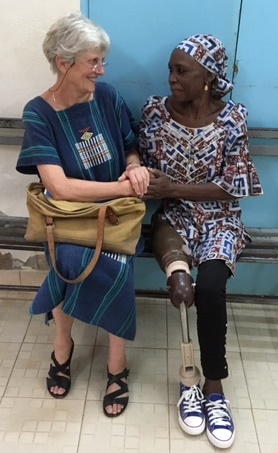
During my tour of the tiny ‘Centre d’appareillage’ at Niamey’s central hospital I met Hawa. She had already greeted me enthusiastically, speaking in perfect French when I came in. I wasn’t sure whether she was staff or patient.  She was practicing walking, with one leg of her own and the other an artificial one that was produced at the centre.  After my rounds I returned to where we had met. She was taking a break. What she is doing, learning to walk again, is hard.Hawa1

We sat for about an hour and chatted. I learned that she was from Agadiz, a city more or less in the center of the country, which also happens to be the meeting points of all the traffic routes: trafficking of drugs, weapons and those poor souls from all over Africa who spent fortunes to get to a very uncertain future in Europe, if they make it through the Sahara at all, and survive its various predators, heat, thirst and then the boat ride to Europe.

Hawa and her family were in a car when they were attacked. Here in the Sahel and Sahara, there is the equivalent of the Somali piracy practices. Most of the attacks are done by criminals who want cars and money, or maybe they are just high on drugs and have guns they like to shoot.  She was severely wounded and, her luck, picked up by ICRC and transported to the hospital. At the hospital her leg was amputated. After that she became a patient of the rehab center where I am spending this week. She is poster lady for CICR, for the rehab center and for the miracles that P&O (prosthetics and orthotics) professionals and physical therapists can perform.

Hawa is about 40 years old and has three children, divided between her ex-husband and herself.  Her French is so good that I suspect she was a school teacher but I haven’t asked. There are so many other things I want to ask her about her life before and after.

I noticed she had the name of a man tattooed on her arm, looking much like the numbers one sees on the arms of concentration camp survivors. I asked her what that was and why, wondering whether she was, at a young age – it was clearly an old tattoo – promised to a man who had already written his name on her. The ensuing conversation was a bit confused and I could tell she was not willing to share much with several men standing nearby. One of the attending therapists told me she had written it herself because she was in love with that man, at which she started to laugh. It’s hard to imagine a woman in this conservative country doing such a thing. Suffice to say she is no longer married, also unusual. Maybe hubby has taken a younger wife elsewhere – after all what good is a wife with only one leg.

There are other people I saw in the center and in the adjacent PT section, with what look like bullet wounds and/or amputations. Some told me their stories – attacks survived. North and Northeast of Niamey is like the Wild West, where there is only one law which is dictated by those who have the most guns, good transport and money that can buy loyalty from anyone hungry for money.

In the book A Force for Good that I am reading, about the Dalai Lama (and written by Daniel Goleman) he tells the story of someone who is asked to comment on people who are ultra rich. He responds by saying, incredulously, “but they only have one stomach?” I was wondering about these warlords and traffickers in the Sahara – they too have only one stomach; what can they do with all these riches they accumulate, while traversing the Sahara, over the bodies of all these hapless people, seeking a better life?  Maybe they drive around in a nice car, with air conditioning, a Rolex on their wrist and the latest Apple watch/phone. But they are in the Sahara where there is no electricity, no recharging stations, just heat and sand. Do they care what time it is and whether they had sufficiently REM sleep last night?  Are they happy? And then I think of Hawa and her smile and her positive energy to embrace whatever comes her way.

One generation later

My assignment in Mali ended on a high note, even if it didn’t always look like it would. At my last lunch with ICRC colleagues I met a fellow traveler who was also going to Niamey on the midnight flight – that makes waiting in airports a lot more pleasant.

After several debriefings at ICRC I returned to the hotel. I asked to see my bill and pay. As it turned out their credit card machine was broken. Luckily I had enough cash, though just barely, to pay the bill in a combination of CFA and dollars. That had been good intuition to bring dollars and get a lot of cash out of the Ecobank machine.

The Turkish Airlines flight from Bamako to Niamey was empty, although I managed to sit in one of the few rows that was filled. I suggested that the very tired 3 year old sit by the window but he chose to sit next to me. He flopped against me with his head and then with his feet. He was traveling with his mom to Istanbul and then Rome, a rather roundabout way, but I suppose the ticket was cheaper than Air France.

I helped mom put up her case in the overhead bin – something I can now do thanks to my daily swims. I few months ago I had to ask for help; now I can provide help. Even though I have only 3 tendons attached to my rotator cuff in my right shoulder, they are getting stronger by the day. The swimming has been a discovery for me. I didn’t think I liked it.

We arrived at 1:30 AM in Niamey, temperature 30 degrees! The ICRC car was waiting for us and dropped me off at a hotel that hadn’t even opened when I was here 30 years ago. Now it looks like it was 100 years old. I know plenty of old hotels that are nearing their centennial anniversary that look a whole lot better. The place has suffered from neglect, poor maintenance and probably poor quality building materials. Still, it is billed as the luxury hotel of Niamey.

I was too tired to care about which room they gave me, and tumbled into bed for a short sleep as my alarm was set for only 4 hours later. When I woke up I decided that the room I had, with a view onto a fly-over and thick dark curtains hiding a small dilapidated window, was too depressing for a 10 days stay. I requested a move to the back of the hotel that looked out on the pool, palm trees and the Niger River, the same river I had just left behind in Bamako.

The pool is twice as big as the one at my Bamako hotel, and also mostly unused, though it is not tucked away and out of sight of most hotel guests. Still the people here seem not to care about using it, whoever the guests are.

Next to the hotel is the Palais des Congres, where, the day of my arrival, the first ladies of West Africa came together to discuss genital mutilation, early marriage, domestic labor and other malpractices that hurt young girls. These practices used to be defended as ‘it’s our culture.’ I was happy to see that these issues have now reached the top. When I was here 30 years ago you would be hissed at, especially by men, if you raised any of these. Fran Hosken was an early activist against genital cutting in those heady days of the 70s. Her activism was dismissed as annoying American interference in age old rituals. She was ahead of her time. If she is still alive today she would be pleased. No one is arguing anymore that such practices are bad for everyone – and raising them is no longer political suicide.


December 2025
M T W T F S S
1234567
891011121314
15161718192021
22232425262728
293031  

Categories

Blog Stats

  • 136,984 hits

Enter your email address to follow this blog and receive notifications of new posts by email.

Join 76 other subscribers