Posts Tagged 'Pune'

Oil, peace and calm

About 6 kilometers from where my friends live, beyond the outskirts of Pune, is the Tanman Ayurvedic research center, associated with the International Academy of Ayurveda. That was the last item on my ‘checking the boxes’ list – an Ayurvedic massage; not just one, the Tanman massage but also the Shirodara, where a copper container with hot oil angles over your head and drips the hot oil on your forehead. It advertises as a stress and tension reducer, which it did so well I fell asleep. 

All slippery and oily I was led to a steam box where I nearly fell asleep again. My therapist (Chief Therapist said her name tag) was Blessy, a young woman whose husband I later met and who was also a Chief Therapist.

For the final moments of the ‘treatment’ that I had signed up for, I felt like a queen with a personal attendant. She helped me as if I was too old to do things for myself – I could have taken it as an insult but I loved it. She walked me across the slippery floor, soaped and then rinsed my body under the shower, washed my hair, toweled it dry, combed it and helped me put on my clothes. At the end she planted a kiss on my chin and embraced me tenderly. 

There are people in residence here, living in small cottages. There is also a restaurant that is open at all times for breakfast, lunch and dinner. I heard one woman ask when it was lunch time. The junior doctor, who had checked my tongue, my weight and my blood pressure, told her, ‘when you are hungry.’

Currently there are two American women and two Spaniards in residence for treatments. These can take anywhere from a few days to several weeks. After an initial consultation (done by email for non residents), the senior doctor(s) make a preliminary diagnosis, draw up a treatment plan and indicate how long it will take. That’s when you buy your plane ticket. Once you are here a physical exam will finalize the treatment plan and confirm the length of the required stay. You might decide to change your return date at that point.

The center has an organic farm, lots of cows (a particular breed important from Rajastan – Tharparkar Desi cows), yoga in the morning and evening, a number of senior and junior ayurvedic doctors who are available for consultation and all sorts of treatments for all sorts of ailments.  

There is a treatment of 7-15 days for arthritis I would be interested in (ankle, heel, knees, finger joints). The length depends on the source of arthritis. It could be related to osteoporosis (a longer treatment) or to toxins in your body (less time), or other causes. We are all uniquely configured and uniquely responding to what we eat, our habits, our sleep, our environment and our digestion (agni).

In between treatments, yoga, meditation, walks and meals you can take Ayurvedic cooking lessons, learn about herbal medicine, buy Ayrvedic products. And, if you are tired of peace and calm, get a cab into Pune for coffee, alcohol, processed food and polluted air.

I can think of some people who could benefit from a week here.
Food and religion

Having completed my world peace duties, we completed our journey into Pune with a south Indian thali lunch. Thali is served on a stainless steel platter with small cups that are filled by wandering servers. Each has several small pans which contain dal, a vegetable mix, a thin broth. Then there is raita and a potato based stew, the latter served directly onto the plate. All this is accompanied by several kinds of breads, like roti, paratha, puri, etc. Everything is spiced, some very hot, some not so. The servers continue to fill your plate until you say no, so it is easy to overeat. After the first course there is fried rice and then sweets to complete the meal. My friends see to it that I sample as many different foods as possible. 

In the evening we had the neighbors over, a retired couple (he navy, she a criminal justice lawyer) who have adopted my friends as their daughter and son in law. Daily, a small dish shows up from next door with something to eat. 

I was warned that the man has an intense dislike of the religion of India’s neighbors. I had intended not to disclose that all my overseas assignments had been in countries with a predominantly (if not all) Muslim population. But it was as if he knew because he started off our conversation straight away, saying he had read all the holy texts, and Hinduism was the bets religion to have.

Although he predicted that Islam would take over the world in about 50 years, he also dismissed the religion and its holy texts as no good (not good for women, not good for the world). I tried to convey a more nuanced view on Islam, having lived in countries with very different interpretations of Islam by ordinary people. But, having fought on India’s western front, he was unfazed. His wife came from Kashmir, so the dislike of religion, conflated with a particular national identity, was shares between husband and wife. Interestingly, this conflation seems to be happening in the US right now as well with Trumps latest executive order regarding jews and Israel.

He challenged me several times to see whether I could name the places in the holy Quran that said women were equal to men; he had given my friends the book with Arabic text and English translation, which was pulled out. I searched for the ‘W’ of women but of course any argument would fall on deaf ears. He had made up his mind a long time ago.

He asked (of course) about my religion. I said ‘Quaker’ which tends to be confused with Mormons and other sects. I tried to explain these were quite different. What is Quakerism? My mother also thought it was a sect. I still not quite sure what to call it, if not a sect.

We had dinner two days later with the same couple at their house. He had, in the meantime, researched the Quakers and was pleased that we believed some of the same things (no place for dogmatic or abusive priests or mans. He understood that Quakers are not like Mormons. That was a relief.

Mormons have been converting people in India for a long time and may therefore be the best known of protestant sects. Like in Nepal, where the converted are often referred to as ‘dal-bhat’ christians (dal=pulses and bhat=rice), here they are called ‘rice-christians.’

The next door couple knew a Canadian Mormon couple who had stayed at their AirBnB in Delhi and they kept in touch, even meeting in Canada whenever they visit their son who has emigrated to Canada. They thought I looked like the (Mormon) wife and so they called them up on facetime; why not act right away to check an idea? We check ideas and definitions on google. Checking resememblances is best done on FaceTime.

So they called. and we looked at one another, and said hi. I didn’t think we looked similar (the couple is quite a bit younger, no grey hairs yet) but I am used to people from other parts of the world who think (white) women of European ancestry and short hair look similar (in Africa people always said I looked like Princes Di). 

We chatted for a while and thenwaved to each other and everyone was left with whatever their opinion they ahd about us looking alike or not, and I had made some new friends in Winnipeg.

Before dinner we were treated to a karaoke performance of our host who has a beautiful voice, singing traditional Hindu songs. My friend was also invited to sing. She too has a beautiful voice. I was worried that I had to sing as well. Thus far I have managed to avoid karaoke in my life. Luckily this remains so.

The dinner was of course amazing, Indian with a touch of Russia (where they ahd lived for a few years): a beet/yogurt salad, and ice-cream for desert. I am violating my rule about not getting second helpings all the time here.

A small contribution to world peace

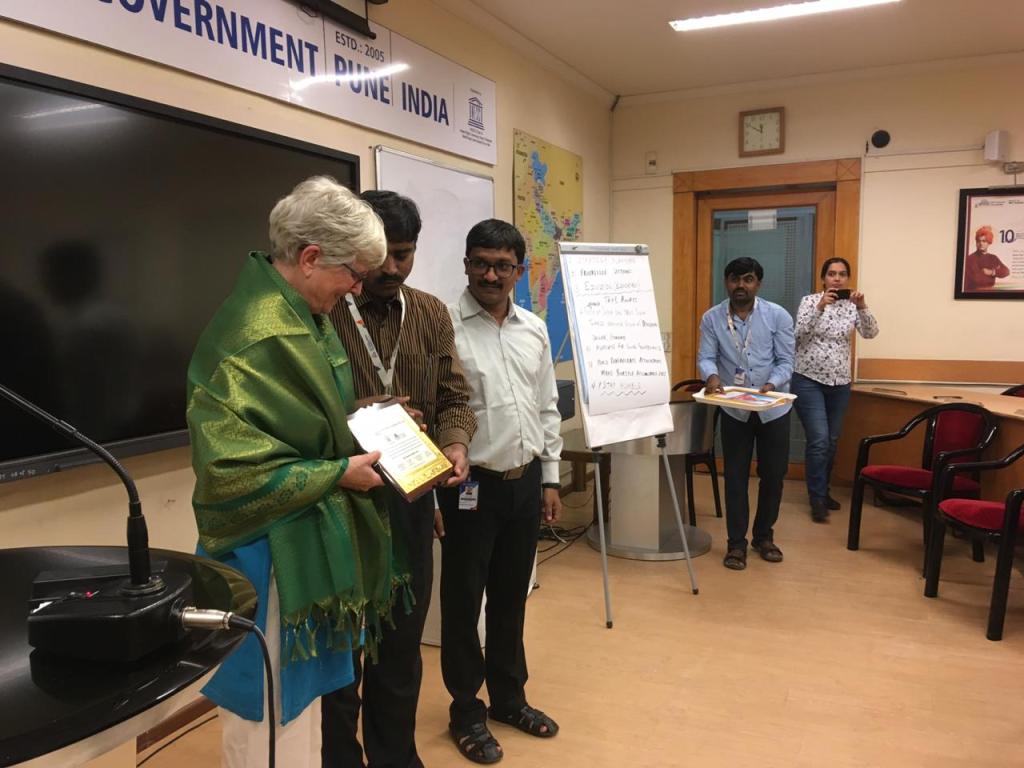
My friend R is an alumnus of MIT. I had thought that the M stood for Massachusetts and that this was an Indian branch of the US MIT. Not so, the ‘M’ stands for Maharashtra, the state in which Mumbai and Pune are located. Through him I was invited to give a guest lecture at the MIT School of Government inside the World Peace University.

Until just minutes before my appearance it was not clear how much time I would have and who would actually be in the room. During a meeting with the Dean of the School we cleared up the confusion of me being a Construction Management expert (an inference based on the work we are seeking with the Department of Urban Development in UP, and Urban Development appearing to be synonymous with construction).

We settled on a 30 to 40 minutes ‘lecture.’ I was told there would be about 40 students. About two-thirds from the School of Government, most of the rest students from the Business School and then some faculty and a research assistant.

I indicated that I was not going to use any PowerPoints, which simplified things as I could easily adapt to whatever time slot was available. As a free agent I am very keen to preserve, as much as I can, my freedom of movement and choice. This is working in my favor.

I learned that not one person in the classroom planned to go into civil service – which I thought curious for a School of Government. But then again, the Indian system of government is quite different from the US system . This school trains and prepares the next generation of political leaders. The school has a strong Hindu/spiritual basis and a patron saint.

A Hindu prayer was broadcasted as we arrived at the classroom; everyone stopped in their tracks and stayed still in reverent silence. Daily, students are reminded, not only through the prayer, but also yoga and meditation and physical exercise classes that are part of the curriculum, what their calling ought to be (World Peace) and the values that need thus to be respected. 

At the start of the session I was seated, together with R and V with my back to the students watching my name on the projection screen and listening to one of the students reading my bio that R had sent them.

After that I had about 30 minutes for the session. I engaged in conversation with the students, having them talk, in pairs, about how they were going to resolve the dilemma of having promised everything to everyone during the campaign, and then, if elected, running into the reality of powerful stakeholder groups that would thwart any changes that these stakeholder groups didn’t like (usually promises made to the poorest segments of the population that would require some sacrifices by the elites).

There were only two women in the government class (and none in the business class). I tried to engage them but they were shy and not forthcoming. I was puzzled about this, knowing that there are plenty of strong female politicians to serve as role models. V thought it could have been the language. Even though classes are conducted in English it was clear not everyone was comfortable (at least in my presence) to express themselves in English. Still, it was a bit disappointing. 

At the end of the session I received a green silky stole and was given a framed picture of the school’s patron saint and a wooden plaque thanking me for my service to the school’s mission. Official and phone photos were taken, then a group photo and we were done.

Two young students had been assigned to guide us around, though they did not take part in the session as they had to be in class elsewhere. They had name badges that identified them as ‘student representative: female,’ and ‘student representative: male.’ 

After the session they joined us in a small conference room where we were served sweet chai and cookies. One of the students slipped into the room and asked permission to ask me a question. This was granted by the academic head. Since I mentioned I had worked for decades in Africa, he wondered whether I could connect him to someone in South Africa (but in particular Lesotho) as he was doing a project about political leadership in that country. As it so happened I knew just the right person there, an ex-MSH colleague very active in engaging young people in ethical political leadership. The connection was made overnight.

The student reps were both HR students (no issue or surprise about female students there (99% of the class is female!). They walked us to the main entrance of the World Peace University where a large shrine dominated the space and the walls were decorated with paintings of India’s freedom fighters as well as the patron saint.

Big business and hill stations

My Indian friends picked me up at the hotel in Navi Mumbai and we set out to the Reliance company’s headquarters. It is not just a headquarter building, as I had imagined, but countless buildings, including two new skyscrapers for start-ups. There is tight security – requiring advance registration, IDs and visitor badges. A comparison suggests that the Reliance office park is about the same acreage (26 acres) as Googleplex. We were received in gleaming, light and airy building I, with it’s 40 meter long koi pool in the five story lobby. Along the walls was the Creation story of Reliance, which was started by the father of the current Chairman and Managing Director, with dealing in spices and then yarn. 

We met with one of Reliance’s VPs to discuss a design event that is to take place in the near future to align some 300+ senior leaders around an ambitious new venture. My friends’ company is in charge of  lining up the crew to pull off this event. They put me on the ticket and figured it would help if the VP had a chance to get to know me up close.

After our very animated meeting the VP took us to the all vegetarian company cafeteria where he tested my ability to handle spicy street food (there is a a highly sanitized street food station, with servers/cooks clad in traditional chef’s garb, including the tall white pleated hats). I liked the snacks but promptly broke out in a coughing fit, to be followed by another after another dish. Both were extinguished with a dish of American ice cream. And so I failed terribly in this department. I can only hope, that, not being hired to eat local food, it will not affect my chances to return to Mumbai early next year on a paid gig.

We left late afternoon for the ride to Pune which is about 120 kilometers and takes 3 hours and change (provided there are not accidents on the road). Halfway we stopped at a roadside food court which had Ronald McDonald sitting unperturbed on a bench at the entrance, not different from anywhere else in the world. Starbucks was there as well as some other US fast food chains, but also the Indian response to Starbucks (a chai chain), where we drank small cups of very sweet masala chai. 

The road took us into the mountains, through tunnels and finally into Pune, also an IT hub that is competing with Hyderabad for second place after Bangalore. I had some idea that this was a small town but it is another Asian megacity (nr 31 on the list of Asian megacities according to data from 2014 and 2015), after Delhi, Mumbai, Hyderabad and Bangalore but before Jaipur and Lucknow.)

My friends live on the eastern side of Pune in what the Brits would call a ‘hill station,’ where they occupy a flat on the second floor of tower 6 of a complex that currently has 8 towers (each 10 floors high) with more under construction.

They have a fairly spacious 3 bed and 3 bathroom flat with a large balcony looking out over the valley where Pune lies with its noise and traffic congestion. Up here I only hear crickets and occasionally dogs and the laughter of children playing in the mostly empty garage on the ground floor.

I could tell there was a grandiose vision for this development (there are sport courts, horse riding facilities, a soccer field, playground, trails further up the mountain, a clubhouse/restaurant with swimming pool and gym. But the occupancy rate is about 20% and 3 BR flats can be rented for less than 300 dollars. Fire sales are happening frequently and most of the shops in the attractive looking shopping center are shuttered, never having been occupied. It looks like this was a giant miscalculation, yet they keep on building the next towers.

Some of the dark flats are owned by NRIs (nonresident Indians) who like to have a piece of Indian real estate. Maybe they too thought it was an investment. Or a weekend place for city folks. I can see why: the nights are cool, the days are pleasantly warm (upper 70s), the air is clean and nature all around. We arrived too late to cook and had dinner in the clubhouse/restaurant higher up the hill, sitting on the terrace with a wonderful view and eating, what else, great Indian food.  I slept like a baby in their comfy guestroom, Today I didn’t do a thing. I am served three home-cooked Indian meals a day, lounged around in my pajamas till 10, read, watched SNL’s NATO cafeteria spoof with my hosts, wished Axel and Sita a safe trip home from Paris, met R’s cousin and husband, had great conversations all through the day and went for an early evening walk under a nearly full moon. What’s not to like.


December 2025
M T W T F S S
1234567
891011121314
15161718192021
22232425262728
293031  

Categories

Blog Stats

  • 136,984 hits

Enter your email address to follow this blog and receive notifications of new posts by email.

Join 76 other subscribers