Yesterday was all about making plans, a necessary activity dreaded by some, taught by many and botched by even more because it has become such an organizational ritual. Ali prepared the group for the exercise by showing them his unit’s capacity building plan and the resources made available to support the provinces. Some over-enthusiastic participants wanted to elevate our approach (the LDP) to something akin a state religion. They want the tools to be made obligatory, get the government to create LDP policies, create government positions in the provinces, LDP committees and what not. I got worried. I often see this phenomenon where people feel powerless. They demand central government intervention (the archetype of the heroic leader riding in for a rescue), the creation of committees or new staff positions. These things create the illusion of progress; the kind of progress that is evidenced by being able to tick something off your to-do list. Of course it is pseudo progress and the only thing it does is drain scarce resources. I suspect this may explain why central bureaucracies in many developing countries have gotten so bloated. We, the development types, carry much responsibility for that. We have created a monster!
.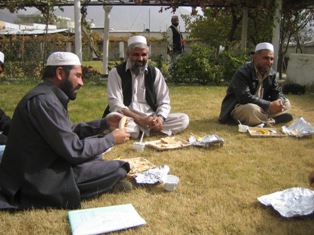 I am slowly starting to get to know the participants just when they are about to go home. It takes me a while and when you see people only for three days as I did last March, it isn’t enough time. Now I added another three days and I am beginning to find out who is who and from where. I sat with some of the men eating on the grass and we talked about our new (US) President. They asked me what the difference was with Bush (gulp) and why we were all so excited about Obama. When I told them I found Obama inspiring, one responded, “he talks like a parrot.” This, I quickly found out, was considered a compliment
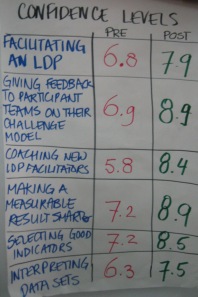 And then the workshop was over and everything defaulted to what had become before plus whatever people gained from being here for three days. I know that somewhere in Afghanistan there will be an Open Space session in the near future; hopefully there will be some improved management and leadership (we will wait for the data to support this) and a little more confidence to tackle the enormous challenges ahead. I know that for the group as a whole confidence notched up a little. I already have data for that.
The cold weather has suddenly moved in – the temperature dipped and my dual-mode airco, set to heat, is having a hard time blowing warm air in against the cold air that seeps in through ill fitting doors and windows. Six years ago I arrived here the 16th of November and I have memories of intense cold. Until now it has been like summer. With the cold weather the clouds have also moved in. Gone are the cloudless blue skies. I try not to worry about leaving Kabul airport in the clouds again but it does occupy a piece of my mind.
Luckily I will be very preoccupied with other things till then. On Saturday I am helping one of the director generals develop the rudiments of a team so that he can start to tackle the enormous challenges on his plate together with his direct reports. I have had the most minimal of briefings with him (not with his reports) and suspect I will not know until I see them what exactly they need to be working on. I will have to conduct the retreat on a wing and a prayer, since tomorrow is everyone’s day off.
On Sunday a large event starts in one of the big hotels. Over a hundred people convene to try to solve issues that cannot be solved by any one group alone. I have been asked to facilitate a panel as well as the group work leading up to the panel. The intent is to get the six DGs to make decisions, promises or commitments to actions that will remove obstacles and unclog bottlenecks. The original format was a panel consisting of the DGs (6) facing 34 provincial directors who are asking questions about why things are not moving, with the remaining 100 people watching from the back. Luckily I have been given the freedom to redesign the event to allow for a more consultative approach to problem solving. It is a considerable design challenge given that the point of departure is 12 major problem areas rather than a shared vision.


 Sylvia's Journal
The crowd at the hotel – directors up front, confronting others is seemingly not very conducive to anyone finding and acting on common ground – more confrontation than anything else is the picture I get.
I think of a restatement of the goal, or vision by the leadership first.
Divergence, convergence.
I also think about groups sitting together first to find their common points – moderating the divergence to get to a focus sooner – then report outs to everyone, with a bit of scribing or at least putting the flipcharts out for all to see for the remainder of the session. Then a further convergence process around which is the key leverage point, if any. Then finally asking the group again for a solution – a design – to that point(s).
I’m reminded of this from “Creating shared vision” form the Fieldbook. As long as things seem to be in this us/them, selling versus codesigning mode, then mastering the form makes sense:
Tips for mastering the “telling” mode
Inform people directly, clearly, and consistently
An effective “telling” medium is efficient, revelatory, direct, and consistent throughout the organization. Letters and videos, if well produced, serve this need; so do personal speeches, especially if there are opportunities for questions and follow-up. Make sure to substantiate what you’ve got to say. Filling in the reasons why a change must be made is essential, if the organization is going to follow.
Tell the truth about current reality
One central function of vision is to generate creative tension; to make sure people understand the difficulties of current reality, and generate the “pull” that comes from understanding your true distance from the vision. Anything less than the truth can destroy credibility. If some information is sensitive or confidential, explain why you can’t disclose it. Be careful not to build your message on a negative vision of the fu¬ture that you’re trying to avoid, such as: “Our vision is to avoid getting killed by the competition.” There is a profound difference between “vision by desperation” and “vision by aspiration.”
Be clear about what is negotiable and what is not
There may be certain areas where subordinates have degrees of freedom to influence, and others where they literally have no influence. If so, tell them. If you are being held accountable by the board for certain results with few degrees of freedom, tell them that.
Paint the details, but not too many details
A vision ultimately needs richness and detail to come to life. Early on, however, don’t fill in too many details, because this may be the organization’s only opportunity to make the vision its own. When Honda’s senior managers sought to create a pattern of innovation, they set out the simple vision: “Let’s Gamble.” Branches of the company, in North America and elsewhere, translated that into specific ideas for action.
The limits of “telling”
Research on verbal communications shows that people remember only about 25 percent of a message told to them. And everyone may remember a different 25 percent! Moreover, if the message is a “told” vision, people will comply, but few will feel any reason to commit themselves to it. Leaders who rely on “telling” often end up frustrated with what they perceive as poor communication: “I spelled out the vision, but peo¬ple still don’t seem to act according to it.” Unfortunately, many managers respond by repeating the same message, at a louder volume, or on a longer video. But employees can only go so far when they are passive recipients of a vision.
It will be far more effective for the boss to begin moving to the right on the continuum to “selling.”