After an early breakfast and many goodbyes, yesterday morning, we distributed ourselves over several small buses that took us to the various field visit sites, some rural, some urban. I joined the Dhaka urban maternal and neonatal child health group. We visited the Corail slum area to see BRAC’s birthing huts, a program that provides very basic facility-based delivery care to some 700 women through traditional midwives supported by a community health volunteer and an upward chain of increasingly trained healthcare workers. It’s still a pilot project but the results are promising.
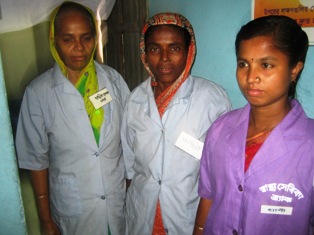 We met some of the traditional urban midwives, community health workers; saw a bunch at the conclusion of their training, and some of the BRAC program staff responsible for services to the 10.000 households that live in this one of several Dhaka slums. BRAC program coordinators took us through small passage ways, over scary looking open gutters into compounds and even houses (smaller than my king size bed in the BRAC Inn) where we met with brand new moms, or very pregnant ones and thanked our lucky stars that we were born on the right side of the tracks.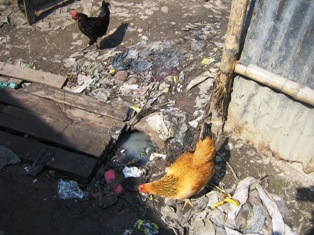
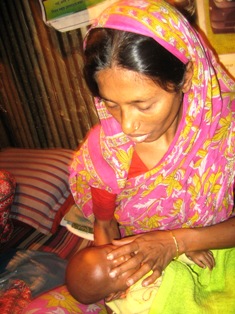
Everyone, kids, women and men alike asked to have their picture taken and grinned with delight upon seeing their picture on the camera screen. This is probably why so many annual reports and pamphlets from international health organizations have pictures from this part of the world on their covers. We also met with a member of a microfinance group and visited a BRAC school, where the students welcomed us in beautiful English, danced and sang and asked for nonstop picture taking. All the kids told us their name, then each mentioned a country of the world and then what they wanted to become. One girl wanted to become a pilot and so, naturally, we posed for a picture together. 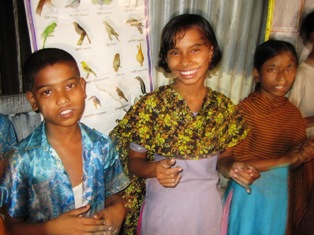 She promised to write me when she entered pilot school – which will be some ten years from now. In between the acts we practiced writing our names, they writing mine in English script, me writing mine in Bangla, no small feat for either any one of us.
All the urban Dhaka groups met for lunch at the BRAC Inn before swarming out over Dhaka in various directions to go shopping, which is part of any conference experience in the world; the people from far away go to the handicraft places while the people from the region go to the discount designer wear market places. In Dhaka this means to the factory outlets where seconds from the countless factories that produce for the US and European clothing markets are sold. A bunch of us went to Aarong, BRAC’s upscale clothing, linens and handicraft chain of stores to buy our Christmas gifts and for me to get some new Shalwar Kamees dresses, handy for future trips to Afghanistan, Pakistan, India and Bangladesh.
For dinner I met up with my Nepali friends, one old, one new, and Pedro a computer engineer from Cuba who is awaiting his return to Nepal, pining for a beer and some proper nightlife and his girl friend. When he returns next month they plan to start a Salsa dance academy in parallel to a computer engineering business. “You see,” he explained to me, “in Cuba engineers also do salsa, we develop both of these sides of ourselves.” But a drink surely helps. He ordered coffee and the rest of us drank water and toasted each other and pretended all were cold beers; just a few more days for me and an entire month for Pedro (for visa reasons he has to wait until 2009 before he can enter Nepal again).
I stayed up very late delighted with my private and fast internet connection, cleaning out my mailbox while watching a rerun of Jaws, without the music of course, but still putting my fingers in my ears when I knew what the music was doing (doodoodoodoodoodoodoodoo).
And now on to the last part of my assignment and check out how the faculty at BRAC’s School of Public Health teaches new professionals how to manage and lead the way to significant impact, like their mother institution has done for more than 30 years.


 Sylvia's Journal
Scaling up to scale up…
And now on to the last part of my assignment and check out how the faculty at BRAC’s School of Public Health teaches new professionals how to manage and lead the way to significant impact, like their mother institution has done for more than 30 years.
Reading your pieces made me think of Amartya Sen and his idea of “positive freedom”.
Amartya Sen who wrote (in 1981)on the food crisis in Bengal in 1943 emphasized the role of “human capital” in overcoming what were seen as the intractable, mechanical constraints of markets.
“Thus, Sen points to a number of social and economic factors, such as declining wages, unemployment, rising food prices, and poor food-distribution systems. These issues led to starvation among certain groups in society. His capabilities approach focuses on positive freedom, a person’s actual ability to be or do something, rather than on negative freedom approaches, which are common in economics and simply focuses on non-interference. In the Bengal famine, rural laborers’ negative freedom to buy food was not affected. However, they still starved because they were not positively free to do anything, they did not have the functioning of nourishment, nor the capability to escape morbidity.
His model included support for the capability to use –
“..Senses, Imagination, and Thought. Being able to use the senses, to imagine, think, and reason– and to do these things in a “truly human” way, a way informed and cultivated by an adequate education, including, but by no means limited to, literacy and basic mathematical and scientific training. Being able to use imagination and thought in connection with experiencing and producing works and events of one’s own choice…”
and –
“Practical Reason. Being able to form a conception of the good and to engage in critical reflection about the planning of one’s life. (This entails protection for the liberty of conscience and religious observance.)”
http://en.wikipedia.org/wiki/Capabilities_approach