Archive for April, 2010


Ropes

Saturday is physical therapy day, if I can help it. I showed my PT the diagnostic report from the American University Hospital MRI doc and ask for a translation in plain English. I wanted to know first of all if the report contained good news or bad news.

The good news was that the smaller of the two tears, the infraspinatus, had healed well, which meant that a few exercises were no longer needed. But the larger tear had not healed all that well and inflammation explained my recent problems. This meant new execises.

While the PT was attending to me all the other ladies in the room were watching our every movement with great interest. You could see them wonder, who is this blue-eyed foreign lady and why is she here. They asked questions about me, which, unbeknown to them I could follow. I told my PT that she should warn the Afghan patients that I could actually understand their questions.

After PT I scheduled my weekly Thai oil massage which was as good as ever, worth every penny of the 40 dollars and the 5 dollar tip.

I asked the driver and guard whether we could get me some traditional roper furniture. This led to a wild goose hunt from east to west and north to south; we covered most of Kabul in search of the outdoor rope-chair set. It’s the concept, Axel explained later; they simply cannot understand why a foreigner would want traditional rope furniture (‘farnichar’ in Dari) when shiny Pakistani or Chinese furniture can be had.

Strange enough Chinese (read imported) stands for high quality even though, by our standards, it is far from high quality. I was taken to a showroom of fancy (read: cheap) imported ‘farnichar’ even though I thought I had explained I wanted none of it. They kept showing me beds yet I had indicated, I thought, that I didn’t want a bed. My limited Dari was clearly an impediment to expeditious shopping.

After two hours we gave up. I went home, prepared for my Dari class, had two hours of Dari during which I learned more prepositions, and then we went back home for a brief interlude before heading out again for dinner at the Washington Post house where our friend Robin is staying. Around the dinner table we had many nationalities: Japanese, Afghan, American, Canadian, German, Dutch, Spanish, French and Italian, even though there were only 8 people present. Except for Axel, Sabina and Robin, everyone else had at least 2 nationalities.
Sozani

In an effort to save some of my enormous stash of accumulated vacation days from going ‘poof’ I have decided to join my sister’s family on a boat ride in Holland on May 8 to celebrate the wedding of my nephew Da(a)n and his Scottish bride Jane. Although we haven’t been able to find a reasonable fare, the boss has signed off on my leave request and our fantasies about the trip are dancing far ahead of us.

After some calculations I realized that I stood to lose 28 days (7 weeks of vacation) if I didn’t find a way to use these days. A 5 days trip to Holland and taking Thursdays off from now till the end of June will help a bit but I will still lose days unless a special permission is granted to me to carry more days over the Fiscal Year line than the max (30). This may require an Act of God, I don’t know; maybe a few prayers will help.

I also learned that I cannot be in the US for more than 27 days until the end of September. This has something to do with taxes, as per the advice of a specialist in these matters. So we are counting a lot these days.

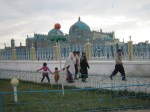
For our Friday walk we went to Babur’s garden, a spectacular restoration compliments of Aga Khan. Inside the 7 meter walled garden Afghans can pretend it is peaceful here and enjoy the beautifully landscaped garden with their families, sitting on carpets, cooking whole meals in the ubiquitous little pressure cookers. This is the promise of Afghanistan, if only…(sigh).

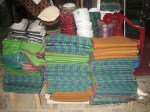
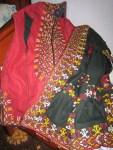
After our walk we accompanied Steve on his weekly Chicken Street walk and was drawn to the store of Mr. Happy (Khoshal) who has enormous stash of embroidered pieces from all over Central Asia. Sozani is the local name for embroidery.

It is the Uzbek needlework that I am most enchanted with although, really, everything is vibrant, beautiful, and very very dirty.

I am dipping all the pieces I bought in a bucket with Woolite. I don’t know if that is sacrilege but how else do I get the stains from cooking, eating, living out of these textiles? The first change of water was black, or red if the embroidery was that color.

I have some fantasy of using the pieces in my sewing projects but one has to be practical – they need to be washed sometimes.

Grimaces and switches

Today we learned from the organization that warns us through multiple daily email messages about adverse events in the provinces and in the capital, that a rehearsal of ‘in extremis’ support involving elements from the international military (IMF) as well as the Afghan national security forces (ANSF) was going to take place at the main UN compound earlier this morning.

We were told that this would in all likelihood include several vehicles (‘and other associated gadgets’). The warning continued that, if one was to venture near the UNICA compound (strongly discouraged), one would also see ‘men with grimacing faces and overt displays of various types of weaponry.’ The message concluded with the advise ‘to postpone any intended squash matches.’ Darn!

Of course people play squash here; and cricket (the national cricket team qualified for the Asian Cricket Council), and volleyball, and soccer and tennis. Today our drivers, guards and some of the TB doctors, dressed in blue and white jerseys leftover from World TB Day, played a tournament right outside my office while I was doing a (required) quiz about procurement integrity and struggling with Adobe on how to sign my certificate (I passed) electronically.

After pulling some handles here and there we received word from the Swiss Ministry of Foreign Affairs, through their Kabul mission that the decision to deny a visa to my two colleagues (to attend a conference in Geneva) was being revisited. After three phone calls from various officials we finally got the word: the visa is granted and they should go back to Islamabad to pick it up. Those who have followed this drama, unfolding over several months with what we thought was the final (and maddening) denouement in Islamabad two weeks ago, can appreciate this new outcome.

The world does run on relationships, which comes right after oil, weapons and drugs I believe. It is once more a reminder that the switch is at the top and if you can make a connection with ‘up there’ everything becomes possible.

It is funny that for some of my Afghan colleagues who are several rungs below me in the hierarchy, I am their switch. This is a new experience and I am starting to learn to recognize when I have a switch-seeker at my door. The higher you climb the easier it is to see the possibilities, and then grant or deny access to them.

Hearts, minds, ears and… oops

Axel, Steve and I went to a lecture by our ex colleague Paul F who shared the findings of his research into the barely examined assumption that development projects will stabilize Afghanistan. It is the basis for policy decisions with enormous consequences.

This was not the first investigation into ‘aid effectiveness’ that I had heard about but this one included the military. Not surprisingly, given that aid was all thrown together into one basket, some of it was appreciated and some of it was useless.

Some of the very large development projects are actually contributing to the destabilization and undermining of the central government because of the opportunities for large scale fraud and corruption that they offer. The amounts of money that are sloshing around in these projects is obscene given that your average Afghan farmer (not a poppy farmer) makes about 300 dollars a year.

The competition that is generated to get a chunk of the pie sometimes turns deadly because settling of accounts is easy here where you can buy your way in and out of anything, including murder and justice.

The military, even in a relatively safe and stable province like Balkh, continues to be an irritant to the general population: the convoys that mess up already congested traffic and jeopardizes anyone in close proximity (we can attest to this from our experience in Kabul), the ignorance about cultural norms, language, the rapid turnover and lack of institutional memory and the easy money that is available to buy the peace here and there with all the perverse incentives that it sets up.

AFP reports in our local newspaper that US Special Forces blast heavy metal, country and rock music from an armored vehicle wired up to speakers that are so powerful that the sound can be heard two kilometers away whenever insurgents open fire. Somehow the military has convinced itself that his will force the hapless locals to choose between the Taliban and the Americans.

What are they thinking? The only people whose hearts and minds are won by the music are the American soldiers themselves who had a blast (pardon the pun) putting the play list together; everyone else is covering their ears and running for cover hating these heathen Americans more with every song.

What was the most worrisome information I got from the lecture was the size of the pot of money that is available to the military to ‘win hearts and minds.’ The Commander’s Emergency Response Program (CERP) has increased its budget from 0 to 1.6 billion dollars in 7 years, leaving all the other so-called development partners way behind in the dust. The distortion that this money influx creates is grotesque.

I had always wondered about what people were thinking about this ‘winning hearts and minds,’ once it was done. What then? Could you lose hearts and minds easily after winning them? One researcher who looked into this found, no surprise, that you cannot stockpile goodwill. When the money dries up, people get upset again – there goes your hard-won heart and mind. Oops.

Firewalking

It seems ages ago that I got up this morning. More than 12 hours later I arrived home to see my honey sitting on the terrace, with glasses of a certain type ready for the cocktail hour. That was a nice reception for a tired worker.

I tried to fall back into my routine but I don’t have the email under control and the computer is still not entirely recovered and there is so much to do, and so many dilemmas that require much thinking.

For example, how can we support prison health if the condition attached to US government funds is that they can’t benefit terrorists? But the terrorists should be in the prisons. Carrying the reasoning through the Afghans should let the terrorists go so we can help the Afghan government provide basic health services to prisoners.

Distinguishing between bad prisoners and the very bad (terrorists) is not that easy in this country. These are the kind of practical dilemmas that our lawmakers may not have thought about.

In the meantime, Karzai is playing noisily with firecrackers on TV and on the front pages of local newspapers. He uses every opportunity to accuse foreigners of messing with his country: they (we) are responsible for botched elections, for invading Afghanistan with ulterior motives (of course), mishandling the millions of dollars that are streaming into this country (I might add, streaming out as well) and ‘mistakenly’ killing civilians (note the quotation marks).

What if we just all walked away? I mean, all of us.

Music, birds, wolves, guns and roses

Our provincial health advisor from Jawzjan province had arranged for a dinner outside Mazar in a place we should have seen by daylight. It was the country house of the father-in-law of a friend of his; a large piece of walled land with a simple mud brick building with a veranda as wide as the house on one side.

Surrounding the house were bird cages with parrots, small colored birds and at least 20 kawks all feathered down for the night. Kawks are the fighting partridge-like birds that you see everywhere in small rattan cages, frantically circling their small space till the next fight.

There was also a wolf, people said, and we walked around the grounds in the dark to find it. It turned out to be a German Sheppard tethered with a frayed rope to a tree. An adorable fluffy puppy was kept in a crate. The puppy will grow into a huge fighting dog. The owner of the house supposedly likes animals but I think he also likes to fight.

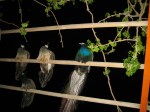
Following our host with a flashlight we stumbled over small dikes, through rose gardens, past an empty swimming pool, under the almond trees, a grape arbor with four magnificent peacocks resting on top, and back to the house where the rest of our party had already installed themselves on the flat pillows around the beginnings of a meal.

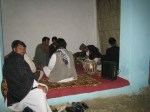
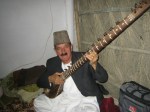
At the head of the ‘table’ sat an elderly gentleman next to a slighter younger man with a pockmarked face. They were the musicians summoned to enhance our pleasure. As it turned out they are famous in Afghanistan, Hadji Bahawaladin, the tambour nawaz and his table side kick. They are more often seen on stages inside and outside the country playing to large crowds. Our host knew them and has asked them to play in this very intimate setting, just for us.

The older of the two played the tambour, which I always thought were drums; but here a tambour is a kind of zither with a very long neck; the younger man played two full-bellied drums (table) that had a remarkable range of tones. He tuned his drums using a hammer to push small wooden blocks all around the drums up and down under the tense straps that held them in place.

But first we ate: qabuli pilaw, yoghurt, fried fish, kafta kebabs, salad followed by apples and oranges – a fairly standard menu. There was little talk; eating is serious business here. Then, after our walk around the grounds and after the dinner remains were cleared we sat down for an extraordinary and intimate concert. Only at the very end was there some dancing by a few of the resident staff and finally by our own guys, including one of the provincial health advisors who turns out to have a talent for singing.

And with this our trip to Mazar has come to an end. We headed home in a small twin engine over the snow capped mountains again and in less than 45 minutes were back on the ground in Kabul. Alain and I met Axel at the Flower Street Café in Qala Fatoula for a lovely lunch outside.

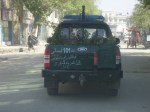
We drove back to Karte Seh behind a Police truck that was filled with roses – that’s what this place is all about: guns and roses.

It was too late to go to the office after that; we spent the rest of the afternoon and the beginning of the evening playing backgammon and scrabble outside until it was too chilly. It’s nice to be home again.

Stories

All morning we are hearing stories. Some made us happy, like the one from a ENT doctor who impressed the (German) funders of his clinic with the achievements that he accomplished after he went through our leadership program. He was even given a scholarship for a course in India.

But then the story, at least as told by him, turned sour. When the German organization discovered that he had a received a colleague of mine from the US who had interviewed him about his clinic’s success and highlighted the leadership program (we try to create leaders, and since this looked like one, we took some of the credit), his scholarship was withdrawn and he was asked to resign [I am sure we are missing some of the fine nuances].

Now he is deputy provincial director and leading there to his heart’s delight. This includes telling the governor about the Challenge Model while diagnosing his hearing problems.The ENT doc and his team proudly showed us all the initiatives they had taken which had resulted in an impressive array of public health achievements: number of patients showing up with dog bites at the clinic per month reduced from 40 to 0. For this dogs had to die – until the public is better informed, slaughterhouses removed to outside the city limits, losing fighting dogs not turned loose and pet dogs vaccinated. All this is part of their leadership project, for the long term.

They also increased vaccination of pregnant women to avoid tetanus, deliveries attended by skilled birth attendants, increased compliance with hospital infection prevention procedures and antenatal care. We all cheered; and not just for this team but for all the other teams that had produced similarly impressive results simply by changing their behavior.

A team from Balkh Province was invited to participate since they are our host. But Balkh is not a USAID-funded province and thus is not benefitting from our leadership programs. It is part of the arrangement between the European Union, the WorldBank and USAID: the 43 provinces were assigned (on what basis I don’t know) to the three funders. Balkh wants what the others get, and so we told them to talk with their chiefs and chief funder.

Each of us got some ‘easy’ (read ‘safe’), some difficult and some dangerous provinces, according to the conditions at the time of the agreement. That situation has changed a bit since then and the US is increasingly taking on provinces and health centers that were not in its initial portfolio. The EU and WB have not always taken kindly to these incursions. But, like the case of the Germans, one wonders, aren’t we all in this together to help Afghanistan?

The sad stories have mostly to do with security: friends killed by Taliban, death threats, not being able to wear a suit and a tie when travelling from one province to another, drugs being stolen and health personnel resigning to save their skins. We were also disappointed that a quick escapade that Alain and I had planned to the river further north that separates Afghanistan from Uzbekistan was nixed by our security people. They thought it too risky for us and, by extension, risky for our Afghan colleagues. And so we stayed in the basement all day, observing the workshop and our dynamite facilitator team.

Trying

After my first good experience here with the internet it stopped and didn’t come back for the night, nor the next morning; As a result I was not able to post an entry yesterday even though there was much to tell. And there certainly was no chance of putting the wonderful pictures up that I took during our tour yesterday later afternoon.

Alain and I took the facilitator team out for dinner to a restaurant that was recommended, the Kefayat Clup. It is a large complex that would have been called a pleasure garden in Babur’s days. Several halls, restaurant and even a coffee shop surround gardens and walk ways.

Outside one of the restaurants are the now familiar 6 by 8 feet carpeted eating platforms with their sitting (tushaq) and leaning (balish) pillows. We found it too cold and instead opted for sitting in the empty restaurant with a large and centrally placed flat TV screen and harsh fluoresecent lights; it was slightly less cold inside, the only redeeming feature.

The food was great: kabobs, manto, homemade yogurt, spinach, rice and ‘shepards’ salad (any dish labeled as a shepard dish indicates that it was and can be put together quickly).

Colored lights outside outlined the shapes of trees (real) and giant flowers (not real) shaped like daisies and tulips. The tulip is everywhere: embroidered on ancient textiles, knotted into carpets, as giant shapes on top of the mosque, in advertisements for cell phone service. The tulip came from these parts of the world; the Dutch only exploited the commercial opportunity it provided by perfecting its shape and colors to match the whims of the buying public. But nature had given the tulip to the people here first; they just left it small and wild.

Back at the hotel I finally had to figure out the bedding arrangement. There were two small beds and one large one. Each had a mattress with a scratchy tweed-like cover, then a curtain-like shiny piece of cloth put over that and then there was one sheet, all slightly smaller than the mattress. Folded at the foot of the bed where a few of the giant and heavy Chinese blankets that are ubiquitous here. It was a little too cool to do without them.

I pulled the cover over me and its warmth quickly dispelled any thoughts of all of the hotel customers before me who had slept under the same cover. I marvel once again how easy we humans adjust to change – we may not like it, but we have no choice. That’s how things go here.

I was up early and joined Ali in the large meeting room in the basement where he sat in the half dark reading the book that we wrote at MSH some 5 years ago about leadership development. It is in its third printing now and we hope to have a Dari/Pashto version sometime in the future.

When Afghans have breakfast they ‘eat tea’ and so I was invited to do so. Breakfast, served on long tables, consisted of two kinds of breads, one small and savory and the other large and sweet with black cumin seeds sprinkled over them. The breads are served with small saucers of jam and cream, foreigners’ cream they call it, but this foreigner, who otherwise loves cream, declined.

Breakfast, as most other communal meals I have observed in Afghanistan, is hardly a social affair – everyone eats in silence and fast – as if it is nothing more than a biological requirement.

Treasure

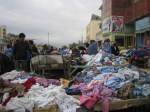
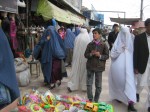
Alain and I asked for a tour of the city while it was still light. We drove to the enormous bazaar and then got out and joined the throngs of shoppers, walking through the sometimes narrow, sometimes wide streets of the bazar, with one of our hosts and guards in front of us and the others in back.

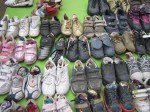
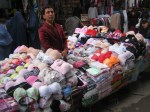
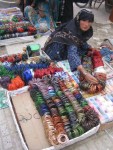
A good part of the market is taken up by merchants in second-hand (European/US) clothing and shoes. After that came the market for shiny women’s textiles before the bazar where men get their ‘Karzai’ coats, their woolen wraps, their hats, their scarves, their long Arabic dresses, and Punjabi outfits; less shiny than the women but exotic nevertheless.

I wanted to bring back one or two of the Turkmen embroidered ‘chapans, stiff coats with long sleeves that have more of a ceremonial function than having arms in them.’ The Turkmen embroidery is the most striking part of the wedding dress that Sita bought in Lebanon. I had some fantasy of cutting one up and making a matching tie for the groom.

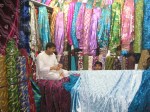
Our hosts led me to a shop that had what I was looking for, hundreds of them, stashed away between thousands of other exquisitely embroidered pieces of clothing and bedding. It was hard to choose from the collection. I don’t think I could ever put scissors into these coats to turn them into something else, least of all a tie.

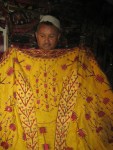
When the shopkeeper indicated that one of the coats was 8000 my colleagues asked, Afghanis or dollars, jokingly [8000 Afghanis is about 160 dollars – 8000 dollars is 8000 dollars]. The shopkeeper told us he actually had an 8000 dollar chapan. Everyone wanted to see it. He climbed on a rickety stair and pulled something wrapped in Ikat cloth from a pile of nondescript items. He unwrapped it as if it was a newborn baby. Inside was coat in perfect condition with the finest embroidery on yellow silk. The manufacturing date was embroidered at the bottom: 1915. The museum quality coat was made for and worn by an Uzbeki Prime Commandar nearly 100 years ago. We let him wrap his treasure up and put it back where it was waiting for the day that someone would gladly pay those 8000 dollars.

Mazar

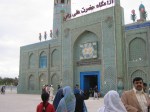
It was a little over 30 years ago that Axel and I had visited Mazar-i-Sharif and Balkh Province. At that time we had come here using a combination of public transport and hitch-hiking. It was fall and the colors were magnificent.

That trip was a little less costly than our 300 dollars one way flight with the UN plane. At that time we could have lived on that single fare for an entire month. But we never saw the magnificent snow-capped mountains that stretch between Kabul and Mazar. The plane provided us first row seats to this spectacular landscape.

We are lodged in a rather odd guesthouse that is clearly not catering to westerners. Signs and names are all written in Dari, including the name of the hotel. If it is appealing to any foreigners it would be Russians. The second language on the guesthouse business card is Cyrillic. This is no surprise as the old USSR is not far from here.

The place looks like some builder got a hold of pattern books with architectural flourishes from the oddest places, and then copied and distributed them pell-mell across the building and its various add-ons. The prevailing colors are pink and pastel green, except my room which is tinted pastel yellow and violet, like an Easter basket arrangement.

To its credit (and my surprise) the guesthouse has wireless (it works for a while); to its discredit the bathroom turned out to be without towels, soap or toilet paper. Someone had to go out and get it and came back with two brand new towels, 2 new toothbrushes, a big bar of ‘luxury’ soap, a large tube of toothpaste and a small bottle of anti-dandruff shampoo. Ask and the universe will provide.

When we arrived at the hotel at least 40 pairs of (men’s) shoes were outside the door. It looked like a second hand shoe market. I put my shoes among the others. My small clogs were hopelessly out of place between all the large and pointy shoes. But then I discovered that there was a separate shelf for the women’s shoes inside the entrance – a small shelf; after all how many women use hotels? As with anything else here women have a separate place for just about everything, even their shoes.

And so we all walk around the hotel in our socks or slippers – it feels a little intimate, as if you are among family. And in some ways I am – there are many people here I have known since early 2008 when I started working with the provincial teams. We are in this unusual and enviable position that we have the resources (thank you American taxpayer) to bring the provincial teams together not just once, not just twice, but every year at least a few times. As a result we are developing deep experience, deep knowledge and repeated skill practice rather than the usual shallow exposure that people get in one-off workshops.

When the program for the day was over the facilitation team started their end-of-day huddle and did all the things, and more, that I taught them a long time ago when I was still part of the team. But now I was excused, as all was done in Dari and it is their show, not mine anymore.


April 2010
M T W T F S S
 1234
567891011
12131415161718
19202122232425
2627282930  

Categories

Blog Stats

  • 136,984 hits

Enter your email address to follow this blog and receive notifications of new posts by email.

Join 76 other subscribers