Posts Tagged 'msh'

The last station of worklife

As part of the cleaning up I was confronted with the many stations I traveled through during my career. Many memories were released by combing through the physical reminders of more than 40 years of learning, teaching, mentoring, and coaching. These had accumulated on bookshelves (about 30 linear feet) and in filing cabinets and folders. I invited a friend and erstwhile (younger) colleague of mine who followed in my footsteps to come and help herself. She came and carted of several linear feet. Each book, each article, each notebook floods me with memories. But I am now fully retired because of Elon Musk and his chainsaw with which he tore USAID to shreds. There is no going back. Whole bookcases have been dismantled. Dutch books, including my childhood favorites (Saskia en Jeroen, Pinkeltje, Jip en Janneke) went to my Dutch friend in Baltimore who has grandkids that understand this language which my grandchildren, regrettably, don’t. Another batch of French OD and leadership books is waiting to be shipped to someone still at MSH who teaches in the French speaking world. All that makes for a lot of farewells and business for UPS.

As I was cleaning out and finding items that I used during my career, I couldn’t help to reflect on the role of technology and electronics and the enormous leaps that happened during my worklife. When I started my career in public health in the early 80s we did have computers which I thought of as advanced at the time. Looking back it is laughable how little capacity they had: the original IBM PC in 1981 had 16KB of RAM, the Commodore had a whopping 64KB of RAM and my Apple IIC ran with less than 48KB. It was enough to write reports and occasionally play the Lemonade Stand game. We worked with large ‘floppies’ on an Exxon computer at my first US job at AVSC in New York. Later those floppies became smaller and eventually they became small hard plastic. My South African friend Kurt called these ‘stiffies’ which raised eyebrows of an American librarian.

And then came travel in this new era of technology. Our so-called portable computers were not portable, a colleague cvalled them luggable. It was not something you took on a plane. Besides, these were shared computers, used only as needed, by several colleagues. And then came the laptops. During a trip I made to Zimbabwe I impressed my colleagues by taking apart the telephone wire casing in my hotel room and connect my computer ‘s modem to the color-coded telephone wires. I have no idea how I did that, especially since I was a bit of a Luddite at the time. But that was a big shift. After that I traveled with a laptop, speakers and even a printer, which filled half my suitcase. I experimented with any new thing, like having access to a music library on my computer (MusicMatch) and playing songs through small portable speakers instead having to bring a pile of CDs and sort out a hotel’s audio system. Over time travel also became easier because we no longer needed printed tickets which, if you didn’t get them on time, would cause a panic. All our data would from now on be in ‘systems’ which has downsides that are becoming increasingly visible and menacing these days. The age of innocence! For years I had my social security number on my checks which I used for everything, and were thus seen by many eyes before credit cards took over. With AI that can even impersonate our voices, I am very concerned about the society my grandchildren will inhabit as adults.

In these earlier innocent days, none of today’s concerns were on my horizon. In the 2000s thumb (or flash) drives shoved the floppies and stiffies aside and took over. At first they had capacity of 8MB, huge compared to the earlier computers. By the time MSH provided its travellers with these tiny technology wonders, they had already expanded their capacity. I kept my 256MB Kingston thumb drive which I could wear on a lanyard around my neck. These drives made it possible to move data from one place to another. Of course, in a great example of mimicry, we exposed ourselves to viruses by plugging our thumb drives into computer sockets of unknown purity, or the reverse, and then discovered these computers or thumb drives were infected with viruses that transferred quietly into our data or our computers. Crash.

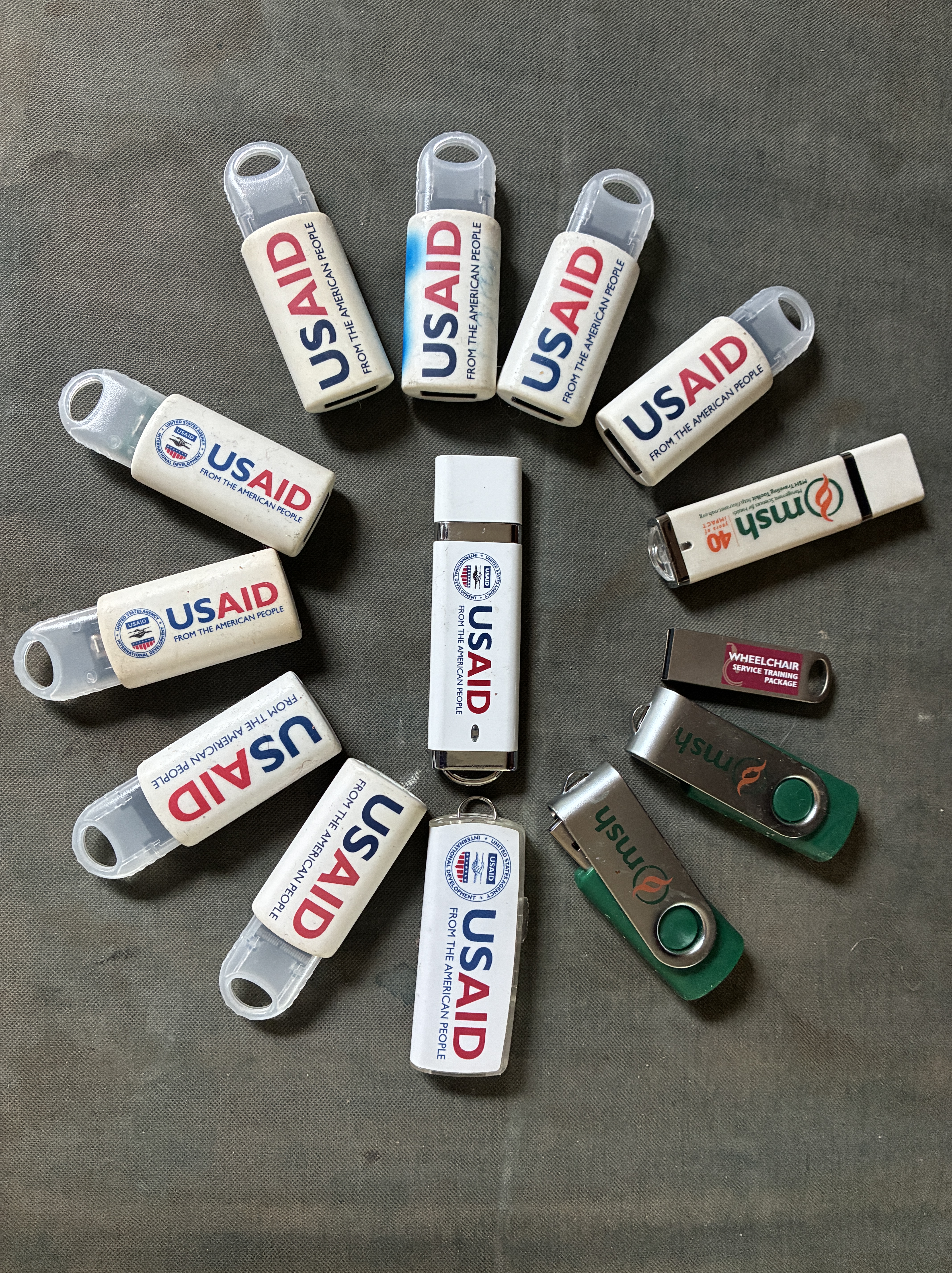
Over time I accumulated a bag full of thumb/flash drives. Many of them with the USAID logo on them. Finding these in the back of a drawer brought a flood of memories and sadness. But also gratefulness for what I was able to do and what my younger colleagues were forced to give up. All these drives are being recycled. I decided not to check what is on them. I don’t want to know.
Lift for the Phoenix

A couple of years before COVID, those of us who had worked at one time or another at Management Sciences for Health (MSH) and lived in the Greater Boston area, would get together at a local restaurant. We would be a small group of 10-20 people at most. Sometimes many showed up, sometimes only a few. MSH had started in the Boston area and so some of the old timers who had worked at Headquarters still resided nearby. But over the years many more people had spread out across the globe, either to places they had originally come from, or because of work, partners, family or bucket lists wishes led them away. And then COVID happened and we all started to use Zoom as our meeting place. Because one did no longer need to live near Boston, now anyone could joins us.


I created a Google Group and people started to join and bring others along, with the only requirement that one had to have worked at MSH, not necessarily in the US, but anywhere in one of its projects worldwide. Since we could meet more easily with each other we started to have our zoom calls more frequently. Slowly the group grew bigger. I made all the people I knew personally into owners of the Google Group so that they could bring others on board. We now have 242 members, spread between California and Japan. Our alumni bonds are now stronger than ever and we all care deeply about the work that we did, that is currently happening and that needs to happen in spite of all the obstacles.

Ever since Elon Musk decimated USAID, cheered on by those who did not understand the work of USAID and what it cost the taxpayer (mere pennies), the ground began to give way to what had been my life’s work and that of countless others I had worked with and worked for over the last 30+ years. The whole edifice, which had been built over 60 years, collapsed in just a couple of weeks. And with that, entire organizations and the livelihood of many more evaporated. One year later, the ripples are still felt in many families, not just in the US. MSH and other international development organizations saw their life’s work decimated and labeled as corrupt and fraudulent without a thread of evidence put forward by DOGE and its cronies. The glee with which Musk waved his chainsaw made me want to wish him a very bad chainsaw accident.

But even worse than all those problems and insults to us and my friends and colleagues who lost their livelihood is what happened to the people who benefitted from the care and concern of the American people. Over the past year, a 50% reduction in worldwide donor assistance for global health has led to countless deaths and untold suffering. Worse yet, funding is expected to fall even further, as healthcare costs continue to rise and the world careens from one disaster to another.

The people we served suddenly saw their lives and health of their families and children jeopardized after there had been many improvements. Some had had, for the first time ever, access to decent health care, provided by well trained and trustworthy medical personnel who were equipped with what they needed to do their work well, including safe medicines. Some approaches were still in clinical trials, sometimes nearing their final stage to determine what worked and what didn’t. People in those trials found themselves suddenly without access to the medicines that kept them alive or functioning. In spite of the denials by (US) government officials, many died. Many children died. Many HIV patients, without access to their medicines reverted to full blown AIDS, and the infection cycles that had been successfully reduced, started up again. Decades of progress wiped out by a few powerful zealots.

Since all this has been happening we have intensified our alumni meetings on Zoom. We are now meeting every 6 weeks and learn how our alma mater organization is faring. We are cheering on its current leadership and remaining few employees. I am encouraged by the dedication to keep on going, never give up, and to remain faithful to the ultimate goal with which MSH was founded more than 55 years ago: to bridge the gap between what is known and what is done in the realm of public health.

If this was in my time at MSH a knowledge gap, now it is clearly a funding gap. A good thing is that countries are stepping up to take responsibility for their own healthcare systems, a monumental challenge integrating skilled healthcare workers, quality facilities, efficient pharmaceutical supply chains, and robust data for informed decisions. For 55 years, this is what MSH helped those governments with, often in partnership with local organizations, provincial and district government structures and local communities. That was the work I was involved with all over Africa and in particular in Afghanistan. We helped to develop the expertise needed to build, repair and strengthen health systems. And the US government helped us do that. Now, without that, and knowing that expertise alone isn’t enough we try to band together, all of us alumni and the friends of friends of friends. Anyone reading this can join and help MSH continue to do its important work. Every contribution helps to give the Phoenix the lift to rise out of the ashes and lift others alongside its mighty wings.


September 2026
M T W T F S S
 123456
78910111213
14151617181920
21222324252627
282930  

Categories

Blog Stats

  • 143,959 hits

Recent Comments

Edith Maxwell's avatarEdith Maxwell on Boosted out
Sallie Craig Huber's avatarSallie Craig Huber on Rays for real
Lucy's avatarLucy on Probabilities
Olya's avatarOlya on Cuts
Olya Duzey's avatarOlya Duzey on The surgeon’s helpers

Enter your email address to follow this blog and receive notifications of new posts by email.

Join 78 other subscribers