Archive for the 'Uncategorized' Category


Bitter and sweet

After many ups and downs and countless visits to Afghan and Pakistani doctors and hospitals the mother of one of my staff died. The men will go to the funeral in Logar province, a two hour drive from here. This is one thing I cannot participate in. For one the formal ceremony is a men’s affair. The women will be at the home. But Logar is also of limits for us foreigners and the presence of a foreigner is a risk for everyone. The security situation makes it difficult for us to participate, even if only marginally, in the lives of our Afghan colleagues.

In our last day of the workshop we covered the topics of scanning methods, listening, inquiry into current reality, stakeholder analysis and work climate. I am discovering that there are parts of our program that have a very different feel and effect in an all (Afghan) female group. We had the women act out situations in which the other is not listening and then identify what makes for good listening. I noticed that the women have a high tolerance for not being listened to. This should come as no surprise. I am used to seeing (senior) men, in this same exercise throw up their hands in frustration after less than a minute of not being listened to.

I decided to drop Covey’s Circle of Influence because the center circle (one can control one’s behavior and attitudes) does not necessarily ring true for women here; the decision to walk out of the door, what to wear, and who to visit or invite is, for many Afghan woman, not their decision but their husbands’. And as far as attitudes are concerned, these are so shaped by the interplay of culture and religion that the word ‘control’ hardly applies. This became clear when we talked about life’s purpose and personal vision – most, with few exceptions, were about servitude (to God, husband, family, patients).

The hours I spent learning Dari are paying off. I can now understand a good part of the conversations and participate without having every sentence translated. The total immersion added a few more words to my vocabulary which is becoming ever more firmly anchored in my brain’s language center.

M. discovered the chairman’s hammer. The basement is also the meeting place for Toastmasters International, where Afghans practice monthly how to become more polished speakers. The hammer and speaker’s lectern are part of Toastmasters equipment. M. held the hammer like a weapon. It’s an unusual sight seeing a woman waving a hammer. It surely is an object of power. Under my breath I muttered, “you go girl!”

During the training my facilitator mentees experienced some very real life challenges; as when someone from the leadership team, who had missed most of the sessions, started voicing an interpretation (right or wrong) about what concepts and words meant in a way that created some disturbances and confusion. Managing this dynamic is a difficult facilitation challenge to manage for newbies. But that is how we learn: you trip, you stumble, and there lies the treasure! I can remember a few of such stumbles and then treasures found as a result.

On the way home one of the two facilitators bought us the sweetest mandarins, called maltas, to celebrate our sweet success in bringing this first leadership workshop to completion with everyone excited and hungry for more. We dropped her off at home before heading to the office for M to pick up some emails and her kids at the daycare center (kodakistan) and me to get my newspapers (I wanted to see how Holbrooke’s death was reported).

At the gate we said goodbye to our driver. He logged many kilometers and even more hours going all over town to collect us in the morning and drop us off at night. He drove a rental mini bus of the kind that are ubiquitous in Kabul, with a cracked windscreen and a large bunch of plastic grapes swinging wildly below the rearview mirror as we bumped along unpaved roads. It even had an (empty) ski rack on each side of the roof.

Concentrations

Last night we watched the third and last (as far as we know) of the three modern day Sherlock Holmes movies. They are delightful, complex and fast and so unintelligible that they leave us wondering ‘huh?’ All three require multiple viewings, and this last one (‘The Great Game’) certainly stumped me. It is about what happens when Sherlock gets bored.

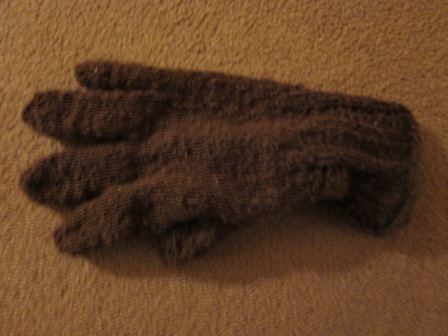
Maybe it is because I was concentrating too much (though not enough) on my knitting. It was attempt # 35 or thereabouts at the same darn glove. The complexities of movie and glove interfered with each other. In the 90 minutes of the movie I unraveled and restarted the wrist section 5 times. I am working on the left hand; not because I finished the right hand (I nearly have) but because the right hand is too big; it would fit the hand of a large man, two of my fingers easily slide into the section that should hold just one; the lacy wrist part incongruously lining the giant fingers.

Although I said several times to Axel that I was going to stop this madness and start another project, with a higher chance at success, I couldn’t help myself and started all over again when the movie was over and the distractions gone. What drives me to continue this project, I wonder?

Maybe the whole thing is a metaphor for my desire to wake up Afghan men to the treasure trove of women’s talent that is in their midst. Like the gloves, I have never done it before and I know it is very difficult, and, I am learning, it requires endless stops and starts. The drive comes from vision: for both glove and women in Afghanistan I have a very clear vision of faraway success.

I came home to a house with all windows and doors wide open despite the winter weather. One of our bucharis (stoves) had misfired and filled, first Axel’s room and then all others, with diesel smoke. I found Axel sitting at the dining room table wheezing and coughing, complaining about a headache, telling me how it could have killed him if he had been asleep in his office room. That was only a theoretical possibility: he doesn’t sleep there, we don’t have a diesel stove in our bedroom and would never have one lit during the night. Still, the air quality is in our face again and would be one reason not to live too long in this country.

When I got up in the morning I noticed a dark black ring around the air purifier and its instruction book lying on the ground next to my bed. It was an unpleasant reminder of the blank gunk that gets attracted to the air purifier and that otherwise would have been in our lungs as well. That, the misfire fumes and the usual fumes that waft unnoticed through our house during the winter months. Right now we do worry a little about the concentrations of diesel particles in our lungs.

Hope, intent and the possible

For the next three days I am sitting in the back of a windowless basement room watching my two female mentees facilitate the leadership program for the Afghan Midwives Association.

I have forgotten what it is like to be in a room with only women. My one male staff member who was assigned as coach to the facilitation team could not accompany us for family reasons. The only male in the room is a young boy who accompanied his mom. He is well behaved and sits quietly in a corner. I gave him paper and markers and the English alphabet to practice.

On our way into town one of the facilitators realized she had left her prepared flipcharts at home. I asked her whether she could redo them at the workshop site. She replied, “yes, hopefully.” My immediate reaction was to say, “no, not hopefully! You can or you cannot?” Of course the word hopefully was a translation of “incha’allah” a word that stands at the end of every statement of intent. It is an acknowledgement of man’s powerlessness in the face of God’s intent with us. All human intent can be derailed if God wishes to do so, even the preparation of flipcharts.

In true Western fashion I consider much of what is needed to prepare for a workshop under my control – I over plan, over anticipate; I have contingency plans A,B,C all lined up in my head like a British queu. And when things are not under my control I know they are under the control of other, more powerful people, except of course for ‘Acts of God’ (as defined by our insurance industry) like volcano eruptions and earthquakes. That’s when I would use the word incha’llah.

As we worked our way into the center of the city the ubiquitous construction of open gutters blocked the entrance to a side street on our way. The detour made it difficult to find the building in which the workshop was being held. “See,” my colleagues said, “what happens when you leave incha’allah out? We lose our way!” Here, God is everywhere, and while I plan, (S)HE laughs.

I took great delight in seeing the transformation of my two young female colleagues. They stood tall, spoke with confidence and were so very different from how they are at work when in the company of men, where they look small, act from a position of low power, often speaking with soft voices (if they speak at all). I wish I could show my male colleagues how confident and talented these ladies are. For now they have to take my word but I hope, before I leave Afghanistan, that they can see for themselves.

And while I was basking in this vision of the possible, Steve visited Turquois Mountain’s Murad Khany’s urban renewal project, also a vision thing, and Axel attended another vision-drenched event; a graduation ceremony of one of his students at the Turkish high school.

This slideshow requires JavaScript.

Complexity and tradition

Today was one of those days that put complexity and the real deep work of development center stage. I am reading an excellent piece of research and conceptual thinking about capacity building. It is dense and refers to disciplines and philosophies that are hardly know here, except where carried in from the outside by consultants who may or may not be good at making the stuff digestible.

On page 19 of the Capacity, Change and Performance Study report (by Heather Baser and Peter Morgan, European Centre for Development Policy Management, April 2008) a table compares assumptions in different planning approaches, grouping them in two categories: traditional planning and complex adaptive systems. The rubrics are: source and nature of direction, objectives, role of variables, focus of attention, sense of structure, shadow system, measures of success, paradox, view on planning, attitude towards diversity and conflict, leadership, control, history, external interventions, vision and the act of planning itself, point of intervention, reaction to uncertainty and effectiveness.

I checked my own assumptions against those in the table and found myself squarely in the traditional column. A humbling experience for someone who, at least at a philosophical level, thought herself conversant with the complex adaptive systems approach. When I had to look at my practices I was far off the mark.

The study is not an easy read. Just forwarding the large file to colleagues is not a realistic option. This is after all not a reading culture and if it is dense for me, I can’t even begin to imagine how daunting it would be for others not familiar with the systems thinking and complex adaptive systems literature.

This is one of those rare moments when I long to be at headquarters, where this sort of intellectual exercise is not considered a luxury and acknowledged as critical to informing our work.

In the middle of all this pondering we had a meeting about what seemed like a simple request from USAID about 8 months ago: to order medical equipment for 500 health facilities. We tried to wriggle out of the assignment because some of my colleagues knew how complex and how time consuming this was. I had no idea. Now, 8 months later we are just beginning to scratch the surface. If I didn’t know that procurement is at the heart of much development assistance, I do know that now and how complex it really is.

There are cultural habits that leave new equipment tightly wrapped in its original packaging because the boss says so, leaving me guessing why this is such a common practice (the more seasoned folks can tell exactly why).

There are pragmatic and bureaucratic reasons: if it doesn’t leave the storage room it can always be accounted for and no one can accuse the storekeeper of stealing. [Steve told us a story about a guard who buried a broken chair to avoid accusations that he had stolen the chair. His son was there to witness so he could unearth it in case the accusation happened after his death.]

There are unethical business practices that lead vendors to promise one quality and deliver less quality for the same price. There is a scarcity mindset that leads health facilities to ask for the moon, blurring the lines between what is needed and what is wanted; one never knows when the source of all these goodies dry up. Or there is simple greed – wanting ever more. And finally there are managerial variables such as number, price, quality, time to delivery, storage, etc., and technical variables: specifications and quality.

We ended up hiring someone to look at all of this. He is a surgeon who knows Afghanistan’s health systems, structures and practices well. He explained to us this morning what a minefield this is and all the ways that we can taint our reputation with the many stakeholder groups that will hold us accountable, each holding us to a different standard (cost, quality, time to delivery, appropriateness, serviceability, etc.).

And while we discussed this millions of dollars worth of stuff, the ground shuddered from the heavy road building equipment outside our office and our eyes watered from the gas leaking from the defective gas burning stove that kept us warm between the chilly concrete walls and floors of the Herat Conference room.

First day

For the government Saturday is the first day of the week, for us the last day of our weekend. Sometimes we have to give up that last day, as was the case today. I attended a gathering to put the final stamp of approval on a hospital strategy that has been in the making for over a year. It was the crowning event. The Acting Minister attended the entire event, including lunch. She will be a major player in aligning and mobilizing other ministers around this strategy that aims, in the end, to accomplish full hospital autonomy.

The entire meeting was in Dari. I tried to follow the slides, projected on the right side of the room. Those were the ones in Dari. I kept frantically thumbing through my dictionary to look up the words on the slide before they disappeared. It was a relief to have few slides and each slide with very few words. This is a bit of a novelty. I could see the hand of our hospital consultant in the production process.

Speeches, questions and answers were all in Dari which made it a little difficult for the foreigners, some ISAF, some US government, and some EU folks, to follow things closely. There were many opinions expressed, even by people who had not even read the strategy. The minister shook the strategy document in front of everyone asking, how many of you have read it? It was another one of her light touches to gently confront people with the importance of doing their homework.

The total immersion was for me yet another Dari class, which I continued a few hours later with my Dari teacher Najla. She tested my vocabulary by asking me questions in Dari and then requesting answers that used as many new words as possible. In the second hour I tried to read some of the poems from the book my boss has given me. My teacher suggested I just read a few stanzas of the first poem which goes on for pages and pages. Without understanding much of the meaning of what I was reading, I am sure I butchered the treasured poem.

For dinner we worked our way across town to visit Adriana who lives in the UN compound. It took us a long time to get there because of the Shia celebrations that block whole streets and a US army convoy that doesn’t just stop all traffic but also makes our phones inoperable. Once on Jalalabad road we drove several times past the well hidden compound before finding it in the thick smog that comes from wood and diesel stoves, dust and bad gasoline.

Inside the compound is a parallel universe, parallel to the other parallel universes around town: the American compound, the Green Village and the bases. I am glad we live in Afghanistan and not between gray blast walls and barbed wire. We could just imagine the security consultants with their clipboards pointing out where all the soft spots were, putting the fear of God in the UN operations and security folks while doing a brisk business in concrete, wire and related products.

Friday treats

This morning my driver found all the access roads to the massage place blocked. That’s the confusing thing here; one day a road is open, the next week it is blocked. I was finally dropped off in front of a series of road barriers to walk the kilometer or so to the massage place, accompanied by one of our guards. The weather was beautiful and I didn’t mind to stretch my legs although the views were not great: grey blast walls, barbed wire, armed guards and road blocks.

The blockade had also kept the Uzbeki hairdresser away with whom I had made an appointment. Luckily Lisa had brought in three Philippina colleagues, all skilled in the beauty and relaxation business. I was given a quick and adequate haircut squeezed in between the logistics company one and only office desk and the multipurpose couch (nails, feet and facials). More equipment had entered the place since I was last there: 4 large portable air conditioners on wheels and 2 water coolers. It is becoming increasingly hard to move around the furniture, the spa equipment and the four employees.

While my hair was cut, and a massage was given to another expat behind a curtain a few feet away, a Chinese karaoke DVD was put on for my entertainment. It showed D-rated photo models with long blond hair, ill fitting clothes, big mouths and too much lipstick swaying in a light breeze from tree/handrailing to tree/handrailing or staring wistfully out into the future. All the while the words of this then that love song were displayed in large letters across the screen. The words that needed to be sung turned blue so I could participate if I had wanted.

The haircut was followed by an expert reflexology treatment (lower legs and feet) from the new member of the beauty team and then Lisa finished things off with a similarly expert massage of the rest of me. After I emerged from my treatment she introduced me to the next customer who was being pedi-, and manicured on the couch, as ‘my mom.’ I could have been if I too, like her, had conceived at the age of 12.

Before our next social engagement (a delayed Thanksgiving dinner at Razia jan’s) I sat in the warm winter sun on our dusty terrace, tackling the second digit of the left cashmere glove. While people on the US East Coast are shivering, we are quite comfortable high up in the Afghan Alps.

Razia jan had, as usual, produced a delicious mélange of great people and great food. There was one Afghan-American couple with her living ‘behind the wall,’ at the US compound while the Afghan husband lives in town. She used to be in Afghanistan before so she knows what’s missing – and hopes that the one year tour will go quickly.

We had real turkey, stuffing and gravy, mashed potatoes and sweet potatoes. Even the marshmallow dollops were not forgotten. The dessert menu was as extensive as the main meal, served with cardamom tea to help the digestion.

We said goodbye to Razia’s lodger Tina who we got to know over the last 6 months. She is returning home (Atlanta) before starting a degree program in Civil Rights Law in the UK. With studies in religion and conflict, augmented with civil rights law, we think it is highly likely she will come back here sometimes.

Stories of hope and despair

We finished phase two of the leadership program. It was good to have sat in the back because I now know better where my work is. I sometimes wished I could look inside people’s minds to find out how the program affects (or not) their thinking. During the closing reflection I tried to pry loose some of these invisible thoughts but here, as a foreigner, one never knows whether the answers one gets are genuine or attempts to please the foreigner. Or whether the clichés I hear are attempts in a language not fully mastered to express thoughts constructed in their own. As I learn the construction of Dari sentences I can recognize when this happens.

Today was SOLA class after work. This time 5 girls showed up, unlike last week when no one did because of exams. Those are now over and we resumed our session about vision and learning how women in Afghanistan are able (or not) to overcome their thousand and one challenges. I had asked each girl to interview a woman, any age, to whom they look up for accomplishments in the face of all these challenges.

Fatima had interviewed their cleaning lady. She read from her handwritten notes. It started cheery enough. She quoted her cleaning lady as saying, “one beautiful day, when I was nine years old, I was coming home from tending the sheep in the fields when my mother told me that I was going to be engaged. I was very happy because it meant I would get new clothes. But then when I got married my world became hell. I had a baby at 12…”

At this point Fatima’s interview was cut short because the cleaning lady could no longer hold her tears. There were, presumably, another 30 intervening years of hell, during which the husband was killed by the Russians and the 5 daughters grew up. Although it is an intensely sad story, I was happy to hear that this story will not repeat itself anymore. Three of the five daughters are now doctors, one is sitting for her high school exams and the last one is in middle school.

Hila read her story about a girl who had lost both her parents at age 12 and then became the primary caretaker of an 11 day old baby while going to school and educating herself. This orphan is now a 25 year old lady doctor. Everyone clapped when Hila finished her story with the surprise revelation that the 11 day old baby was Hila herself and that this lady doctor, although not her biological mother, is the one she calls mommy.

The last twenty minutes we listened, holding our breath, interrupted now and then by gasps and some tears, to another story of a 16 year old, engaged, married, beaten, miscarrying a boy (her fault) at 17, betrayed, beaten, abused and shunned by her husband. We were all looking sadly at each other but then things took a turn for the better and the story became a story of redemption. The husband cut loose from his overbearing parents, choosing his wife over them. He repented, and helped his wife escape from his parents’ house and moved her to her sister’s while he went overseas for a job. Now he is back and preparing for another posting, this time everyone comes along. There is a job, money and love. It was a combination of Cinderella and the frog prince. Safia wiped her tears and everyone sighed. It is then that I realized that these are not stories as they are for us – these are real life experiences surrounding these girls on all sides, sometimes uncomfortably close.

Next week we will start our reading program, now that we have explored their visions and fueled them with stories of women who overcame mountains of misfortune and are now successful, either themselves or their offspring. We explored possible books to read and choose Khalid Hussein’s A Thousand Splendid Suns – a bit of a stretch language-wise, but familiar terrain. This weekend I will be hunting around town for 6 copies and prepare the assignments.

Loopy snags, fossils and poetry

For the umpteenth time I snagged my scarf on something pointy or sharp that is sticking out of something else where you don’t expect it. Some of my loosely woven clothes have little holes here and there; the scarves I can usually fix although some remain a bit loopy.

All this, snags and sharp things, the experience of being snagged and resulting loopiness are delicious metaphors for our lives in Afghanistan.

All day I sat on the side in our Kabul Conference room watching the second day of our leadership program, phase II, watching a team that wasn’t really a team struggle to color between the lines (follow the facilitation notes). A few newbies were observing, sitting at the sidelines with me. I pointed out the snags and how to fix them while they helped me with translation.

Hopefully they were learning along with everyone else and learning from mistakes made. People are critical of each other and so am I of the team and especially one of my staff who is the master facilitator; it is a habit easily acquired here. It is good that the Appreciative Inquiry literature pops up now and then to remind me that good things are happening as well. People are learning and excited about it.

Since I arrived a little over one year ago I have not sat in these workshops much or supervised the staff who are facilitating them as closely as I should have. As a result some ‘fossilization’ has occurred – errors made and not corrected, becoming embedded in the routines.

As a technical director responsible for management and leadership I have many managerial tasks, am expected to attend many internal and external meetings and events. With only so many hours in a day and many double bookings it has been hard to sit in the back when workshops are going on for long periods of time.

And then there is the language barrier. All the workshops are done in Dari. A year and even half a year ago I wasn’t able to follow what people were saying when they didn’t follow the script. Now I am at a 40% level of understanding and can roughly follow the conversations. I can detect when discussion drift into side roads, or, to stick with the metaphor, when facilitators get snagged.

I received a present from my boss, a book of poetry that he claims is simple, third grade level. But my boss is a poet himself and an avid reader and memorizer of poetry. His standards are high, as my colleagues told me. They think it is much too advanced for me. To make things even more challenging, the print is tiny. It is hard for someone who is still reading letter by letter rather than by gestalt, to identify whether there are one, two or three dots on or below the letters. I think I should have asked for a book of simple nursery rhymes instead.

While the teams were doing group work I translated an official (and short) invitation letter from Dari into English. This was made easier because the reverse of the letter had the invitation in English. I am writing the words in a special notebook for work related words. The short letter had about 20 new words. This is helping me to expand my professional vocabulary with words like ‘consensus meeting,’ ‘stakeholders,’ ‘final draft,’ ‘strategy’ (istartezjee), ‘gathering,’ ‘bring to completion,’ ‘presentation,’ ‘date,’ and ‘venue.’ I feel that I am moving off one plateau and heading towards a next one, a little higher up.

Marching on

‘Afghan men blamed for gender prejudice,’ is one of the headlines in our local newspaper. It appears right below ‘Poppy cultivation un-Islamic, say scholars.’ I am glad these things are out in the open. At least we are clear on that now.

There were some very good tidings in the newspaper as well: our Dutch compatriot Peter, kidnapped in October in Kunduz is free and can rejoin his wife and kids in Holland. His picture and that of his driver illustrated the observation that they appeared to be in ‘depressed mental state.’ Who wouldn’t after such an ordeal.

I had an interesting day at work. In the morning some of us met to review the activities in our work plan that are not moving along as planned. It was a small group that came together (too many competing schedules) but the conversation was interesting as we discussed why some things are just not happening. Many of those are in my portfolio with which I have struggled for some time now – how to get senior leaders to accept and make time for improving their leadership skills.

The contradiction is that every document that analyzes what’s wrong here (and there are many because most advisors and technical assistants follow the ‘deficit school’ of institutional development) cites weak leadership skills, but when we propose actions to remedy this other things always take precedence – especially those activities that have immediate, and visible or tangible outcomes.

The irony of my job here is that it would be much easier to do if the leadership and management skills were well developed, which of course would make my presence here redundant.

In the afternoon I sat between my two young female mentees, the ones who will play a facilitator role in an upcoming leadership development program for the midwives, a program that starts next week. They are thrown in the deep but I know they will swim because they are smart and they can. Today they were participatory observers in a similar program, second stage, for some of our own teams, a team from the medical university and one from the ministry.

I can understand a great deal more now of the conversations that are held in Dari, but not yet the jokes. One joke concerned women – there are four in the room – should they have protested? My young mentees are very aware of the roles society has given them: eyes down, be quiet. I am encouraging them to lift their eyes up and not be quiet but it is a hard sell. I offer to speak out for them when they can but reminded them that I am here only for awhile.

I often notice how powerlessness produces a kind of criticism that is counterproductive, not only because it is always (and understandably) voiced when the strong and dominant are out of earshot but also because it focuses energy away from the self and onto the other, which is rather wasteful from an energy conservation point of view.

On target on time

Our requests for work permits are being processed. So is my request to leave the country for our quarterly R&R, sometime in early January.

While this is being done I returned to my tasks. One of those is to review our activity plan with a view to risk management: identifying where the risks are (of not producing deliverables, of not being prepared for eventualities, of losing people and things, etc.).

It is a good practice introduced by one of my Australian colleagues. I am seeing the advantage of having other nationalities (than those of our host country) on our staff – we are drawing from a much wider reservoir of knowledge instead of recycling our own (American) bathwater.

As the days tick away toward the last day of the project (a little more than 200 days) the competition for timeslots for workshops, study tours, training is becoming more intense. Sometimes different units are targeting the same people, and of course the higher you go in the hierarchy the smaller the pool. Since my focus is senior leadership development I am feeling the squeeze especially hard.

Training activities are tangible and highly desirable if you want to keep up spending rates and have evidence that you are busy implementing your plan, on target, on time. But some of our work plan activities are not so distinct.

In two of my teams work plan activities are of the coaching type, routine and ongoing capacity development that takes place in the workplace – these are the ones hard to connect to results; and if the object of the coaching is not interested (or too busy) it leaves us stranded with our plans.

In contrast, a third team is responsible for ordering, shipping, clearing and distributing millions of dollars of pharmaceutical products to the health facilities in about one third of Afghanistan’s provinces. Compared to the coaching the intended outcome is clear cut and tangible. Not that it is easier (getting things transported here, clearing customs and preventing loss and leakage is no mean task in this part of the world) but when all is said and done at least you can see results for all the efforts: pharmacies being stocked and doling out pills to patients.


September 2026
M T W T F S S
 123456
78910111213
14151617181920
21222324252627
282930  

Categories

Blog Stats

  • 144,029 hits

Recent Comments

Edith Maxwell's avatarEdith Maxwell on Boosted out
Sallie Craig Huber's avatarSallie Craig Huber on Rays for real
Lucy's avatarLucy on Probabilities
Olya's avatarOlya on Cuts
Olya Duzey's avatarOlya Duzey on The surgeon’s helpers

Enter your email address to follow this blog and receive notifications of new posts by email.

Join 78 other subscribers